

The DOI matches its Crossref record; 56 of the 56 references it cites were found in a registry or an index.
Big Data Impacting Dynamic Food Safety Risk Management in the Food Chain
Open accessAbstract
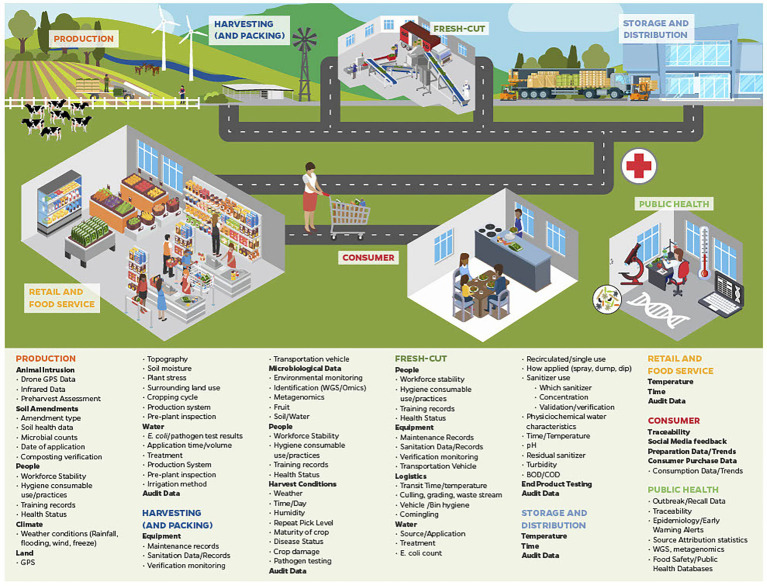
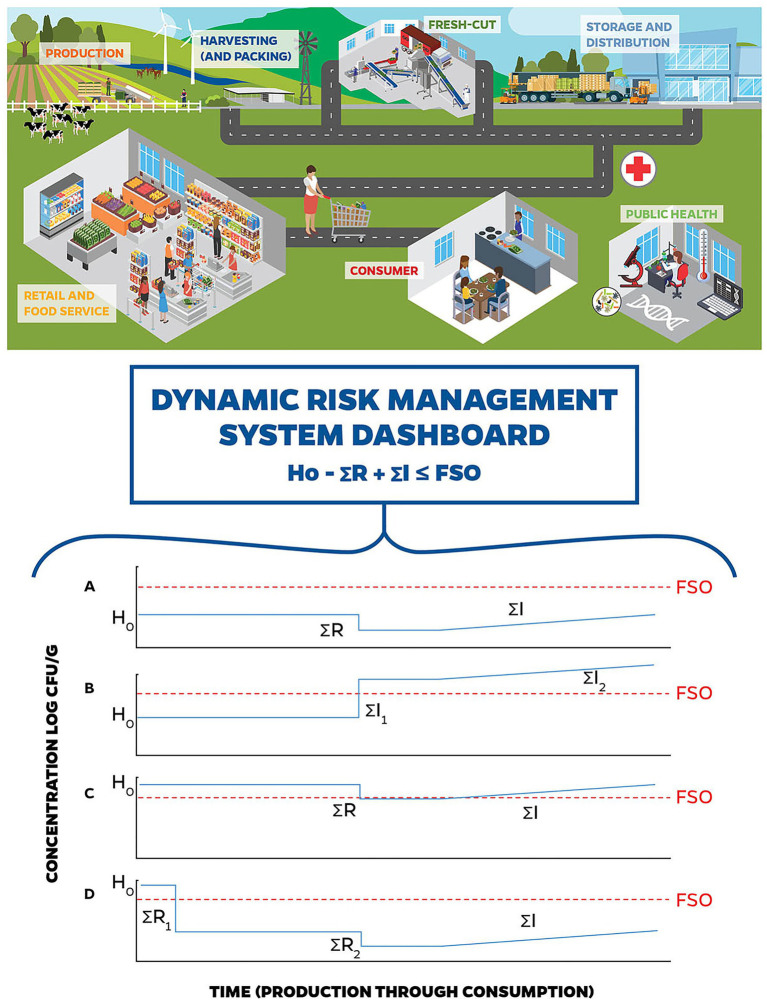
Foodborne pathogens are a major contributor to foodborne illness worldwide. The adaptation of a more quantitative risk-based approach, with metrics such as Food safety Objectives (FSO) and Performance Objectives (PO) necessitates quantitative inputs from all stages of the food value chain. The potential exists for utilization of big data, generated through digital transformational technologies, as inputs to a dynamic risk management concept for food safety microbiology. The industrial revolution in Internet of Things (IoT) will leverage data inputs from precision agriculture, connected factories/logistics, precision healthcare, and precision food safety, to improve the dynamism of microbial risk management. Furthermore, interconnectivity of public health databases, social media, and e-commerce tools as well as technologies such as blockchain will enhance traceability for retrospective and real-time management of foodborne cases. Despite the enormous potential of data volume and velocity, some challenges remain, including data ownership, interoperability, and accessibility. This paper gives insight to the prospective use of big data for dynamic risk management from a microbiological safety perspective in the context of the International Commission on Microbiological Specifications for Foods (ICMSF) conceptual equation, and describes examples of how a dynamic risk management system (DRMS) could be used in real-time to identify hazards and control Shiga toxin-producing Escherichia coli risks related to leafy greens.
Overview
The claims and statistics of this paper haven’t been checked yet.
Run the check — free, no account needed. It reads the open-access text and checks the sources it cites.
Integrity signals
Registry
Cites
Statistics
Figures
Verification
Claims the paper makes
The claims and statistics of this paper haven’t been checked yet.
Run the check — free, no account needed. It reads the open-access text and checks the sources it cites.
Claims other papers make about this one
Each is checked against this paper’s own text: does it say what the citing paper says it does?
The source backs part of the claim, not all of it — or backs it for a different population, condition or comparison.
In the citing paper
“Simultaneously, real-time monitoring technologies integrating bioinformatics with multi-omics and digital health data are starting to allow for the long-term tracking of probiotic strains and host responses, especially in translational and post-market settings [159,160].”
From Current Concepts in Probiotic Safety and Efficacy (2026) · cites this paper as [159]
Experimental — accuracy not yet measured
Self-check
Percentages, sums and reported differences re-computed from the paper’s own numbers.
The self-check needs the paper’s full text.
Citations
Cites
Foodborne illness acquired in the United States—Major pathogens
Scallan, E., Hoekstra, R. M., Angulo, F. J., Tauxe, R. V., Widdowson, M.-A., Roy, S. L., Jones, J. L., & Griffin, P. M. (2011) · Emerging Infectious Diseases · doi:10.3201/eid1701.p11101 · Cited by 7,657
Big Data in Smart Farming – A review
Wolfert, J., Ge, L., Verdouw, C. N., & Bogaardt, M. J. (2017) · Agricultural Systems · doi:10.1016/j.agsy.2017.01.023 · Cited by 4,196
Sustainable Intensification in Agriculture: Premises and Policies
Garnett, T., Appleby, M. C., Balmford, A., Bateman, I. J., Benton, T. G., Bloomer, P., Burlingame, B., Dawkins, M., Dolan, L., Fraser, D., et al. (2013) · Science · doi:10.1126/science.1234485 · Cited by 1,741
A review on the practice of big data analysis in agriculture
Kamilaris, A., Kartakoullis, A., & Prenafeta-Boldú, F. X. (2017) · Computers and Electronics in Agriculture · doi:10.1016/j.compag.2017.09.037 · Cited by 1,193
Goldstein, B. A., Navar, A. M., Pencina, M. J., & Ioannidis, J. P. A. (2017) · Journal of the American Medical Informatics Association · doi:10.1093/jamia/ocw042 · Cited by 936
Precision Agriculture Techniques and Practices: From Considerations to Applications
Shafi, U., Mumtaz, R., García-Nieto, J., et al. (2019) · Sensors · doi:10.3390/s19173796 · Cited by 791
A review of wireless sensors and networks' applications in agriculture
Aqeel-ur-Rehman, Abbasi, A. Z., Islam, N., & Shaikh, Z. A. (2011) · Computer Standards & Interfaces · doi:10.1016/j.csi.2011.03.004 · Cited by 736
Precision Public Health for the Era of Precision Medicine
Khoury, M. J., Iademarco, M. F., & Riley, W. T. (2015) · American Journal of Preventive Medicine · doi:10.1016/j.amepre.2015.08.031 · Cited by 584
King, T., Cole, M., Farber, J. M., Eisenbrand, G., Zabaras, D., Fox, E. M., & Hill, J. P. (2017) · Trends in Food Science & Technology · doi:10.1016/j.tifs.2017.08.014 · Cited by 571
Self-citationFood authentication: Techniques, trends & emerging approaches
Danezis, G. P., Tsagkaris, A. S., Camin, F., et al. (2016) · TrAC Trends in Analytical Chemistry · doi:10.1016/j.trac.2016.02.026 · Cited by 559
Research works printed but not linked: 2
- Armbruster, 2014, Informatics to Support International Food Safety, 127
- Hasnan, 2018, Short Review: Application Areas of Industry 4.0 Technologies
Cited by
Sorted by citations
Current Concepts in Probiotic Safety and Efficacy
Churin, A. A., Sokolyanskaya, L. O., Lukina, A. P., & Karnachuk, O. V. (2026) · Nutrients · doi:10.3390/nu18040696 · Cited by 31
“Simultaneously, real-time monitoring technologies integrating bioinformatics with multi-omics and digital health data are starting to allow for the long-term tracking of probiotic strains and host responses, especially in translational and post-market settings [159,160].”
Metadata
- Authors
- Donaghy, J. A., Danyluk, M. D., Ross, T., Krishna, B., & Farber, J.
- Affiliations
- Nestlé (Switzerland) (CH)
- University of Florida (US)
- University of Tasmania (AU)
- University of Guelph (CA)
- Corresponding author
- Donaghy, John A.
- Venue
- Frontiers in Microbiology
- Publisher
- Frontiers Media SA
- Published
- 2021-05-21
- Volume
- 12
- Pages
- 668196-668196
- ISSN
- 1664-302X (ISSN-L)
- PMC
- PMC8177817
- OpenAlex
- W3161815819
- Cited by
- 67
- References
- 56
- Citations by year
- 2026: 16 · 2025: 14 · 2024: 13 · 2023: 8 · 2022: 15 · 2021: 1
- FWCI
- 5.53
- Type
- journal article
- Language
- en
- Open access
- gold
- doi.org
- Licence
- Locations
- Frontiers in Microbiology (publishedVersion, cc-by)
- PubMed Central (publishedVersion, cc-by)
- PubMed (publishedVersion)
- DOAJ (DOAJ: Directory of Open Access Journals) (submittedVersion, cc-by-sa)
- Figshare (submittedVersion, cc-by)
- Topics
- Life Sciences › Agricultural and Biological Sciences › Food Science › Food Safety and Hygiene
- Life Sciences › Agricultural and Biological Sciences › Food Science › Food Supply Chain Traceability
- Life Sciences › Agricultural and Biological Sciences › Food Science › Salmonella and Campylobacter epidemiology
- Keywords
- big data, dynamic risk management, food safety, foodborne pathogens, quantitative risk assessment, food safety objectives, performance goals, Internet of Things, food traceability, blockchain, Shiga toxin-producing Escherichia coli, leafy vegetables, data interoperability
About these checks
Registry, retraction, Cites and statistics results are computed, not judged, with one exception: a printed reference that no index lists is read once by a model before it counts as a citation error. Claims are extracted by a model and kept only when their quote appears verbatim in the text; each cited source is then checked, with a model’s help, for whether it says what the claim relies on. Those verdicts can be wrong — read the claim’s quote and the cited source before relying on one.
Statistics and arithmetic are recomputed, not judged.
Confidence bands are shown only for fields calibrated on our annotated test set. None is calibrated yet, so no band is shown.
What counts as a claim ›How we measure confidence ›How we check this ›
Are you an author, or do you see a problem with this page? Request a review
