

The DOI matches its Crossref record; 79 of the 79 references it cites were found in a registry or an index.
Bioinformatic identification of ClpI, a distinct class of Clp unfoldases in Actinomycetota
Open accessPublished version of a preprint
Abstract
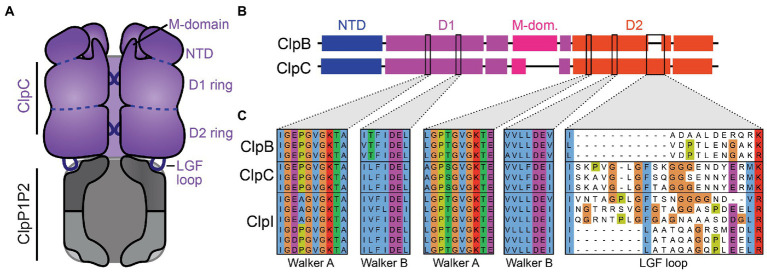
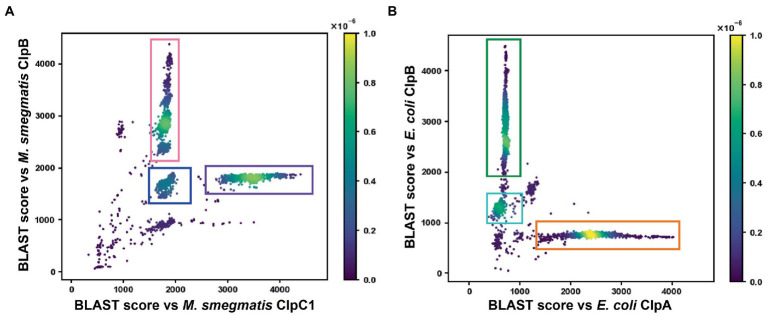
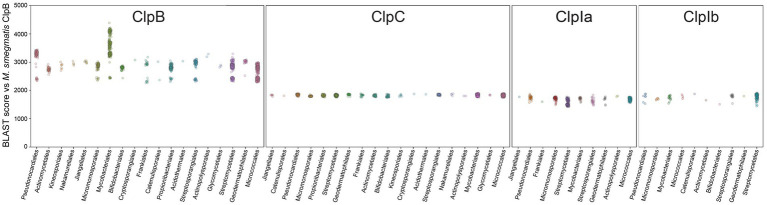
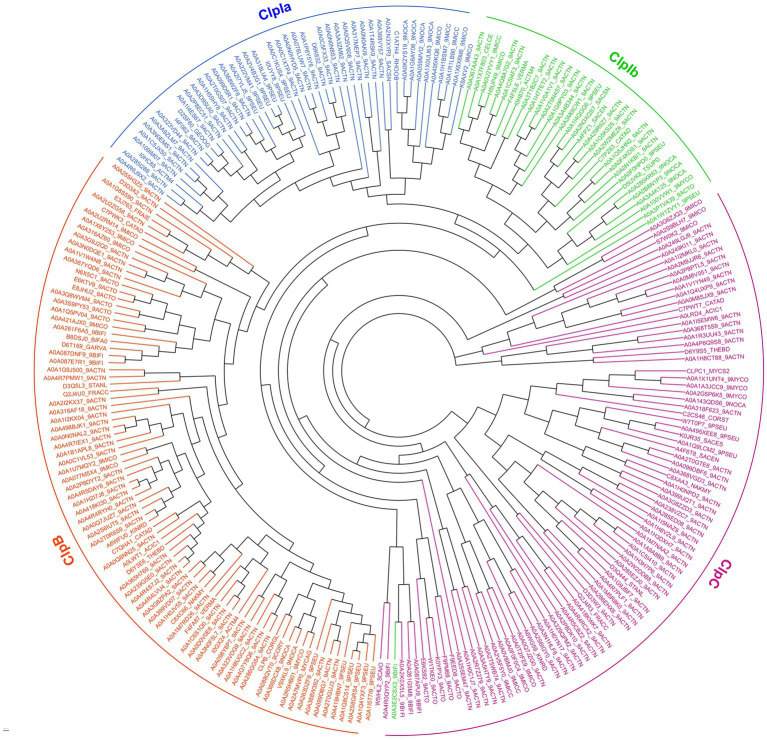
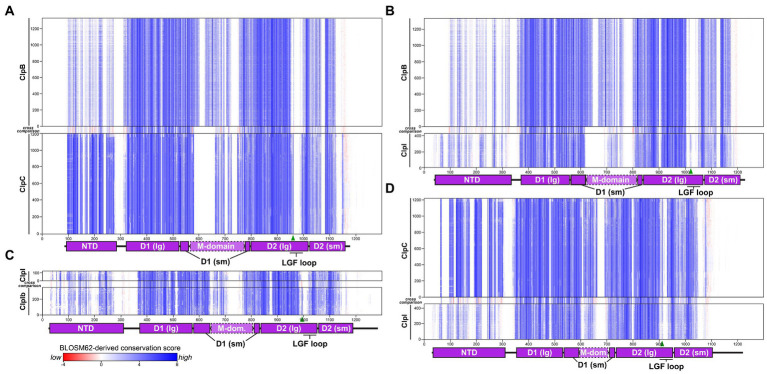
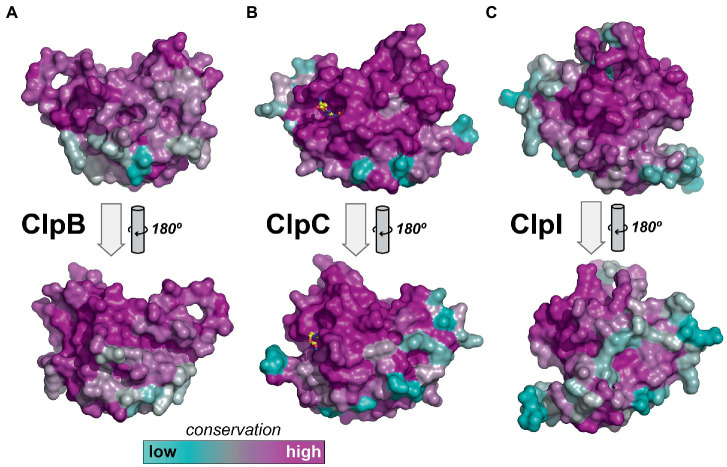
All clades of bacteria possess Hsp100/Clp family unfoldase enzymes that contribute to aspects of protein quality control. In Actinomycetota, these include ClpB, which functions as an independent chaperone and disaggregase, and ClpC, which cooperates with the ClpP1P2 peptidase to carry out regulated proteolysis of client proteins. We initially sought to algorithmically catalog Clp unfoldase orthologs from Actinomycetota into ClpB and ClpC categories. In the process, we uncovered a phylogenetically distinct third group of double-ringed Clp enzymes, which we term ClpI. ClpI enzymes are architecturally similar to ClpB and ClpC, with intact ATPase modules and motifs associated with substrate unfolding and translation. While ClpI possess an M-domain similar in length to that of ClpC, its N-terminal domain is more variable than the strongly conserved N-terminal domain of ClpC. Surprisingly, ClpI sequences are divisible into sub-classes that either possess or lack the LGF-motifs required for stable assembly with ClpP1P2, suggesting distinct cellular roles. The presence of ClpI enzymes likely provides bacteria with expanded complexity and regulatory control over protein quality control programs, supplementing the conserved roles of ClpB and ClpC.
Overview
The claims and statistics of this paper haven’t been checked yet.
Run the check — free, no account needed. It reads the open-access text and checks the sources it cites.
Integrity signals
Registry
Cites
Statistics
Figures
Verification
Claims the paper makes
The claims and statistics of this paper haven’t been checked yet.
Run the check — free, no account needed. It reads the open-access text and checks the sources it cites.
Self-check
Percentages, sums and reported differences re-computed from the paper’s own numbers.
The self-check needs the paper’s full text.
Citations
Cites
Basic local alignment search tool
Altschul, S. F., Gish, W., Miller, W., Myers, E. W., & Lipman, D. J. (1990) · Journal of Molecular Biology · doi:10.1006/jmbi.1990.9999 · Cited by 98,669
Thompson, J. D., Higgins, D. G., & Gibson, T. J. (1994) · Nucleic Acids Research · doi:10.1093/nar/22.22.4673 · Cited by 64,617
MUSCLE: multiple sequence alignment with high accuracy and high throughput
Edgar, R. C. (2004) · Nucleic Acids Research · doi:10.1093/nar/gkh340 · Cited by 44,662
Highly accurate protein structure prediction with AlphaFold
Jumper, J., Evans, R., Pritzel, A., Green, T., Figurnov, M., Ronneberger, O., Tunyasuvunakool, K., Bates, R., Žídek, A., Potapenko, A., et al. (2021) · Nature · doi:10.1038/s41586-021-03819-2 · Cited by 43,764
Matplotlib: a 2D graphics environment
Hunter, J. D. (2007) · Computing in Science & Engineering · doi:10.1109/mcse.2007.55 · Cited by 39,249
WebLogo: A Sequence Logo Generator: Figure 1
Crooks, G. E., Hon, G., Chandonia, J.-M., & Brenner, S. E. (2004) · Genome Research · doi:10.1101/gr.849004 · Cited by 12,386
Amino acid substitution matrices from protein blocks.
Henikoff, S., & Henikoff, J. G. (1992) · Proceedings of the National Academy of Sciences · doi:10.1073/pnas.89.22.10915 · Cited by 6,218
Biopython: freely available python tools for computational molecular biology and bioinformatics
Cock, P. J. A., Antao, T., Chang, J. T., Chapman, B. A., Cox, C. J., Dalke, A., Friedberg, I., Hamelryck, T., Kauff, F., Wilczynski, B., et al. (2009) · Bioinformatics · doi:10.1093/bioinformatics/btp163 · Cited by 6,080
HMMER web server: interactive sequence similarity searching
Finn, R. D., Clements, J., & Eddy, S. R. (2011) · Nucleic Acids Research · doi:10.1093/nar/gkr367 · Cited by 5,952
Ashkenazy, H., Abadi, S., Martz, E., Chay, O., Mayrose, I., Pupko, T., & Ben-Tal, N. (2016) · Nucleic Acids Research · doi:10.1093/nar/gkw408 · Cited by 3,163
Research works printed but not linked: 1
- Van Rossum, 2009, Python 3 Reference Manual
Metadata
- Authors
- Jiang, J., & Schmitz, K. R.
- Affiliations
- University of Delaware (US)
- Corresponding author
- Schmitz, Karl R.
- ORCID
- Schmitz, Karl R.
- Venue
- Frontiers in Microbiology
- Publisher
- Frontiers Media SA
- Published
- 2023-04-17
- Volume
- 14
- Pages
- 1161764-1161764
- ISSN
- 1664-302X (ISSN-L)
- PMC
- PMC10149685
- OpenAlex
- W4366208117
- Cited by
- 3
- References
- 79
- Citations by year
- 2026: 1 · 2024: 2
- FWCI
- 0.27
- Type
- journal article
- Language
- en
- Open access
- gold
- doi.org
- Licence
- Locations
- Frontiers in Microbiology (publishedVersion, cc-by)
- bioRxiv (Cold Spring Harbor Laboratory) (acceptedVersion, cc-by-nc-nd)
- PubMed Central (publishedVersion, cc-by)
- PubMed (publishedVersion)
- DOAJ (DOAJ: Directory of Open Access Journals) (submittedVersion, cc-by-sa)
- Funders
- National Institute of General Medical Sciences (P20GM104316)
- Topics
- Life Sciences › Biochemistry, Genetics and Molecular Biology › Molecular Biology › Heat shock proteins research
- Life Sciences › Biochemistry, Genetics and Molecular Biology › Genetics › Bacterial Genetics and Biotechnology
- Life Sciences › Biochemistry, Genetics and Molecular Biology › Molecular Biology › Protein Structure and Dynamics
- Keywords
- actinobacteria, ClpB, ClpC, protein quality control, M-domain, protein disaggregation
About these checks
Registry, retraction, Cites and statistics results are computed, not judged, with one exception: a printed reference that no index lists is read once by a model before it counts as a citation error. Claims are extracted by a model and kept only when their quote appears verbatim in the text; each cited source is then checked, with a model’s help, for whether it says what the claim relies on. Those verdicts can be wrong — read the claim’s quote and the cited source before relying on one.
Statistics and arithmetic are recomputed, not judged.
Confidence bands are shown only for fields calibrated on our annotated test set. None is calibrated yet, so no band is shown.
What counts as a claim ›How we measure confidence ›How we check this ›
Are you an author, or do you see a problem with this page? Request a review
How to cite
Cite CoChat for the checks on this page, and the paper for its own findings.
- This page
- CoChat. (2026). Citation check: Bioinformatic identification of ClpI, a distinct class of Clp unfoldases in Actinomycetota. https://app.cochat.ai/papers/10.3389/fmicb.2023.1161764
- The paper
- Jiang, J., & Schmitz, K. R. (2023). Bioinformatic identification of ClpI, a distinct class of Clp unfoldases in Actinomycetota. Frontiers in Microbiology. https://doi.org/10.3389/fmicb.2023.1161764
Data sources
Bibliographic data: Semantic Scholar, OpenAlex, Crossref.
Contains information from the Semantic Scholar Academic Graph Datasets, made available under the ODC Attribution License (ODC-BY 1.0).
Semantic Scholar’s data is described in: Kinney, R., et al. (2023). The Semantic Scholar Open Data Platform. arXiv:2301.10140.
