

The DOI matches its Crossref record; 324 of the 325 references it cites were found in a registry or an index.
The role of altered protein acetylation in neurodegenerative disease
Open accessAbstract
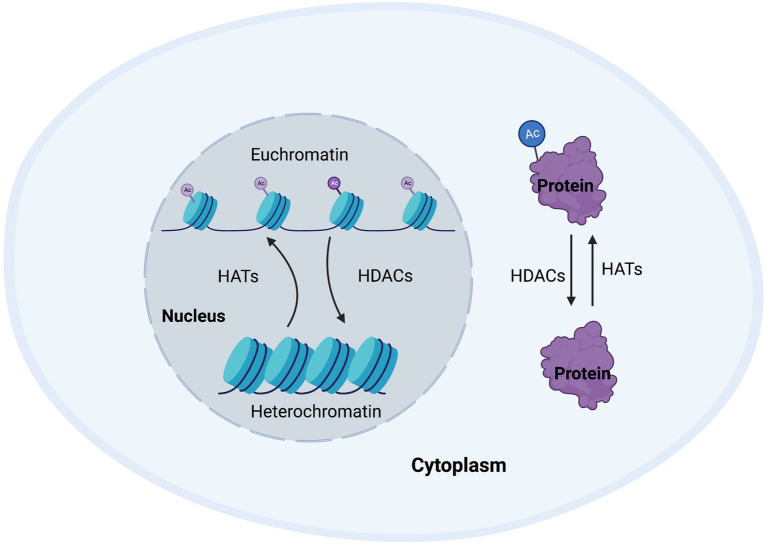
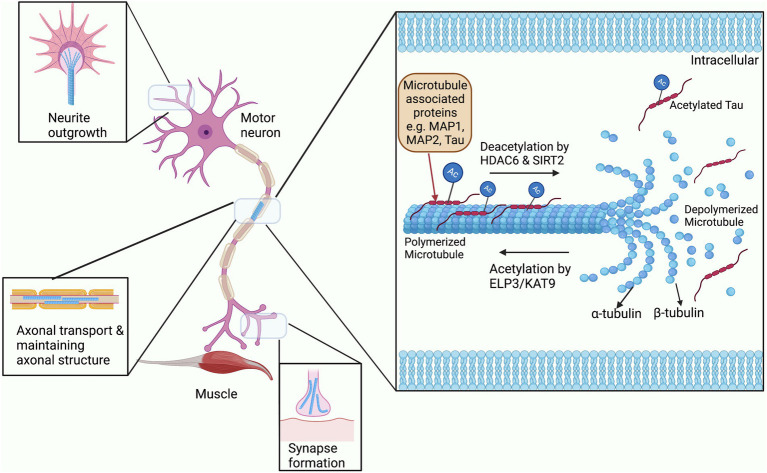
Acetylation is a key post-translational modification (PTM) involved in the regulation of both histone and non-histone proteins. It controls cellular processes such as DNA transcription, RNA modifications, proteostasis, aging, autophagy, regulation of cytoskeletal structures, and metabolism. Acetylation is essential to maintain neuronal plasticity and therefore essential for memory and learning. Homeostasis of acetylation is maintained through the activities of histone acetyltransferases (HAT) and histone deacetylase (HDAC) enzymes, with alterations to these tightly regulated processes reported in several neurodegenerative diseases including Alzheimer’s disease (AD), Parkinson’s disease (PD), Huntington’s disease (HD), and amyotrophic lateral sclerosis (ALS). Both hyperacetylation and hypoacetylation can impair neuronal physiological homeostasis and increase the accumulation of pathophysiological proteins such as tau, α-synuclein, and Huntingtin protein implicated in AD, PD, and HD, respectively. Additionally, dysregulation of acetylation is linked to impaired axonal transport, a key pathological mechanism in ALS. This review article will discuss the physiological roles of protein acetylation and examine the current literature that describes altered protein acetylation in neurodegenerative disorders.
Overview
The claims and statistics of this paper haven’t been checked yet.
Run the check — free, no account needed. It reads the open-access text and checks the sources it cites.
Integrity signals
Registry
Cites
Statistics
Figures
Verification
Claims the paper makes
The claims and statistics of this paper haven’t been checked yet.
Run the check — free, no account needed. It reads the open-access text and checks the sources it cites.
Claims other papers make about this one
Each is checked against this paper’s own text: does it say what the citing paper says it does?
The source backs part of the claim, not all of it — or backs it for a different population, condition or comparison.
In the citing paper
“Growing evidence supports that epigenetic dysregulation through histone deacetylases (HDACs) plays a critical role in synaptic dysfunction and memory loss in Alzheimer’s disease”
From CI-994 is a dual modulator of class I HDACs and Wnt/β-catenin signaling for the treatment of Alzheimer's disease (2026) · cites this paper as [8]
Experimental — accuracy not yet measured
Self-check
Percentages, sums and reported differences re-computed from the paper’s own numbers.
The self-check needs the paper’s full text.
Citations
Cites
Tissue-based map of the human proteome
Uhlén, M., Fagerberg, L., Hallström, B. M., Lindskog, C., Oksvold, P., Mardinoglu, A., Sivertsson, Å., Kampf, C., Sjöstedt, E., Asplund, A., et al. (2015) · Science · doi:10.1126/science.1260419 · Cited by 15,286
Shrestha, S., & Offer, S. M. (2016) · Medical Epigenetics · doi:10.1159/000444713 · Cited by 8,951
Mitochondrial Dysfunction and Oxidative Stress in Neurodegenerative Diseases
Lin, M. T., & Beal, M. F. (2006) · Nature · doi:10.1038/nature05292 · Cited by 6,455
Lysine acetylation targets protein complexes and co-regulates major cellular functions
Choudhary, C., Kumar, C., Gnad, F., Nielsen, M. L., Rehman, M., Walther, T. C., Olsen, J. V., & Mann, M. (2009) · Science · doi:10.1126/science.1175371 · Cited by 4,040
Histone deacetylases (HDACs): characterization of the classical HDAC family
RUIJTER, A. J. M. D., GENNIP, A. H. V., CARON, H. N., KEMP, S., & KUILENBURG, A. B. P. V. (2003) · Biochemical Journal · doi:10.1042/bj20021321 · Cited by 3,114
A protein factor essential for microtubule assembly
Weingarten, M. D., Lockwood, A. H., Hwo, S. Y., & Kirschner, M. W. (1975) · Proceedings of the National Academy of Sciences · doi:10.1073/pnas.72.5.1858 · Cited by 3,089
Haberland, M., Montgomery, R. L., & Olson, E. N. (2008) · Nature Reviews Genetics · doi:10.1038/nrg2485 · Cited by 2,600
Goedert, M., Spillantini, M. G., Jakes, R., Rutherford, D., & Crowther, R. A. (1989) · Neuron · doi:10.1016/0896-6273(89)90210-9 · Cited by 2,492
HDAC6 is a microtubule-associated deacetylase
Hubbert, C., Guardiola, A., Shao, R., Kawaguchi, Y., Ito, A., Nixon, A., Yoshida, M., Wang, X.-F., & Yao, T.-P. (2002) · Nature · doi:10.1038/417455a · Cited by 2,403
Proteomic analysis of post-translational modifications
Mann, M., & Jensen, O. N. (2003) · Nature Biotechnology · doi:10.1038/nbt0303-255 · Cited by 2,176
Cited by
Sorted by citations
Yang, J., Zhi, W., & Wang, L. (2024) · Molecules · doi:10.3390/molecules29122812 · Cited by 63
“Specific acetylation sites regulate the formation of tau aggregates, synaptic signalling, and long-term potentiation [74,75].”
BackgroundOrthogonal Translation for Site-Specific Installation of Post-translational Modifications
Gan, Q., & Fan, C. (2024) · Chemical Reviews · doi:10.1021/acs.chemrev.3c00850 · Cited by 55
Proteostasis disruption and senescence in Alzheimer’s disease pathways to neurodegeneration
Thapa, R., Bhat, A. A., Shahwan, M. J., Ali, H., Padmapriya, G., Bansal, P., Rajotiya, S., Barwal, A., Prasad, G. V. S., Pramanik, A., et al. (2024) · Brain Research · doi:10.1016/j.brainres.2024.149202 · Cited by 48
The pathogenic mechanism of TAR DNA-binding protein 43 (TDP-43) in amyotrophic lateral sclerosis
Wang, X., Hu, Y., & Xu, R. (2023) · Neural Regeneration Research · doi:10.4103/1673-5374.382233 · Cited by 37
Št́astná, M. (2024) · FEBS Journal · doi:10.1111/febs.17108 · Cited by 32
Metadata
- Authors
- Kabir, F., Atkinson, R., Cook, A. L., Phipps, A. J., & King, A. E.
- Affiliations
- University of Tasmania (AU)
- Corresponding author
- Phipps, Andrew James
- Venue
- Frontiers in Aging Neuroscience
- Publisher
- Frontiers Media SA
- Published
- 2023-01-04
- Volume
- 14
- Pages
- 1025473-1025473
- ISSN
- 1663-4365 (ISSN-L)
- PMC
- PMC9845957
- OpenAlex
- W4313477105
- Cited by
- 75
- References
- 325
- Citations by year
- 2026: 20 · 2025: 22 · 2024: 25 · 2023: 8
- FWCI
- 1.98
- Type
- journal article
- Language
- en
- Open access
- gold
- doi.org
- Licence
- Locations
- Frontiers in Aging Neuroscience (publishedVersion, cc-by)
- PubMed Central (publishedVersion, cc-by)
- PubMed (publishedVersion)
- DOAJ (DOAJ: Directory of Open Access Journals) (submittedVersion, cc-by-sa)
- Figshare (submittedVersion, cc-by)
- Funders
- National Health and Medical Research Council (APP1136913)
- Topics
- Life Sciences › Biochemistry, Genetics and Molecular Biology › Molecular Biology › Histone Deacetylase Inhibitors Research
- Life Sciences › Neuroscience › Cellular and Molecular Neuroscience › Alzheimer's disease research and treatments
- Life Sciences › Neuroscience › Cellular and Molecular Neuroscience › Genetic Neurodegenerative Diseases
- Keywords
- protein acetylation, post-translational modification, neurodegenerative diseases, histone acetyltransferase, histone deacetylase, Alzheimer's disease, Parkinson's disease, Huntington's disease, amyotrophic lateral sclerosis, tau protein, alpha-synuclein, huntingtin, axonal transport, neuroplasticity
About these checks
Registry, retraction, Cites and statistics results are computed, not judged, with one exception: a printed reference that no index lists is read once by a model before it counts as a citation error. Claims are extracted by a model and kept only when their quote appears verbatim in the text; each cited source is then checked, with a model’s help, for whether it says what the claim relies on. Those verdicts can be wrong — read the claim’s quote and the cited source before relying on one.
Statistics and arithmetic are recomputed, not judged.
Confidence bands are shown only for fields calibrated on our annotated test set. None is calibrated yet, so no band is shown.
What counts as a claim ›How we measure confidence ›How we check this ›
Are you an author, or do you see a problem with this page? Request a review
