

The DOI matches its Crossref record; 172 of the 172 references it cites were found in a registry or an index.
Network Analysis and Precision Rehabilitation for the Post-concussion Syndrome
Open accessAbstract
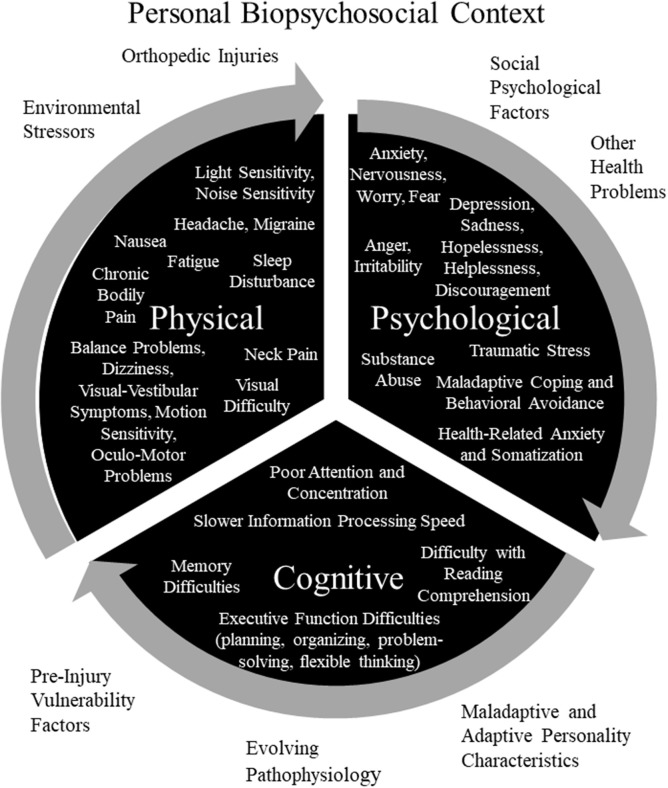
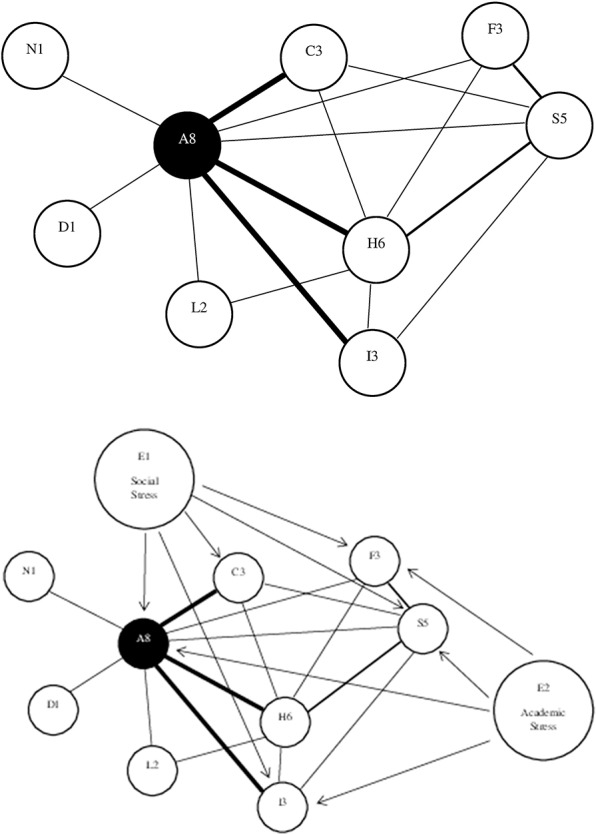
Some people experience persistent symptoms following a mild traumatic brain injury (MTBI), and the etiology of those symptoms has been debated for generations. Post-concussion-like symptoms are caused by many factors both before and after MTBI, and this non-specificity is the bedrock of the conundrum regarding the existence of the post-concussion syndrome. A latent model or common cause theory for the syndrome is inconsistent with the prevailing biopsychosocial conceptualization. It is the thesis of this paper that adopting a network perspective for persistent symptoms following MTBI, including the post-concussion syndrome, could lead to new insights and targeted treatment and rehabilitation strategies. The network perspective posits that symptoms co-occur because they are strongly inter-related, activating, amplifying, and mutually reinforcing, not because they arise from a common latent disease entity. This approach requires a conceptual shift away from thinking that symptoms reflect an underlying disease or disorder toward viewing inter-related symptoms as constituting the syndrome or disorder. The symptoms do not arise from an underlying syndrome-the symptoms are the syndrome. A network analysis approach allows us to embrace heterogeneity and comorbidity, and it might lead to the identification of new approaches to sequenced care. The promise of precision rehabilitation requires us to better understand the interconnections among symptoms and problems so that we can produce more individualized and effective treatment and rehabilitation.
Overview
The claims and statistics of this paper haven’t been checked yet.
Run the check — free, no account needed. It reads the open-access text and checks the sources it cites.
Integrity signals
Registry
Cites
Statistics
Figures
Verification
Claims the paper makes
The claims and statistics of this paper haven’t been checked yet.
Run the check — free, no account needed. It reads the open-access text and checks the sources it cites.
Claims other papers make about this one
Each is checked against this paper’s own text: does it say what the citing paper says it does?
The cited source says what the claim attributes to it.
In the citing paper
“it has been argued that PPCS have a biopsychosocial conceptualisation.”
From Acceptance and commitment therapy for mild traumatic brain injury (ACTion-mTBI): a quasiexperimental feasibility study (2025) · cites this paper as [17]
Self-check
Percentages, sums and reported differences re-computed from the paper’s own numbers.
The self-check needs the paper’s full text.
Citations
Cites
Diagnostic and Statistical Manual of Mental Disorders
American Psychiatric Association (2013) · doi:10.1176/appi.books.9780890425596 · Cited by 116,369
Posttraumatic Stress Disorder in the National Comorbidity Survey
Kessler, R. C. (1995) · Archives of General Psychiatry · doi:10.1001/archpsyc.1995.03950240066012 · Cited by 10,379
Kessler, R. C., Berglund, P., Demler, O., Jin, R., Koretz, D., Merikangas, K. R., Rush, A. J., Walters, E. E., & Wang, P. S. (2003) · JAMA · doi:10.1001/jama.289.23.3095 · Cited by 7,988
Network analysis: An integrative approach to the structure of psychopathology
Borsboom, D., & Cramer, A. O. J. (2013) · Annual Review of Clinical Psychology · doi:10.1146/annurev-clinpsy-050212-185608 · Cited by 4,359
A network theory of mental disorders
Borsboom, D. (2017) · World Psychiatry · doi:10.1002/wps.20375 · Cited by 3,482
A tutorial on regularized partial correlation networks
Epskamp, S., & Fried, E. I. (2018) · Psychological Methods · doi:10.1037/met0000167 · Cited by 2,918
Grant, B. F., Stinson, F. S., Dawson, D. A., Chou, S. P., Dufour, M. C., Compton, W., Pickering, R. P., & Kaplan, K. (2004) · Archives of General Psychiatry · doi:10.1001/archpsyc.61.8.807 · Cited by 2,889
Foa, E. B., Cashman, L., Jaycox, L., & Perry, K. (1997) · Psychological Assessment · doi:10.1037/1040-3590.9.4.445 · Cited by 2,709
Comorbidity: a network perspective
Cramer, A. O. J., Waldorp, L. J., van der Maas, H. L. J., & Borsboom, D. (2010) · Behavioral and Brain Sciences · doi:10.1017/s0140525x09991567 · Cited by 1,575
Mental disorders as networks of problems: a review of recent insights
Fried, E. I., van Borkulo, C. D., Cramer, A. O. J., Boschloo, L., Schoevers, R. A., & Borsboom, D. (2016) · Social Psychiatry and Psychiatric Epidemiology · doi:10.1007/s00127-016-1319-z · Cited by 1,144
Research works printed but not linked: 5
- Heilbronner, 1993, Factors associated with postconcussion syndrome: neurological, psychological, or legal?, Trial Diplomacy J., 16, 161
- 1992, The ICD-10 Classification of Mental and Behavioural Disorders: Clinical Descriptions and Diagnostic Guidelines
- 1994, Diagnostic and Statistical Manual of Mental Disorders. 4th ed
- Iverson, 2012, A biopsychosocial conceptualization of poor outcome from mild traumatic brain injury, 37
- Ruff, 1999, Mild traumatic brian injury, 315
Cited by
Sorted by citations
Voormolen, D. C., Haagsma, J. A., Polinder, S., Maas, A. I. R., Steyerberg, E. W., Vuleković, P., Sewalt, C. A., Gravesteijn, B. Y., Čović, A., Anđelić, N., et al. (2019) · Journal of Clinical Medicine · doi:10.3390/jcm8111921 · Cited by 116
Pre-symptomatic intervention for autism spectrum disorder (ASD): defining a research agenda
Grzadzinski, R., Amso, D., Landa, R. J., Watson, L. R., Guralnick, M. J., Zwaigenbaum, L., Deák, G. O., Estes, A. M., Brian, J. A., Bath, K. G., et al. (2021) · Journal of Neurodevelopmental Disorders · doi:10.1186/s11689-021-09393-y · Cited by 98
Natural language processing in clinical neuroscience and psychiatry: A review
Crema, C., Attardi, G., Sartiano, D., & Redolfi, A. (2022) · Frontiers in Psychiatry · doi:10.3389/fpsyt.2022.946387 · Cited by 77
Subtypes of Sport-Related Concussion: a Systematic Review and Meta-cluster Analysis
Langdon, S., Königs, M., Adang, E. A. M. C., Goedhart, E. A., & Oosterlaan, J. (2020) · Sports Medicine · doi:10.1007/s40279-020-01321-9 · Cited by 55
Balalla, S. K., Krägeloh, C., Medvedev, O. N., & Siegert, R. J. (2020) · Neurotrauma Reports · doi:10.1089/neur.2020.0017 · Cited by 54
Metadata
- Authors
- Iverson, G. L.
- Affiliations
- Harvard University (US)
- Corresponding author
- Iverson, Grant L.
- ORCID
- Iverson, Grant L.
- Venue
- Frontiers in Neurology
- Publisher
- Frontiers Media SA
- Published
- 2019-05-29
- Volume
- 10
- Pages
- 489-489
- ISSN
- 1664-2295 (ISSN-L)
- PMC
- PMC6548833
- OpenAlex
- W2947325756
- Cited by
- 121
- References
- 165
- Citations by year
- 2026: 20 · 2025: 9 · 2024: 10 · 2023: 19 · 2022: 25 · 2021: 18 · 2020: 17 · 2019: 2
- FWCI
- 2.26
- Type
- journal article
- Language
- en
- Open access
- gold
- doi.org
- Licence
- Locations
- Frontiers in Neurology (publishedVersion, cc-by)
- PubMed Central (publishedVersion, cc-by)
- PubMed (publishedVersion)
- DOAJ (DOAJ: Directory of Open Access Journals) (submittedVersion, cc-by-sa)
- Funders
- Spaulding Research Institute
- Topics
- Health Sciences › Medicine › Clinical Neurology › Traumatic Brain Injury Research
- Health Sciences › Medicine › Clinical Neurology › Long-Term Effects of COVID-19
- Social Sciences › Psychology › Experimental and Cognitive Psychology › Mental Health Research Topics
- Keywords
- post-concussion syndrome, mild traumatic brain injury, symptom networks, symptom co-occurrence, precision rehabilitation, biopsychosocial model, symptom heterogeneity, comorbidities, personalized treatment
About these checks
Registry, retraction, Cites and statistics results are computed, not judged, with one exception: a printed reference that no index lists is read once by a model before it counts as a citation error. Claims are extracted by a model and kept only when their quote appears verbatim in the text; each cited source is then checked, with a model’s help, for whether it says what the claim relies on. Those verdicts can be wrong — read the claim’s quote and the cited source before relying on one.
Statistics and arithmetic are recomputed, not judged.
Confidence bands are shown only for fields calibrated on our annotated test set. None is calibrated yet, so no band is shown.
What counts as a claim ›How we measure confidence ›How we check this ›
Are you an author, or do you see a problem with this page? Request a review
