

Inhibitory control deficits in patients with mesial temporal lobe epilepsy: an event-related potential analysis based on Go/NoGo task
Open accessThe DOI matches its Crossref record; 87 of the 87 references it cites were found in a registry or an index.
Abstract
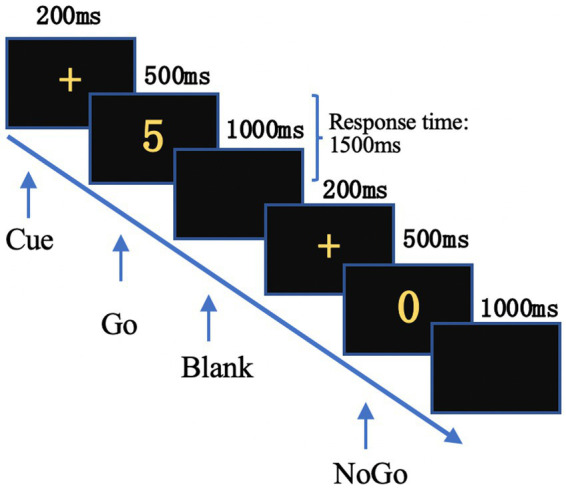
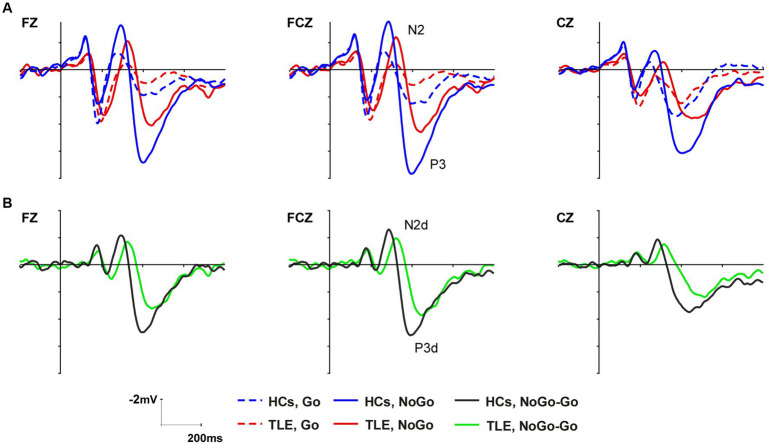
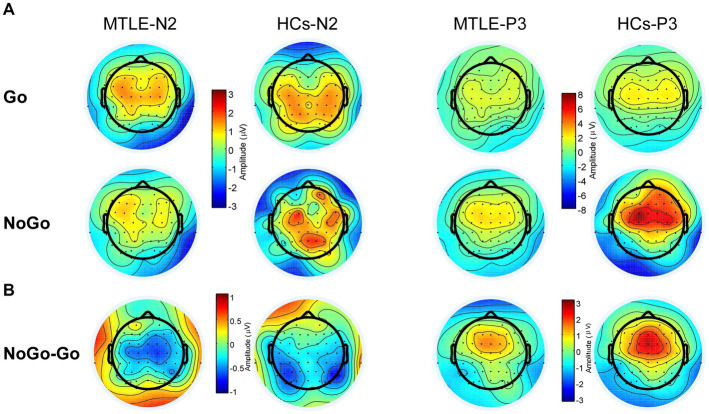
Objective: Neuropsychiatric comorbidities are common among patients with mesial temporal lobe epilepsy (MTLE). One of these comorbidities, impulsivity, can significantly impact the quality of life and prognosis. However, there have been few studies of impulsivity in these patients, and the existing findings are inconsistent. The present study investigates impulsivity in MTLE patients from the perspective of inhibitory control and its underlying processes using event-related potentials (ERPs) initiated using a Go/NoGo task. Methods: A total of 25 MTLE patients and 25 age-, gender-, and education-matched healthy controls (HCs) completed an unequal visual Go/NoGo task. Different waveforms as well as behavioral measures were analyzed between Go and NoGo conditions (N2d and P3d). Impulsivity was also assessed using self -rating scales, and clinical variables that may be related to ERPs were explored. Results: Compared with HCs, MTLE patients exhibited significantly longer reaction time (RT) (p = 0.002) and lower P3d especially at the frontal electrode sites (p = 0.001). In the MTLE group, the seizure frequency (p = 0.045) and seizure types (p < 0.001) were correlated with the P3d amplitude. A self-rated impulsivity assessment revealed that MTLE patients had higher non-planning (p = 0.017) and total scores (p = 0.019) on the BIS-11 as well as higher DI (p = 0.010) and lower FI (p = 0.007) on the DII. Conclusion: The findings demonstrate that the presence of inhibitory control deficits in patients with MTLE are characterized by deficits in the late stage of inhibition control, namely the motor inhibition stage. This study improves our understanding of impulsivity in MTLE patients and suggests that ERPs may constitute a sensitive means of detecting this trait.
Overview
The claims and statistics of this paper haven’t been checked yet.
Free: it reads the open-access text and checks the first 5 claims that cite a source we can check. Create a free account to check every claim.
Integrity signals
Registry
Cites
Statistics
Figures
Verification
Claims the paper makes
The claims and statistics of this paper haven’t been checked yet.
Free: it reads the open-access text and checks the first 5 claims that cite a source we can check. Create a free account to check every claim.
Claims other papers make about this one
Each is checked against this paper’s own text: does it say what the citing paper says it does?
The check wasn’t confident either way, so it gives no verdict — never disputed.
In the citing paper
“The Turkish version of the IUS-12 was validated by Sarıçam and colleagues [46], who reported strong internal consistency for the total scale (Cronbach’s α = 0.88), with subscale α coefficients of 0.84 for prospective anxiety and 0.77 for inhibitory anxiety. The Turkish IUS-12 also demonstrated good test–retest reliability and construct validity IUS-12.”
From Neural correlates of response inhibition following cognitive behavioral therapy in obsessive–compulsive disorder: a randomized controlled EEG study (2026) · cites this paper as [46]
Experimental — accuracy not yet measured
Self-check
Percentages, sums and reported differences re-computed from the paper’s own numbers.
The self-check needs the paper’s full text.
Citations
Cites
Fisher, R. S., Cross, J. H., French, J. A., Higurashi, N., Hirsch, E., Jansen, F. E., Lagae, L., Moshé, S. L., Peltola, J., Roulet Perez, E., et al. (2017) · Epilepsia · doi:10.1111/epi.13670 · Cited by 3,483
Bardo, M. T., & Hammer, R. P. (1991) · Neuroscience · doi:10.1016/0306-4522(91)90226-e · Cited by 3,219
Evenden, J. L. (1999) · Psychopharmacology · doi:10.1007/pl00005481 · Cited by 2,044 · cited 1×
“Impulsivity is not a singular concept, rather it encompasses a broad range of actions that are poorly conceived, prematurely expressed, unduly risky, or inappropriate to the situation and it often leads to undesirable outcomes (9, 10).”
BackgroundInhibition and impulsivity: behavioral and neural basis of response control
Bari, A., & Robbins, T. W. (2013) · Progress in Neurobiology · doi:10.1016/j.pneurobio.2013.06.005 · Cited by 1,921
Functional and dysfunctional impulsivity: Personality and cognitive correlates.
Dickman, S. J. (1990) · Journal of Personality and Social Psychology · doi:10.1037//0022-3514.58.1.95 · Cited by 1,323
Electrophysiological correlates for response inhibition in a Go/NoGo task
Bokura, H., Yamaguchi, S., & Kobayashi, S. (2001) · Clinical Neurophysiology · doi:10.1016/s1388-2457(01)00691-5 · Cited by 767
Electroencephalography of response inhibition tasks: Functional networks and cognitive contributions
Huster, R. J., Enriquez-Geppert, S., Lavallee, C. F., Falkenstein, M., & Herrmann, C. S. (2013) · International Journal of Psychophysiology · doi:10.1016/j.ijpsycho.2012.08.001 · Cited by 743
Mesial Temporal Lobe Epilepsy: What Have We Learned?
Engel, J. (2001) · The Neuroscientist · doi:10.1177/107385840100700410 · Cited by 557
Deficits in behavioural inhibition in substance abuse and addiction: a meta-analysis.
Smith, J. L., Mattick, R. P., Jamadar, S. D., & Iredale, J. M. (2014) · Drug and Alcohol Dependence · doi:10.1016/j.drugalcdep.2014.08.009 · Cited by 546 · cited 2×
“Furthermore, analyzing the pattern of performance differences can provide insights into potential deficits (49).”
BackgroundAltered Functional Connectivity and Small-World in Mesial Temporal Lobe Epilepsy
Liao, W., Zhang, Z., Pan, Z., Mantini, D., Ding, J., Duan, X., Luo, C., Lu, G., & Chen, H. (2010) · PLoS ONE · doi:10.1371/journal.pone.0008525 · Cited by 521
Cited by
Hippocampal sclerosis: A review on current research status and its mechanisms
Zhao, T., Cui, X., Zhang, X., Zhao, M., Rastegar‐Kashkooli, Y., Wang, J., Li, Q., Jiang, C. Q., Li, N., Xing, F., et al. (2025) · Ageing Research Reviews · doi:10.1016/j.arr.2025.102716 · Cited by 28
Self-citationAttention and inhibition deficits in narcolepsy type 1: behavioral and electrophysiological markers
Li, Z., Han, X., Xu, J., Xu, Q., Ge, X., Yang, Y., Yu, J., Lou, G., Gui, Y., Chen, F., et al. (2025) · Translational Psychiatry · doi:10.1038/s41398-025-03684-x · Cited by 2
Çınaroğlu, M., Ülker, S. V., Yılmazer, E., & Sayar, G. H. (2026) · BMC Psychology · doi:10.1186/s40359-026-05201-1
“The Turkish version of the IUS-12 was validated by Sarıçam and colleagues [46], who reported strong internal consistency for the total scale (Cronbach’s α = 0.88), with subscale α coefficients of 0.84 for prospective anxiety and 0.77 for inhibitory anxiety.”
InfluentialExecutive Functions of Children with Epilepsy Revealed by Electrophysiology
Kaga, Y., Tando, T., & Ishii, S. (2024) · てんかん研究 · doi:10.3805/jjes.42.31
Torabi, R., Nasiri, F., & Rahmani, F. (2025) · Women s Reproductive Health · doi:10.1080/23293691.2025.2542314
Metadata
- Authors
- Shao, C., Li, D., Zhang, X., Xiang, F., Zhang, X., & Wang, X.
- Affiliations
- Chinese PLA General Hospital (CN)
- Corresponding author
- Zhang, Xi
- Wang, Xiangqing
- Venue
- Frontiers in Neurology
- Publisher
- Frontiers Media SA
- Published
- 2024-01-08
- Volume
- 14
- Pages
- 1326841-1326841
- ISSN
- 1664-2295 (ISSN-L)
- PMC
- PMC10804952
- OpenAlex
- W4390666551
- Cited by
- 5
- References
- 87
- Citations by year
- 2026: 1 · 2025: 3 · 2024: 1
- FWCI
- 1.46
- Type
- journal article
- Language
- en
- Open access
- gold
- doi.org
- Licence
- Locations
- Frontiers in Neurology (publishedVersion, cc-by)
- PubMed Central (publishedVersion, cc-by)
- PubMed (publishedVersion)
- DOAJ (DOAJ: Directory of Open Access Journals) (submittedVersion, cc-by-sa)
- Topics
- Health Sciences › Medicine › Clinical Neurology › Epilepsy research and treatment
- Life Sciences › Neuroscience › Cognitive Neuroscience › Neural and Behavioral Psychology Studies
- Social Sciences › Psychology › Clinical Psychology › Historical and Modern Theater Studies
- Keywords
- mesial temporal lobe epilepsy, impulsivity, inhibitory control, go/no-go task, P300, motor inhibition, neuropsychiatric comorbidity, seizure frequency, seizure types, BIS-11, event-related potentials
About these checks
Registry, retraction, Cites and statistics results are computed, not judged, with one exception: a printed reference that no index lists is read once by a model before it counts as a citation error. Claims are extracted by a model and kept only when their quote appears verbatim in the text; each cited source is then checked, with a model’s help, for whether it says what the claim relies on. Those verdicts can be wrong — read the claim’s quote and the cited source before relying on one.
Statistics and arithmetic are recomputed, not judged.
Confidence bands are shown only for fields calibrated on our annotated test set. None is calibrated yet, so no band is shown.
What counts as a claim ›How we measure confidence ›How we check this ›
Are you an author, or do you see a problem with this page? Request a review
Data sources
Bibliographic data: Semantic Scholar, OpenAlex, Crossref.
Contains information from the Semantic Scholar Academic Graph Datasets, made available under the ODC Attribution License (ODC-BY 1.0).
Semantic Scholar’s data is described in: Kinney, R., et al. (2023). The Semantic Scholar Open Data Platform. arXiv:2301.10140.
