

Systematic review of memory assessment in virtual reality: evaluating convergent and divergent validity with traditional neuropsychological measures
Open accessThe DOI matches its Crossref record; 62 of the 63 references it cites were found in a registry or an index.
Abstract
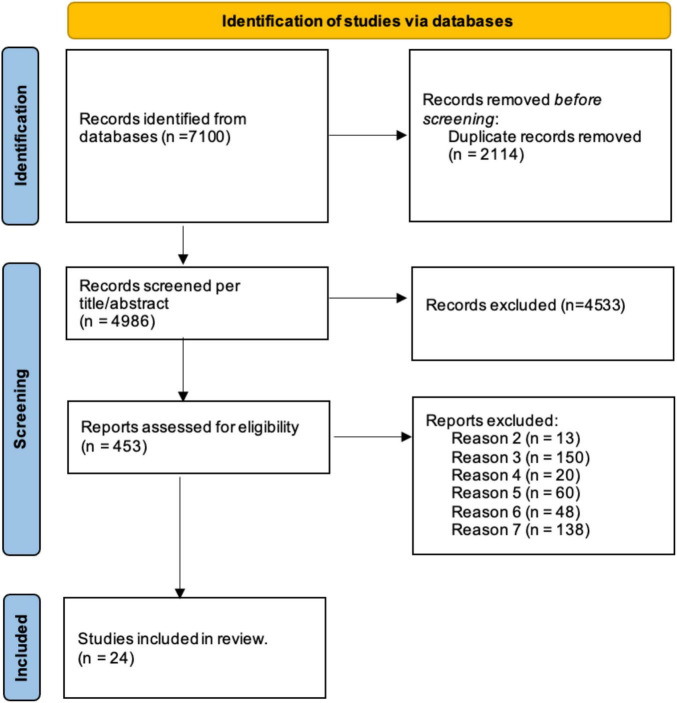
Introduction: The evaluation of memory is a crucial aspect of both cognitive research and clinical applications, as it offers valuable insights into an individual’s cognitive wellbeing and performance. Conventional neuropsychological assessments represent the established method for assessing different aspects of memory. Recent technological advancements, specifically in the field of virtual reality (VR), have introduced novel methods for evaluating memory. Objective: This systematic review aims to examine the current state of memory assessment using VR technologies, assessing the degree of convergence and divergence between VR-based memory assessments and conventional neuropsychological tests. Method: A systematic review of the literature was conducted searching PubMed, PsycINFO, Web of Science databases, leading to the incorporation of 24 studies. Studies were grouped according to the examined memory domain (episodic, prospective, spatial domain). Convergence and divergence validity were examined for each, and information on software and hardware features was collected. Results: This review demonstrates a notable alignment between VR-based memory assessments and conventional neuropsychological tests. Moreover, VR tasks have shown to exhibit associations with executive functions and overall cognitive performance. The inclusion of various ecological contexts, such as residential environments, commercial establishments, and simulated scenarios, serves to augment the ecological validity of memory evaluations conducted in VR. Discussion: The findings indicate that VR assessments demonstrate a functional perspective by effectively capturing the dynamic relationship between memory, executive functions, and overall cognitive performance. Nevertheless, it is imperative to acknowledge and tackle certain constraints that may hinder the widespread adoption and utilization of VR tasks. These limitations encompass factors such as restricted accessibility to VR tasks and the presence of heterogeneity in VR hardware and software. The dynamic and ever-changing nature of VR technology presents a range of potential avenues for future investigation and utilization in the domain of memory evaluation.
Overview
The claims and statistics of this paper haven’t been checked yet.
Free: it reads the open-access text and checks the first 5 claims that cite a source we can check. Create a free account to check every claim.
Integrity signals
Registry
Cites
Statistics
Figures
Verification
Claims the paper makes
The claims and statistics of this paper haven’t been checked yet.
Free: it reads the open-access text and checks the first 5 claims that cite a source we can check. Create a free account to check every claim.
Claims other papers make about this one
Each is checked against this paper’s own text: does it say what the citing paper says it does?
The check wasn’t confident either way, so it gives no verdict — never disputed.
In the citing paper
“the TabCAT-Brain Health Assessment developed at UCSF is an iPad-based in-clinic assessment that includes immediate scoring, outperforms traditional paper-based assessments, has had organic adoption across several UCSF-affiliated PCP clinics, and is free for primary care use.54–57”
From Review of Artificial Intelligence for Clinical Use in Alzheimer's Disease and Related Dementias (2026) · cites this paper as [56]
Experimental — accuracy not yet measured
Self-check
Percentages, sums and reported differences re-computed from the paper’s own numbers.
The self-check needs the paper’s full text.
Citations
Cites
The PRISMA 2020 statement: An updated guideline for reporting systematic reviews
Page, M. J., McKenzie, J. E., Bossuyt, P. M., Boutron, I., Hoffmann, T. C., Mulrow, C. D., Shamseer, L., Tetzlaff, J. M., Akl, E. A., Brennan, S. E., et al. (2021) · BMJ · doi:10.1136/bmj.n71 · Cited by 108,283
QUADAS-2: a revised tool for the quality assessment of diagnostic accuracy studies
Whiting, P. F., Rutjes, A. W. S., Westwood, M. E., Mallett, S., Deeks, J. J., Reitsma, J. B., Leeflang, M. M. G., Sterne, J. A. C., Bossuyt, P. M. M., & the QUADAS-2 Group* (2011) · Annals of Internal Medicine · doi:10.7326/0003-4819-155-8-201110180-00009 · Cited by 14,199
The PRISMA 2020 Statement: An Updated Guideline for Reporting Systematic Reviews
Page, M. J., McKenzie, J. E., Bossuyt, P. M., Boutron, I., Hoffmann, T. C., Mulrow, C. D., Shamseer, L., Tetzlaff, J. M., Akl, E. A., Brennan, S. E., et al. (2021) · International Journal of Surgery · doi:10.1016/j.ijsu.2021.105906 · Cited by 11,748
The PRISMA 2020 statement: an updated guideline for reporting systematic reviews
Page, M. J., McKenzie, J., Bossuyt, P., Boutron, I., Hoffmann, T., mulrow, C., Shamseer, L., Tetzlaff, J., Akl, E., Brennan, S. E., et al. (2020) · doi:10.31222/osf.io/v7gm2_v1 · Cited by 8,090
Benton, A. L. (1994) · Annual Review of Psychology · doi:10.1146/annurev.ps.45.020194.000245 · Cited by 2,307
Chaytor, N., & Schmitter-Edgecombe, M. (2003) · Neuropsychology Review · doi:10.1023/b:nerv.0000009483.91468.fb · Cited by 1,055
Abstract and concrete behavior an experimental study with special tests.
Goldstein, K., & Scheerer, M. (1941) · Psychological Monographs · doi:10.1037/h0093487 · Cited by 879
Do laboratory tests predict everyday memory? A neuropsychological study
Sunderland, A., Harris, J. E., & Baddeley, A. D. (1983) · Journal of Verbal Learning and Verbal Behavior · doi:10.1016/s0022-5371(83)90229-3 · Cited by 545
Ecological Validity of Neuropsychological Testing
Long, C. J., & Sbordone, R. J. (1996) · Cited by 425
Detecting navigational deficits in cognitive aging and Alzheimer disease using virtual reality
Cushman, L. A., Stein, K., & Duffy, C. J. (2008) · Neurology · doi:10.1212/01.wnl.0000326262.67613.fe · Cited by 363
Research works printed but not linked: 3
- Fuchs P. (2006). Le traité de la Réalité Virtuelle, Vol. 2. Paris: Presses des MINES.
- Pieri L. Serino S. Cipresso P. Mancuso V. Riva G. Pedroli E. (2022). The ObReco-360°: A new ecological tool to memory assessment using 360° immersive technology. Virtual Real. 26 639– 648. 10.1007/S10055-021-00526-1/FIGURES/5 · doi:10.1007/s10055-021-00526-1/figures/5
- Sbordone R. J. Long C. (1996). Ecological Validity of Neuropsychological Testing. Boca Raton, FL: CRC Press.
Cited by
González-Erena, P. V., Fernández‐Guinea, S., & Kourtesis, P. (2025) · Encyclopedia · doi:10.3390/encyclopedia5010008 · Cited by 46
“For memory assessment, XR-based tools immerse participants in tasks that require them to remember objects, locations, or sequences within virtual spaces [24].”
InfluentialCaporusso, E., Melillo, A., Perrottelli, A., Giuliani, L., Marzocchi, F. F., Pezzella, P., & Giordano, G. M. (2025) · Frontiers in Behavioral Neuroscience · doi:10.3389/fnbeh.2025.1543005 · Cited by 21
“…findings from studies on other cognitive domains, such as spatial and episodic memory, where research on the validity of VR approaches has also highlighted varying degrees of divergence between VR-based and traditional measures (Miskowiak et al., 2021; Jespersen et al., 2024; Mancuso et al., 2024).”
Solares, L., Llana, T., García-Navarra, S., & Méndez, M. (2025) · Applied Sciences · doi:10.3390/app15189903 · Cited by 14
Llana, T., Perpetuini, D., Zorzo, C., & Méndez, M. (2025) · Applied Sciences · doi:10.3390/app15041881 · Cited by 9
Review of Artificial Intelligence for Clinical Use in Alzheimer's Disease and Related Dementias
Breithaupt, A. G., Tang, A., Paolillo, E. W., Bibars, M., Johnson, E. C. B., Saloner, R., Possin, K. L., Windon, C. C., Hill-Jarrett, T. G., Giorgio, J., et al. (2026) · Seminars in Neurology · doi:10.1055/a-2744-9871 · Cited by 6
“18 A recent example is work from the Mayo Clinic highlighting an AI model that can detect nine different neurodegenerative phenotypes from FDG-PET images, with initial validation from ADNI with AUC of 0.93.”
InfluentialVirtual reality and mixed reality in the assessment of spatial memory
García-Navarra, S., Solares, L., & Méndez, M. (2025) · Exploration of Digital Health Technologies · doi:10.37349/edht.2025.101151 · Cited by 6
Lastrucci, A., Iosca, N., Zani, M., Simontacchi, G., Bastida, C., Casati, M., Berni, N., Napoli, A., Cesareo-Santoro, N., Gualtieri, N., et al. (2025) · Radiography · doi:10.1016/j.radi.2025.103284 · Cited by 4
Tütüncü, E. K., & Slater, M. (2025) · IEEE Conference on Virtual Reality and 3D User Interfaces Abstracts and Workshops (VRW) · doi:10.1109/vrw66409.2025.00230 · Cited by 2
Bruni, F., Mancuso, V., Panigada, J., Stramba‐Badiale, M., Cipresso, P., & Pedroli, E. (2024) · JMIR Aging · doi:10.2196/56796 · Cited by 2
“Nevertheless, while several virtual reality instruments exist to assess memory, only a limited number leverage the unique advantages of 360° media, using computer-generated scenarios [39].”
Self-citationPalombi, T., Chirico, A., Mandolesi, L., Mancini, M., Passarello, N., Volta, E., Alivernini, F., & Lucidi, F. (2025) · Electronics · doi:10.3390/electronics14153143 · Cited by 2
Mancuso, V., Tursi, A., Bardi, M., Arlati, S., Saritas, S. N., Santo, S. G. D., Cavallo, M., & Pedroli, E. (2025) · Lecture notes in computer science · doi:10.1007/978-3-031-97766-4_12 · Cited by 1
Self-citationThe Virtual Supermarket Test: A New Tool for Assessing Planning in Adults From Buenos Aires
Seivane, M. S., & Brenlla, M. E. (2025) · Assessment · doi:10.1177/10731911251390381 · Cited by 1
Bruni, F., Bigotto, F., Mancuso, V., Cavedoni, S., Panigada, J., Stramba-Badiale, M., Serino, S., & Pedroli, E. (2026) · Frontiers in Human Neuroscience · doi:10.3389/fnhum.2025.1753364 · Cited by 1
Self-citationSimonian, N., & Reggente, N. (2026) · Virtual Worlds · doi:10.3390/virtualworlds5010007 · Cited by 3
“…often correlated with executive function and global cognition, suggesting VR assessments more accurately reflect the interdependent nature of cognitive processes in real-world settings, a “functional perspective” [46] that captures memory as it naturally operates alongside other cognitive domains.”
InfluentialUsability Study of a Virtual Reality-Based Ecological Battery for Memory Assessment: A Pilot Study
Mancuso, V., Arlati, S., Saritas, S. N., Borghesi, F., Santo, S. G. D., Cavallo, M., & Pedroli, E. (2024) · IEEE International Conference on Metrology for eXtended Reality, Artificial Intelligence and Neural Engineering (MetroXRAINE) · doi:10.1109/metroxraine62247.2024.10797097 · Cited by 1
Self-citationComparative analysis of five diagnostic tools in detecting mild cognitive impairment in older adults
Ferasat, M., Ghoochani, B. Z., Kaveh, M. H., Caycho‐Rodríguez, T., & Asadollahi, A. (2025) · Middle East Current Psychiatry · doi:10.1186/s43045-025-00534-w · Cited by 1
Rekers, S., Meyer, T. C., & Finke, C. (2025) · Computers in Human Behavior Reports · doi:10.1016/j.chbr.2025.100730 · Cited by 2
Yilmaz, U., Karadeniz, C., Demirkaya, B., Sparrenberg, L., Toraman, D., Yağmurlu, K., Hasoğlu, T., Yüksel, Ç., Sifa, R., & Albayram, Ö. (2025) · AI in neuroscience. · doi:10.1177/2997979x251401408 · Cited by 1
Mancuso, V., Franchini, F., Arlati, S., Saritas, S. N., Santo, S. G. D., Cavallo, M., & Pedroli, E. (2025) · IEEE International Conference on Metrology for eXtended Reality, Artificial Intelligence and Neural Engineering (MetroXRAINE) · doi:10.1109/metroxraine66377.2025.11340260 · Cited by 1
Self-citationBoynton, H. G., Fontanese, M. S., & Barnett, M. D. (2026) · Assessment · doi:10.1177/10731911251407473
Zhang, S., & Pai, Y. S. (2026) · CHI Conference Extended Abstracts on Human Factors in Computing Systems (CHI EA) · doi:10.1145/3772363.3799264
Cavallo, N. D., Amitrano, F., Coccia, A., Miccio, C., Santangelo, G., Marcuccio, L., D’Addio, G., & Moretta, P. (2026) · Neuropsychology Review · doi:10.1007/s11065-026-09693-x · Cited by 1
The Effect of Unexpected Visual Stimuli on Short-Term Memory in Immersive Experience
Zhang, S., Li, M., Xiao, Y., Lu, X., (15435), Y. W., & Li, S. (2026) · Lecture notes in computer science · doi:10.1007/978-981-95-7195-6_6
Solares, L., Garcés-Arilla, S., Méndez, M., & Méndez-López, M. (2026) · Cognitive Affective & Behavioral Neuroscience · doi:10.3758/s13415-026-01463-9
Russell, V., & Murphy, D. (2026) · International Conference on Virtual Reality · doi:10.1109/icvr70658.2026.11672484
“Mancuso et al. [8] demonstrated that VR enables the simulation of ecologically valid spatial contexts, supporting the study of spatial memory in environments that better approximate real-world conditions.”
Leitao, M. R., Farokhnia, M., Leggio, L., & Persky, S. (2026) · Journal of Medical Extended Reality · doi:10.1177/29941520261484294
“9,10 For example, VR-situated cognitive testing tends to be more sophisticated and engender more realistic cognitive load than classical test approaches, therefore better re fl ecting real-world performance.”
Neuropsychological assessments: Tools and techniques
Reddy, K. J., Nair, S., & Prashanth, A. (2026) · Elsevier eBooks · doi:10.1016/b978-0-443-36544-7.00004-5
Adaptive and Personalized Assessment Pathways Enabled by GenAI
Kayyali, M. (2026) · Advances in computational intelligence and robotics book series · doi:10.4018/979-8-3373-9089-5.ch006
Bousché, E., Embrechts, E., Pires, I. I. F., Gosselt, I. K., Huygelier, H., & Nijboer, T. C. W. (2026) · Applied Neuropsychology Adult · doi:10.1080/23279095.2026.2720586
Long-term episodic memory alterations and the role of perceived stress in post-COVID-19 condition
Llana, T., Solares, L., Garcés-Arilla, S., Juan, M. ‐., Méndez, M., & Méndez-López, M. (2026) · Acta Psychologica · doi:10.1016/j.actpsy.2026.108017
Apostolaki, S., & Ρούσσος, Π. (2026) · Psychological Research · doi:10.1007/s00426-026-02408-0
“Immersive VR can hold spatial layout and timing fixed while retaining much of the perceptual and interactive texture of real exploration (Brookes et al., 2020; Cadet & Chainay, 2020; Mancuso et al., 2024; Smith, 2019).”
Metadata
- Authors
- Mancuso, V., Sarcinella, E. D., Bruni, F., Arlati, S., Di Santo, S. G., Cavallo, M., Cipresso, P., & Pedroli, E.
- Affiliations
- Università degli Studi eCampus (IT)
- Università Cattolica del Sacro Cuore (IT)
- National Research Council (IT)
- University of Turin (IT)
- Corresponding author
- Mancuso, Valentina
- ORCID
- Venue
- Frontiers in Human Neuroscience
- Publisher
- Frontiers Media SA
- Published
- 2024-05-16
- Volume
- 18
- Pages
- 1380575-1380575
- ISSN
- 1662-5161 (ISSN-L)
- PMC
- PMC11137286
- OpenAlex
- W4396972569
- Cited by
- 31
- References
- 63
- Citations by year
- 2026: 14 · 2025: 15 · 2024: 2
- FWCI
- 2.31
- Type
- journal article
- Language
- en
- Open access
- gold
- doi.org
- Licence
- Locations
- Frontiers in Human Neuroscience (publishedVersion, cc-by)
- PubMed Central (publishedVersion, cc-by)
- PubMed (publishedVersion)
- Institutional Research Information System University of Turin (University of Turin) (submittedVersion, other-oa)
- DOAJ (DOAJ: Directory of Open Access Journals) (submittedVersion)
- IRIS eCampus Telematic University (Università degli Studi eCampus) (submittedVersion)
- Funders
- Ministero della Salute
- Topics
- Social Sciences › Psychology › Experimental and Cognitive Psychology › Cognitive Functions and Memory
- Physical Sciences › Computer Science › Human-Computer Interaction › Virtual Reality Applications and Impacts
- Social Sciences › Psychology › Experimental and Cognitive Psychology › Cognitive Abilities and Testing
- Keywords
- virtual reality, memory assessment, convergent validity, discriminant validity, neuropsychological assessment, episodic memory, prospective memory, spatial memory, executive function, ecological validity, cognitive performance
About these checks
Registry, retraction, Cites and statistics results are computed, not judged, with one exception: a printed reference that no index lists is read once by a model before it counts as a citation error. Claims are extracted by a model and kept only when their quote appears verbatim in the text; each cited source is then checked, with a model’s help, for whether it says what the claim relies on. Those verdicts can be wrong — read the claim’s quote and the cited source before relying on one.
Statistics and arithmetic are recomputed, not judged.
Confidence bands are shown only for fields calibrated on our annotated test set. None is calibrated yet, so no band is shown.
What counts as a claim ›How we measure confidence ›How we check this ›
Are you an author, or do you see a problem with this page? Request a review
Data sources
Bibliographic data: Semantic Scholar, OpenAlex, Crossref.
Contains information from the Semantic Scholar Academic Graph Datasets, made available under the ODC Attribution License (ODC-BY 1.0).
Semantic Scholar’s data is described in: Kinney, R., et al. (2023). The Semantic Scholar Open Data Platform. arXiv:2301.10140.
