

The DOI matches its Crossref record; 45 of the 45 references it cites were found in a registry or an index.
Integrating music and nature: a scoping review of research on interventions involving both music- and nature-based strategies for mental health and wellbeing
Open accessAbstract
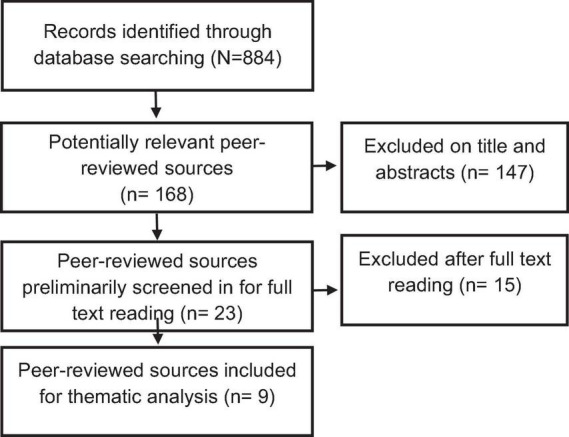
Introduction: Both music-related and nature-based therapeutic activities can enhance wellbeing, physical, social, emotional, and mental health, and recovery from posttraumatic stress. While music- and nature-based therapeutic approaches have been studied individually, research is limited on the holistic combination of music- and nature-based therapeutic interventions. Thus, a scoping review was conducted to chart primary research on the combined use of music- and nature-based therapeutic strategies and their effects on overall wellbeing, and within this scope, potentially on mental and behavioral health outcomes. Methods: Included were peer-reviewed articles reporting primary research findings on how (if at all) the combined use of both music and nature-based interventions impacted wellbeing and thus, mental and behavioral health. All studies had to be reported in English. Excluded were studies that did not involve both nature-based and music-related therapeutic activities, those not involving primary research, and articles without a clear discussion on potential impacts on wellbeing, mental, or behavioral health. After applying this inclusion and exclusion criteria, 884 potentially relevant peer-reviewed articles were identified, 23 of which were preliminarily screened in upon abstract and title review. After full text reading, eight of these articles were deemed eligible for the review and were thematically analyzed. Results: Four themes were identified from the reviewed studies: (a) music- and nature-based activities yield benefits across various aspects of wellbeing, (b) multiple activities can be combined and adapted for diverse contexts and populations, (c) more research is needed on the combined therapeutic use of music and nature, and (d) choice and expression should be prioritized, which music and nature can facilitate. The primary focus of the reviewed studies was on how music-based interventions in outdoor or natural settings can impact multiple aspects of wellbeing, particularly emotional wellbeing, and with this, improved mood. Discussion: The results suggest that combining music and nature-based therapeutic approaches can improve mental and behavioral health by enhancing multiple aspects of wellbeing. For example, music-making in natural settings can foster deep connections with nature and spiritual wellness. Implications for future research are provided, as further research is needed on the combined use of music- and nature-based therapeutic activities.
Overview
The claims and statistics of this paper haven’t been checked yet.
Run the check — free, no account needed. It reads the open-access text and checks the sources it cites.
Integrity signals
Registry
Cites
Statistics
Figures
Verification
Claims the paper makes
The claims and statistics of this paper haven’t been checked yet.
Run the check — free, no account needed. It reads the open-access text and checks the sources it cites.
Claims other papers make about this one
Each is checked against this paper’s own text: does it say what the citing paper says it does?
The check wasn’t confident either way, so it gives no verdict — never disputed.
In the citing paper
“Individuals with PTSD often experience persistent hypervigilance and difficulty disengaging from threat-related cognitions, making it difficult to relax and initiate sleep [114].”
From Pre-Sleep Anxiety: Mechanisms and Therapeutic Approaches in Clinical Practice. (2026) · cites this paper as [114]
Experimental — accuracy not yet measured
Self-check
Percentages, sums and reported differences re-computed from the paper’s own numbers.
The self-check needs the paper’s full text.
Citations
Cites
Using thematic analysis in psychology
Braun, V., & Clarke, V. (2006) · Qualitative Research in Psychology · doi:10.1191/1478088706qp063oa · Cited by 194,414
The Body Keeps the Score: Brain, Mind, and Body in the Healing of Trauma
Ray, A. (2015) · The Permanente Journal · doi:10.7812/tpp/14-211 · Cited by 2,215
Chanda, M. L., & Levitin, D. J. (2013) · Trends in Cognitive Sciences · doi:10.1016/j.tics.2013.02.007 · Cited by 1,247 · cited 1×
“At the behavioral level, music influences neurochemical activity—including dopamine, serotonin, and oxytocin—thereby supporting stress regulation, emotional balance, and social connectedness (Chanda and Levitin, 2013).”
Embodiment and Experience: The Existential Ground of Culture and Self
Csordas, T. (1995) · Journal of the Royal Anthropological Institute · doi:10.2307/3034915 · Cited by 1,229
(2011) · Cited by 1,181
Associations between nature exposure and health: a review of the evidence
Jimenez, M. P., DeVille, N. V., Elliott, E. G., Schiff, J. E., Wilt, G. E., Hart, J. E., & James, P. (2021) · International Journal of Environmental Research and Public Health · doi:10.3390/ijerph18094790 · Cited by 726
Butler, A., Hall, H., & Copnell, B. (2016) · Worldviews on Evidence-Based Nursing · doi:10.1111/wvn.12134 · Cited by 539
Seinfeld, S., Figueroa, H., Ortiz‐Gil, J., & Sanchez-Vives, M. V. (2013) · Frontiers in Psychology · doi:10.3389/fpsyg.2013.00810 · Cited by 282
Biophilia and the Conservation Ethic
Wilson, E. O. (2013) · Princeton University Press eBooks · doi:10.2307/jj.40831413.5 · Cited by 269
How nature nurtures: Amygdala activity decreases as the result of a one-hour walk in nature
Sudimac, S., Sale, V., & Kühn, S. (2022) · Molecular Psychiatry · doi:10.1038/s41380-022-01720-6 · Cited by 234 · cited 3×
“Thus, music-and nature-based activities can be used to help the body shift away from the stress-driven sympathetic state, promoting balance and wellbeing (Detweiler et al., 2015; Corbijn van Willenswaard et al., Hand et al. 10.3389/fnhum.2025.1664304 2017; Sudimac et al., 2022).”
Influential
Research works printed but not linked: 6
- Hand, 2020, Perceptions of Sexual Violence in Later Life: A Three Paper Dissertation Study.
- Kellert, 1993, Introduction, 18
- Montgomery, 2015, The theoretical and therapeutic paradigm of botanical arranging., J. Ther. Hortic., 25, 16
- Ruzany, 2022, Embodied Digital Storytelling with Ancestral Legacy.
- Ulrich, 1993, Biophilia, biophobia, and natural landscapes, 73
- 2022, COVID-19 Pandemic Triggers 25% Increase in Prevalence of Anxiety and Depression Worldwide.
Cited by
Sorted by citations
Noda, Y., & Noda, T. (2025) · Brain Sciences · doi:10.3390/brainsci15111248 · Cited by 15
“Success will depend on embedding therapeutic aims within education systems, tailoring protocols to cultural contexts, aligning interventions with sleep and motor neuroscience principles, and deploying scalable delivery models under rigorous ethical safeguards [2,80,100].”
Pre-Sleep Anxiety: Mechanisms and Therapeutic Approaches in Clinical Practice.
Song, S., Irfan, M., Tahir, Z., Garrison, K. A., & Ziskind, S. (2026) · Current Sleep Medicine Reports · doi:10.1007/s40675-026-00370-2
Sustainable behaviours within music therapy: A view from the United Kingdom
Watson, T., & Davey-Hewins, J. (2026) · British Journal of Music Therapy · doi:10.1177/13594575261424466
“…that evidences how nature and music therapy can be used together, not only to enhance outcomes for service users but also to provide links to the world and to nature, resulting in more compassion towards the planet (Hand et al., 2025; Lindvang and Daniels Beck, 2024; Pfeifer et al., 2019).”
Metadata
- Authors
- Hand, M. D., Ihara, E. S., Moore, M., & Shaw, M.
- Affiliations
- George Mason University (US)
- Corresponding author
- Hand, Michelle D.
- Venue
- Frontiers in Human Neuroscience
- Publisher
- Frontiers Media SA
- Published
- 2025-08-26
- Volume
- 19
- Pages
- 1664304-1664304
- ISSN
- 1662-5161 (ISSN-L)
- PMC
- PMC12418201
- OpenAlex
- W4413696614
- Cited by
- 3
- References
- 45
- Citations by year
- 2026: 2 · 2025: 1
- FWCI
- 0.59
- Type
- journal article
- Language
- en
- Update notices
- correction (2026-07-21)
- Open access
- gold
- doi.org
- Licence
- Locations
- Frontiers in Human Neuroscience (publishedVersion, cc-by)
- PubMed (publishedVersion)
- PubMed Central (publishedVersion, cc-by)
- DOAJ (DOAJ: Directory of Open Access Journals) (submittedVersion, cc-by-sa)
- Topics
- Social Sciences › Psychology › Social Psychology › Music Therapy and Health
- Social Sciences › Urban Studies › Urban Green Space and Health
- Social Sciences › Psychology › Clinical Psychology › Art Therapy and Mental Health
- Keywords
- music therapy, nature-based interventions, well-being, mental health, emotional well-being, mood, spiritual health, behavioral health
About these checks
Registry, retraction, Cites and statistics results are computed, not judged, with one exception: a printed reference that no index lists is read once by a model before it counts as a citation error. Claims are extracted by a model and kept only when their quote appears verbatim in the text; each cited source is then checked, with a model’s help, for whether it says what the claim relies on. Those verdicts can be wrong — read the claim’s quote and the cited source before relying on one.
Statistics and arithmetic are recomputed, not judged.
Confidence bands are shown only for fields calibrated on our annotated test set. None is calibrated yet, so no band is shown.
What counts as a claim ›How we measure confidence ›How we check this ›
Are you an author, or do you see a problem with this page? Request a review
