

The DOI matches its Crossref record; 141 of the 143 references it cites were found in a registry or an index.
Calcitonin gene-related peptide is a key neurotransmitter in the neuro-immune axis
Open accessAbstract
The question of how the neural and immune systems interact in host defense is important, integrating a system that senses the whole body with one that protects. Understanding the mechanisms and routes of control could produce novel and powerful ways of promoting and enhancing normal functions as well as preventing or treating abnormal functions. Fragmentation of biological research into specialities has resulted in some failures in recognizing and understanding interactions across different systems and this is most striking across immunology, hematology, and neuroscience. This reductionist approach does not allow understanding of the in vivo orchestrated response generated through integration of all systems. However, many factors make the understanding of multisystem cross-talk in response to a threat difficult, for instance the nervous and immune systems share communication molecules and receptors for a wide range of physiological signals. But, it is clear that physical, hard-wired connections exist between the two systems, with the key link involving sensory, unmyelinated nerve fibers (c fibers) containing the neuropeptide calcitonin gene-related peptide (CGRP), and modified macrophages, mast cells and other immune and host defense cells in various locations throughout the body. In this review we will therefore focus on the induction of CGRP and its key role in the neuroimmune axis.
Overview
The claims and statistics of this paper haven’t been checked yet.
Run the check — free, no account needed. It reads the open-access text and checks the sources it cites.
Integrity signals
Registry
Cites
Statistics
Figures
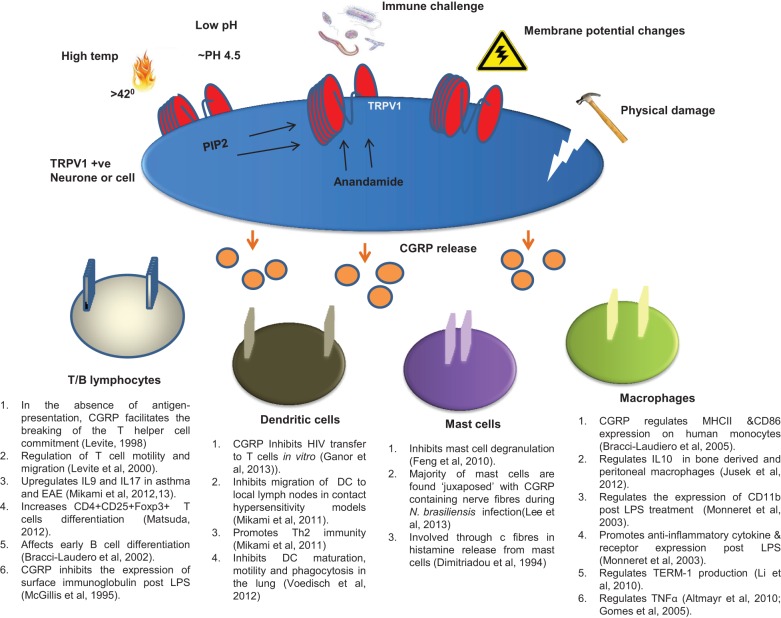
Verification
Claims the paper makes
The claims and statistics of this paper haven’t been checked yet.
Run the check — free, no account needed. It reads the open-access text and checks the sources it cites.
Claims other papers make about this one
Each is checked against this paper’s own text: does it say what the citing paper says it does?
The source backs part of the claim, not all of it — or backs it for a different population, condition or comparison.
In the citing paper
“Type II afferents express neuropeptides such as CGRP (37, 38, 54), which in somatic C-fibers (55) modulates the activity of immune cells that proliferate after trauma (56).”
From Damage-evoked signals in cochlear neurons and supporting cells (2024) · cites this paper as [55]
Experimental — accuracy not yet measured
Self-check
Percentages, sums and reported differences re-computed from the paper’s own numbers.
The self-check needs the paper’s full text.
Citations
Cites
The capsaicin receptor: a heat-activated ion channel in the pain pathway
Caterina, M. J., Schumacher, M. A., Tominaga, M., Rosen, T. A., Levine, J. D., & Julius, D. J. (1997) · Nature · doi:10.1038/39807 · Cited by 9,132
Induced root-secreted phenolic compounds as a belowground plant defense
Lanoue, A., Burlat, V., Schurr, U., & Röse, U. S. R. (2010) · Plant Signaling & Behavior · doi:10.4161/psb.5.8.12337 · Cited by 5,462
The Cloned Capsaicin Receptor Integrates Multiple Pain-Producing Stimuli
Tominaga, M., Caterina, M. J., Malmberg, A. B., Rosen, T. A., Gilbert, H., Skinner, K., Raumann, B. E., Basbaum, A. I., & Julius, D. J. (1998) · Neuron · doi:10.1016/s0896-6273(00)80564-4 · Cited by 3,086
Calcitonin gene-related peptide is a potent vasodilator
Brain, S. D., Williams, T. J., Tippins, J. R., Morris, H. R., & MacIntyre, I. M. (1985) · Nature · doi:10.1038/313054a0 · Cited by 2,085
Vanilloid (Capsaicin) Receptors and Mechanisms
SZALLASI, A., & Blumberg, P. M. (1999) · Pharmacological Reviews · doi:10.1016/s0031-6997(24)01403-0 · Cited by 1,903
Capsaicin: cellular targets, mechanisms of action, and selectivity for thin sensory neurons.
Holzer, P. D. (1991) · Pharmacological Reviews · doi:10.1016/s0031-6997(25)06664-5 · Cited by 1,784
Acetylcholine-Synthesizing T Cells Relay Neural Signals in a Vagus Nerve Circuit
Rosas-Ballina, M., Olofsson, P. S., Ochani, M., Valdés-Ferrer, S. I., Levine, Y. A., Reardon, C., Tusche, M. W., Pavlov, V. A., Andersson, U., Chavan, S., et al. (2011) · Science · doi:10.1126/science.1209985 · Cited by 1,551
Twenty years of research on cytokine-induced sickness behavior
Dantzer, R., & Kelley, K. W. (2007) · Brain, Behavior, and Immunity · doi:10.1016/j.bbi.2006.09.006 · Cited by 1,420
Chuang, H.-H., Prescott, E. D., Kong, H., Shields, S. D., Jordt, S. E., Basbaum, A. I., Chao, M. V., & Julius, D. J. (2001) · Nature · doi:10.1038/35082088 · Cited by 1,257
The neuropharmacology of capsaicin: review of some recent observations.
Buck, S. H., & Burks, T. F. (1986) · Pharmacological Reviews · doi:10.1016/s0031-6997(25)06866-8 · Cited by 849
Research works printed but not linked: 1
- Holzer P. Maggi C. A. (1998). Dissociation of dorsal root ganglion neurons into afferent and efferent-like neurons. Neuroscience 86, 389– 398 9881854
Cited by
Sorted by citations
Items 101–200 of 226
Promotion of corneal angiogenesis by sensory neuron-derived calcitonin gene-related peptide
Zhu, S., Zidan, A. A., Pang, K., Musayeva, A., Kang, Q., & Yin, J. (2022) · Experimental Eye Research · doi:10.1016/j.exer.2022.109125 · Cited by 18
Exogenous drug-induced mouse models of atopic dermatitis
Zheng, R., Ren, Y., Liu, X., He, C., Liu, H., Wang, Y., Li, J., Xia, S., Liu, Z., Ma, Y., et al. (2024) · Cytokine & Growth Factor Reviews · doi:10.1016/j.cytogfr.2024.01.003 · Cited by 18
Maleitzke, T., Hildebrandt, A., Weber, J., Dietrich, T., Appelt, J., Jahn, D., Zocholl, D., Baranowsky, A., Duda, G. N., Tsitsilonis, S., et al. (2020) · Lara D. Veeken · doi:10.1093/rheumatology/keaa711 · Cited by 18
Thrombospondin-1 Is Necessary for the Development and Repair of Corneal Nerves
Tatematsu, Y., Khan, Q., Blanco, T., Bair, J. A., Hodges, R. R., Masli, S., & Dartt, D. A. (2018) · International Journal of Molecular Sciences · doi:10.3390/ijms19103191 · Cited by 18
ILC2-derived CGRP triggers acute inflammation and nociceptive responses in bacterial cystitis
Yang, Z., Liu, Y., Xiang, Y., Chen, R., Chen, L., Wang, S., Lv, L., Zang, M., Zhou, N., Li, S., et al. (2024) · Cell Reports · doi:10.1016/j.celrep.2024.114859 · Cited by 17
The roles of the nerve-immune axis in modulating bone regeneration
Zhao, Y., Xu, K., Wu, K., Guo, Z., Li, H., Lin, N., Ye, Z., Huang, X., Xu, J., & Huang, D. (2026) · Bone Research · doi:10.1038/s41413-025-00476-3 · Cited by 18
Radiofrequency Irradiation Modulates TRPV1-Related Burning Sensation in Rosacea
Oh, S., Son, M., Park, J., Kang, D., & Byun, K. (2021) · Molecules · doi:10.3390/molecules26051424 · Cited by 17
Neurotransmitter and neuropeptide regulation of gut immunity
Wong, C., & Chiu, I. M. (2025) · Current Opinion in Neurobiology · doi:10.1016/j.conb.2025.103036 · Cited by 16
Levite, M., Safadi, R., Milgrom, Y., Massarwa, M., & Galun, E. (2021) · Neuropeptides · doi:10.1016/j.npep.2021.102159 · Cited by 17
Sex differences in neuro(auto)immunity and chronic sciatic nerve pain
Linher‐Melville, K., Shah, A. A., & Singh, G. (2020) · Biology of Sex Differences · doi:10.1186/s13293-020-00339-y · Cited by 17
Lai, A., Ho, L., Evashwick‐Rogler, T. W., Watanabe, H., Salandra, J. M., Winkelstein, B. A., Laudier, D. M., Hecht, A. C., Pasinetti, G. M., & Iatridis, J. C. (2019) · PLoS ONE · doi:10.1371/journal.pone.0225674 · Cited by 16
Cyclic Stretch of Either PNS or CNS Located Nerves Can Stimulate Neurite Outgrowth
Kampanis, V., Tolou-Dabbaghian, B., Zhou, L., Roth, W., & Puttagunta, R. (2020) · Cells · doi:10.3390/cells10010032 · Cited by 15
From bite to brain: Neuro‐immune interactions in food allergy
Houghton, V., Eiwegger, T., Florsheim, E. B., Knibb, R. C., Thuret, S., & Santos, A. F. (2024) · Allergy · doi:10.1111/all.16366 · Cited by 16
Subalakshmi, S., Rushendran, R., & Vellapandian, C. (2025) · Journal of Neuroimmune Pharmacology · doi:10.1007/s11481-025-10197-3 · Cited by 14
Anti-CGRP in cluster headache therapy
Giani, L., Cecchini, A. P., & Leone, M. (2019) · Neurological Sciences · doi:10.1007/s10072-019-03786-7 · Cited by 14
The potential role of TRPV1 in pulmonary hypertension: Angel or demon?
Zhang, X., Ye, L., Huang, Y., Ding, X., & Wang, L. (2019) · Channels · doi:10.1080/19336950.2019.1631106 · Cited by 14
Thymosin β4: A Multi-Faceted Tissue Repair Stimulating Protein in Heart Injury
Bjørklund, G., Dadar, M., Aaseth, J., & Chirumbolo, S. (2019) · Current Medicinal Chemistry · doi:10.2174/0929867326666190716125456 · Cited by 14
Battini, V., Carnovale, C., Clementi, E., & Sessa, M. (2023) · Expert Opinion on Drug Safety · doi:10.1080/14740338.2023.2223958 · Cited by 13
Jia, F., Du, L., He, J., Zhang, Z., Hou, X., Dong, Q., Bian, Z., & Zhao, L. (2024) · Journal of Ethnopharmacology · doi:10.1016/j.jep.2024.118256 · Cited by 17
The analgesic effect of paeoniflorin: A focused review
Li, M., Zhu, X., Zhang, M., Yu, J. G., Jin, S., Hu, X., & Piao, H. (2024) · Open Life Sciences · doi:10.1515/biol-2022-0905 · Cited by 14
Arkless, K. L., Argunhan, F., & Brain, S. D. (2018) · Handbook of experimental pharmacology · doi:10.1007/164_2018_129 · Cited by 12
Sleep deficiency exacerbates periodontal inflammation via trigeminal TRPV1 neurons
Li, J., Cui, Z., Gong, H., Zhang, Y., Yuan, Z., Zhang, Z.-H., Ma, Z., Zhou, N., Huang, C., Zhao, Y., et al. (2025) · Proceedings of the National Academy of Sciences · doi:10.1073/pnas.2424169122 · Cited by 12
Mast cell–neuron axis in allergy
Gaudenzio, N., & Basso, L. (2022) · Current Opinion in Immunology · doi:10.1016/j.coi.2022.102213 · Cited by 12
Cellular and Molecular Roles of Immune Cells in the Gut-Brain Axis in Migraine
Zhou, Y., Pang, M., Ma, Y., Lu, L., Zhang, J., Wang, P., Li, Q., & Yang, F. (2023) · Molecular Neurobiology · doi:10.1007/s12035-023-03623-1 · Cited by 12
Brain-immune interactions in health and disease
Dénes, Á., & Miyan, J. A. (2014) · Frontiers in Neuroscience · doi:10.3389/fnins.2014.00382 · Cited by 12
Endothelial senescence drives intrinsic skin aging via the neuroimmune CGRP-mast cell axis in mice
Wicaksono, S. A., Ryanto, G. R. T., Suzuki, Y., Hara, T., Ikeda, K., Fukumoto, T., Hirata, K., Otake, H., & Emoto, N. (2025) · Communications Biology · doi:10.1038/s42003-025-09097-2 · Cited by 11
Effect of intracanal diode laser application and low-level laser therapy on CGRP change
Arslan, H., Köseoğlu, S., Yıldız, E. D., Arabacı, T., Savran, L., Yıldız, D. A., & Veyisoğlu, G. (2018) · Brazilian Oral Research · doi:10.1590/1807-3107bor-2018.vol32.0125 · Cited by 11
Sollmann, N., Schandelmaier, P., Weidlich, D., Börner, C., Urban, G., Lang, M., Zimmer, C., Karampinos, D. C., Landgraf, M. N., Heinen, F., et al. (2021) · Cephalalgia · doi:10.1177/0333102421996374 · Cited by 11
Song, P. I., & Armstrong, C. A. (2019) · British Journal of Dermatology · doi:10.1111/bjd.17777 · Cited by 11
Photophobia and migraine outcome during treatment with galcanezumab
di Cola, F. S., Ceccardi, G., Bolchini, M., Caratozzolo, S., Liberini, P., Padovani, A., & Rao, R. (2023) · Frontiers in Neurology · doi:10.3389/fneur.2022.1088036 · Cited by 10
Nanovaccines: Antigen selection, stabilization, adjuvantation, formulation, and evaluation
Lu, L., Yang, M., Deng, D., Shi, X., Lovell, J. F., & Jin, H. (2025) · Coordination Chemistry Reviews · doi:10.1016/j.ccr.2025.216806 · Cited by 10
Expression of calcitonin gene-related peptide in atopic dermatitis and correlation with distress
Abdelhadi, S., Nordlind, K., Johansson, B., Theodorsson, E., Holst, M., & Lönndahl, L. (2023) · Immunopharmacology and Immunotoxicology · doi:10.1080/08923973.2023.2253988 · Cited by 10
Complex cellular responses to tooth wear in rodent molar
Mahdee, A. F., Alhelal, A. G. M., Eastham, J. E., Whitworth, J. M., & Gillespie, J. (2015) · Archives of Oral Biology · doi:10.1016/j.archoralbio.2015.10.004 · Cited by 10
Damage-evoked signals in cochlear neurons and supporting cells
Wood, M. B., Nowak, N., & Fuchs, P. A. (2024) · Frontiers in Neurology · doi:10.3389/fneur.2024.1361747 · Cited by 7
Neuro-immune cell interactions in the regulation of intestinal immune homeostasis
Hou, X., & Artis, D. (2024) · Current Opinion in Gastroenterology · doi:10.1097/mog.0000000000001065 · Cited by 10
Neuroimmune Crosstalk in Psoriasis: Mechanisms and Therapeutic Implications
Gao, H., Fang, Y., Zhang, Y., Xie, T., Chen, Z., & Wang, G. (2025) · Inflammation · doi:10.1007/s10753-025-02385-3 · Cited by 9
The use of flow cytometry to examine calcium signalling by TRPV1 in mixed cell populations
Assas, M. B., Abdulaal, W. H., Wakid, M. H., Zakai, H. A., Miyan, J. A., & Pennock, J. L. (2017) · Analytical Biochemistry · doi:10.1016/j.ab.2017.03.025 · Cited by 9
Neuroanatomy of lymphoid organs: Lessons learned from whole‐tissue imaging studies
Cao, Y., Chen, H., & Yang, J. H. (2023) · European Journal of Immunology · doi:10.1002/eji.202250136 · Cited by 10
Menon, N., & Kishen, A. (2023) · Biomolecules · doi:10.3390/biom13081193 · Cited by 10
Migraine treatment and COVID‐19 vaccines: No cause for concern
Gelfand, A. A., & Poland, G. A. (2021) · Headache The Journal of Head and Face Pain · doi:10.1111/head.14086 · Cited by 9
Callejas, B. E., Sousa, J. A., Flannigan, K. L., Wang, A., Higgins, E., Herik, A., Li, S., Rajeev, S., Rosentreter, R. E., Panaccione, R., et al. (2024) · American Journal of Physiology-Gastrointestinal and Liver Physiology · doi:10.1152/ajpgi.00159.2024 · Cited by 8
Mariotton, J., Sams, A. G., Cohen, E., Sennepin, A., Siracusano, G., Sanvito, F., Edvinsson, L. I., Delongchamps, N. B., Zerbib, M., Lopalco, L., et al. (2021) · Frontiers in Immunology · doi:10.3389/fimmu.2021.785072 · Cited by 8
Alcohol-Induced Headache with Neuroinflammation: Recent Progress
Zhu, H., Xing, Y., Akan, O. D., & Yang, T. (2023) · Fermentation · doi:10.3390/fermentation9020184 · Cited by 8
Li, Q., Li, S., Yao, Y., Ma, Z., & Huang, C. (2023) · Brain Behavior and Immunity · doi:10.1016/j.bbi.2023.06.014 · Cited by 8
Wang, Y., Liu, Z., Tian, Y., Zhao, H., & Fu, X. (2024) · Frontiers in Oncology · doi:10.3389/fonc.2024.1370111 · Cited by 6
Doan, H. N., & Chang, M. C. (2025) · Journal of Pain Research · doi:10.2147/jpr.s534655 · Cited by 11
Botulinum toxin A as an alternative treatment for folliculitis decalvans
Neri, S. R. N. G., Franzolin, M. R., Kalil, C. L. P. V., Michalany, N. S., Michalany, A. O., & Domingos, M. D. O. (2023) · JAAD Case Reports · doi:10.1016/j.jdcr.2023.02.022 · Cited by 7
Psychoneuroimmunological approach to gastrointestinal related pain
Toljan, K., & Vrooman, B. (2017) · Scandinavian Journal of Pain · doi:10.1016/j.sjpain.2017.10.010 · Cited by 7
Neuro-immune regulation of sepsis-associated delirium via the PBN-CeA-spleen axis
Dong, M., Zou, Y. F., Ye, Z., Zou, W., Zhang, L., Ai, Y., & Peng, Q. (2025) · Journal of Neuroinflammation · doi:10.1186/s12974-025-03527-y · Cited by 9
Emerging roles of immune cell-derived neurotransmitters in immunity and disease
Ng, L., Xiao, F., Deng, C., & Lu, L. (2026) · Immunity & Inflammation · doi:10.1007/s44466-026-00028-2 · Cited by 6
Neuro-immune interactions in urticaria:a pruritus-centric dissection
Ke, C., Ma, N., Chen, G., Yao, Y., Ji, J., & Jiao, Q. (2026) · Frontiers in Immunology · doi:10.3389/fimmu.2026.1782901 · Cited by 6
Disorders of calcium metabolism
Winter, W. E., & Harris, N. (2020) · Elsevier eBooks · doi:10.1016/b978-0-12-818277-2.00010-8 · Cited by 7
Yamaguchi, T., Salavatian, S., Kuwabara, Y., Hellman, A., Taylor, B. K., Howard-Quijano, K. J., & Mahajan, A. (2023) · Biomedicines · doi:10.3390/biomedicines11102720 · Cited by 6
Rahman, S. M., Buchholz, D. W., Imbiakha, B., Jager, M. C., Leach, J., Osborn, R. M., Birmingham, A. O., Dewhurst, S., Aguilar, H. C., & Luebke, A. E. (2024) · Journal of Virology · doi:10.1128/jvi.00066-24 · Cited by 6
Lung-Innervating Neurons in Lung Homeostasis and Diseases
Su, Y., Zhu, Z., & Sun, X. (2025) · Physiology · doi:10.1152/physiol.00036.2025 · Cited by 5
Molecular and cellular pruritus mechanisms in the host skin
Li, L., Li, Z.-E., Mo, Y.-L., Li, W.-Y., Li, H., Yan, G., Qin, X., & Piao, L. (2024) · Experimental and Molecular Pathology · doi:10.1016/j.yexmp.2024.104889 · Cited by 7
Tear neuropeptides are associated with clinical symptoms and signs of dry eye patients
Zhang, Y., Zhang, H., Zhu, X., Ye, H., Yang, K., Zhou, X., & Hong, J. (2025) · Annals of Medicine · doi:10.1080/07853890.2025.2451194 · Cited by 5
The Neuropeptide CGRP Induces Bipolar Syndrome in Group 2 Innate Lymphoid Cells
Motomura, Y., Kobayashi, T., & Moro, K. (2019) · Immunity · doi:10.1016/j.immuni.2019.09.015 · Cited by 5
Majie cataplasm provides a shield against asthmatic punch from the neuroimmune system
Ji, W., Yu, X. L., Gao, Y., Ren, B., Zhang, S., Wang, Q., & Wang, X. (2020) · Heliyon · doi:10.1016/j.heliyon.2020.e03896 · Cited by 5
Thymic mast cells: at three-way crossroads
Гусельникова, В. В., & Polevshchikov, A. V. (2021) · Immunologiya · doi:10.33029/0206-4952-2021-42-4-327-336 · Cited by 5
The neuroimmune axis and chronic pain disorders
Feenstra, R. A., den Dunnen, W. F. A., & Laman, J. D. (2025) · iScience · doi:10.1016/j.isci.2025.114250 · Cited by 4
Hu, R., Lou, Y., Wang, L., He, W., Ma, X., Li, X., & Yue, Z. (2026) · Cellular and Molecular Life Sciences · doi:10.1007/s00018-026-06090-8 · Cited by 4
Limjunyawong, N., & Dong, X. (2019) · Immunity · doi:10.1016/j.immuni.2019.08.014 · Cited by 4
Neuroinflammation in the pathogenesis of central neuropathic pain
Оspelnikova, Т. P., Денисовна, Ш. А., Voskresenskaya, O. N., & Ermilova, E. V. (2022) · S S Korsakov Journal of Neurology and Psychiatry · doi:10.17116/jnevro20221220617 · Cited by 4
Al-Keilani, M. S., Almomani, B. A., Jaradat, S. A., Al‐Sawalha, N. A., & Qawasmeh, M. A. (2023) · CNS & Neurological Disorders - Drug Targets · doi:10.2174/1871527322666230403130540 · Cited by 5
Ye, Z., Zhao, A., Li, X., Hao, Y., Huang, D., Chen, J., Li, T., Dai, Y., Sun, W., Ma, L., et al. (2025) · Advanced Science · doi:10.1002/advs.202507128 · Cited by 6
Mosaddeghi-Heris, R., Forghani, N., Dehnavi, N. S., Saberivand, M., tahavvori, A., Azin, S., Taheri, N., & Martelletti, P. (2026) · Biology · doi:10.3390/biology15100756 · Cited by 3
Al-Shalan, H. A. M., Hu, D., Wang, P., Uddin, M. J., Chopra, A., Greene, W. K., & Ma, B. (2023) · Viruses · doi:10.3390/v15112198 · Cited by 3
Singh, H., Naik, M., Suri, M., Hanifa, M., Jaggi, A. S., & Bali, A. (2025) · Biochemical Pharmacology · doi:10.1016/j.bcp.2025.117206 · Cited by 3
Thymic mast cells: From morphology to physiology
Polevshchikov, A. V., & Гусельникова, В. В. (2021) · Integrative Physiology · doi:10.33910/2687-1270-2021-2-1-15-20 · Cited by 3
Sadri, Z., Najafi, F., Beiranvand, R., Vahid, F., & Harooni, J. (2022) · Nutrition & Food Science · doi:10.1108/nfs-05-2022-0145 · Cited by 3
AnchorDock for Blind Flexible Docking of Peptides to Proteins
Slutzki, M., Ben‐Shimon, A., & Niv, M. Y. (2017) · Methods in molecular biology · doi:10.1007/978-1-4939-6798-8_7 · Cited by 3
Dai, C., Zhang, B., Liao, Y., Liu, Q., Wu, F., Lv, X., Zeng, K., & Zhu, X. (2021) · Disease Markers · doi:10.1155/2021/5546858 · Cited by 3
Huang, S., Ziegler, C. G. K., Austin, J., Mannoun, N., Vukovic, M., Ordovás-Montañés, J., Shalek, A. K., & von Andrian, U. H. (2019) · bioRxiv (Cold Spring Harbor Laboratory) · doi:10.1101/833509 · Cited by 3
Calcitonin Gene-Related Peptide Ameliorates Experimental Dry Eye Disease
Lin, Z., Verma, B., Zhu, S., Zidan, A. A., Najafi, S., Naderi, A., Elbasiony, E., & Yin, J. (2025) · Investigative Ophthalmology & Visual Science · doi:10.1167/iovs.66.11.58 · Cited by 2
Deloach, S., Kumar, A., Ruggiero, E., Ball, R., Gleason, K., Kubinak, J. L., DiPette, D. J., & Potts, J. D. (2025) · Cells · doi:10.3390/cells14201580 · Cited by 2
Cen, R., Dai, Y., Li, K. Y., Wu, Z., Li, X., & Zhang, C. (2026) · BMC Oral Health · doi:10.1186/s12903-026-08438-9 · Cited by 2
Disarming the “Neural Hijack”: Repurposing neuroactive drugs for cancer therapy
Jin, M.-Z., Dang, H.-R., & Jin, W.-L. (2026) · Pharmacology & Therapeutics · doi:10.1016/j.pharmthera.2026.109051 · Cited by 3
Xie, E., He, Y., Cao, T., Li, C., & Wang, Z. (2026) · Journal of Neuroinflammation · doi:10.1186/s12974-026-03938-5 · Cited by 2
Neuroinflammation in the Pathogenesis of Neuropathic Pain Syndrome
Оspelnikova, Т. P., Денисовна, Ш. А., Voskresenskaya, O. N., & Ermilova, E. V. (2023) · Neuroscience and Behavioral Physiology · doi:10.1007/s11055-023-01387-8 · Cited by 2
Neuropeptide stimulation of physiological and immunological responses in precision‐cut lung slices
Patlin, B. H., Schwerdtfeger, L., & Tobet, S. A. (2023) · Physiological Reports · doi:10.14814/phy2.15873 · Cited by 2
Immunobiology and pharmacology of neuropeptide substance P
Aslam, E., Gijasi, A., Perner, C., van Wijk, R. C., Märtson, A., van Westen, G. J. P., Bot, I., Heitman, L. H., & Mashaghi, A. (2024) · Elsevier eBooks · doi:10.1016/b978-0-443-22194-1.00001-x · Cited by 3
CGRPβ suppresses the pathogenesis of ulcerative colitis via the immunoproteasome
Shibao, T., Hase, H., Mizokami, K., Usui, A., Kitae, K., Ueda, Y., Jingushi, K., & Tsujikawa, K. (2025) · Scientific Reports · doi:10.1038/s41598-025-91933-w · Cited by 2
Lorga, I., Teixeira, A., Carvalho, B., Soares, J., Ribeiro, N., Cardoso, M. S., Cunha, J. C. E., Santos, J., Silva, R. A., Vilanova, M., et al. (2025) · Microorganisms · doi:10.3390/microorganisms13092119 · Cited by 2
Keck, S., Galati‐Fournier, V., Kym, U., Moesch, M., Usemann, J., Müller, I., Subotic, U., Tharakan, S. J., Krebs, T. F., Stathopoulos, E., et al. (2021) · Zurich Open Repository and Archive (University of Zurich) · doi:10.5167/uzh-216782 · Cited by 2
Lai, N. Y., Musser, M. A., Pinho-Ribeiro, F. A., Baral, P., Ma, P., Potts, D. E., Chen, Z., Paik, D., Soualhi, S., Shi, H., et al. (2019) · bioRxiv (Cold Spring Harbor Laboratory) · doi:10.1101/580555 · Cited by 2
Calcitonin Gene-Related Peptide Level in Cystic Fibrosis Patients
Galiniak, S., Biesiadecki, M., Rościszewska-Żukowska, I., & Rachel, M. (2024) · Life · doi:10.3390/life14050565 · Cited by 1
The impact of CGRP monoclonal antibodies on cytokine expression in chronic migraine: a cohort study
Ray, J. C., McDonald, S. J., Todaro, M., Baker, J., Yeh, W. Z., Hutton, E. J., Matharu, M. S., & Butzkueven, H. (2025) · Journal of Neurology · doi:10.1007/s00415-025-13400-w · Cited by 1
Assas, M. B. (2026) · Frontiers in Immunology · doi:10.3389/fimmu.2026.1841366 · Cited by 1
Chen, C.-S., Gillis, J. E., Cohen, J. A., Glathar, A. R., Chen, Y., Weiss, E. S., McKendrick, L. M., Bacon, C. O., Smith, C. J., Spencer, N. J., et al. (2026) · Immunity · doi:10.1016/j.immuni.2026.07.010 · Cited by 1
The Role of the Neuroimmune Network in Allergic Inflammation
Васильевич, K. В. (2022) · Springer eBooks · doi:10.1007/978-3-031-04309-3_4 · Cited by 1
Wright, A., Murphy, S. F., & VandeVord, P. J. (2024) · Neurobiology of Pain · doi:10.1016/j.ynpai.2024.100178 · Cited by 3
Calcitonin Gene-Related Peptide Receptor Blocker Inhibits Spontaneous Activity of Human Ureter
Јаnkovic, S., Janković, S. V., Stojadinović, D., Stojadinovic, M. M., Djuric, J. M., & Milosavljevic, I. M. (2015) · Pharmacology · doi:10.1159/000438865 · Cited by 1
Nitecka-Buchta, A., Marek, B., Kapustecka, J. B., & Baron, S. (2017) · Endokrynologia Polska · doi:10.5603/ep.2017.0025 · Cited by 1
Food Allergies and Oral Tolerance
Васильевич, K. В. (2022) · Springer eBooks · doi:10.1007/978-3-031-04309-3_7 · Cited by 1
Keck, S., Galati-Fournier, V., Kym, U., Moesch, M., Usemann, J., Subotic, U., Tharakan, S. J., Krebs, T. F., Stathopoulos, E., Schmittenbecher, P., et al. (2020) · bioRxiv (Cold Spring Harbor Laboratory) · doi:10.1101/2020.06.15.151621 · Cited by 1
Immunology of Tooth Movement and Root Resorption in Orthodontics
Hassan, W. N. W., & Waddington, R. J. (2023) · Wiley eBooks · doi:10.1002/9781119893035.ch10 · Cited by 1
Transcriptomic Response to Immune Challenge in Zebra Finch (Taeniopygia Guttata) Using RNA-SEQ
Scalf, C. (2018) · TopSCHOLAR (Western Kentucky University)
Unilateral Remission of Psoriasis Associated with a Spinal Arteriovenous Malformation
Watabe, D., Tominaga, M., Matsuda, H., Takamori, K., & Amano, H. (2019) · Acta Dermato Venereologica · doi:10.2340/00015555-3177
Nociceptor Regulation of the Intestinal Immune Landscape During Salmonella Typhimurium Infection
Potts, D. E. (2019) · Digital Access to Scholarship at Harvard (DASH) (Harvard University)
Metadata
- Authors
- Assas, B. M., Pennock, J. I., & Miyan, J. A.
- Affiliations
- University of Manchester (GB)
- ORCID
- Miyan, Jaleel A.
- Venue
- Frontiers in Neuroscience
- Publisher
- Frontiers Media SA
- Published
- 2014
- Volume
- 8
- Pages
- 23-23
- ISSN
- 1662-453X (ISSN-L)
- PMC
- PMC3924554
- OpenAlex
- W2104082801
- Cited by
- 226
- References
- 143
- Citations by year
- 2026: 21 · 2025: 26 · 2024: 24 · 2023: 25 · 2022: 13 · 2021: 25 · 2020: 26 · 2019: 25 · 2018: 15 · 2017: 13 · 2016: 5 · 2015: 7 · 2014: 1
- FWCI
- 0.99
- Type
- journal article
- Language
- en
- Open access
- gold
- doi.org
- Licence
- cc-by
- Locations
- Frontiers in Neuroscience (publishedVersion, cc-by)
- Europe PMC (PubMed Central) (publishedVersion, cc-by)
- PubMed Central (publishedVersion, cc-by)
- PubMed (publishedVersion)
- Research Explorer (The University of Manchester) (publishedVersion)
- DOAJ (DOAJ: Directory of Open Access Journals) (submittedVersion, cc-by-sa)
- Topics
- Life Sciences › Neuroscience › Cellular and Molecular Neuroscience › Neuropeptides and Animal Physiology
- Health Sciences › Medicine › Physiology (medical) › Pain Mechanisms and Treatments
- Life Sciences › Neuroscience › Neurology › Vagus Nerve Stimulation Research
- Keywords
- calcitonin gene-related peptide, neuroimmune axis, neuroimmune interactions, unmyelinated C fibers, sensory nerves, neuropeptides, mast cells, macrophages, host defense, innate immunity
About these checks
Registry, retraction, Cites and statistics results are computed, not judged, with one exception: a printed reference that no index lists is read once by a model before it counts as a citation error. Claims are extracted by a model and kept only when their quote appears verbatim in the text; each cited source is then checked, with a model’s help, for whether it says what the claim relies on. Those verdicts can be wrong — read the claim’s quote and the cited source before relying on one.
Statistics and arithmetic are recomputed, not judged.
Confidence bands are shown only for fields calibrated on our annotated test set. None is calibrated yet, so no band is shown.
What counts as a claim ›How we measure confidence ›How we check this ›
Are you an author, or do you see a problem with this page? Request a review
