

The DOI matches its Crossref record; 132 of the 135 references it cites were found in a registry or an index.
N, N-Dimethyltryptamine (DMT), an Endogenous Hallucinogen: Past, Present, and Future Research to Determine Its Role and Function
Open accessAbstract
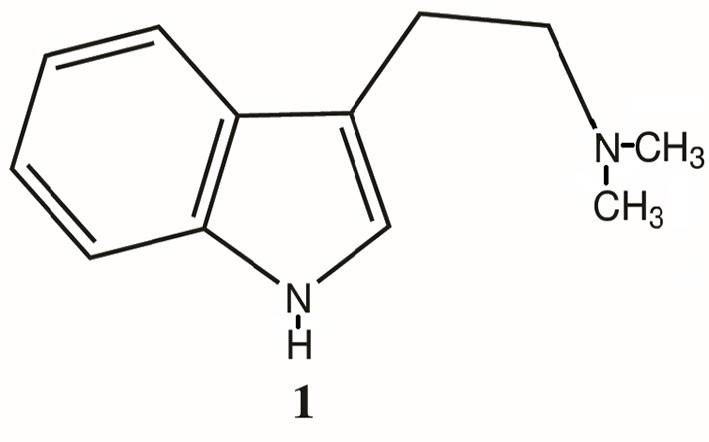
This report provides a historical overview of research concerning the endogenous hallucinogen N, N-dimethyltryptamine (DMT), focusing on data regarding its biosynthesis and metabolism in the brain and peripheral tissues, methods and results for DMT detection in body fluids and brain, new sites of action for DMT, and new data regarding its possible physiological and therapeutic roles. Research that further elaborates its consideration as a putative neurotransmitter is also addressed. Taking these studies together, the report proposes several new directions and experiments to ascertain the role of DMT in the brain, including brain mapping of enzymes responsible for the biosynthesis of DMT, further studies to elaborate its presence and role in the pineal gland, a reconsideration of binding site data, and new administration and imaging studies. The need to resolve the "natural" role of an endogenous hallucinogen from the effects observed from peripheral administration are also emphasized.
Overview
The claims and statistics of this paper haven’t been checked yet.
Run the check — free, no account needed. It reads the open-access text and checks the sources it cites.
Integrity signals
Registry
Cites
Statistics
Figures
Verification
Claims the paper makes
The claims and statistics of this paper haven’t been checked yet.
Run the check — free, no account needed. It reads the open-access text and checks the sources it cites.
Claims other papers make about this one
Each is checked against this paper’s own text: does it say what the citing paper says it does?
The cited source says what the claim attributes to it.
In the citing paper
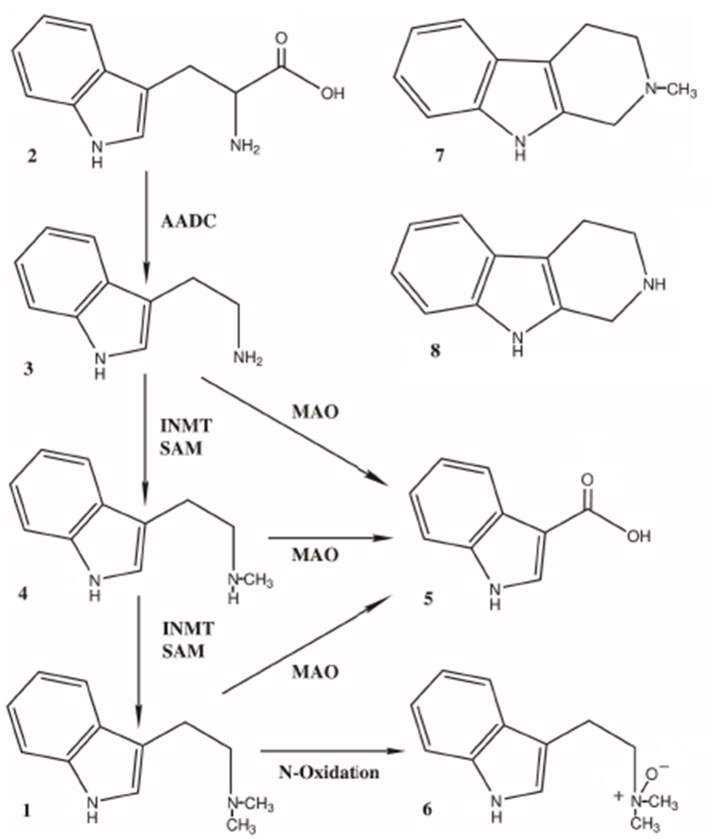
“The brain enzyme uses S-adenosylmethionine as a methyl donor for the successive formation of N-methyltryptamine and then DMT (9) [122].”
From Molecular and Functional Imaging Studies of Psychedelic Drug Action in Animals and Humans. (2021) · cites this paper as [122]
Self-check
Percentages, sums and reported differences re-computed from the paper’s own numbers.
The self-check needs the paper’s full text.
Citations
Cites
Antidepressant effects of ketamine in depressed patients
Berman, R. M., Cappiello, A., Anand, A., Oren, D. A., Heninger, G. R., Charney, D. S., & Krystal, J. H. (2000) · Biological Psychiatry · doi:10.1016/s0006-3223(99)00230-9 · Cited by 3,856
Nichols, D. E. (2016) · Pharmacological Reviews · doi:10.1124/pr.115.011478 · Cited by 1,762
Predicting new molecular targets for known drugs
Keiser, M. J., Setola, V., Irwin, J. J., Laggner, C., Abbas, A. I., Hufeisen, S. J., Jensen, N. H., Kuijer, M. B., Matos, R. C., Tran, T. B., et al. (2009) · Nature · doi:10.1038/nature08506 · Cited by 1,667
Nichols, D. E. (2004) · Pharmacology & Therapeutics · doi:10.1016/j.pharmthera.2003.11.002 · Cited by 1,211
Pilot Study of Psilocybin Treatment for Anxiety in Patients With Advanced-Stage Cancer
Grob, C. S., Danforth, A. L., Chopra, G. S., Hagerty, M., McKay, C. R., Halberstadt, A. L., & Greer, G. R. (2011) · Archives of General Psychiatry · doi:10.1001/archgenpsychiatry.2010.116 · Cited by 1,206
Neural correlates of the psychedelic state as determined by fMRI studies with psilocybin
Carhart-Harris, R. L., Erritzoe, D., Williams, T., Stone, J. M., Reed, L. J., Colasanti, A., Tyacke, R. J., Leech, R., Malizia, A. L., Murphy, K., et al. (2012) · Proceedings of the National Academy of Sciences · doi:10.1073/pnas.1119598109 · Cited by 1,172
Psilocybin-assisted treatment for alcohol dependence: A proof-of-concept study
Bogenschutz, M. P., Forcehimes, A. A., Pommy, J. A., Wilcox, C. E., Barbosa, P., & Strassman, R. J. (2015) · Journal of Psychopharmacology · doi:10.1177/0269881114565144 · Cited by 1,151
Functional Selectivity and Classical Concepts of Quantitative Pharmacology
Urban, J. D., Clarke, W. P., von Zastrow, M., Nichols, D. E., Kobilka, B. K., Weinstein, H., Javitch, J. A., Roth, B. L., Christopoulos, A., Sexton, P. M., et al. (2006) · Journal of Pharmacology and Experimental Therapeutics · doi:10.1124/jpet.106.104463 · Cited by 1,131
González-Maeso, J., Weisstaub, N. V., Zhou, M., Chan, P., Ivic, L., Ang, R., Lira, A., Bradley-Moore, M., Ge, Y., Zhou, Q., et al. (2007) · Neuron · doi:10.1016/j.neuron.2007.01.008 · Cited by 925
Neural correlates of the LSD experience revealed by multimodal neuroimaging
Carhart-Harris, R. L., Muthukumaraswamy, S., Roseman, L., Kaelen, M., Droog, W., Murphy, K., Tagliazucchi, E., Schenberg, E. E., Nest, T., Orban, C., et al. (2016) · Proceedings of the National Academy of Sciences · doi:10.1073/pnas.1518377113 · Cited by 859
Research works printed but not linked: 7
- Cozzi, 2011, Indolethylamine-N-methyltransferase expression in primate nervous tissue, Abstr. Soc. Neurosci., 37, 840
- Goncalves de Lima, 1946, Observacio es sobre o “vinho de Jurema” utilizado pelos indios Pancaru' de Tacaratu' (Pernambuco) [Observations on the “vinho de Jurema” used by the Pancaru' Indians of Tacaratu' (Pernambuco)], Ariquivos do Instituto de Pesquisas Agronomicas, 4, 45
- Lu, 1974, Correlation between brain N,N-dimethyltryptamine (DMT) levels and bar pressing behavior in rats: effect of MAO inhibition, Pharmacologist, 16, 237
- McKenna, 1998, The scientific investigation of ayahuasca: a review of past and current research, Heffter Rev. Psychedelic Res., 1, 65
- Mishor, 2011, Chapter 5: DMT and Human Consciousness, 85
- Shulgin, 1997, Tihkal: The Continuation
- Szára, 1961, Hallucinogenic effects and metabolism of tryptamine derivatives in man, Fed. Proc., 20, 885
Cited by
Sorted by citations
Davis, A. K., Clifton, J. M., Weaver, E. G., Hurwitz, E. S., Johnson, M. W., & Griffiths, R. R. (2020) · Journal of Psychopharmacology · doi:10.1177/0269881120916143 · Cited by 148
Yao, Y., Guo, D., Lu, T., Liu, F.-L., Huang, S., Diao, M.-Q., Li, S., Zhang, X.-J., Kosten, T. R., Shi, J., et al. (2024) · Psychiatry Research · doi:10.1016/j.psychres.2024.115886 · Cited by 162
Morales-Garcia, J. A., Calleja-Conde, J., Lopez-Moreno, J. A., Alonso-Gil, S., Sanz-SanCristobal, M., Riba, J., & Perez-Castillo, A. (2020) · Translational Psychiatry · doi:10.1038/s41398-020-01011-0 · Cited by 138
Subacute effects of the psychedelic ayahuasca on the salience and default mode networks
Pasquini, L., Palhano-Fontes, F., & de Araújo, D. B. (2020) · Journal of Psychopharmacology · doi:10.1177/0269881120909409 · Cited by 120
Brito-da-Costa, A. M., Dias-da-Silva, D., Gomes, N. G. M., Dinis-Oliveira, R. J., & Madureira-Carvalho, Á. (2020) · Pharmaceuticals · doi:10.3390/ph13110334 · Cited by 117
Metadata
- Authors
- Barker, S. A.
- Affiliations
- Louisiana State University (US)
- Corresponding author
- Barker, Steven A.
- ORCID
- Barker, Steven A.
- Venue
- Frontiers in Neuroscience
- Publisher
- Frontiers Media SA
- Published
- 2018-08-06
- Volume
- 12
- Pages
- 536-536
- ISSN
- 1662-453X (ISSN-L)
- PMC
- PMC6088236
- OpenAlex
- W2885412565
- Cited by
- 177
- References
- 135
- Citations by year
- 2026: 14 · 2025: 29 · 2024: 29 · 2023: 38 · 2022: 26 · 2021: 16 · 2020: 16 · 2019: 7 · 2018: 1
- FWCI
- 1.68
- Type
- journal article
- Language
- en
- Open access
- gold
- doi.org
- Locations
- Frontiers in Neuroscience (publishedVersion, cc-by)
- Europe PMC (PubMed Central) (publishedVersion, cc-by)
- PubMed Central (publishedVersion, cc-by)
- PubMed (publishedVersion)
- DOAJ (DOAJ: Directory of Open Access Journals) (submittedVersion)
- Topics
- Social Sciences › Psychology › Clinical Psychology › Psychedelics and Drug Studies
- Life Sciences › Neuroscience › Cellular and Molecular Neuroscience › Neurotransmitter Receptor Influence on Behavior
- Life Sciences › Neuroscience › Cognitive Neuroscience › Hallucinations in medical conditions
- Keywords
- N,N-dimethyltryptamine, DMT, pineal gland
About these checks
Registry, retraction, Cites and statistics results are computed, not judged, with one exception: a printed reference that no index lists is read once by a model before it counts as a citation error. Claims are extracted by a model and kept only when their quote appears verbatim in the text; each cited source is then checked, with a model’s help, for whether it says what the claim relies on. Those verdicts can be wrong — read the claim’s quote and the cited source before relying on one.
Statistics and arithmetic are recomputed, not judged.
Confidence bands are shown only for fields calibrated on our annotated test set. None is calibrated yet, so no band is shown.
What counts as a claim ›How we measure confidence ›How we check this ›
Are you an author, or do you see a problem with this page? Request a review
