

The DOI matches its Crossref record; 40 of the 40 references it cites were found in a registry or an index.
Qualitative and quantitative meta-analysis of acupuncture effects on the motor function of Parkinson's disease patients
Open accessAbstract
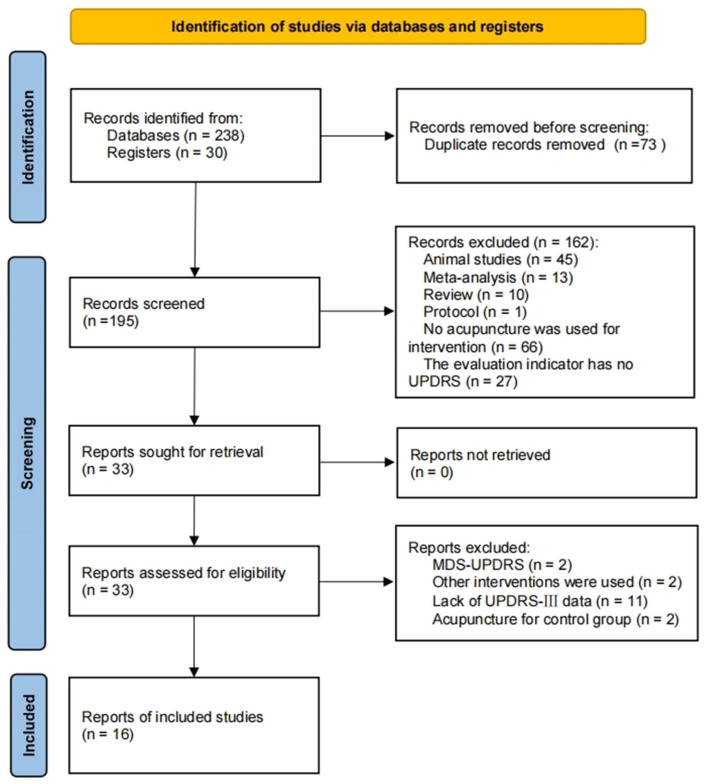
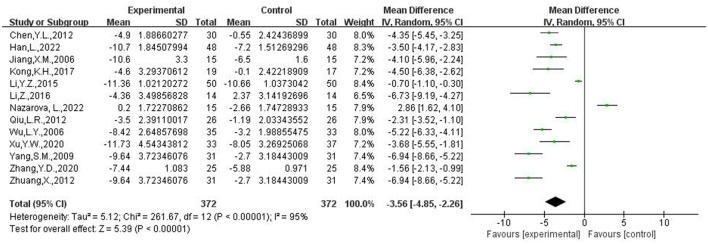
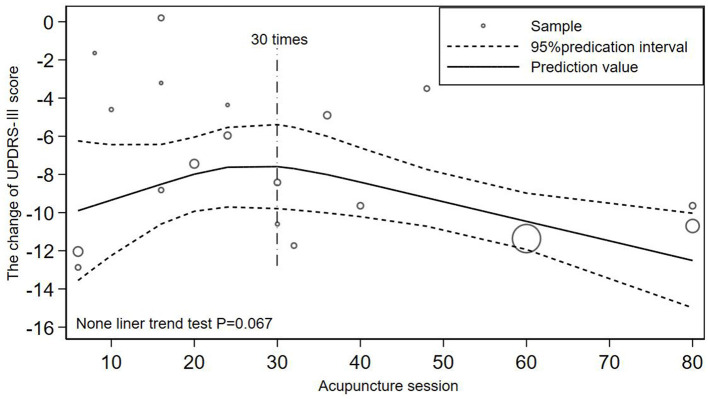
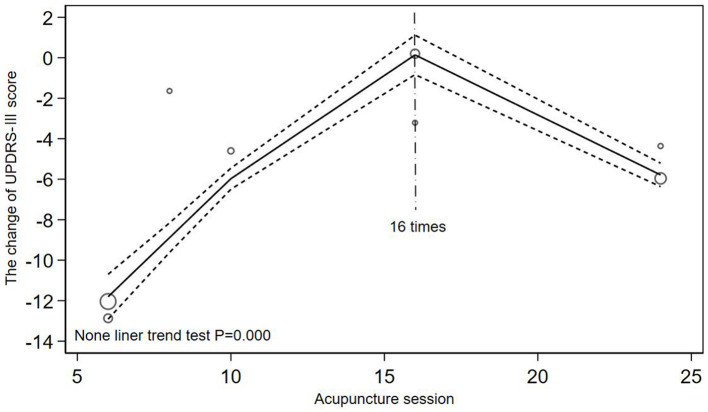
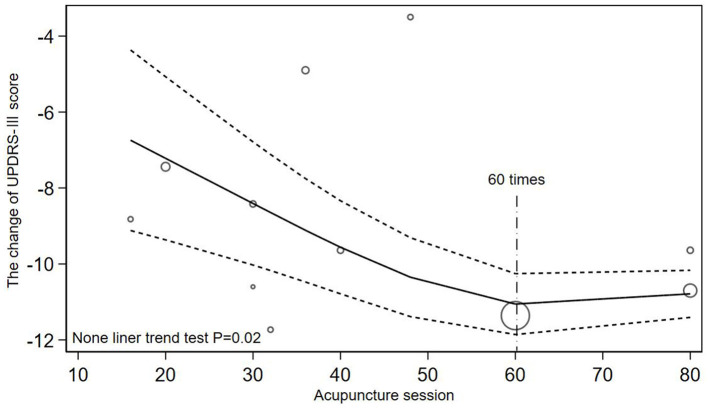
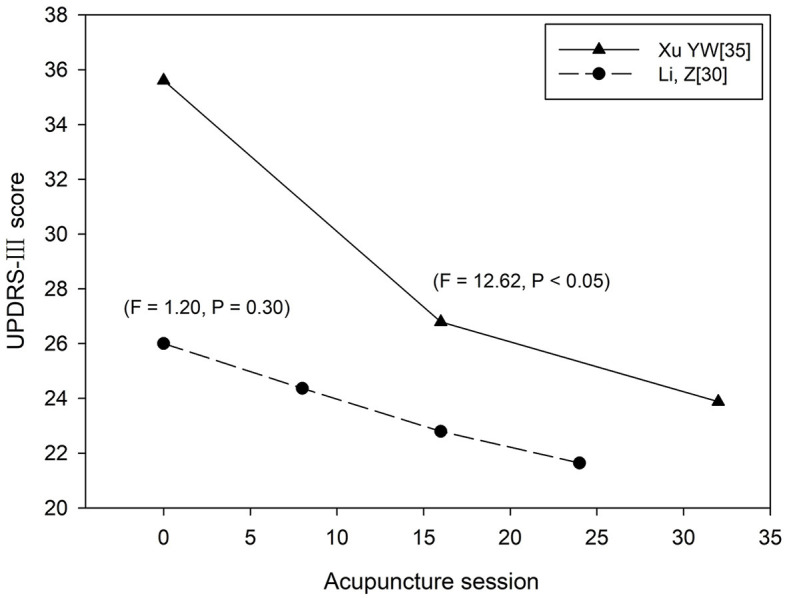
Objective: To explore the association between acupuncture sessions and its effects on the motor function of Parkinson's Disease (PD). Methods: Eight databases and two clinical trials registries were searched from inception to August 2022. Randomized controlled trials (RCTs) that compared acupuncture with sham acupuncture, or antiparkinsonian drugs, were included. After qualitative meta-analysis, a non-linear meta regression approach with restricted cubic spline was used to investigate the dose-response relationship between acupuncture sessions and their efficacy on the Unified Parkinson's Disease Rating Scale Part III (UPDRS-III) score. Subgroup meta-analysis was performed of the included studies according to the weekly acupuncture frequency. And finally, the included studies containing the determination of intermediate efficacy were compared. Results: Of the 268 citations screened, 16 studies (462 patients of PD) were included. The qualitative meta-analysis showed that the acupuncture group had better effect on UPDRS-III scores than the control group. And the quantitative meta-analysis suggested that acupuncture dose was correlated with the reduction of UPDRS-III score in PD patients with motor symptoms. In subgroup analysis, on the one hand, when the frequency of acupuncture was no more than 3 times a week, with the increase of acupuncture session, the changes of UPDRS-III score decreased and then increased ( P = 0.000). On the other hand, when acupuncture for more than 3 times a week and the dose of acupuncture treatment was <60 times, the changes of UPDRS-III score increased with the increase of acupuncture dose, but the score stopped to decrease if the dose continued to increase ( P = 0.020). The comparative analysis of two quantitative RCTs found that the score improvement was more significant at the higher weekly acupuncture frequency. Interpretation: This study found that when treating PD patients with motor symptoms, acupuncture treatment may need to reach a certain dose to obtain better therapeutic effect and excessive acupuncture stimulation may cause the body to develop a certain tolerance. However, the above results still need to be verified by more high-quality clinical studies. The protocol was registered on PROSPERO International Prospective Register of Systematic Reviews (CRD42022351428).
Overview
The claims and statistics of this paper haven’t been checked yet.
Run the check — free, no account needed. It reads the open-access text and checks the sources it cites.
Integrity signals
Registry
Cites
Statistics
Figures
Verification
Claims the paper makes
The claims and statistics of this paper haven’t been checked yet.
Run the check — free, no account needed. It reads the open-access text and checks the sources it cites.
Self-check
Percentages, sums and reported differences re-computed from the paper’s own numbers.
The self-check needs the paper’s full text.
Citations
Cites
1 retracted
Li, L., Jin, X., Cong, W., Du, T., & Zhang, W. (2022) · BioMed Research International · doi:10.1155/2022/7403627 · Cited by 14
RetractedPreferred Reporting Items for Systematic Reviews and Meta-Analyses: the PRISMA statement
Moher, D., Liberati, A., Tetzlaff, J., Altman, D. G., & for the PRISMA Group (2009) · BMJ · doi:10.1136/bmj.b2535 · Cited by 83,823
The Cochrane Collaboration's tool for assessing risk of bias in randomised trials
Higgins, J. P. T., Altman, D. G., Gotzsche, P. C., Juni, P., Moher, D., Oxman, A. D., Savovic, J., Schulz, K. F., Weeks, L., Sterne, J. A. C., et al. (2011) · BMJ · doi:10.1136/bmj.d5928 · Cited by 33,817
Dermyshi, E., Wang, Y., Yan, C., Hong, W., Qiu, G., Gong, X., & Zhang, T. (2017) · Neonatology · doi:10.1159/000454668 · Cited by 24,451
Goetz, C. G., Tilley, B. C., Shaftman, S. R., Stebbins, G. T., Fahn, S., Martinez‐Martin, P., Poewe, W., Sampaio, C., Stern, M. B., Dodel, R., et al. (2008) · Movement Disorders · doi:10.1002/mds.22340 · Cited by 7,536
Adams, J. L., Dinesh, K., Xiong, M., Tarolli, C. G., Sharma, S., Sheth, N., Aranyosi, A. J., Zhu, W., Goldenthal, S., Biglan, K. M., et al. (2017) · Digital Biomarkers · doi:10.1159/000479018 · Cited by 3,171
Dorsey, E. R., Elbaz, A., Nichols, E., Abbasi, N., Abd-Allah, F., Abdelalim, A., Adsuar, J. C., Ansha, M. G., Brayne, C., Choi, J.-Y. J., et al. (2018) · The Lancet Neurology · doi:10.1016/s1474-4422(18)30295-3 · Cited by 2,816
Litvan, I., Goldman, J. G., Tröster, A. I., Schmand, B. A., Weintraub, D., Petersen, R. C., Mollenhauer, B., Adler, C. H., Marder, K., Williams‐Gray, C. H., et al. (2012) · Movement Disorders · doi:10.1002/mds.24893 · Cited by 2,609
Inflammation in Parkinson’s Disease: Mechanisms and Therapeutic Implications
Pajares, M., I. Rojo, A., Manda, G., Boscá, L., & Cuadrado, A. (2020) · Cells · doi:10.3390/cells9071687 · Cited by 779
Spline Functions in Data Analysis
Wold, S. (1974) · Technometrics · doi:10.1080/00401706.1974.10489142 · Cited by 405
Research works printed but not linked: 16
- Li, 2015, Study of Scalp Acupuncture on Parkinson's Disease with the Chorea Trembling Control Area
- Li, 2016, Clinical Study of Acupuncture Paratherapy for Parkinson's Disease Tremor and its Underlying Neuromechanism Based on Functional Magnetic Resonance Imaging.
- Lin, 2016, Analysis on the influencing factors of acupuncture efficacy, Asia-Pacific Traditional Med., 12, 100
- Qiu, 2021, Clinical Study on Bushen Yangsui Acupuncture Therapy in Treatment of Parkinson's Disease with Mild Cognitive Impairment of Suihai Buzu Type.
- Wu, 2006, Clinical and Experimental Study on Treating Parkinson's Disease Mainly with the Therapy of Trembling-Three Needles.
- Xi, 2009, Acupuncture tolerance, Clin. J. Acupuncture Moxibustion, 25, 43
- Xu, 2021, The Observation of Qihuang Acupuncture Therapy in the Treatment of Parkinson's Disease: A Randomization Clinical Trial.
- Xuchang, 2015, How to perform dose-response meta-analysis: a brief introduction of methodology, Chin. J. Evidence-Based Med., 15, 1236
- Yang, 2020, The Observation of Qihuang Acupuncture Therapy in the Treatment of Parkinson' s Disease with Dyskinesia: A Randomization Clinical Trial.
- Yang, 2009, The Clinical Study of Using Tremor Three Needles in the Treatment of Parkinson's Disease.
- Yu, 2017, Chinese society of Parkinson's disease and movement disorders, Parkinson's disease and movement disorder section of neurologist branch of chinese medical doctor association, Chinese guidelines for the treatment of Parkinson′s disease (fourth edition), Chin. J. Neurol., 53, 973
- Zhang, 2021, Research progress on the relationship between acupuncture curative effect and acupuncture retention and interval time, J. Tianjin Univ. Traditional Chinese Med., 40, 666
- Zhang, 2018, Clinical observation of ordinary acupuncture plus Zhigou (TE6) and Zhaohai (KI6) for constipation due to yin deficiency in Parkinson's disease, Shanghai J. Acupuncture Moxibustion, 37, 165
- Zhang, 2020, Analysis of Rules of Acupoint Prescription for Acupuncture Treatment and Effect of Acupuncture of Zishui Hanmu Method plus Medoba on Parkinson's Disease.
- Zhou, 2020, Meta analysis of acupuncture in the treatment of pathogenic motor symptoms of Parkinson' s dis-ease, Global Traditional Chin. Med, 13, 326
- Zhuang, 2012, Clinical research on the treatment of Parkinson's disease with trembling three-needle, Chin. Med. Clinic. J., 24, 1162, 10.16448/j.cjtcm.2012.12.007 · DOI
Cited by
Pereira, C. R., Machado, J., Criado, B., Santos, R., Reis, A. M., Ramos, B., Santos, M. J., & Greten, H. J. (2025) · Clinical Parkinsonism & Related Disorders · doi:10.1016/j.prdoa.2025.100324 · Cited by 1
“Several studies demonstrated a correlation between acupuncture and a reduction in motor symptoms in PD [12], as well as improvements in non-motor symptoms including mood, sleep, depression, anxiety, and autonomic dysfunctions [13,14].”
Metadata
- Authors
- Lei, S., Fan, J., Liu, X., Xv, X., Zhang, J., Zhou, Z., & Zhuang, L.
- Affiliations
- Guangzhou University of Chinese Medicine (CN)
- First Affiliated Hospital of Guangzhou University of Chinese Medicine (CN)
- Corresponding author
- Zhuang, Lixing
- Venue
- Frontiers in Neuroscience
- Publisher
- Frontiers Media SA
- Published
- 2023-05-09
- Volume
- 17
- Pages
- 1125626-1125626
- ISSN
- 1662-453X (ISSN-L)
- PMC
- PMC10203172
- OpenAlex
- W4378348810
- Cited by
- 21
- References
- 40
- Citations by year
- 2026: 5 · 2025: 10 · 2024: 5 · 2023: 1
- FWCI
- 1.23
- Type
- journal article
- Language
- en
- Open access
- gold
- doi.org
- Licence
- Locations
- Frontiers in Neuroscience (publishedVersion, cc-by)
- PubMed Central (publishedVersion, cc-by)
- PubMed (publishedVersion)
- DOAJ (DOAJ: Directory of Open Access Journals) (submittedVersion, cc-by-sa)
- Funders
- National Natural Science Foundation of China
- Topics
- Health Sciences › Medicine › Complementary and alternative medicine › Acupuncture Treatment Research Studies
- Health Sciences › Medicine › Clinical Neurology › Parkinson's Disease Mechanisms and Treatments
- Health Sciences › Medicine › Complementary and alternative medicine › Traditional Chinese Medicine Studies
- Keywords
- acupuncture, Parkinson's disease, motor function, UPDRS-III, dose-response relationship, acupuncture frequency, sham acupuncture, antiparkinsonian drugs, treatment tolerance
About these checks
Registry, retraction, Cites and statistics results are computed, not judged, with one exception: a printed reference that no index lists is read once by a model before it counts as a citation error. Claims are extracted by a model and kept only when their quote appears verbatim in the text; each cited source is then checked, with a model’s help, for whether it says what the claim relies on. Those verdicts can be wrong — read the claim’s quote and the cited source before relying on one.
Statistics and arithmetic are recomputed, not judged.
Confidence bands are shown only for fields calibrated on our annotated test set. None is calibrated yet, so no band is shown.
What counts as a claim ›How we measure confidence ›How we check this ›
Are you an author, or do you see a problem with this page? Request a review
Data sources
Bibliographic data: Semantic Scholar, OpenAlex, Crossref.
Contains information from the Semantic Scholar Academic Graph Datasets, made available under the ODC Attribution License (ODC-BY 1.0).
Semantic Scholar’s data is described in: Kinney, R., et al. (2023). The Semantic Scholar Open Data Platform. arXiv:2301.10140.
