

The DOI matches its Crossref record; 34 of the 34 references it cites were found in a registry or an index.
Feasibility of Bioimpedance Analysis to Assess the Outcome of Complex Decongestive Therapy in Cancer Treatment-Related Lymphedema
Open accessAbstract
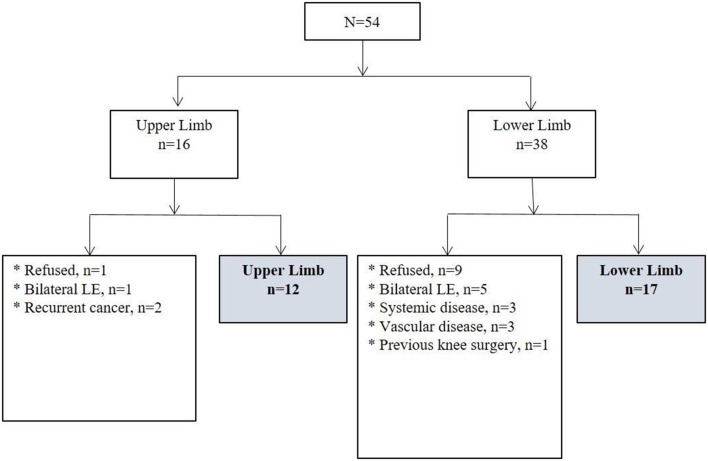
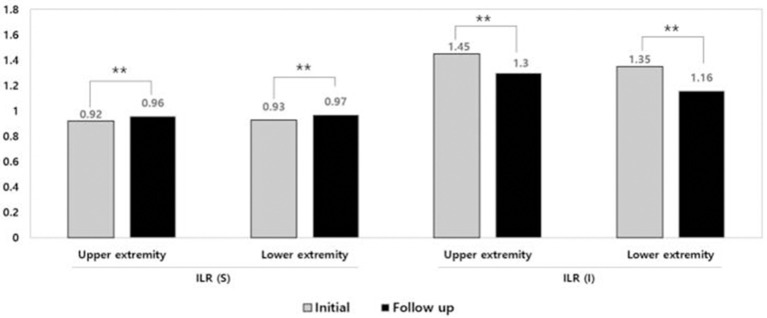
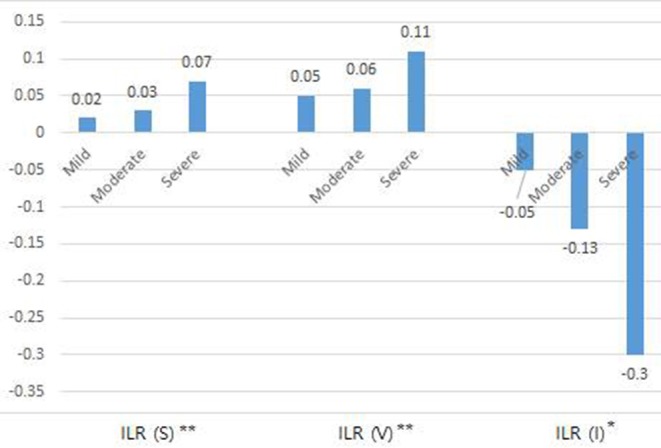
Background: Cancer treatment-related lymphedema (CTRL) affects patients physically, psychologically and emotionally, and remains a significant quality of life issue among patients with cancer. Reliable methods to measure changes in lymphedema are required for early detection, acute intensive treatment, and long-term management. Here, we evaluated the use of bioimpedance analysis (BIA) as a tool to measure lymphedema before and after treatment. Patients and Methods: Patients with CTRL who were admitted to a secondary university hospital between October 2017 and July 2018 for complex decongestive therapy (CDT) were eligible for this prospective cohort study. Circumferential measure (CM) and BIA were used to evaluate lymphedema at admission (initial) and before discharge (follow-up, FU). Volume was calculated from the CM using the truncated cone formula. The inter-limb ratios (ILRs) of the circumference, volume, and impedance were also calculated as the unaffected limb to affected limb. Each parameter before and after treatment and correlations between parameters also were analyzed. Results: A total of 29 patients (12 upper- and 17 lower-extremity CTRL) completed were included in this analysis. Absolute value and the ILRs of circumference, volume or impedance, and extracellular water/total body water (ECW/TBW) were significantly improved at FU (p<0.01, p<0.05). The initial and FU absolute values, ILRs, ECW/TBW correlated significantly with each other (p<0.01, p<0.05). The cutoff values of ECW/TBW for moderate and severe degree of CTRL were 0.3855 and 0.3955, respectively. The changes of ILRs between initial and FU assessments were significantly different among three groups according to lymphedema severity (p<0.01, p<0.05). Conclusions: BIA data correlates significantly with clinical measurement, and therefore can be a practical tool in monitoring outcome measure after lymphedema treatment. In addition, BIA is more sensitive to subtle changes in lymphedema, and therefore can be useful for the long-term maintenance of lymphedema.
Overview
The claims and statistics of this paper haven’t been checked yet.
Run the check — free, no account needed. It reads the open-access text and checks the sources it cites.
Integrity signals
Registry
Cites
Statistics
Figures
Verification
Claims the paper makes
The claims and statistics of this paper haven’t been checked yet.
Run the check — free, no account needed. It reads the open-access text and checks the sources it cites.
Claims other papers make about this one
Each is checked against this paper’s own text: does it say what the citing paper says it does?
The source backs part of the claim, not all of it — or backs it for a different population, condition or comparison.
In the citing paper
“Lymphedema is another condition most commonly observed during the treatment of cancer [36]; however, increasing evidence has shown the potential link between lymphedema and obesity [37].”
From The Utility of Body Composition Assessment in Nutrition and Clinical Practice: An Overview of Current Methodology (2021) · cites this paper as [36]
Experimental — accuracy not yet measuredThe cited source says what the claim attributes to it.
In the citing paper
“Due to the swelling located in the limbs of patients with lymphedema, segmental bioelectrical impedance analysis (BIA) has demonstrated significant relationships with clinical measurements and can be used as a practical tool for monitoring individuals during treatment [36,38].”
From The Utility of Body Composition Assessment in Nutrition and Clinical Practice: An Overview of Current Methodology (2021) · cites this paper as [36]
Self-check
Percentages, sums and reported differences re-computed from the paper’s own numbers.
The self-check needs the paper’s full text.
Citations
Cites
Regulation of Cell Volume in Health and Disease
McManus, M. L., Churchwell, K. B., & Strange, K. B. (1995) · New England Journal of Medicine · doi:10.1056/nejm199511093331906 · Cited by 455
Lymphedema in Breast Cancer Survivors: Incidence, Degree, Time Course, Treatment, and Symptoms
Norman, S. A., Localio, A. R., Potashnik, S. L., Torpey, H. A. S., Kallan, M. J., Weber, A. L., Miller, L. T., DeMichele, A. M., & Solin, L. J. (2008) · Journal of Clinical Oncology · doi:10.1200/jco.2008.17.9291 · Cited by 380
Lymphedema following breast cancer treatment and impact on quality of life: A review
Taghian, N. R., Miller, C. L., Jammallo, L. S., O’Toole, J., & Skolny, M. N. (2014) · Critical Reviews in Oncology/Hematology · doi:10.1016/j.critrevonc.2014.06.004 · Cited by 333
Early diagnosis of lymphedema using multiple frequency bioimpedance.
Cornish, B., Chapman, M., Hirst, C., Mirolo, B. R., Bunce, I., Ward, L. C., & Thomas, B. J. (2001) · PubMed · Cited by 312
Obesity is a Risk Factor for Developing Postoperative Lymphedema in Breast Cancer Patients
Helyer, L. K., Varnic, M., Le, L. W., Leong, W. L., & McCready, D. R. (2009) · The Breast Journal · doi:10.1111/j.1524-4741.2009.00855.x · Cited by 289
McNeely, M. L., Magee, D. J., LEES, A. W., Bagnall, K. M., Haykowsky, M. J., & Hanson, J. (2004) · Breast Cancer Research and Treatment · doi:10.1023/b:brea.0000032978.67677.9f · Cited by 277
Incidence and risk factors of lymphedema after breast cancer treatment: 10 years of follow-up
Pereira, A. C. P. R., Koifman, R. J., & Bergmann, A. K. (2017) · The Breast · doi:10.1016/j.breast.2017.09.006 · Cited by 253
Brennan, M. J., & Miller, L. T. (1998) · Cancer · doi:10.1002/(sici)1097-0142(19981215)83:12b+ · Cited by 244
Pusic, A. L., Cemal, Y., Albornoz, C. R., Klassen, A. F., Cano, S., Sulimanoff, I., Hernandez, M., Massey, M. F., Cordeiro, P. G., Morrow, M., et al. (2012) · Journal of Cancer Survivorship · doi:10.1007/s11764-012-0247-5 · Cited by 240
Deltombe, T., Jamart, J., Recloux, S., Legrand, C., Vandenbroeck, N., Theys, S., & Hanson, P. (2007) · PubMed · Cited by 221
Research works printed but not linked: 2
- Petit, 2006, First randomised study in 25 years demonstrating an improvement in global survival for metastatic cancers of the uterine cervix, Bull Du Cancer., 93, 250
- Functionality and quality of life of patients with unilateral lymphedema of a lower limb: a cross-sectional studye20180066 PedrosaBCS MaiaJN FerreiraAPL De AraujoM MontenegroEJN Da SilvaFL 10.1590/1677-5449.00661831320877J Vasc Bras.182019 · DOI
Cited by
Sorted by citations
Holmes, C. J., & Racette, S. B. (2021) · Nutrients · doi:10.3390/nu13082493 · Cited by 473
Ge, Y., Ruan, G., Zhang, Q., Dong, W., Zhang, X., Song, M., Zhang, X., Li, X.-R., Zhang, K., Tang, M., et al. (2022) · Nutrition & Metabolism · doi:10.1186/s12986-022-00667-3 · Cited by 33
Martins, A., Oliveira, R., Brito, J., Costa, T., Ramalho, F., Pimenta, N., & Santos-Rocha, R. (2021) · Physiology and Behavior · doi:10.1016/j.physbeh.2021.113400 · Cited by 25
Low, S. K., Ng, T. P., Lim, C. L., Ang, S. F., Moh, A. M. C., Wang, J., Yap, P. L. K., Cheong, C. Y., Goh, K. S., Ang, K., et al. (2020) · Journal of Diabetes · doi:10.1111/1753-0407.13104 · Cited by 29
Fluid Shifts Induced by Physical Therapy in Lower Limb Lymphedema Patients
Brix, B., Apich, G., Roessler, A., Ure, C., Schmid-Zalaudek, K., Hinghofer-Szalkay, H., & Goswami, N. (2020) · Journal of Clinical Medicine · doi:10.3390/jcm9113678 · Cited by 21
Metadata
- Authors
- Cho, K. H., Han, E. Y., Lee, S. A., Park, H., Lee, C., & IM, S. H.
- Affiliations
- CHA University (KR)
- Jeju National University (KR)
- CHA University Bundang Medical Center (KR)
- Yonsei University (KR)
- Corresponding author
- IM, Sang Hee
- Venue
- Frontiers in Oncology
- Publisher
- Frontiers Media SA
- Published
- 2020-02-11
- Volume
- 10
- Pages
- 111-111
- ISSN
- 2234-943X (ISSN-L)
- PMC
- PMC7026363
- OpenAlex
- W3005738269
- Cited by
- 29
- References
- 34
- Citations by year
- 2026: 1 · 2025: 3 · 2024: 2 · 2023: 4 · 2022: 9 · 2021: 7 · 2020: 3
- FWCI
- 2.08
- Type
- journal article
- Language
- en
- Open access
- gold
- doi.org
- Licence
- Locations
- Frontiers in Oncology (publishedVersion, cc-by)
- PubMed Central (publishedVersion, cc-by)
- PubMed (publishedVersion)
- DOAJ (DOAJ: Directory of Open Access Journals) (submittedVersion, cc-by-sa)
- YUHSpace (Yonsei University Medical Library) (submittedVersion, cc-by-nc-nd)
- Funders
- National Research Foundation
- Topics
- Health Sciences › Medicine › Oncology › Lymphatic System and Diseases
- Health Sciences › Medicine › Oncology › Cancer survivorship and care
- Health Sciences › Medicine › Surgery › Lymphatic Disorders and Treatments
- Keywords
- bioelectrical impedance analysis, complex decongestive therapy, extracellular water to total body water ratio, lymphedema severity, lower limb lymphedema, upper limb lymphedema
About these checks
Registry, retraction, Cites and statistics results are computed, not judged, with one exception: a printed reference that no index lists is read once by a model before it counts as a citation error. Claims are extracted by a model and kept only when their quote appears verbatim in the text; each cited source is then checked, with a model’s help, for whether it says what the claim relies on. Those verdicts can be wrong — read the claim’s quote and the cited source before relying on one.
Statistics and arithmetic are recomputed, not judged.
Confidence bands are shown only for fields calibrated on our annotated test set. None is calibrated yet, so no band is shown.
What counts as a claim ›How we measure confidence ›How we check this ›
Are you an author, or do you see a problem with this page? Request a review
