

The DOI matches its Crossref record; 3 of the 3 references it cites were found in a registry or an index.
Causality Evaluation of Drug-Induced Liver Injury in Newborns and Children in the Intensive Care Unit Using the Updated Roussel Uclaf Causality Assessment Method
Abstract
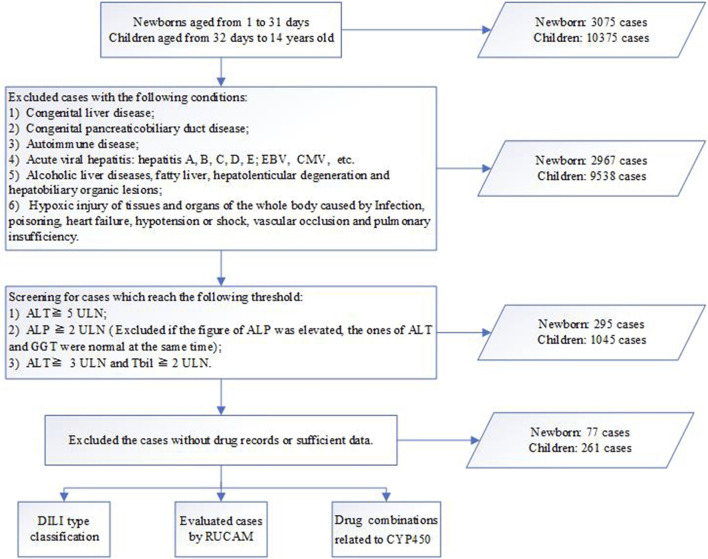
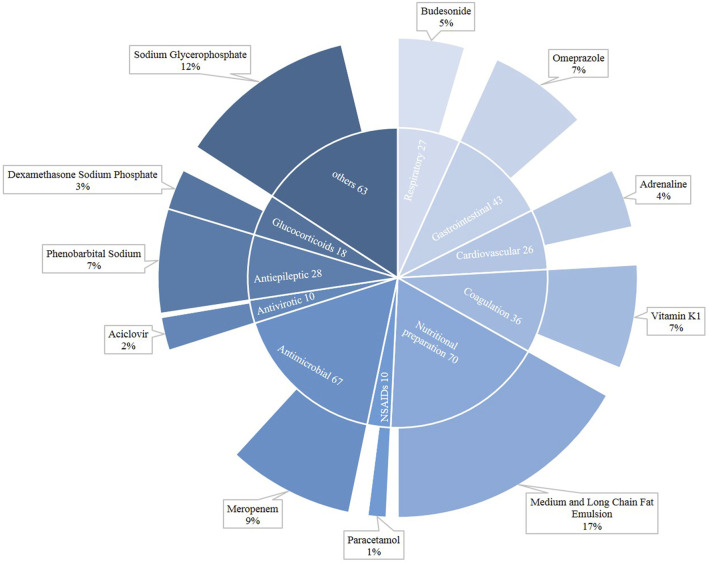
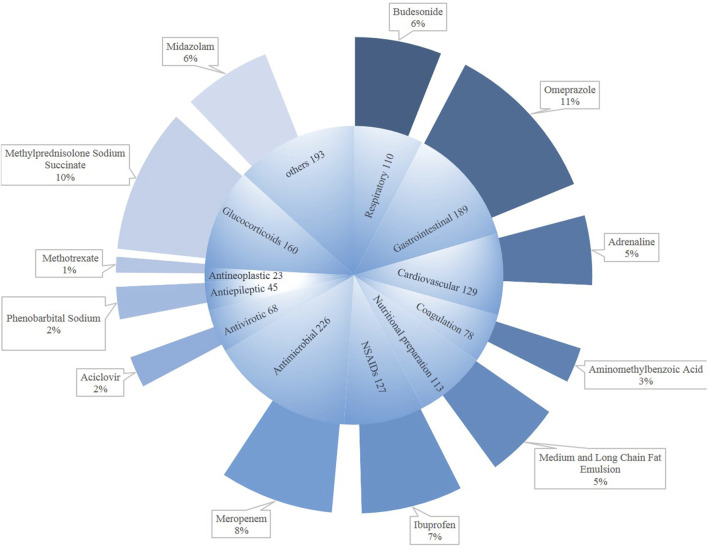
Purpose: Drug-induced liver injury (DILI) is a common adverse reaction in the clinic; however, there are relatively few reports of DILI in critically ill newborns and children. Making use of the Pediatric Intensive Care database (PIC), this study identifies which drugs are related to DILI in neonates and children in China. Methods: Using the PIC, we screened for patients whose liver was suspected of being injured by drugs during hospitalization. The medicine they used was then assessed by the Roussel Uclaf Causality Assessment Method (RUCAM). At the same time, we also collated drug combinations that may affect CYP (Cytochrome P) enzyme metabolism, which may cause DILI. Results: A total of 13,449 patients were assessed, of whom 77 newborns and 261 children were finally included. The main type of liver injury in neonates was mixed (83.1%), while the hepatic injury types of children were mostly distributed between hepatocellular (59.4%) and cholestatic (28.4%). In terms of the RUCAM assessment, the drugs that were most considered to cause or be associated with hepatic injury in newborns were medium and long chain fat emulsions (17%), sodium glycerophosphate (12%), and meropenem (9%); while omeprazole (11%), methylprednisolone sodium succinate (10%), and meropenem (8%) were the primary culprits of DILI in children. Drug combinations frequently seen in neonates that may affect CYP enzyme metabolism are omeprazole + budesonide (16.9%), dexamethasone + midazolam (10.4%), and midazolam + sildenafil (10.4%). In children, the commonly used drug combinations are fentanyl + midazolam (20.7%), ibuprofen + furosemide (18.4%), and diazepam + omeprazole (15.3%). Conclusions: In this study, medium and long chain fat emulsions and sodium glycerophosphate have been strongly associated with DILI in newborns, while omeprazole and methylprednisolone sodium succinate play an important role in the DILI of children. Also, attention should be paid to the effect on CYP enzymes when using multiple drugs at the same time. In future DILI cases, it is advisable to use the latest RUCAM for prospective study design so that complete case data and high RUCAM scores can be collected.
Overview
The claims and statistics of this paper haven’t been checked yet.
Run the check — free, no account needed. It reads the open-access text and checks the sources it cites.
Integrity signals
Registry
Cites
Statistics
Figures
Verification
Claims the paper makes
The claims and statistics of this paper haven’t been checked yet.
Run the check — free, no account needed. It reads the open-access text and checks the sources it cites.
Claims other papers make about this one
Each is checked against this paper’s own text: does it say what the citing paper says it does?
In the citing paper
“However, the scientifically valid information on which prescriptions for children are currently based is very scarce. In many cases, the information used is that available for the adult population, since clinical trials in children are difficult to perform [4,5].”
From Metabolomic Analysis of Pediatric Patients with Idiosyncratic Drug-Induced Liver Injury According to the Updated RUCAM (2023) · cites this paper as [5]
Self-check
Percentages, sums and reported differences re-computed from the paper’s own numbers.
The self-check needs the paper’s full text.
Citations
Cites
Björnsson, E. S., Bergmann, O. M., Björnsson, H. K., Kvaran, R. B., & Olafsson, S. (2013) · Gastroenterology · doi:10.1053/j.gastro.2013.02.006 · Cited by 865
Incidence and Etiology of Drug-Induced Liver Injury in Mainland China
Shen, T., Liu, Y., Shang, J., Xie, Q., Li, J., Yan, M., Xu, J., Niu, J., Liu, J., Watkins, P. B., et al. (2019) · Gastroenterology · doi:10.1053/j.gastro.2019.02.002 · Cited by 615
Self-citationChildren versus adults: pharmacokinetic and adverse-effect differences
Anderson, G. D. (2002) · Epilepsia · doi:10.1046/j.1528-1157.43.s.3.5.x · Cited by 187 · cited 1×
“As a consequence of the incomplete maturity of such vital functions at birth, neonates show significant differences in absorption, distribution, metabolism, and excretion, compared to adults (Anderson, 2002).”
Background
Research works printed but not linked: 25
- Chalasani, 2015, Features and Outcomes of 899 Patients with Drug-Induced Liver Injury: The DILIN Prospective Study, Gastroenterology, 148, 10.1053/j.gastro.2015.03.006 · DOI · Paper page
- Coen, 2015, Metabolic Phenotyping Applied to Pre-clinical and Clinical Studies of Acetaminophen Metabolism and Hepatotoxicity, Drug Metab. Rev., 47, 29, 10.3109/03602532.2014.982865 · DOI
- Danan, 1993, Causality Assessment of Adverse Reactions to Drugs--I. A Novel Method Based on the Conclusions of International Consensus Meetings: Application to Drug-Induced Liver Injuries, J. Clin. Epidemiol., 46, 1323, 10.1016/0895-4356(93)90101-6 · DOI · Paper page
- Danan, 2015, RUCAM in Drug and Herb Induced Liver Injury: The Update, Int. J. Mol. Sci., 17, 14, 10.3390/ijms17010014 · DOI · Paper page
- De Gregori, 2009, Drug Transporters and Renal Drug Disposition in the Newborn. The Journal of Maternal-Fetal & Neonatal Medicine : the Official Journal of the European Association of Perinatal Medicine, the Federation of Asia and Oceania Perinatal Societies, the Int. Soc. Perinatal Obstetricians, 22, 31, 10.1080/14767050903184470 · DOI
- DiPaola, 2019, Antimicrobials and Antiepileptics Are the Leading Causes of Idiosyncratic Drug-Induced Liver Injury in American Children, J. Pediatr. Gastroenterol. Nutr., 69, 152, 10.1097/MPG.0000000000002383 · DOI · Paper page
- Faa, 2012, A Developmental Approach to Drug-Induced Liver Injury in Newborns and Children, Curr. Med. Chem., 19, 4581, 10.2174/092986712803306385 · DOI
- Ferrajolo, 2010, Drug-induced Hepatic Injury in Children: a Case/non-Case Study of Suspected Adverse Drug Reactions in VigiBase, Br. J. Clin. Pharmacol., 70, 721, 10.1111/j.1365-2125.2010.03754.x · DOI
- Hines, 2013, Developmental Expression of Drug Metabolizing Enzymes: Impact on Disposition in Neonates and Young Children, Int. J. pharmaceutics, 452, 3, 10.1016/j.ijpharm.2012.05.079 · DOI
- Hines, 2008, The Ontogeny of Drug Metabolism Enzymes and Implications for Adverse Drug Events, Pharmacol. Ther., 118, 250, 10.1016/j.pharmthera.2008.02.005 · DOI
- Kang, 2020, Evaluation of Drug-Induced Liver Injury Developed during Hospitalization Using Electronic Health Record (EHR)-Based Algorithm, Allergy Asthma Immunol. Res., 12, 430, 10.4168/aair.2020.12.3.430 · DOI
- Kraus, 1993, Alterations in Theophylline Metabolism during the First Year of Life, Clin. Pharmacol. Ther., 54, 351, 10.1038/clpt.1993.160 · DOI
- Liu, 2009, Recent Advances in Metabolism-Based Drug-Drug Interactions, J. Zhejiang University(Medical Sciences), 38, 215, 10.3785/j.issn.1008-9292.2009.02.017 · DOI
- Lucena, 2020, Drug-induced Liver Injury in Older People. The Lancet, Gastroenterol. Hepatol., 5, 862, 10.1016/S2468-1253(20)30006-6 · DOI · Paper page
- Magnusson, 1995, Serum Osteocalcin and Bone and Liver Alkaline Phosphatase Isoforms in Healthy Children and Adolescents, Pediatr. Res., 38, 955, 10.1203/00006450-199512000-00021 · DOI
- Matalová, 2016, Specific Features of Pharmacokinetics in Children, Drug Metab. Rev., 48, 70, 10.3109/03602532.2015.1135941 · DOI
- Morselli, 1976, Clincial Pharmacokinetics in Neonates, Clin. Pharmacokinet., 1, 81, 10.2165/00003088-197601020-00001 · DOI
- Ocete-Hita, 2017, Analysis of Immunogenetic Factors in Idiosyncratic Drug-Induced Liver Injury in the Pediatric Population, J. Pediatr. Gastroenterol. Nutr., 64, 742, 10.1097/MPG.0000000000001502 · DOI
- Teschke, 2021, Idiosyncratic Drug Induced Liver Injury, Cytochrome P450, Metabolic Risk Factors and Lipophilicity: Highlights and Controversies, Int. J. Mol. Sci., 22, 458, 10.3390/ijms22073441 · DOI
- Teschke, 2018, Top-ranking Drugs Out of 3312 Drug-Induced Liver Injury Cases Evaluated by the Roussel Uclaf Causality Assessment Method, Expert Opin. Drug Metab. Toxicol., 14, 1169, 10.1080/17425255.2018.1539077 · DOI · Paper page
- Vuppalanchi, 2007, Etiology of New-Onset Jaundice: How Often Is it Caused by Idiosyncratic Drug-Induced Liver Injury in the United States?, Am. J. Gastroenterol., 102, 558, 10.1111/j.1572-0241.2006.01019.x · DOI
- Wrighton, 1992, The Human Hepatic Cytochromes P450 Involved in Drug Metabolism, Crit. Rev. Toxicol., 22, 1, 10.3109/10408449209145319 · DOI
- Zanger, 2013, Cytochrome P450 Enzymes in Drug Metabolism: Regulation of Gene Expression, Enzyme Activities, and Impact of Genetic Variation, Pharmacol. Ther., 138, 103, 10.1016/j.pharmthera.2012.12.007 · DOI · Paper page
- Zhang, Research advance of Drug-Induced Liver Injury in Children, Infect. Dis. Inf., 32, 269, 10.3969/j.issn.1007-8134.2019.03.019 · DOI
- Zhang, Drug Induced Liver Injury in Children: An Analysis of Medication and Clinical Features, J. Clin. Hepatol., 35, 579, 10.3969/j.issn.1001-5256.2019.03.025 · DOI
Cited by
Sorted by citations
Andújar-Vera, F., Alés-Palmer, M. L., Muñoz-de-Rueda, P., Iglesias-Baena, I., & Ocete-Hita, E. (2023) · International Journal of Molecular Sciences · doi:10.3390/ijms241713562 · Cited by 10
Metadata
- Authors
- Ye, L., Feng, Z., Huang, L., Guo, C., Wu, X., He, L., Tan, W., Wang, Y., Wu, X., Hu, B., Li, T., Yang, G., Chengxian, G., & He, Q.
- Venue
- Frontiers in Pharmacology
- Publisher
- Frontiers Media SA
- Published
- 2021-12-20
- Volume
- 12
- ISSN
- 1663-9812
- PMC
- PMC8721278
- Cited by
- 15
- References
- 3
About these checks
Registry, retraction, Cites and statistics results are computed, not judged, with one exception: a printed reference that no index lists is read once by a model before it counts as a citation error. Claims are extracted by a model and kept only when their quote appears verbatim in the text; each cited source is then checked, with a model’s help, for whether it says what the claim relies on. Those verdicts can be wrong — read the claim’s quote and the cited source before relying on one.
Statistics and arithmetic are recomputed, not judged.
Confidence bands are shown only for fields calibrated on our annotated test set. None is calibrated yet, so no band is shown.
What counts as a claim ›How we measure confidence ›How we check this ›
Are you an author, or do you see a problem with this page? Request a review
