

The DOI matches its Crossref record; 59 of the 59 references it cites were found in a registry or an index.
Simultaneous Improvement and Genetic Dissection of Salt Tolerance of Rice (Oryza sativa L.) by Designed QTL Pyramiding
Open accessAbstract
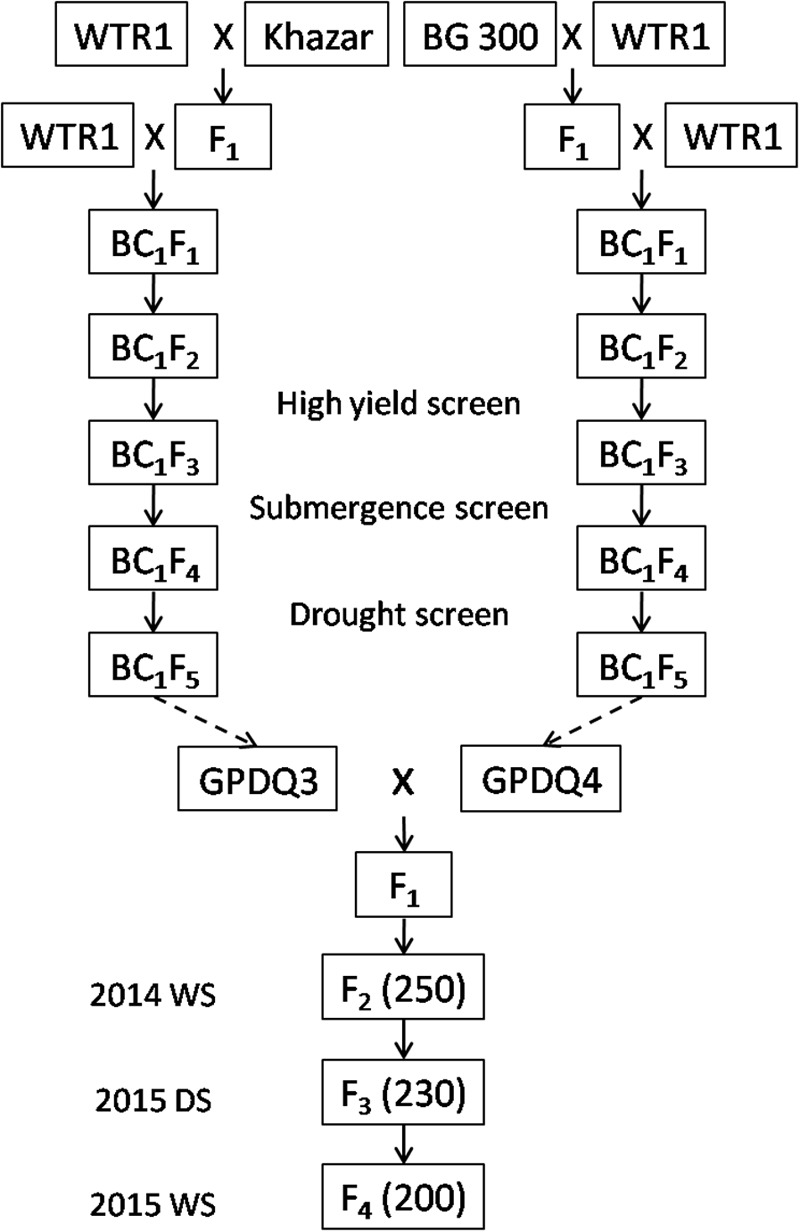
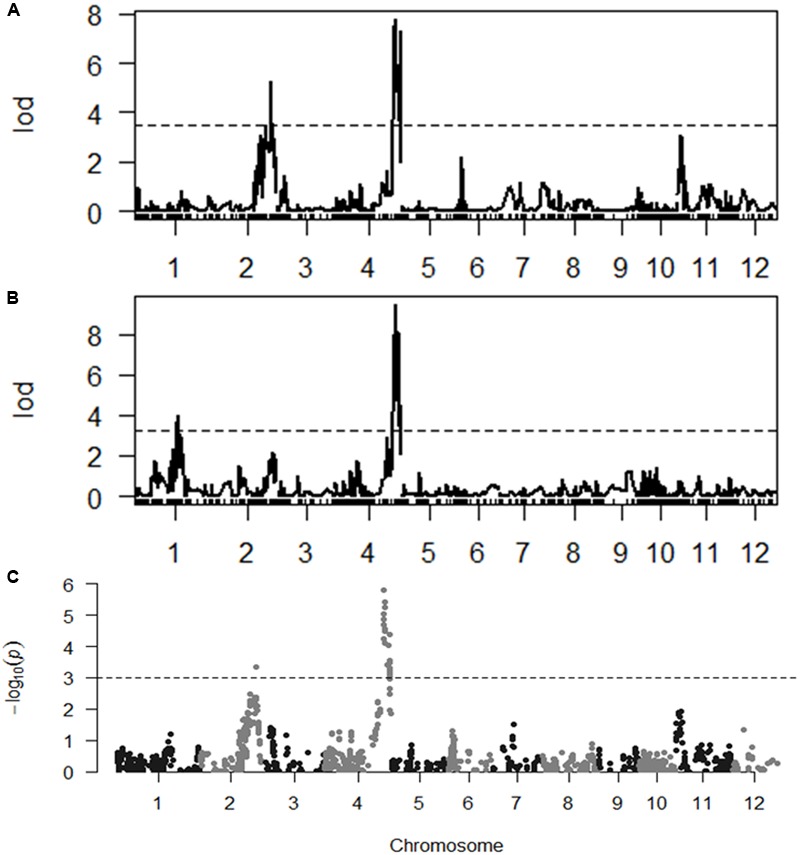
Breeding of multi-stress tolerant rice varieties with higher grain yields is the best option to enhance the rice productivity of abiotic stresses prone areas. It also poses the greatest challenge to plant breeders to breed rice varieties for such stress prone conditions. Here, we carried out a designed QTL pyramiding experiment to develop high yielding “Green Super Rice” varieties with significantly improved tolerance to salt stress and grain yield. Using the F4 population derived from a cross between two selected introgression lines, we were able to develop six mostly homozygous promising high yielding lines with significantly improved salt tolerance and grain yield under optimal and/or saline conditions in three years. Simultaneous mapping using the same breeding population and tunable genotyping-by-sequencing technology, we identified three QTL affecting salt injury score and leaf chlorophyll content. By analyzing 32M SNP data of the grandparents and graphical genotypes of the parents, we discovered 87 positional candidate genes for salt tolerant QTL. According to their functional annotation, we inferred the most likely candidate genes. We demonstrated that designed QTL pyramiding is a powerful strategy for simultaneous improvement and genetic dissection of complex traits in rice.
Overview
The claims and statistics of this paper haven’t been checked yet.
Run the check — free, no account needed. It reads the open-access text and checks the sources it cites.
Integrity signals
Registry
Cites
Statistics
Figures
Verification
Claims the paper makes
The claims and statistics of this paper haven’t been checked yet.
Run the check — free, no account needed. It reads the open-access text and checks the sources it cites.
Claims other papers make about this one
Each is checked against this paper’s own text: does it say what the citing paper says it does?
The source backs part of the claim, not all of it — or backs it for a different population, condition or comparison.
In the citing paper
“The pyramiding of genes associated with drought tolerance, salinity resistance, and nutrient acquisition has enhanced the overall resilience of crops like rice and maize (Pang et al., 2017; Shailani et al., 2020).”
From Emerging applications of gene editing technologies for the development of climate-resilient crops (2025) · cites this paper as Pang et al., 2017
Experimental — accuracy not yet measured
Self-check
Percentages, sums and reported differences re-computed from the paper’s own numbers.
The self-check needs the paper’s full text.
Citations
Cites
Mechanisms of Salinity Tolerance
Munns, R., & Tester, M. (2008) · Annual Review of Plant Biology · doi:10.1146/annurev.arplant.59.032607.092911 · Cited by 13,792
R/qtl: QTL mapping in experimental crosses
Broman, K. W., Wu, H., Sen, Ś., & Churchill, G. A. (2003) · Bioinformatics · doi:10.1093/bioinformatics/btg112 · Cited by 3,481
Laboratory manual for physiological studies of rice
Yoshida, S., Forno, D. A., & Cock, J. H. (1971) · International Rice Research Institute eBooks · Cited by 3,002
Shrivastava, P., & Kumar, R. (2014) · Saudi Journal of Biological Sciences · doi:10.1016/j.sjbs.2014.12.001 · Cited by 2,949
A rice quantitative trait locus for salt tolerance encodes a sodium transporter
Ren, Z., Gao, J., Li, L., Cai, X., Huang, W., Chao, D., Zhu, M., Wang, Z., Luan, S., & Lin, H. (2005) · Nature Genetics · doi:10.1038/ng1643 · Cited by 1,503
Permutation Tests for Multiple Loci Affecting a Quantitative Character
Doerge, R. W., & Churchill, G. A. (1996) · Genetics · doi:10.1093/genetics/142.1.285 · Cited by 1,126
Origin, dispersal, cultivation and variation of rice
Khush, G. S. (1997) · Springer eBooks · doi:10.1007/978-94-011-5794-0_3 · Cited by 972
He, J.-F., Zhao, X., Laroche, A., Lu, Z., Liu, H., & Li, Z. (2014) · Frontiers in Plant Science · doi:10.3389/fpls.2014.00484 · Cited by 676
Self-citationCharacterization of transcription factor gene SNAC2 conferring cold and salt tolerance in rice
Hu, H., You, J., Fang, Y., Zhu, X., Qi, Z., & Xiong, L. (2008) · Plant Molecular Biology · doi:10.1007/s11103-008-9309-5 · Cited by 652
Lutts, S., Kinet, J., & Bouharmont, J. (1995) · Journal of Experimental Botany · doi:10.1093/jxb/46.12.1843 · Cited by 638
Research works printed but not linked: 4
- Dabney, 2004, QVALUE: The Manual Version 1.0
- Gregorio, 1997, Screening Rice for Salinity Tolerance.
- 2013, Standard Evaluation System (SES) for Rice.
- 2015, R: A Language and Environment for Statistical Computing.
Cited by
Sorted by citations
Emerging applications of gene editing technologies for the development of climate-resilient crops
Chavhan, R. L., Jaybhaye, S. G., Hinge, V. R., Deshmukh, A. S., Shaikh, U. S., Jadhav, P. K., Kadam, U. S., & Hong, J. C. (2025) · Frontiers in Genome Editing · doi:10.3389/fgeed.2025.1524767 · Cited by 55
Metadata
- Authors
- Pang, Y., Chen, K., Wang, X., Wang, W., Xu, J., Ali, J., & Li, Z.
- Affiliations
- International Rice Research Institute (PH)
- Agricultural Genomics Institute at Shenzhen (CN)
- Chinese Academy of Agricultural Sciences (CN)
- Corresponding author
- Ali, Jauhar
- Li, Zhikang
- Venue
- Frontiers in Plant Science
- Publisher
- Frontiers Media SA
- Published
- 2017-07-20
- Volume
- 8
- Pages
- 1275-1275
- ISSN
- 1664-462X (ISSN-L)
- PMC
- PMC5517400
- OpenAlex
- W2737305023
- Cited by
- 46
- References
- 59
- Citations by year
- 2026: 1 · 2025: 3 · 2024: 1 · 2023: 3 · 2022: 8 · 2021: 13 · 2020: 9 · 2019: 5 · 2018: 2 · 2017: 1
- FWCI
- 3.08
- Type
- journal article
- Language
- en
- Open access
- gold
- doi.org
- Licence
- cc-by
- Locations
- Frontiers in Plant Science (publishedVersion, cc-by)
- PubMed Central (publishedVersion, cc-by)
- PubMed (publishedVersion)
- CGSPace A Repository of Agricultural Research Outputs (Consultative Group for International Agricultural Research) (submittedVersion)
- DOAJ (DOAJ: Directory of Open Access Journals) (submittedVersion, cc-by-sa)
- Greater South Information System
- Funders
- Bill and Melinda Gates Foundation (OPP1130530, Y2017CG21)
- National Natural Science Foundation of China (31501291, OPP1130530, 2015BAD02B01-2, 31471429)
- Topics
- Life Sciences › Biochemistry, Genetics and Molecular Biology › Genetics › Genetic Mapping and Diversity in Plants and Animals
- Life Sciences › Agricultural and Biological Sciences › Plant Science › Rice Cultivation and Yield Improvement
- Life Sciences › Agricultural and Biological Sciences › Plant Science › Genetics and Plant Breeding
- Keywords
- salt tolerance, rice, QTL pyramiding, green super rice, grain yield, introgression lines, leaf chlorophyll content, candidate genes, abiotic stress tolerance
About these checks
Registry, retraction, Cites and statistics results are computed, not judged, with one exception: a printed reference that no index lists is read once by a model before it counts as a citation error. Claims are extracted by a model and kept only when their quote appears verbatim in the text; each cited source is then checked, with a model’s help, for whether it says what the claim relies on. Those verdicts can be wrong — read the claim’s quote and the cited source before relying on one.
Statistics and arithmetic are recomputed, not judged.
Confidence bands are shown only for fields calibrated on our annotated test set. None is calibrated yet, so no band is shown.
What counts as a claim ›How we measure confidence ›How we check this ›
Are you an author, or do you see a problem with this page? Request a review
