

Multi-omics revolution to promote plant breeding efficiency
Open accessThe DOI matches its Crossref record; 242 of the 243 references it cites were found in a registry or an index.
Abstract
Crop production is the primary goal of agricultural activities, which is always taken into consideration. However, global agricultural systems are coming under increasing pressure from the rising food demand of the rapidly growing world population and changing climate. To address these issues, improving high-yield and climate-resilient related-traits in crop breeding is an effective strategy. In recent years, advances in omics techniques, including genomics, transcriptomics, proteomics, and metabolomics, paved the way for accelerating plant/crop breeding to cope with the changing climate and enhance food production. Optimized omics and phenotypic plasticity platform integration, exploited by evolving machine learning algorithms will aid in the development of biological interpretations for complex crop traits. The precise and progressive assembly of desire alleles using precise genome editing approaches and enhanced breeding strategies would enable future crops to excel in combating the changing climates. Furthermore, plant breeding and genetic engineering ensures an exclusive approach to developing nutrient sufficient and climate-resilient crops, the productivity of which can sustainably and adequately meet the world’s food, nutrition, and energy needs. This review provides an overview of how the integration of omics approaches could be exploited to select crop varieties with desired traits.
Overview
The claims and statistics of this paper haven’t been checked yet.
Free: it reads the open-access text and checks the first 5 claims that cite a source we can check. Create a free account to check every claim.
Integrity signals
Registry
Cites
Statistics
Figures
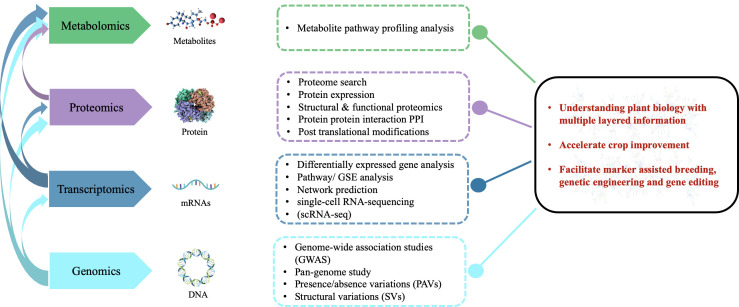
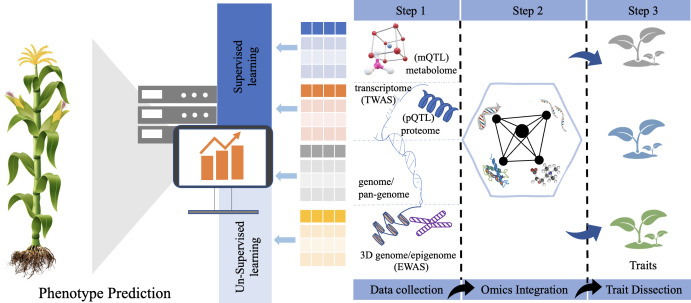
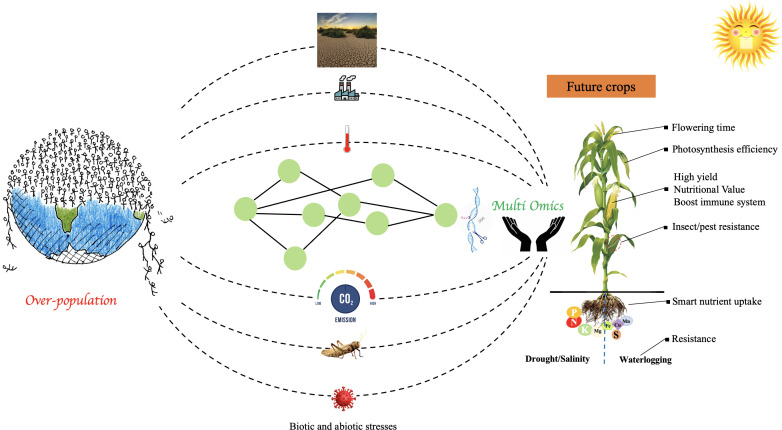
Verification
Claims the paper makes
The claims and statistics of this paper haven’t been checked yet.
Free: it reads the open-access text and checks the first 5 claims that cite a source we can check. Create a free account to check every claim.
Claims other papers make about this one
Each is checked against this paper’s own text: does it say what the citing paper says it does?
In the citing paper
“These studies often refer to “multi-omics data,”? encompassing genomics, transcriptomics, proteomics, metabolomics, and phenomics (Mahmood et al. 2022).”
From A review of multimodal deep learning methods for genomic-enabled prediction in plant breeding (2024) · cites this paper as Mahmood et al. 2022
Self-check
Percentages, sums and reported differences re-computed from the paper’s own numbers.
The self-check needs the paper’s full text.
Citations
Cites
Molecular Structure of Nucleic Acids: A Structure for Deoxyribose Nucleic Acid
WATSON, J. D., & CRICK, F. H. C. (1953) · Nature · doi:10.1038/171737a0 · Cited by 13,584 · cited 1×
“The discovery of DNA structure (18631865) revolutionized plant breeding in the molecular era (Watson and Crick, 1953); thereupon, new breeding techniques were introduced such as marker-assisted selection (MAS) and the genetically modified (GM) approach (Shen et al.”
Analysis of the genome sequence of the flowering plant Arabidopsis thaliana
Initiative, T. A. G. (2000) · Nature · doi:10.1038/35048692 · Cited by 9,301 · cited 1×
“The first plant genome of Arabidopsis was constructed 22 years ago (Kaul et al., 2000; Theologis et al., 2000).”
BackgroundA Draft Sequence of the Rice Genome ( Oryza sativa L. ssp. indica )
Yu, J., Hu, S., Wang, J., Wong, G. K.-S., Li, S., Liu, B., Deng, Y., Dai, L., Zhou, Y., Zhang, X., et al. (2002) · Science · doi:10.1126/science.1068037 · Cited by 4,208
Self-citationThe B73 Maize Genome: Complexity, Diversity, and Dynamics
Schnable, P. S., Ware, D., Fulton, R. S., Stein, J. C., Wei, F., Pasternak, S., Liang, C., Zhang, J., Fulton, L., Graves, T. A., et al. (2009) · Science · doi:10.1126/science.1178534 · Cited by 4,046 · cited 1×
“, 2002), maize (Schnable et al., 2009), tomato (The Tomato Genome Consortium, 2012), wheat (Ling et al.”
BackgroundImproved protein structure prediction using potentials from deep learning
Senior, A. W., Evans, R., Jumper, J., Kirkpatrick, J., Sifre, L., Green, T., Qin, C., Žídek, A., Nelson, A. W. R., Bridgland, A., et al. (2020) · Nature · doi:10.1038/s41586-019-1923-7 · Cited by 3,378 · cited 1×
“amounts of high-throughput data and solve problems in pertinent domains by using freely available software, and algorithms such as DL in prediction of protein structures (Senior et al., 2020).”
MethodThe tomato genome sequence provides insights into fleshy fruit evolution
The Tomato Genome Consortium (2012) · Nature · doi:10.1038/nature11119 · Cited by 3,289 · cited 2×
“Less than 300 whole genome assemblies at the chromosomal level (representing about 900 species) have been sequenced so far out of the estimated ~0.5 million species in the green plant clade (Kress et al., 2022), that include rice (Goff et al., 2002), maize (Schnable et al., 2009), tomato (The Tomato Genome Consortium,…”
BackgroundInfluentialA Draft Sequence of the Rice Genome ( Oryza sativa L. ssp. japonica )
Goff, S. A., Ricke, D., Lan, T.-H., Presting, G., Wang, R., Dunn, M., Glazebrook, J., Sessions, A., Oeller, P., Varma, H., et al. (2002) · Science · doi:10.1126/science.1068275 · Cited by 2,838 · cited 1×
“, 2022), that include rice (Goff et al., 2002), maize (Schnable et al.”
BackgroundEarly allopolyploid evolution in the post-Neolithic Brassica napus oilseed genome
Chalhoub, B., Denoeud, F., Liu, S., Parkin, I. A. P., Tang, H., Wang, X., Chiquet, J., Belcram, H., Tong, C., Samans, B., et al. (2014) · Science · doi:10.1126/science.1253435 · Cited by 2,479
Abiotic stress responses in plants
Zhang, H., Zhu, J., Gong, Z., & Zhu, J.-K. (2022) · Nature Reviews Genetics · doi:10.1038/s41576-021-00413-0 · Cited by 2,166 · cited 2×
“Frontiers in Plant Science 06 to abiotic stimuli (Ueda and Seki, 2020; Zhang et al., 2022a).”
BackgroundDynamics and function of DNA methylation in plants
Zhang, H., Lang, Z., & Zhu, J.-K. (2018) · Nature Reviews Molecular Cell Biology · doi:10.1038/s41580-018-0016-z · Cited by 1,815 · cited 1×
“Numerous DNA-methylation studies have been conducted associating with seed development, plant organ differentiation, fruit ripening, and response to environmental stresses AND the functional role in gene regulation (Zhang et al., 2018).”
Background
Cited by
Roychowdhury, R., Das, S. P., Gupta, A., Parihar, P., Chandrasekhar, K., Sarker, U., Kumar, A., Ramrao, D. P., & Sudhakar, C. (2023) · Genes · doi:10.3390/genes14061281 · Cited by 297
Plant responses to climate change, how global warming may impact on food security: a critical review
Janni, M., Maestri, E., Gullì, M., Marmiroli, M., & Marmiroli, N. (2024) · Frontiers in Plant Science · doi:10.3389/fpls.2023.1297569 · Cited by 160
“…yield, grain size, fl owering time, fi ber quality and disease resistance paves the way for the application of new breeding techniques (NBTs) in breeding programs (Bohra et al., 2022) or in the exploitation of existing genetic resources through NGS (next-generation sequencing) (Mahmood et al., 2022).”
BackgroundCotton and drought stress: An updated overview for improving stress tolerance
Zafar, S., Afzal, H., Ijaz, A., Mahmood, A., Ayub, A., Nayab, A., Hussain, S., Hussan, M. U., Sabir, M. A., Zulfiqar, U., et al. (2023) · South African Journal of Botany · doi:10.1016/j.sajb.2023.08.029 · Cited by 90
Satrio, R. D., Fendiyanto, M. H., & Miftahudin, M. (2024) · Springer eBooks · doi:10.1007/978-981-97-1699-9_25 · Cited by 133
Amin, A., Zaman, W., & Park, S. (2025) · Genes · doi:10.3390/genes16070809 · Cited by 100
Metadata
- Authors
- Mahmood, U., Li, X., Fan, Y., Chang, W., Niu, Y., Li, J., Qu, C., & Lu, K.
- Affiliations
- Southwest University (CN)
- Corresponding author
- Qu, Cunmin
- Lu, Kun
- Venue
- Frontiers in Plant Science
- Publisher
- Frontiers Media SA
- Published
- 2022-12-08
- Volume
- 13
- Pages
- 1062952-1062952
- ISSN
- 1664-462X (ISSN-L)
- PMC
- PMC9773847
- OpenAlex
- W4311866940
- Cited by
- 145
- References
- 243
- Citations by year
- 2026: 48 · 2025: 55 · 2024: 30 · 2023: 12
- FWCI
- 3.74
- Type
- journal article
- Language
- en
- Open access
- gold
- doi.org
- Licence
- Locations
- Frontiers in Plant Science (publishedVersion, cc-by)
- PubMed Central (publishedVersion, cc-by)
- PubMed (publishedVersion)
- DOAJ (DOAJ: Directory of Open Access Journals) (submittedVersion, cc-by-sa)
- Funders
- National Natural Science Foundation of China
- Topics
- Life Sciences › Biochemistry, Genetics and Molecular Biology › Genetics › Genetic Mapping and Diversity in Plants and Animals
- Life Sciences › Agricultural and Biological Sciences › Plant Science › Genetics and Plant Breeding
- Life Sciences › Biochemistry, Genetics and Molecular Biology › Genetics › Genetic and phenotypic traits in livestock
- Keywords
- multi-omics, plant breeding, crop breeding, climate-resilient crops, phenotypic plasticity, machine learning, genome editing, crop traits, food security, multi-omics integration
About these checks
Registry, retraction, Cites and statistics results are computed, not judged, with one exception: a printed reference that no index lists is read once by a model before it counts as a citation error. Claims are extracted by a model and kept only when their quote appears verbatim in the text; each cited source is then checked, with a model’s help, for whether it says what the claim relies on. Those verdicts can be wrong — read the claim’s quote and the cited source before relying on one.
Statistics and arithmetic are recomputed, not judged.
Confidence bands are shown only for fields calibrated on our annotated test set. None is calibrated yet, so no band is shown.
What counts as a claim ›How we measure confidence ›How we check this ›
Are you an author, or do you see a problem with this page? Request a review
Data sources
Bibliographic data: Semantic Scholar, OpenAlex, Crossref.
Contains information from the Semantic Scholar Academic Graph Datasets, made available under the ODC Attribution License (ODC-BY 1.0).
Semantic Scholar’s data is described in: Kinney, R., et al. (2023). The Semantic Scholar Open Data Platform. arXiv:2301.10140.
