

The DOI matches its Crossref record; 2 of the 2 references it cites were found in a registry or an index.
Editorial: Plant phenology shifts and their ecological and climatic consequences
Abstract
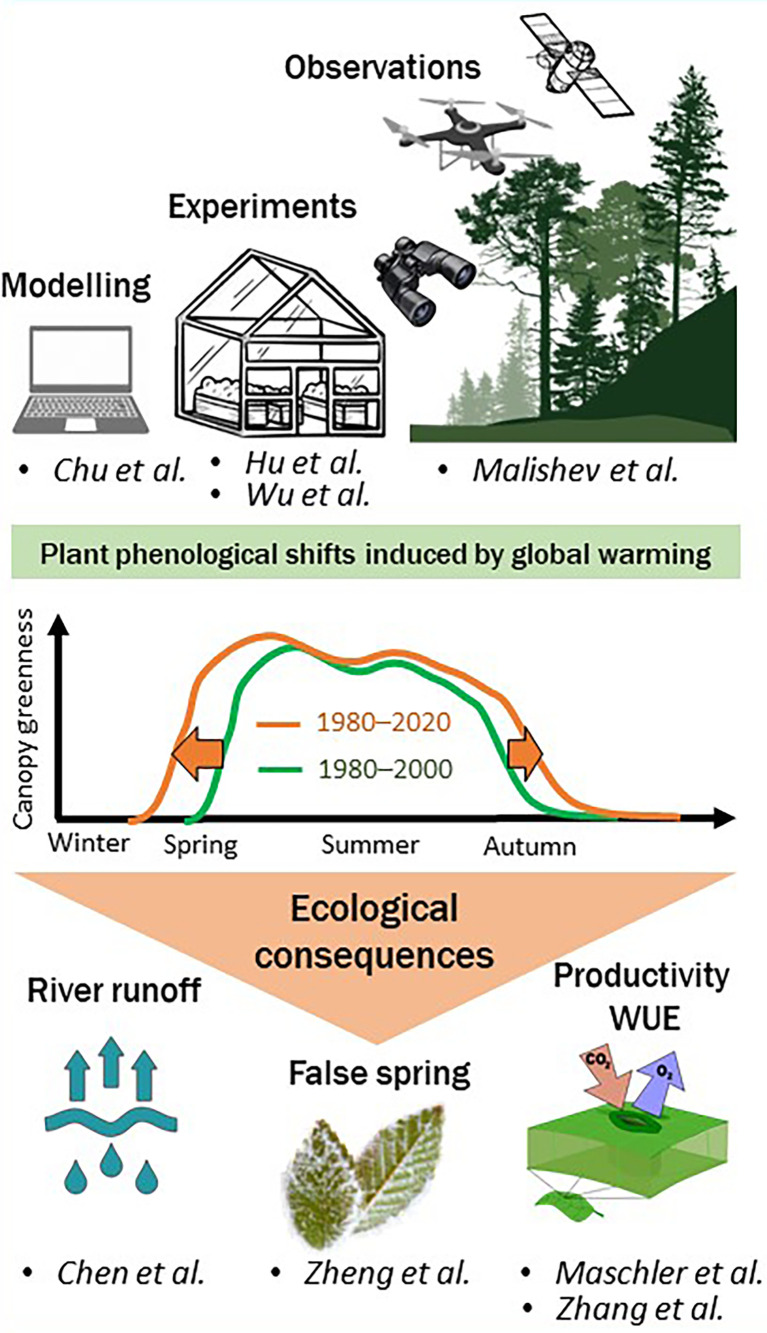
Plant phenology shifts and their ecological and climatic consequencesClimate change is causing plant phenology to shift, with consequences for ecosystems and the Earth's climate.Over the last decades, the timing of many important phenological event has advanced in spring, such as leaf emergence and flowering, or been delayed in fall, such as leaf coloration and leaf fall (Cleland et al., 2007).The consequences of such phenological shifts are still largely unknown, but are hypothesized to have cascading effects on ecosystems (e.g.altering species interactions and the foodweb), carbon and water cycles and Earth' s climate (Piao et al., 2019).With this Research Topic, we aimed to synthesize and inspire innovative research in plant phenology to address research questions and challenges on the consequences of phenological shifts on ecosystem functioning and local hydrology.The articles presented here improve our understanding of the physiological mechanisms responsible for the current phenological changes in spring and fall and provide insight into some of the consequences of these changes on hydrological cycles and ecosystem functioning (Figure 1).In this special topic, four manuscripts investigate the phenological responses to climate change among and within species, focusing on the main climatic drivers of such changes.Specifically, in a theoretical article based on temperature sums required to trigger vegetation onset, Chu et al. demonstrated that early-flushing species, typically grasses and early-growing shrubs, would exhibit larger phenological shifts but accumulate fewer forcing gains in response to a warmer climate than late-flushing species, such as tree species.Malyshev et al. focused on variation of budburst timing and dormancy depth between 146 individual European beech trees monitored over 12 years.They found a high and systematic variation found in budburst timing among individuals and mainly attributed it to differences in their dormancy depth during winter, with earlier-flushing trees being less dormant than late-flushing trees in mid-winter.Hu et al.
Overview
The claims and statistics of this paper haven’t been checked yet.
Run the check — free, no account needed. It reads the open-access text and checks the sources it cites.
Integrity signals
Registry
Cites
Statistics
Figures
Verification
Claims the paper makes
The claims and statistics of this paper haven’t been checked yet.
Run the check — free, no account needed. It reads the open-access text and checks the sources it cites.
Claims other papers make about this one
Each is checked against this paper’s own text: does it say what the citing paper says it does?
The source backs part of the claim, not all of it — or backs it for a different population, condition or comparison.
In the citing paper
“In the context of climate change, where growing seasons are extending in temperate zones 37 , this roughness blind spot leads to a systemic under-prediction of flood hazards during summer monsoon events 38 .”
From AI-driven digital twinning quantifies the trade-off between flood conveyance and riparian stability under climate extremes (2026) · cites this paper as [37]
Experimental — accuracy not yet measured
Self-check
Percentages, sums and reported differences re-computed from the paper’s own numbers.
The self-check needs the paper’s full text.
Citations
Cites
Shifting plant phenology in response to global change
CLELAND, E., CHUINE, I., MENZEL, A., MOONEY, H., & SCHWARTZ, M. (2007) · Trends in Ecology & Evolution · doi:10.1016/j.tree.2007.04.003 · Cited by 2,335
Plant phenology and global climate change: Current progresses and challenges
Piao, S., Liu, Q., Chen, A., Janssens, I. A., Fu, Y., Dai, J., Liu, L., Lian, X., Shen, M., & Zhu, X. (2019) · Global Change Biology · doi:10.1111/gcb.14619 · Cited by 2,120
Self-citation
Cited by
Shin, J. H., Go, S. H., & Park, J. H. (2026) · Scientific Reports · doi:10.1038/s41598-026-63704-8
Metadata
- Authors
- Fu, Y. H., Prevéy, J. S., & Vitasse, Y.
- Venue
- Frontiers in Plant Science
- Publisher
- Frontiers Media SA
- Published
- 2022-11-24
- Volume
- 13
- ISSN
- 1664-462X
- PMC
- PMC9731122
- Cited by
- 16
- References
- 2
About these checks
Registry, retraction, Cites and statistics results are computed, not judged, with one exception: a printed reference that no index lists is read once by a model before it counts as a citation error. Claims are extracted by a model and kept only when their quote appears verbatim in the text; each cited source is then checked, with a model’s help, for whether it says what the claim relies on. Those verdicts can be wrong — read the claim’s quote and the cited source before relying on one.
Statistics and arithmetic are recomputed, not judged.
Confidence bands are shown only for fields calibrated on our annotated test set. None is calibrated yet, so no band is shown.
What counts as a claim ›How we measure confidence ›How we check this ›
Are you an author, or do you see a problem with this page? Request a review
Data sources
Bibliographic data: Semantic Scholar, OpenAlex, Crossref.
Contains information from the Semantic Scholar Academic Graph Datasets, made available under the ODC Attribution License (ODC-BY 1.0).
Semantic Scholar’s data is described in: Kinney, R., et al. (2023). The Semantic Scholar Open Data Platform. arXiv:2301.10140.
