

Generative AI governance in higher education: a case study from Africa
Open accessThe DOI matches its Crossref record; 42 of the 43 references it cites were found in a registry or an index; 7 of the 49 sources its claims cite were checked for support.
Abstract
Introduction: The rapid rise of generative artificial intelligence (Gen-AI), particularly large language models (LLMs), is reshaping the higher education landscape. Yet, there is limited empirical documentation of how African universities are integrating Gen-AI into teaching, learning, and research. This study presents a case study of the University of KwaZulu-Natal (UKZN), one of the first African institutions to develop and implement comprehensive academic guidelines for the responsible use of Gen-AI, aligned with national policy priorities and global debates on academic integrity, transparency, and innovation. Methods: Adopting a qualitative, single-institution case study design, this research draws on process tracing, comparative policy analysis, institutional records, and the authors’ direct involvement as members of the AI Task Team. The guideline development process was documented and analysed, from inception and internal deliberation to external peer review, institutional consultation, and final adoption. Results: The resulting UKZN AI Academic Guidelines are based on four foundational principles: encouraging innovation, ensuring ethical and responsible use, maintaining academic rigour, and building institutional capacity. They establish clear policies on Gen-AI adoption across teaching and research, including curriculum integration, standards for disclosure and authorship, approaches to plagiarism, and guidance on data protection. The guidelines also provide a tiered disclosure framework and embed capacity-building initiatives to support AI literacy among staff and students. Discussion: This case study demonstrates how a higher education institution in the Global South can translate national AI policy into actionable institutional governance while addressing contextual challenges such as resource constraints, digital divides, and multicultural considerations. By framing Gen-AI as an enabling tool rather than a threat, the UKZN model offers a replicable pathway for other African and Global South universities seeking to integrate AI responsibly, enhance academic productivity, and prepare graduates for an AI-driven future.
Overview
CoChat Summary
TL;DR
This qualitative single-institution case study documents how the University of KwaZulu-Natal (UKZN) developed and adopted one of Africa's first comprehensive academic guidelines for generative AI, tracing an eight-stage process from task-team retreat to Senate approval. It argues that framing Gen-AI as an enabling tool with tiered disclosure and capacity-building, rather than banning or detecting it, offers a replicable governance pathway for Global South universities.
Key findings
- The UKZN AI Academic Guidelines rest on four foundational principles: encouraging innovation, ethical and responsible use, academic rigour and integrity, and capacity-building.
- Disclosure is tiered into three levels: optional (language improvement, reference-list compilation), disclosure without prompts (AI significantly contributes to intellectual content but not methodology), and full disclosure (AI influences validity/reliability, e.g. data analysis, hypothesis shaping, predictive models — prompts must also be disclosed).
- The Guidelines state that AI-generated text is not by default plagiarism, since Gen-AI lacks moral agency; but presenting AI-derived ideas as one's own risks idea plagiarism, and paragraphs 6.1.3 and 6.2.2 place responsibility on users to conduct their own literature searches and attribute original sources.
- Gen-AI cannot be credited as co-author or cited as a source; secure AI tools are required for sensitive personal information or protectable IP (paras 6.10, 7.9), with UKZN pursuing an institutional licensing arrangement for POPIA compliance.
- Gen-AI use is the default in curricula, but individual modules may limit it for sound pedagogical reasons; implementation is embedded in existing structures (College Deans of Research and Teaching and Learning reporting to DVCs), with an AI Thought Leadership Forum for monitoring.
Methods
- Qualitative, single-institution case study of the full guideline development cycle, drawing on the authors' direct experience as members of UKZN's AI Task Team, plus team records, supporting documents, and contemporaneous meeting notes.
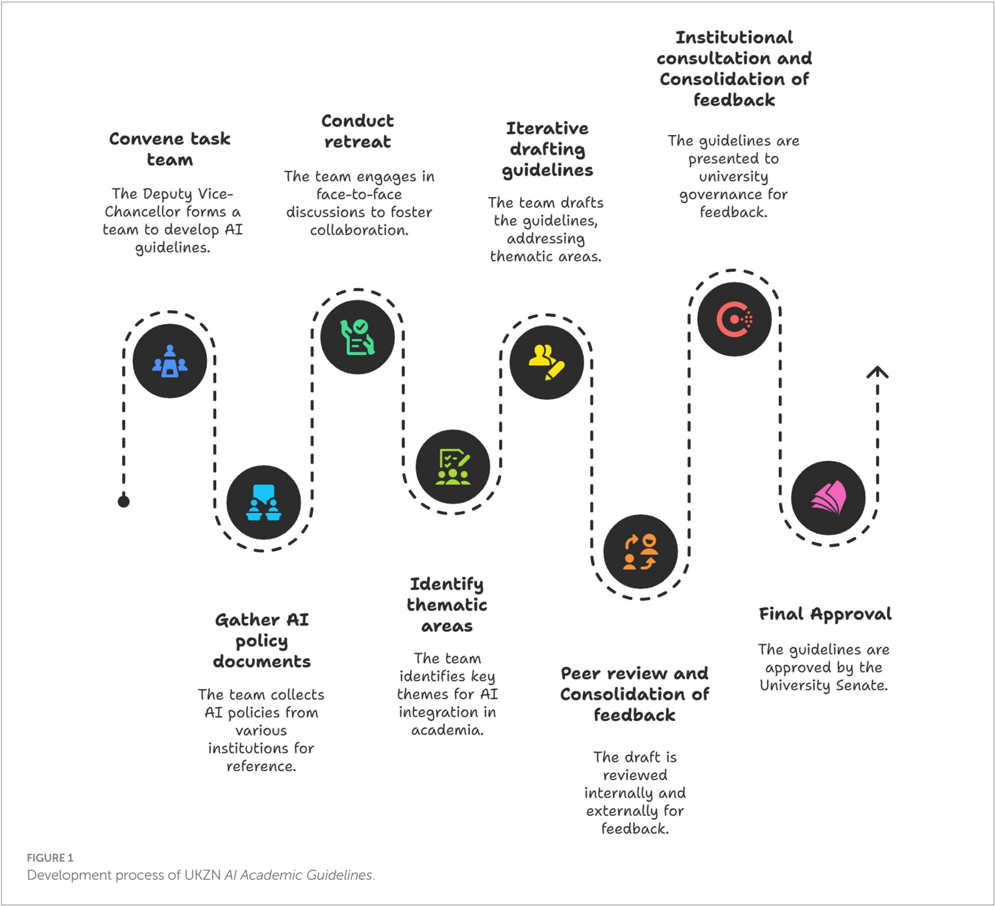
- Process tracing and comparative policy analysis of AI policy documents gathered from South African and international institutions; the eight-stage pathway ran from a mid-2024 task team convened by the DVC for Teaching and Learning (~a dozen members across disciplines and Colleges), through an in-person retreat, thematic drafting groups, iterative plenary cycles, internal and external peer review (two international experts), formal institutional consultation, and Senate approval.
- Three stated objectives: document the development process, analyse how normative principles were operationalised in the final Guidelines, and distil transferable insights for other institutions.
Limitations
- The paper states that substantive self-reflection on implementation outcomes will only be possible after a period of sustained application; the Thought Leadership Forum is described as the mechanism for future feedback and periodic updates.
- The paper notes interdisciplinary collaboration is addressed only implicitly, primarily as an underlying value rather than an analysed provision.
- Evident from the text: the study is a single-institution case with authors writing as participant-insiders, and it reports no empirical outcome data on guideline uptake, compliance, or effects on student learning; the article also discloses that ChatGPT-4 and ChatGPT-5 were used in drafting and revising the manuscript.
Model-written summary. Check it against the paper before relying on it.
Integrity signals
Registry
Cites
Statistics
Figures

Verification
Claims the paper makes
6 Valid · 2 Not valid · 42 Not checked · 71 Own results and interpretations
The cited sources support only part of this claim — read each source’s verdict below.
In the paper
“Cheong et al. (2025) found that both human evaluators and LLM evaluators consistently rated writing less favourably when AI use was disclosed, regardless of content quality.”
§ Generative AI governance in higher education: a case study from Africa > 1.1 Scholarly discourse on AI tools
What the sources say
- Partly supportedcites Cheong et al., 2025 matched to “Penalizing Transparency? How AI Disclosure and Author Demographics Shape Human and AI Judgments About Writing” (2025) sourceExperimental — accuracy not yet measured
The core of the claim is stated directly: the Abstract and Section 4 ('Disclosure, Author's Identity, and the Fragility of LLM Alignment') report that 'humans and LLM raters alike apply a modest but consistent penalty to articles when AI assistance is disclosed', with Fig. 1's caption confirming human raters consistently penalized disclosed articles and both GPT-4o-mini and Qwen2.5-7B-Instruct showing significant disclosure penalties (-0.112 and -0.133 points). However, the qualifier 'regardless of content quality' is not something the source establishes: Section 2 and Appendix C describe a single identical human-authored (health) news article presented in all eighteen conditions, with only author bio/photo and disclosure language varying, so content quality was held constant rather than tested across levels. The claim therefore generalizes the penalty to writing of varying quality, which our copy does not examine (the Discussion explicitly limits the work to one genre and calls for future work across genres and forms of AI involvement); our copy also frames the effect as small (<0.15 on a 7-point scale). (LLM, conf=0.78)
plainstates a cause- Asserted: passes — The authors put it forward as true.
- Checkable: passes — It can be checked against evidence.
- Load-bearing: unclear — It is unclear whether the paper’s conclusions depend on it.
- Based: passes — The paper gives a reason why it holds.
- Partly supported
The cited sources support only part of this claim — read each source’s verdict below.
In the paper
“Importantly, these Guidelines emerge from a Global South setting-characterised by resource constraints, infrastructural diversity, and a strong imperative to bridge digital divides (Maimela and Mbonde, 2025;Sebihi et al., 2025).”
§ Generative AI governance in higher education: a case study from Africa > 4 Conclusion
What the sources say
- Partly supportedcites Maimela and Mbonde, 2025 matched to “Artificial intelligence in south African universities: curriculum transformation and decolonisation—aid or obstacle?” (2025) sourceExperimental — accuracy not yet measured
The Literature review, under “South African universities and AI: challenges and opportunities,” describes resource and infrastructure disparities and calls the digital divide a critical concern. The Recommendations section calls for bridging that divide. Our copy does not identify the UKZN AI Academic Guidelines or establish their particular origins, so it supports the South African context but not the guideline-specific assertion. (LLM, conf=0.86)
- Partly supportedcites Sebihi et al., 2025 matched to “Unveiling AI’S impact in Rwandan higher education: navigating trends, challenges, and imperatives at the University of Rwanda” (2025) sourceExperimental — accuracy not yet measured
The Research section describes uneven AI adoption and disparities in infrastructure and resources across African universities, and Section 2 discusses the need to address the digital divide. These passages support the broader setting described, but the paper does not discuss the UKZN AI Academic Guidelines or establish that those particular guidelines arose from it. Page numbers were not available in our copy. (LLM, conf=0.84)
plainstates a cause- Asserted: passes — The authors put it forward as true.
- Checkable: passes — It can be checked against evidence.
- Load-bearing: passes — The paper’s conclusions depend on it.
- Based: passes — The paper gives a reason why it holds.
- Partly supported
A result the paper reports from its own data — it cites no other source for it, so there is none to check. The quote shows it is in the paper.
In the paper
“the final draft of the UKZN AI Academic Guidelines was submitted to the University Senate, where it was formally approved.”
§ Generative AI governance in higher education: a case study from Africa > FIGURE 1
plainSingle case- Asserted: passes — The authors put it forward as true.
- Checkable: passes — It can be checked against evidence.
- Load-bearing: unclear — It is unclear whether the paper’s conclusions depend on it.
- Based: passes — The paper gives a reason why it holds.
- Rests on 2 assumptions not shown here.
A result the paper states — it cites no source for it, so there is none to check. The quote shows it is in the paper.
In the paper
“Finally, AI-generated outputs are rarely used in isolation in academic work.”
§ Generative AI governance in higher education: a case study from Africa > 3.4 AI-generated text and plagiarism
plain- Asserted: passes — The authors put it forward as true.
- Checkable: passes — It can be checked against evidence.
- Load-bearing: passes — The paper’s conclusions depend on it.
- Based: unclear — It is unclear why the paper says it holds.
In the paper
“The Guidelines take a flexible approach to the integration of Gen-AI into teaching and learning (Amin et al., 2025, pp. 9-16).”
§ Generative AI governance in higher education: a case study from Africa > 3.3 Integration of Gen-AI literacy into curricula: flexibility at module-level
What the sources say
- Not matchedcites Amin et al., 2025, pp. 9-16
An author–year citation the paper’s reference list doesn’t settle. We don’t search these by name.
plain- Asserted: passes — The authors put it forward as true.
- Checkable: passes — It can be checked against evidence.
- Load-bearing: passes — The paper’s conclusions depend on it.
- Based: passes — The paper gives a reason why it holds.
- Not matched
11 more claims
Create a free account to see all 121 claims and every source verdict.
- Probably not a substantial claim. 94
- It may state two separate claims as one. 47
Claims other papers make about this one
Each is checked against this paper’s own text: does it say what the citing paper says it does?
The source backs part of the claim, not all of it — or backs it for a different population, condition or comparison.
In the citing paper
“From a mechanistic perspective, scenarios characterized by conditional permission and pedagogical alignment correlated strongly with enhanced learning engagement, self-efficacy, and agency, alongside reduced anxiety (Barus et al., 2025; Thaldar et al., 2025).”
From Multidimensional responses to generative AI in higher education: an integrative framework linking institutional governance, teaching practice, and student psychological adaptation (2026) · cites this paper as Thaldar et al., 2025
Experimental — accuracy not yet measured
Citations
Cites
ChatGPT: five priorities for research
van Dis, E. A. M., Bollen, J., Zuidema, W., van Rooij, R., & Bockting, C. L. (2023) · Nature · doi:10.1038/d41586-023-00288-7 · Cited by 1,842
ChatGPT in higher education: considerations for academic integrity and student learning
(2023) · Journal of Applied Learning & Teaching · doi:10.37074/jalt.2023.6.1.17 · Cited by 853
Using artificial intelligence in academic writing and research: An essential productivity tool
Khalifa, M., & Albadawy, M. (2024) · Computer Methods and Programs in Biomedicine Update · doi:10.1016/j.cmpbup.2024.100145 · Cited by 580
Yusuf, A., Pervin, N., & Román-González, M. (2024) · International Journal of Educational Technology in Higher Education · doi:10.1186/s41239-024-00453-6 · Cited by 554
ChatGPT and the rise of generative AI: Threat to academic integrity?
Eke, D. O. (2023) · Journal of Responsible Technology · doi:10.1016/j.jrt.2023.100060 · Cited by 532
Jin, Y., Yan, L., Echeverria, V., Gašević, D., & Martinez-Maldonado, R. (2025) · Computers and Education Artificial Intelligence · doi:10.1016/j.caeai.2024.100348 · Cited by 452
Jin, Y., Yan, L., Echeverria, V., Gašević, D., & Martinez-Maldonado, R. (2024) · arXiv · doi:10.48550/arxiv.2405.11800 · Cited by 447
The ethics of disclosing the use of artificial intelligence tools in writing scholarly manuscripts
Hosseini, M., Resnik, D. B., & Holmes, K. (2023) · Research Ethics · doi:10.1177/17470161231180449 · Cited by 341
Brenner, C. A. (2022) · Smart Learning Environments · doi:10.1186/s40561-021-00184-5 · Cited by 148
Balalle, H., & Pannilage, S. (2025) · Social Sciences & Humanities Open · doi:10.1016/j.ssaho.2025.101299 · Cited by 137
Research works printed but not linked: 7
- Amin, N., Badru, A., Botes, M., Bruce-Band, J., Chenia, H., and Chuturgoon, A. A. (2025). Principles and guidelines on the use of generative artificial intelligence tools in academic work. Durban: University of KwaZulu-Natal.
- Churches, A. (2008). Bloom's digital taxonomy.
- 2024, SA national AI policy framework
- Atherton, D., Newman, S., and Esfahany, K. (2023). Proposed Harvard AI code of conduct. Cambridge, Massachusetts (USA).
- Presented at the 2024 IST-Africa conference (IST-Africa) (Dublin, Ireland: IEEE), 01-09.
- Reinmann, G. (2023). Deskilling durch Künstliche Intelligenz? Potenzielle Kompetenzverluste als Herausforderung für die Hochschuldidaktik. Berlin: Hochschulforum Digitalisierung.
- Russell Group (2023). Russell Group principles on the use of generative AI tools in education. London: Russell Group Universities.
Cited by
Institutional approaches to generative AI management in higher education: a systematic review
Bacalso, F. D., Villamor, F. E., Paclipan, C. P., Orquia, C. J. B., Rendon, I. P., Albiso, A. T., & Himang, C. M. (2026) · Frontiers in Education · doi:10.3389/feduc.2026.1814426 · Cited by 23
Governing the unseen: A systematic review of AI literacy among language teachers in higher education
Deng, Y., Çelik, F., & Duran, V. (2026) · Computers and Education: Artificial Intelligence · doi:10.1016/j.caeai.2026.100658 · Cited by 4
The role of Artificial Intelligence in driving digital transformation in Somali higher education
Isak, M. L., & Dahir, U. M. (2026) · Discover Education · doi:10.1007/s44217-026-01765-7 · Cited by 4
“Thaldar et al. [35]document an instructive counter-example: the University of KwaZulu-Natal developed institutional AI guidelines aligned proactively with South Africa’s national AI policy framework, illustrating that anticipatory governance is feasible even within African resource constraints.”
Aryeh-Adjei, A. A., Kayi, E. A., Adu, K. K., & Danquah, M. M. (2026) · Higher Education Skills and Work-based Learning · doi:10.1108/heswbl-12-2025-0596 · Cited by 2
Kuang, W., & Gao, X. (2026) · Frontiers in Psychology · doi:10.3389/fpsyg.2026.1789506 · Cited by 1
Metadata
- Authors
- Thaldar, D., Botes, M., Badru, A., Chenia, H., Duma, S., Dlamini, S. B., Amin, N., Hugo, W., Govender, R., Bruce-Brand, J., Vosloo, A., Koorbanally, N. A., & Chuturgoon, A.
- Affiliations
- University of KwaZulu-Natal (ZA)
- The University of Texas at Austin (US)
- Corresponding author
- Thaldar, Donrich
- ORCID
- Venue
- Frontiers in Political Science
- Publisher
- Frontiers Media SA
- Published
- 2025-12-09
- Volume
- 7
- ISSN
- 2673-3145 (ISSN-L)
- OpenAlex
- W4417151498
- Semantic Scholar
- a56536a569607d61b9d57a28a20d6bcbe160321b
- Cited by
- 40
- References
- 34
- Citations by year
- 2026: 39 · 2025: 1
- FWCI
- 33.14
- Type
- journal article
- Language
- en
- Open access
- gold
- doi.org
- Licence
- Locations
- Frontiers in Political Science (publishedVersion, cc-by)
- DOAJ (DOAJ: Directory of Open Access Journals) (submittedVersion, cc-by-sa)
- Topics
- Social Sciences › Education › Artificial Intelligence in Education
- Physical Sciences › Computer Science › Artificial Intelligence › Ethics and Social Impacts of AI
- Social Sciences › Education › Academic integrity and plagiarism
- Keywords
- generative AI governance, large language models, higher education, academic integrity, plagiarism, AI literacy, institutional capacity building, AI policy implementation, Global South universities, University of KwaZulu-Natal, responsible AI use, digital divide
About these checks
Registry, retraction, Cites and statistics results are computed, not judged, with one exception: a printed reference that no index lists is read once by a model before it counts as a citation error. Claims are extracted by a model and kept only when their quote appears verbatim in the text; each cited source is then checked, with a model’s help, for whether it says what the claim relies on. Those verdicts can be wrong — read the claim’s quote and the cited source before relying on one.
The claim verdicts this report counts are experimental: their accuracy is not yet measured.
A language model drew the claims from the paper on 2026-10-08, under version 3 of the claim definition (model deepseek-v4.1-flash, prompt extract-v3).
A second model labelled each claim on 2026-10-08 (model jev-1.13-20260917, definition revision gold-guideline-v0.2).
Cited sources are checked with a language model’s help (qwen3.8-omni-flash and gpt-6-sol).
Statistics and arithmetic are recomputed, not judged.
Confidence bands are shown only for fields calibrated on our annotated test set. None is calibrated yet, so no band is shown.
What counts as a claim ›How we measure confidence ›How we check this ›
Are you an author, or do you see a problem with this page? Request a review
How to cite
Cite CoChat for the checks on this page, and the paper for its own findings.
- This page
- CoChat. (2026). Citation check: Generative AI governance in higher education: a case study from Africa. https://app.cochat.ai/papers/10.3389/fpos.2025.1666661
- The paper
- Thaldar, D., Botes, M., Badru, A., Chenia, H., Duma, S., Dlamini, S. B., Amin, N., Hugo, W., Govender, R., Bruce-Brand, J., Vosloo, A., Koorbanally, N. A., & Chuturgoon, A. (2025). Generative AI governance in higher education: a case study from Africa. Frontiers in Political Science. https://doi.org/10.3389/fpos.2025.1666661
Data sources
Bibliographic data: Semantic Scholar, OpenAlex, Crossref.
Contains information from the Semantic Scholar Academic Graph Datasets, made available under the ODC Attribution License (ODC-BY 1.0).
Semantic Scholar’s data is described in: Kinney, R., et al. (2023). The Semantic Scholar Open Data Platform. arXiv:2301.10140.
