

The DOI matches its Crossref record; the references it cites are not checked yet.
Ecologically valid virtual reality-based technologies for assessment and rehabilitation of acquired brain injury: a systematic review
Open accessAbstract
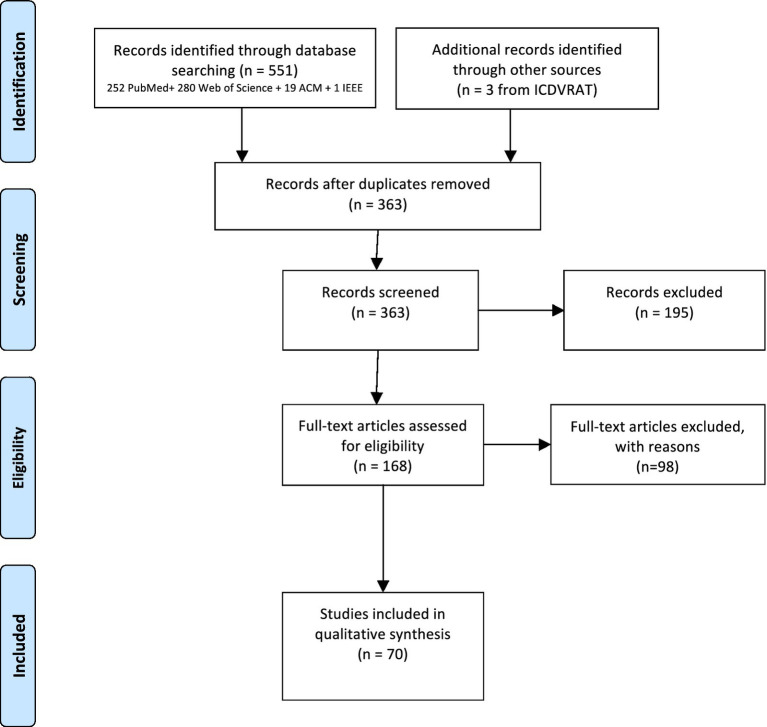
Purpose: A systematic review was conducted to examine the state of the literature regarding using ecologically valid virtual environments and related technologies to assess and rehabilitate people with Acquired Brain Injury (ABI). Materials and methods: A literature search was performed following the PRISMA guidelines using PubMed, Web of Science, ACM and IEEE databases. The focus was on assessment and intervention studies using ecologically valid virtual environments (VE). All studies were included if they involved individuals with ABI and simulated environments of the real world or Activities of Daily Living (ADL). Results: Seventy out of 363 studies were included in this review and grouped and analyzed according to the nature of its simulation, prefacing a total of 12 kitchens, 11 supermarkets, 10 shopping malls, 16 streets, 11 cities, and 10 other everyday life scenarios. These VE were mostly presented on computer screens, HMD’s and laptops and patients interacted with them primarily via mouse, keyboard, and joystick. Twenty-five out of 70 studies had a non-experimental design. Conclusion: Evidence about the clinical impact of ecologically valid VE is still modest, and further research with more extensive samples is needed. It is important to standardize neuropsychological and motor outcome measures to strengthen conclusions between studies. Systematic review registration: identifier CRD42022301560,https://www.crd.york.ac.uk/prospero/display_record.php?RecordID=301560.
Overview
The claims and statistics of this paper haven’t been checked yet.
Free: it reads the open-access text and checks the first 5 claims that cite a source we can check. Create a free account to check every claim.
Integrity signals
Registry
Cites
Statistics
Figures
Verification
Claims the paper makes
The claims and statistics of this paper haven’t been checked yet.
Free: it reads the open-access text and checks the first 5 claims that cite a source we can check. Create a free account to check every claim.
Claims other papers make about this one
Each is checked against this paper’s own text: does it say what the citing paper says it does?
The check wasn’t confident either way, so it gives no verdict — never disputed.
In the citing paper
“the TabCAT-Brain Health Assessment developed at UCSF is an iPad-based in-clinic assessment that includes immediate scoring, outperforms traditional paper-based assessments, has had organic adoption across several UCSF-affiliated PCP clinics, and is free for primary care use.54–57”
From Review of Artificial Intelligence for Clinical Use in Alzheimer's Disease and Related Dementias (2026) · cites this paper as [57]
Experimental — accuracy not yet measured
Self-check
Percentages, sums and reported differences re-computed from the paper’s own numbers.
The self-check needs the paper’s full text.
Citations
The citation lists are queued
They are fetched later and appear here then.
References 181 · Cited by 46
Research works printed but not linked: 21
- Baum, 2009, Executive function performance test: Test protocol booklet
- Burgess, 1996, The Hayling and Brixton tests: Test manual
- Chan, 2009, Hong Kong list learning test, manual & preliminary norm
- D’Elia, 1994, Color trails test
- Delis, 2000, Delis-Kaplan executive function system
- Gilboa, 2019, Assessment of executive functions in children and adolescents with acquired brain injury (ABI) using a novel complex multi-tasking computerised task: the Jansari assessment of executive functions for children (JEF-C\copyright), Neuropsychol. Rehabil., 29, 1359, 10.1080/09602011.2017.1411819 · DOI
- Heaton, 2005, Wisconsin card sorting test-64: Computer version 2 – research edition.
- Hooper, 1983, Hooper visual organization test (VOT)
- Nelson, 1991, National Adult Reading Test (NART)
- Osterrieth, 1954, Filetest de copie d’une figure complex: contribution a l’etude de la perception et de la mémoire, Arch. Psychol., 19, 87
- Piéron, 1955, Metodologia psicotécnica
- Schuhfried, 1996, Reha Com
- Slater, 2022, A separate reality: an update on place illusion and plausibility in virtual reality, Front. Virtual Reality, 3, 914392, 10.3389/frvir.2022.914392S · doi:10.3389/frvir.2022.914392s
- Smith, 1982, Symbol digit modalities test: Manual
- Spreen, 1998, A compendium of neuropsychological tests, 213
- Wechsler, Weschsler Adult Intelligence Scale-III
- Wilson, 1996, Behavioural assessment of the Dysexecutive syndrome (BADS). Bury St
- Wilson, Rivermead Behavioural memory test
- Wilson, Behavioural inattention test: Manual
- Wilson, 2005, The Cambridge prospective memory test
- Zimmerman, 1992, Test Batterie zur Aufmerksamkeitsprüfung (TAP)
Metadata
- Authors
- Faria, A. L., Latorre, J., Silva Cameirão, M., Bermúdez i Badia, S., & Llorens, R.
- Affiliations
- Agencia Regional para o Desenvolvimento da Investigacao Tecnologia e Inovacao (PT)
- Universitat Politècnica de València (ES)
- Corresponding author
- Faria, Ana Lúcia
- ORCID
- Faria, Ana Lúcia
- Venue
- Frontiers in Psychology
- Publisher
- Frontiers Media SA
- Published
- 2023-08-29
- Volume
- 14
- Pages
- 1233346-1233346
- ISSN
- 1664-1078 (ISSN-L)
- PMC
- PMC10497882
- OpenAlex
- W4386291926
- Cited by
- 46
- References
- 181
- Citations by year
- 2026: 18 · 2025: 16 · 2024: 11 · 2023: 1
- FWCI
- 1.59
- Type
- journal article
- Language
- en
- Open access
- gold
- doi.org
- Licence
- Locations
- Frontiers in Psychology (publishedVersion, cc-by)
- PubMed Central (publishedVersion, cc-by)
- PubMed (publishedVersion)
- RiuNet (Universitat Politècnica de València) (submittedVersion, cc-by-nc-nd)
- DOAJ (DOAJ: Directory of Open Access Journals) (submittedVersion, cc-by-sa)
- Funders
- Generalitat Valenciana
- NOVA Laboratory for Computer Science and Informatics (UIDB/04516/2020)
- Conselleria de Innovación, Universidades, Ciencia y Sociedad Digital, Generalitat Valenciana (CIDEXG/2022/15)
- Interreg
- Topics
- Physical Sciences › Computer Science › Human-Computer Interaction › Virtual Reality Applications and Impacts
- Social Sciences › Psychology › Experimental and Cognitive Psychology › Cognitive Functions and Memory
- Health Sciences › Medicine › Rehabilitation › Stroke Rehabilitation and Recovery
- Keywords
- acquired brain injury, virtual reality, brain injury rehabilitation, neuropsychological assessment, activities of daily living, virtual reality therapy, head-mounted displays, outcome measures standardization
About these checks
Registry, retraction, Cites and statistics results are computed, not judged, with one exception: a printed reference that no index lists is read once by a model before it counts as a citation error. Claims are extracted by a model and kept only when their quote appears verbatim in the text; each cited source is then checked, with a model’s help, for whether it says what the claim relies on. Those verdicts can be wrong — read the claim’s quote and the cited source before relying on one.
Statistics and arithmetic are recomputed, not judged.
Confidence bands are shown only for fields calibrated on our annotated test set. None is calibrated yet, so no band is shown.
What counts as a claim ›How we measure confidence ›How we check this ›
Are you an author, or do you see a problem with this page? Request a review
How to cite
Cite CoChat for the checks on this page, and the paper for its own findings.
- This page
- CoChat. (2026). Citation check: Ecologically valid virtual reality-based technologies for assessment and rehabilitation of acquired brain injury: a systematic review. https://app.cochat.ai/papers/10.3389/fpsyg.2023.1233346
- The paper
- Faria, A. L., Latorre, J., Silva Cameirão, M., Bermúdez i Badia, S., & Llorens, R. (2023). Ecologically valid virtual reality-based technologies for assessment and rehabilitation of acquired brain injury: a systematic review. Frontiers in Psychology. https://doi.org/10.3389/fpsyg.2023.1233346
Data sources
Bibliographic data: Semantic Scholar, OpenAlex, Crossref.
Contains information from the Semantic Scholar Academic Graph Datasets, made available under the ODC Attribution License (ODC-BY 1.0).
Semantic Scholar’s data is described in: Kinney, R., et al. (2023). The Semantic Scholar Open Data Platform. arXiv:2301.10140.
