

The relations among foreign language anxiety, academic buoyancy and willingness to communicate in EFL classroom
Open accessThe DOI matches its Crossref record; 75 of the 75 references it cites were found in a registry or an index; none of the 62 sources its claims cite is checked for support yet.
Abstract
This study, grounded in the frameworks of Positive Psychological Resources Theory and Emotion Regulation Theory, investigated the mechanism through which foreign language anxiety (FLA) and academic buoyancy (AB) influence students' willingness to communicate (WTC) in EFL classroom. A mixed-methods approach was employed, combining a Structural Equation Modeling (SEM) analysis based on data from 627 senior high school students and semi-structured interviews with eight randomly selected participants in China. The empirical results indicate that FLA significantly and negatively predicts WTC, while AB plays a partial mediating role in this relationship, thereby validating the proposed “FLA—AB—WTC” path model. These results highlight academic buoyancy as a positive psychological trait that mediates the effect of anxiety on willingness to communicate. This research offers theoretical and practical implications for affective regulation and psychological empowerment in foreign language pedagogy.
Overview
CoChat Summary
TL;DR
This mixed-methods study tested whether academic buoyancy mediates the relationship between foreign language anxiety and willingness to communicate among Chinese senior high EFL learners. It found that FLA negatively predicted WTC, academic buoyancy partially mediated this link, and interviews illustrated emotional-regulation and coping pathways.
Key findings
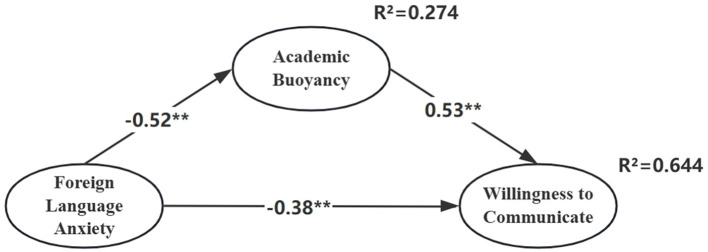
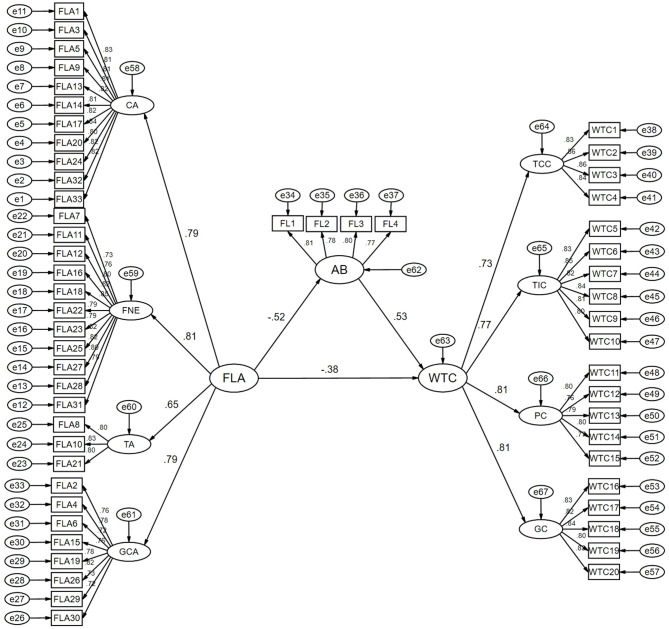
- FLA significantly negatively predicted WTC: direct-effect model β = −0.660, p < 0.001, R² = 43.6%; in the final partial-mediation model, total effect = −0.662, direct effect = −0.383, indirect effect via AB = −0.279, 95% BCa CI [−0.340, −0.223].
- Academic buoyancy partially mediated the FLA–WTC relationship: FLA negatively predicted AB (β = −0.524, p < 0.01), AB positively predicted WTC (β = 0.532, p < 0.01); the partial-mediation model explained 64.4% of WTC variance, 20.8% more than the direct model, and fit better than full mediation (Δχ²(1) = 72.027, p < 0.001).
- Correlations showed FLA dimensions negatively correlated with AB (r = −0.395 to −0.300, p < 0.01) and WTC (r = −0.439 to −0.321, p < 0.01), while AB positively correlated with WTC (r = 0.470–0.579, p < 0.01).
- Qualitative interviews indicated all eight interviewees experienced anxiety moments despite understanding or preparation; AB operated through emotional regulation (e.g., reframing mistakes, deep breathing) and behavioral strategies (e.g., preparing backup answers, drawing on teacher feedback), while teacher style, peer reactions, and task design also shaped WTC.
Methods
- Mixed-methods design: anonymous questionnaires administered to 683 Grade 11 students at a top-tier senior high school in Fujian, China; 627 valid responses (91.8%; 330 male/52.6%, 297 female/47.4%; 523 science/83.4%, 104 humanities/16.6%), plus semi-structured interviews with 8 randomly selected students, each lasting 20–30 min.
- Measures used Chinese-translated 5-point Likert scales: FLCAS (four dimensions; total α = 0.965), academic buoyancy scale (unidimensional; α = 0.867), and WTC scale (four dimensions; total α = 0.946); analyses included CFA, reliability/validity checks, Pearson correlations, SEM, and BCa bootstrapping with 5,000 resamples.
- Two-step SEM compared direct, full-mediation, and partial-mediation models; the partial-mediation model was retained.
Limitations
- Paper-stated: the sample was limited to high school students from a single region; the design was cross-sectional and self-report; future experimental or longitudinal work is needed; contextual classroom factors such as climate, peer interactions, and instructional style were not integrated into the model.
- Evident from the text: all participants were Grade 11 students at one top-tier senior high school in Fujian, limiting generalizability; self-report Likert measures and cross-sectional SEM cannot establish causal direction; the qualitative component included only 8 interviewees, so themes are illustrative rather than broadly generalizable.
Model-written summary. Check it against the paper before relying on it.
Integrity signals
Registry
Cites
Statistics
Figures

Verification
Claims the paper makes
0 Valid · 0 Not valid · 51 Not checked · 83 Own results and interpretations
A result the paper reports from its own data — it cites no other source for it, so there is none to check. The quote shows it is in the paper.
In the paper
“The empirical results indicate that FLA significantly and negatively predicts WTC, while AB plays a partial mediating role in this relationship, thereby validating the proposed “FLA—AB—WTC” path model.”
§ The relations among foreign language anxiety, academic buoyancy and willingness to communicate in EFL classroom > Abstract
boostedstates a cause- Asserted: passes — The authors put it forward as true.
- Checkable: passes — It can be checked against evidence.
- Load-bearing: passes — The paper’s conclusions depend on it.
- Based: passes — The paper gives a reason why it holds.
A result the paper reports from its own data — it cites no other source for it, so there is none to check. The quote shows it is in the paper.
In the paper
“The empirical results indicate that FLA significantly and negatively predicts WTC, while AB plays a partial mediating role in this relationship, thereby validating the proposed “FLA—AB—WTC” path model.”
§ The relations among foreign language anxiety, academic buoyancy and willingness to communicate in EFL classroom > Abstract
hedgedstates a cause- Asserted: passes — The authors put it forward as true.
- Checkable: passes — It can be checked against evidence.
- Load-bearing: passes — The paper’s conclusions depend on it.
- Based: passes — The paper gives a reason why it holds.
A result the paper reports from its own data — it cites no other source for it, so there is none to check. The quote shows it is in the paper.
In the paper
“The squared multiple correlation for WTC (R2) was 0.644, indicating that 64.4% of the variance was explained by the model.”
§ The relations among foreign language anxiety, academic buoyancy and willingness to communicate in EFL classroom > 4 Quantitative results > 4.2 Structural equation modeling: effects of foreign language anxiety and academic buoyancy on willingness to communicate
hedgedstates an association- Asserted: passes — The authors put it forward as true.
- Checkable: passes — It can be checked against evidence.
- Load-bearing: passes — The paper’s conclusions depend on it.
- Based: passes — The paper gives a reason why it holds.
A result the paper reports from its own data — it cites no other source for it, so there is none to check. The quote shows it is in the paper.
In the paper
“Compared with the direct effect model, the inclusion of academic buoyancy increased the explanatory power by 20.8%.”
§ The relations among foreign language anxiety, academic buoyancy and willingness to communicate in EFL classroom > 4 Quantitative results > 4.2 Structural equation modeling: effects of foreign language anxiety and academic buoyancy on willingness to communicate
plainstates a cause- Asserted: passes — The authors put it forward as true.
- Checkable: passes — It can be checked against evidence.
- Load-bearing: passes — The paper’s conclusions depend on it.
- Based: passes — The paper gives a reason why it holds.
54 more claims
Create a free account to see all 134 claims and to verify the 54 references still open.
- It may state two separate claims as one. 45
- Probably not a substantial claim. 42
- The quote only partly states this claim. 1
Statistics recomputed
Every reported test result, recomputed from its test statistic and degrees of freedom. A result shows as not adding up only once an independent check has confirmed it.
- Consistentχ²(1) = 72.027reported p < .001 · recomputed p < .001
“χ2(1) = 72.027, p < .001”
Self-check
Percentages, sums and reported differences re-computed from the paper’s own numbers.
Each contradiction between two passages listed here was confirmed by an independent check.
Rated major: it would touch a result — a value a result rests on, reported and recomputed p-values on opposite sides of the significance level, two passages that conflict with no sign which is right, or a cited work retracted before this paper was published.
In the paper
§ The relations among foreign language anxiety, academic buoyancy and willingness to communicate in EFL classroom > 4 Quantitative results > 4.2 Structural equation modeling: effects of foreign language anxiety and academic buoyancy on willingness to communicate
“However, with academic buoyancy functioning as a positive mediator, the final decrease was mitigated to 0.279 units, indicating that academic buoyancy partially offset the negative influence of anxiety on students' willingness to communicate.”
§ The relations among foreign language anxiety, academic buoyancy and willingness to communicate in EFL classroom > 4 Quantitative results > 4.2 Structural equation modeling: effects of foreign language anxiety and academic buoyancy on willingness to communicate
“The direct effect was −0.383, and the indirect effect through academic buoyancy was −0.279.”
Rated minor: it would not touch a result — a value no result rests on, a p-value that stays on the same side of the significance level, or a conflict that is clerical, resolved elsewhere in the paper, or outside its own findings.
In the paper
§ The relations among foreign language anxiety, academic buoyancy and willingness to communicate in EFL classroom > 4 Quantitative results > 4.2 Structural equation modeling: effects of foreign language anxiety and academic buoyancy on willingness to communicate
“| Full mediation model | 2.356 | 0.925 | 0.922 | 0.047 | 0.075 | 0.576 |”
§ The relations among foreign language anxiety, academic buoyancy and willingness to communicate in EFL classroom > 4 Quantitative results > 4.2 Structural equation modeling: effects of foreign language anxiety and academic buoyancy on willingness to communicate
“the direct-only (R2 = 0.436) and full-mediation (R2 = 0.584) models.”
Citations
Cites
Evaluating structural equation models with unobservable variables and measurement error
Fornell, C., & Larcker, D. F. (1981) · Journal of Marketing Research · doi:10.1177/002224378101800104 · Cited by 109,190
Hu, L., & Bentler, P. M. (1999) · Structural Equation Modeling A Multidisciplinary Journal · doi:10.1080/10705519909540118 · Cited by 108,788
Structural equation modeling in practice: A review and recommended two-step approach
Anderson, J. C., & Gerbing, D. W. (1988) · Psychological Bulletin · doi:10.1037/0033-2909.103.3.411 · Cited by 41,941
Positive psychology: An introduction.
Seligman, M. E. P., & Csikszentmihalyi, M. (2000) · American Psychologist · doi:10.1037/0003-066x.55.1.5 · Cited by 11,351
The emerging field of emotion regulation: an integrative review
Gross, J. J. (1998) · Review of General Psychology · doi:10.1037/1089-2680.2.3.271 · Cited by 9,916
Foreign Language Classroom Anxiety
HORWITZ, E. K., HORWITZ, M. B., & COPE, J. (1986) · The Modern Language Journal · doi:10.1111/j.1540-4781.1986.tb05256.x · Cited by 9,773
Flourish a visionary new understanding of happiness and well-being
Seligman, M. E. P. (2011) · Cited by 7,247
POSITIVE PSYCHOLOGICAL CAPITAL: MEASUREMENT AND RELATIONSHIP WITH PERFORMANCE AND SATISFACTION
LUTHANS, F., AVOLIO, B. J., AVEY, J. B., & NORMAN, S. M. (2007) · Personnel Psychology · doi:10.1111/j.1744-6570.2007.00083.x · Cited by 4,809
(1985) · Medical Entomology and Zoology · Cited by 3,896
Use Omega Rather than Cronbach’s Alpha for Estimating Reliability. But…
Hayes, A. F., & Coutts, J. J. (2020) · Communication Methods and Measures · doi:10.1080/19312458.2020.1718629 · Cited by 2,675
Research works printed but not linked: 7
- Frankl V. E. (1985). Man's Search for Meaning. New York, NY: Simon and Schuster.
- Liu H. (2022). Learners' academic buoyancy: a new topic in individual differences of second language acquisition. Shandong Foreign. Lang. Teach. 43, 47– 55.
- Sun W. (2009). Effects of everyday academic resilience and academic engagement on students' performance in high school. (Master's thesis). Northeast NormalUniversity, Changchun, China.
- Wang C. (2003). The adaptation and validation of the foreign language classroom anxiety scale when applied to Chinese college students. J. Psychol. Sci. 26, 281– 284.
- Wang Y. (2019). A study on junior school students' willingness to communicate in English in different types of classroom interaction. (Master's thesis). Central China Normal University, Wuhan, China.
- Wang Y. (2023). The role of L2 grit in willingness to communicate: mediating effects of foreign language enjoyment and anxiety. Mod. Foreign Lang. 46, 42– 55.
- Zhang K. Han S. (2024). A dynamic CiteSpace analysis of research on foreign language anxiety abroad (2003–2022). J. Ocean Univ. China 21, 122– 132.
Cited by
Autonomy-supportive teaching, positive academic emotions, and agentic engagement in EFL contexts
Gan, L., Zhu, S., & Wang, L. (2026) · BMC Psychology · doi:10.1186/s40359-026-04531-4 · Cited by 8
Zhu, X., Mohd-Said, N.-E., & Shamsudin, C. B. M. (2026) · Frontiers in Psychology · doi:10.3389/fpsyg.2026.1920700 · Cited by 3
Ningsih, I. R., & Espinosa, K. P. M. (2026) · MATCHA Journal of Modern Approaches to Communication Humanities and Academia · doi:10.70152/matcha.v2i1.331 · Cited by 3
Wang, M., & Guo, Y. (2026) · Frontiers in Psychology · doi:10.3389/fpsyg.2026.1821569 · Cited by 2
Damayanti, D. A., Herda, R. K., & Wendt, S. (2026) · Jurnal Wahana Pendidikan · doi:10.25157/jwp.v13i1.22152 · Cited by 2
Metadata
- Authors
- Lin, Y., Wang, B., Zhang, G., & Su, Y.
- Affiliations
- Fujian Normal University (CN)
- Venue
- Frontiers in Psychology
- Publisher
- Frontiers Media SA
- Published
- 2025-10-28
- Volume
- 16
- Pages
- 1634054-1634054
- ISSN
- 1664-1078 (ISSN-L)
- PMC
- PMC12602425
- OpenAlex
- W4415604587
- Semantic Scholar
- 9e82ce7a3cad2ec5e8ffd33a0a20acdbd4ae1052
- Cited by
- 57
- References
- 75
- Citations by year
- 2026: 56 · 2025: 1
- FWCI
- 64.52
- Type
- journal article
- Language
- en
- Open access
- gold
- doi.org
- Licence
- Locations
- Frontiers in Psychology (publishedVersion, cc-by)
- PubMed Central (publishedVersion, cc-by)
- Europe PMC (PubMed Central) (publishedVersion, cc-by)
- PubMed (publishedVersion)
- DOAJ (DOAJ: Directory of Open Access Journals) (submittedVersion)
- Funders
- Fujian Provincial Federation of Social Sciences
- Topics
- Social Sciences › Arts and Humanities › Language and Linguistics › EFL/ESL Teaching and Learning
- Social Sciences › Psychology › Social Psychology › Communication in Education and Healthcare
- Social Sciences › Psychology › Developmental and Educational Psychology › Student Stress and Coping
- Keywords
- foreign language anxiety, academic buoyancy, willingness to communicate, EFL learners, positive psychological resources, emotion regulation, mediation, high school students, psychological empowerment
About these checks
Registry, retraction, Cites and statistics results are computed, not judged, with one exception: a printed reference that no index lists is read once by a model before it counts as a citation error. Claims are extracted by a model and kept only when their quote appears verbatim in the text; each cited source is then checked, with a model’s help, for whether it says what the claim relies on. Those verdicts can be wrong — read the claim’s quote and the cited source before relying on one.
A language model drew the claims from the paper on 2026-11-24, under version 3 of the claim definition (model deepseek-v4.1-flash, prompt extract-v3).
A second model labelled each claim on 2026-11-24 (model jev-1.13-20260917, definition revision gold-guideline-v0.2).
Statistics and arithmetic are recomputed, not judged.
Confidence bands are shown only for fields calibrated on our annotated test set. None is calibrated yet, so no band is shown.
What counts as a claim ›How we measure confidence ›How we check this ›
Are you an author, or do you see a problem with this page? Request a review
Data sources
Bibliographic data: Semantic Scholar, OpenAlex, Crossref.
Contains information from the Semantic Scholar Academic Graph Datasets, made available under the ODC Attribution License (ODC-BY 1.0).
Semantic Scholar’s data is described in: Kinney, R., et al. (2023). The Semantic Scholar Open Data Platform. arXiv:2301.10140.
