

Efficacy and predictors of cognitive stimulation therapy combined with pharmacotherapy for mild-to-moderate Alzheimer’s disease: a randomized controlled trial
Open accessThe DOI matches its Crossref record; 37 of the 37 references it cites were found in a registry or an index; none of the 24 sources its claims cite is checked for support yet.
Abstract
Introduction: Alzheimer’s disease (AD) is associated with progressive cognitive decline, functional impairment, and reduced quality of life. Although pharmacological treatments such as cholinesterase inhibitors and memantine are commonly used, their clinical benefits remain limited and heterogeneous. Cognitive stimulation therapy (CST) may provide additional benefits when combined with standard pharmacotherapy. This randomized controlled trial (RCT) aimed to evaluate the clinical efficacy of modified CST combined with standard drug therapy on cognitive function, activities of daily living, and quality of life in patients with mild-to-moderate AD and to explore key predictors of CST efficacy using a multivariate regression model. Methods: This evaluator-blinded randomized controlled trial enrolled 80 patients with mild-to-moderate Alzheimer’s disease (AD), who were randomly assigned in a 1:1 ratio to either the modified CST plus standard pharmacotherapy group (study group, n = 40) or the standard pharmacotherapy-alone group (control group, n = 40).The modified CST program comprised 14 weekly 45-minute sessions. The primary endpoint was the change in the Alzheimer’s Disease Assessment Scale–Cognitive Subscale (ADAS-Cog) score from baseline to post-intervention. Secondary measures included the Activities of Daily Living (ADL) scale and the Quality of Life in Alzheimer’s disease (QOL-AD) questionnaire. Data were analyzed using an intention-to-treat (ITT) approach. Independent predictors of treatment efficacy were identified using a two-stage screening strategy (univariate screening and stepwise regression). Results: A total of 75 patients completed the study, and 80 were included in the ITT analysis. After 14 weeks of intervention, baseline-adjusted ANCOVA showed that the study group had significantly better post-intervention ADAS-Cog scores than the control group. The adjusted mean difference in ADAS-Cog score was -3.28 points (95% CI: -3.72 to -2.83; P < 0.001), favoring the study group. Significant baseline-adjusted between-group differences were also observed for ADL (adjusted mean difference = -4.93, 95% CI: -8.39 to -1.47; P = 0.006) and QOL-AD (adjusted mean difference = 2.69, 95% CI: 1.01 to 4.37; P = 0.002), both favoring the study group. Higher years of education (β = -0.54, P < 0.001), regular physical activity (β = -0.28, P = 0.003), higher baseline Mini-Mental State Examination (MMSE) scores (β = -0.22, P = 0.001), and active hobbies (β = -0.20, P = 0.002) were significant independent predictors of CST efficacy. Discussion: Modified CST combined with medication significantly delays cognitive decline and improves QOL-AD in patients with mild-to-moderate AD. Educational attainment, lifestyle factors, and cognitive reserve are key determinants of CST efficacy. Relevant institutions should develop targeted enhancement protocols for patients with lower educational levels or insufficient cognitive reserves when implementing CST. Trial Registration: Chinese Clinical Trial Registry, identifier ChiCTR2600118654, https://www.chictr.org.cn .
Overview
CoChat Summary
TL;DR
In this single-center evaluator-blinded RCT of 80 patients with mild-to-moderate Alzheimer’s disease, modified cognitive stimulation therapy (14 weekly 45-minute sessions) plus standard pharmacotherapy improved ADAS-Cog, ADL, and QOL-AD scores versus pharmacotherapy alone. Exploratory regression identified higher education, regular physical activity, higher baseline MMSE, and active hobbies as predictors of greater CST response.
Key findings
- Primary outcome: baseline-adjusted ANCOVA favored the CST group for ADAS-Cog, with an adjusted mean difference of −3.28 points (95% CI −3.72 to −2.83; P < 0.001). Within the study group, ADAS-Cog decreased from 36.2 ± 3.1 to 30.6 ± 2.8 (mean change −5.6 ± 1.2; P < 0.001); in the control group, it decreased from 36.0 ± 3.0 to 33.7 ± 2.9 (mean change −2.3 ± 0.9; P = 0.094). Cohen’s d was 0.81.
- Secondary outcomes also favored the study group: ADL adjusted mean difference −4.93 (95% CI −8.39 to −1.47; P = 0.006) and QOL-AD adjusted mean difference 2.69 (95% CI 1.01 to 4.37; P = 0.002).
- In the intervention-group predictor analysis, greater ADAS-Cog improvement was associated with higher years of education (β = −0.54, P < 0.001), regular physical activity (β = −0.28, P = 0.003), higher baseline MMSE (β = −0.22, P = 0.001), and active hobbies (β = −0.20, P = 0.002); the final model explained 67.1% of variance (R² = 0.671, adjusted R² = 0.633, F(4, 35) = 17.82, P < 0.001).
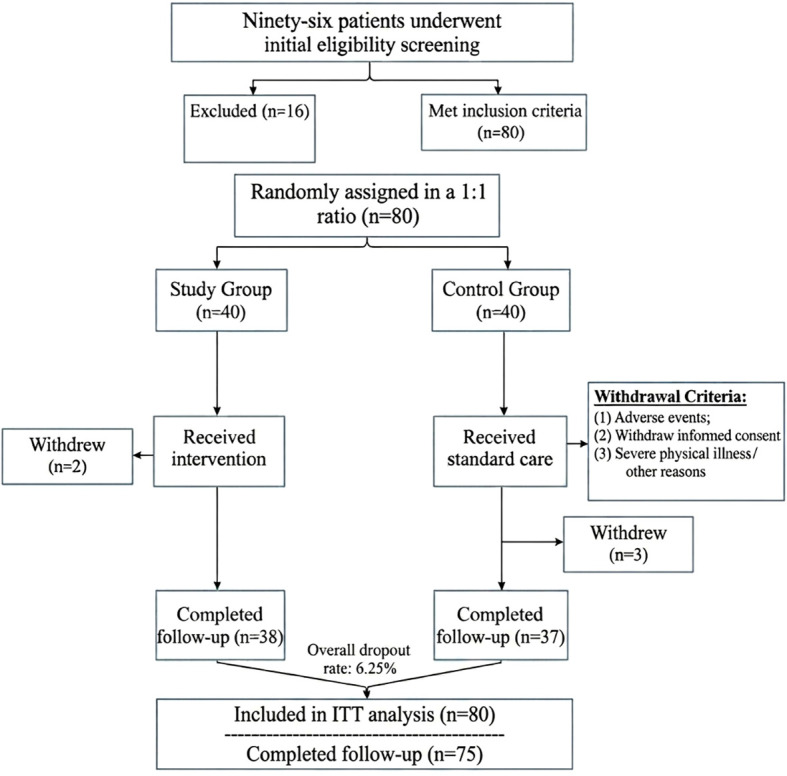
- A total of 75 participants completed the study, while all 80 randomized participants were included in the intention-to-treat analysis; dropout was 6.25% (2 in the study group, 3 in the control group).
Methods
- Single-center, evaluator-blinded RCT conducted at the Geriatric Department of Chongqing Mental Health Center between January 2024 and October 2024. Of 96 patients screened, 80 were enrolled and randomized 1:1 to modified CST plus standard pharmacotherapy (n = 40) or standard pharmacotherapy alone (n = 40), using stratified block randomization by baseline MMSE 10–20 vs 21–24, block size 4, with SAS 9.4; outcome assessments were performed by blinded third-party psychometricians.
- Participants were aged 60–85 years with NIA-AA clinical AD, CDR 1.0 or 2.0, MMSE 10–24, BEHAVE-AD ≥ 8, no significant hearing/visual impairment, and no severe physical illness. All received routine pharmacotherapy: donepezil monotherapy for baseline MMSE 21–24, or donepezil plus memantine for MMSE 10–20. The study group additionally received modified CST: 14 weekly 45-minute sessions in groups of 5–7, with warm-up, themed, and closing activities.
- Primary analysis used intention-to-treat with missing post-intervention data imputed using a worst-case scenario. Post-intervention ADAS-Cog was analyzed by baseline-adjusted ANCOVA; ADL and QOL-AD used the same approach. Predictors of CST efficacy were identified using a two-stage strategy of univariate screening followed by stepwise multivariable regression, with P < 0.05.
Limitations
- The paper states that the sample size was relatively small and the regression analysis was conducted only in the intervention group, so the model may be unstable and vulnerable to overfitting; predictor results should be considered hypothesis-generating. The control group received medication alone without an active social-contact control, so the study cannot fully separate specific cognitive stimulation effects from therapist attention, expectancy, social interaction, and group participation. Follow-up was limited, leaving durability of benefits uncertain.
- Text-evident limitations include the single-center design, the single-blind design (participants and CST implementers were not blinded because of the intervention’s nature), and the authors’ note that the trial was retrospectively registered due to an unintentional oversight.
Model-written summary. Check it against the paper before relying on it.
Integrity signals
Registry
Cites
Statistics
Figures
Verification
Claims the paper makes
0 Valid · 0 Not valid · 22 Not checked · 57 Own results and interpretations
A result the paper reports from its own data — it cites no other source for it, so there is none to check. The quote shows it is in the paper.
In the paper
“Active hobby engagement (β = -0.198, t = -3.304, P = 0.002), regular physical activity (β = -0.278, t = -3.373, P = 0.002), and a higher baseline MMSE score (β = -0.215, t = -3.707, P = 0.001) were also associated with greater reductions in ADAS-Cog scores.”
- Also stated in: § Discussion · hedged
“Baseline cognitive status also appeared to influence the magnitude of benefit.”
§ Efficacy and predictors of cognitive stimulation therapy combined with pharmacotherapy for mild-to-moderate Alzheimer’s disease: a randomized controlled trial > Results > Analysis of predictors of treatment effectiveness
plainstates an association- Asserted: passes — The authors put it forward as true.
- Checkable: passes — It can be checked against evidence.
- Load-bearing: passes — The paper’s conclusions depend on it.
- Based: passes — The paper gives a reason why it holds.
- Also stated in: § Discussion · hedged
A result the paper reports from its own data — it cites no other source for it, so there is none to check. The quote shows it is in the paper.
In the paper
“Higher years of education (β = -0.54, P < 0.001), regular physical activity (β = -0.28, P = 0.003), higher baseline Mini-Mental State Examination (MMSE) scores (β = -0.22, P = 0.001), and active hobbies (β = -0.20, P = 0.002) were significant independent predictors of CST efficacy.”
§ Efficacy and predictors of cognitive stimulation therapy combined with pharmacotherapy for mild-to-moderate Alzheimer’s disease: a randomized controlled trial > Abstract > Results
plainstates an associationn = 75 ·- Asserted: passes — The authors put it forward as true.
- Checkable: passes — It can be checked against evidence.
- Load-bearing: unclear — It is unclear whether the paper’s conclusions depend on it.
- Based: passes — The paper gives a reason why it holds.
A result the paper reports from its own data — it cites no other source for it, so there is none to check. The quote shows it is in the paper.
In the paper
“The decrease was statistically significant in the study group, with scores decreasing from 36.2 ± 3.1 to 30.6 ± 2.8, corresponding to a mean change of -5.6 ± 1.2 points (t = 6.324, P < 0.001).”
- Also stated in: § Cognitive function improvement · plain
“Study Group | 40 | 36.2 ± 3.1 | 30.6 ± 2.8 | -5.6 ± 1.2 | -3.28 | (-3.72, -2.83) | 214.3 | <0.001”
§ Efficacy and predictors of cognitive stimulation therapy combined with pharmacotherapy for mild-to-moderate Alzheimer’s disease: a randomized controlled trial > Results > Cognitive function improvement
plain- Asserted: passes — The authors put it forward as true.
- Checkable: passes — It can be checked against evidence.
- Load-bearing: passes — The paper’s conclusions depend on it.
- Based: passes — The paper gives a reason why it holds.
- Also stated in: § Cognitive function improvement · plain
A result the paper reports from its own data — it cites no other source for it, so there is none to check. The quote shows it is in the paper.
In the paper
“Active hobby engagement (β = -0.198, t = -3.304, P = 0.002), regular physical activity (β = -0.278, t = -3.373, P = 0.002), and a higher baseline MMSE score (β = -0.215, t = -3.707, P = 0.001) were also associated with greater reductions in ADAS-Cog scores.”
- Also stated in: § Discussion · plain
“Regular physical activity was also associated with treatment response.”
§ Efficacy and predictors of cognitive stimulation therapy combined with pharmacotherapy for mild-to-moderate Alzheimer’s disease: a randomized controlled trial > Results > Analysis of predictors of treatment effectiveness
plainstates an association- Asserted: passes — The authors put it forward as true.
- Checkable: passes — It can be checked against evidence.
- Load-bearing: passes — The paper’s conclusions depend on it.
- Based: passes — The paper gives a reason why it holds.
- Also stated in: § Discussion · plain
A result the paper reports from its own data — it cites no other source for it, so there is none to check. The quote shows it is in the paper.
In the paper
“Intergroup comparison showed that the improvement in ADAS-Cog scores was significantly greater in the study group than in the control group, with a mean difference of -3.3 points (95% CI: -4.1, -2.5; t = -2.52; P = 0.008).”
§ Efficacy and predictors of cognitive stimulation therapy combined with pharmacotherapy for mild-to-moderate Alzheimer’s disease: a randomized controlled trial > Results > Cognitive function improvement
plainstates a cause- Asserted: passes — The authors put it forward as true.
- Checkable: passes — It can be checked against evidence.
- Load-bearing: passes — The paper’s conclusions depend on it.
- Based: passes — The paper gives a reason why it holds.
31 more claims
Create a free account to see all 79 claims and to verify the 24 references still open.
- It may state two separate claims as one. 24
- Probably not a substantial claim. 29
Statistics recomputed
Every reported test result, recomputed from its test statistic and degrees of freedom. A result shows as not adding up only once an independent check has confirmed it.
- ConsistentF(4, 35) = 17.82reported p < .001 · recomputed p < .001
“F (4, 35) = 17.82, p < .001”
Self-check
Percentages, sums and reported differences re-computed from the paper’s own numbers.
Each contradiction between two passages listed here was confirmed by an independent check.
Rated minor: it would not touch a result — a value no result rests on, a p-value that stays on the same side of the significance level, or a conflict that is clerical, resolved elsewhere in the paper, or outside its own findings.
In the paper
§ Efficacy and predictors of cognitive stimulation therapy combined with pharmacotherapy for mild-to-moderate Alzheimer’s disease: a randomized controlled trial > Abstract > Results
“regular physical activity (β = -0.28, P = 0.003)”
§ Efficacy and predictors of cognitive stimulation therapy combined with pharmacotherapy for mild-to-moderate Alzheimer’s disease: a randomized controlled trial > Results > Analysis of predictors of treatment effectiveness
“regular physical activity (β = -0.278, t = -3.373, P = 0.002)”
Rated minor: it would not touch a result — a value no result rests on, a p-value that stays on the same side of the significance level, or a conflict that is clerical, resolved elsewhere in the paper, or outside its own findings.
In the paper
“| Variable | | Study group(n = 40) | Control group(n = 40) | T/χ2 value | P value | | --- | --- | --- | --- | --- | --- | | Age (years) | 65-69 | 3 | 4 | 2.858 | 0.582 |”
§ Efficacy and predictors of cognitive stimulation therapy combined with pharmacotherapy for mild-to-moderate Alzheimer’s disease: a randomized controlled trial > Results > Baseline characteristics
Reported 40 · recomputed 20
Citations
Cites
Sample size determination and power analysis using the G*Power software
Kang, H. (2021) · Journal of Educational Evaluation for Health Professions · doi:10.3352/jeehp.2021.18.17 · Cited by 2,572 · cited 1×
“The actual enrollment of 80 patients (40 per group) met the pre-speci fi ed statistical power requirement (19).”
2024 Alzheimer's disease facts and figures
(2024) · Alzheimer's & Dementia · doi:10.1002/alz.13809 · Cited by 2,536
Jia, L., Du, Y., Chu, L., Zhang, Z., Li, F., Lyu, D., Li, Y., Li, Y., Zhu, M., Jiao, H., et al. (2020) · The Lancet Public Health · doi:10.1016/s2468-2667(20)30185-7 · Cited by 1,829
Global, regional, and national burden of Alzheimer's disease and other dementias, 1990–2019
Li, X., Feng, X., Sun, X., Hou, N., Han, F., & Liu, Y. (2022) · Frontiers in Aging Neuroscience · doi:10.3389/fnagi.2022.937486 · Cited by 703
Spector, A., Orrell, M., & Woods, B. (2010) · International Journal of Geriatric Psychiatry · doi:10.1002/gps.2464 · Cited by 196 · cited 1×
“CST is an evidence-based psychosocial intervention that improves patients ’ cognition and quality of life through structured group activities (7).”
Moss, D. E. (2020) · International Journal of Molecular Sciences · doi:10.3390/ijms21103438 · Cited by 124 · cited 1×
“Cholinesterase inhibitors, such as donepezil, increase synaptic acetylcholine availability by inhibiting acetylcholinesterase activity and are widely used to support cholinergic neurotransmission in AD (24).”
Zülke, A. E., Pabst, A., Luppa, M., Roehr, S., Seidling, H., Oey, A., Cardona, M. I., Blotenberg, I., Bauer, A., Weise, S., et al. (2024) · Alzheimer's & Dementia · doi:10.1002/alz.13486 · Cited by 90 · cited 1×
“This multidomain design may encourage patients to repeatedly use preserved cognitive abilities and compensatory strategies in a socially meaningful context (22).”
Nakagomi, A., Tsuji, T., Saito, M., Ide, K., Kondo, K., & Shiba, K. (2023) · Social Science & Medicine · doi:10.1016/j.socscimed.2023.115937 · Cited by 77
Duffner, L. A., Deckers, K., Cadar, D., Steptoe, A., de Vugt, M., & Köhler, S. (2022) · Epidemiology and Psychiatric Sciences · doi:10.1017/s204579602100069x · Cited by 55 · cited 1×
“This result is relevant because leisure activities may represent a current and modi fi able source of cognitive and social engagement (30).”
Carbone, E., Gardini, S., Pastore, M., Piras, F., Vincenzi, M., & Borella, E. (2021) · The Journals of Gerontology: Series B · doi:10.1093/geronb/gbab007 · Cited by 51
Cited by
Martíns, R., Carvalho, N., Loureiro, R., & Loureiro, J. B. (2026) · Brain Sciences · doi:10.3390/brainsci16090944
“…randomized controlled trial published after the search conducted for the present review, Cai et al. compared 14 weekly sessions of modified cognitive stimulation therapy combined with standard pharmacotherapy against pharmacotherapy alone in 80 people with mild-to-moderate Alzheimer’s disease [14].”
Influential
Metadata
- Authors
- Cai, L., Zhao, X., Liao, C., Liu, Q., Hu, S., & Huang, M.
- Affiliations
- Chongqing City Mental Health Center (CN)
- Department of Geriatrics, Chongqing Mental Health Center
- Corresponding author
- Zhao, Xinmin
- ORCID
- Cai, Li
- Venue
- Frontiers in Psychiatry
- Publisher
- Frontiers Media SA
- Published
- 2026-06-26
- Volume
- 17
- Pages
- 1840039-1840039
- ISSN
- 1664-0640 (ISSN-L)
- PMC
- PMC13350246
- OpenAlex
- W7166093680
- Cited by
- 1
- References
- 37
- Citations by year
- 2026: 1
- FWCI
- 2.48
- Type
- journal article
- Language
- en
- Open access
- gold
- doi.org
- Licence
- Locations
- Frontiers in Psychiatry (publishedVersion, cc-by)
- PubMed Central (publishedVersion, cc-by)
- PubMed (publishedVersion)
- DOAJ (DOAJ: Directory of Open Access Journals) (submittedVersion)
- Funders
- Chongqing Municipal Public Health Bureau, Chongqing People's Municipal Government
- Topics
- Health Sciences › Medicine › Psychiatry and Mental health › Dementia and Cognitive Impairment Research
- Life Sciences › Neuroscience › Cellular and Molecular Neuroscience › Alzheimer's disease research and treatments
- Health Sciences › Medicine › Pharmacology (medical) › Cholinesterase and Neurodegenerative Diseases
- Keywords
- Alzheimer's disease, cognitive stimulation therapy, cholinesterase inhibitors, memantine, pharmacotherapy, combination therapy, cognitive function, activities of daily living, quality of life, predictors of treatment efficacy, years of schooling, predictors of treatment response, mild to moderate dementia, cognitive decline, ADAS-Cog, QOL-AD, activities of daily living scale, stepwise regression
About these checks
Registry, retraction, Cites and statistics results are computed, not judged, with one exception: a printed reference that no index lists is read once by a model before it counts as a citation error. Claims are extracted by a model and kept only when their quote appears verbatim in the text; each cited source is then checked, with a model’s help, for whether it says what the claim relies on. Those verdicts can be wrong — read the claim’s quote and the cited source before relying on one.
A language model drew the claims from the paper on 2026-11-27, under version 3 of the claim definition (model deepseek-v4.1-flash, prompt extract-v3).
A second model labelled each claim on 2026-11-27 (model jev-1.13-20260917, definition revision gold-guideline-v0.2).
Statistics and arithmetic are recomputed, not judged.
Confidence bands are shown only for fields calibrated on our annotated test set. None is calibrated yet, so no band is shown.
What counts as a claim ›How we measure confidence ›How we check this ›
Are you an author, or do you see a problem with this page? Request a review
Data sources
Bibliographic data: Semantic Scholar, OpenAlex, Crossref.
Contains information from the Semantic Scholar Academic Graph Datasets, made available under the ODC Attribution License (ODC-BY 1.0).
Semantic Scholar’s data is described in: Kinney, R., et al. (2023). The Semantic Scholar Open Data Platform. arXiv:2301.10140.
