

The DOI matches its Crossref record; 42 of the 42 references it cites were found in a registry or an index.
Perceived entrapment predicts first-onset suicidal ideation: A longitudinal study among medical students in China
Open accessAbstract
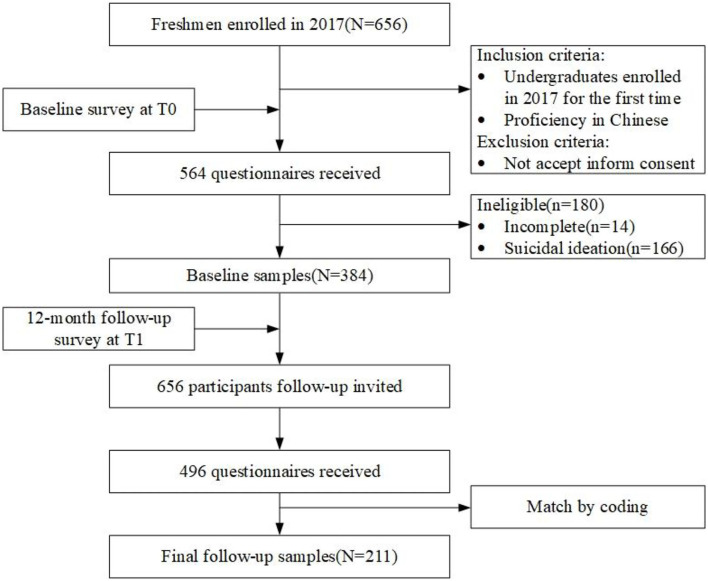
Introduction: The prevalence of suicidal ideation among medical students is high. Evidence indicates that feelings of entrapment are a predictor of suicidal ideation. In this study, we aimed to (1) investigate the prevalence of first-onset suicidal ideation among Chinese medical students and (2) explore the predictive effects of perceived entrapment on first-onset suicidal ideation. Methods: This longitudinal study was conducted between 2018 and 2019 among 211 newly enrolled medical students in Shanghai. Using an anonymous questionnaire, we collected information on sociodemographic (sex, major, parents' income, and academic performance) and psychological (entrapment, depression, loneliness, defeat, social support, and interpersonal needs) variables as well as suicidal ideation. Participants were divided into four subgroups based on their exposure to entrapment (control, new-onset, reduced, and persistent). The primary outcome, first-onset suicidal ideation, was defined as suicidal ideation absent at baseline but present at follow-up. Results: In total, 54.98% of participants (116/211) were women, and 76.78% (162/211) majored in clinical medicine. In the follow-up survey, 6.16% of participants (16/211) reported first-onset suicidal ideation, 17.54% (37/211) reported new-onset entrapment, and 12.80% (27/211) reported persistent entrapment during follow-up. Compared with the control group who reported no perceived entrapment at baseline and follow-up, participants who reported new-onset entrapment had the highest risk of new-onset suicidal ideation [odds ratio (OR) = 14.700, 95% confidence interval (CI) = 2.906–74.364; adjusted OR = 8.798; 95% CI = 1.588–48.757; multivariate OR = 8.238, 95% CI = 1.394–48.693). Conclusion: New-onset entrapment can significantly predict suicidal ideation. Therefore, greater attention is needed for new-onset entrapment, such as intervention for suicidal ideation.
Overview
The claims and statistics of this paper haven’t been checked yet.
Free: it reads the open-access text and checks the first 5 claims that cite a source we can check. Create a free account to check every claim.
Integrity signals
Registry
Cites
Statistics
Figures
Verification
Claims the paper makes
The claims and statistics of this paper haven’t been checked yet.
Free: it reads the open-access text and checks the first 5 claims that cite a source we can check. Create a free account to check every claim.
Claims other papers make about this one
Each is checked against this paper’s own text: does it say what the citing paper says it does?
The source backs part of the claim, not all of it — or backs it for a different population, condition or comparison.
In the citing paper
“The PHQ-9 has been extensively validated by scholars, demonstrating strong reliability and validity (26–28).”
From Prevalence of depressive tendencies among college students and the influence of attributional styles on depressive tendencies in the post-pandemic era (2024) · cites this paper as [27]
Experimental — accuracy not yet measured
Self-check
Percentages, sums and reported differences re-computed from the paper’s own numbers.
The self-check needs the paper’s full text.
Citations
Cites
The PHQ-9: Validity of a brief depression severity measure
Kroenke, K., Spitzer, R. L., & Williams, J. B. W. (2001) · Journal of General Internal Medicine · doi:10.1046/j.1525-1497.2001.016009606.x · Cited by 44,910
Psychometric Characteristics of the Multidimensional Scale of Perceived Social Support
Zimet, G. D., Powell, S. S., Farley, G. K., Werkman, S., & Berkoff, K. A. (1990) · Journal of Personality Assessment · doi:10.1080/00223891.1990.9674095 · Cited by 4,855 · cited 1×
“The MSPSS has been widely used in multiple countries with good reliability and validity (33, 34).”
MethodCross-national prevalence and risk factors for suicidal ideation, plans and attempts
Nock, M. K., Borges, G., Bromet, E. J., Alonso, J., Angermeyer, M., Beautrais, A., Bruffaerts, R., Chiu, W. T., de Girolamo, G., Gluzman, S., et al. (2008) · British Journal of Psychiatry · doi:10.1192/bjp.bp.107.040113 · Cited by 2,654 · cited 2×
“Decades of studies showed that the development of suicide ideation is complex (4, 8).”
BackgroundRotenstein, L. S., Ramos, M. A., Torre, M., Segal, J. B., Peluso, M. J., Guille, C., Sen, S., & Mata, D. A. (2016) · JAMA · doi:10.1001/jama.2016.17324 · Cited by 2,479 · cited 6×
“In this study, we aimed to (1) investigate the prevalence of first-onset suicidal ideation among Chinese medical students and (2) explore the predictive e ects of perceived entrapment on first-onset suicidal ideation.”
BackgroundMethodInfluentialThe integrated motivational–volitional model of suicidal behaviour
O'Connor, R. C., & Kirtley, O. J. (2018) · Philosophical Transactions of the Royal Society B: Biological Sciences · doi:10.1098/rstb.2017.0268 · Cited by 1,781 · cited 1×
“Our research demonstrated the close relationship between entrapment, especially new-onset entrapment, and firstonset suicidal ideation, which supports the IMV model (45, 46), corroborating that perceived entrapment is an important predictor of first-onset suicidal ideation.”
ResultSuicide, Suicide Attempts, and Suicidal Ideation
Klonsky, E. D., May, A. M., & Saffer, B. Y. (2016) · Annual Review of Clinical Psychology · doi:10.1146/annurev-clinpsy-021815-093204 · Cited by 1,675 · cited 1×
“Suicidal ideation is a broad term defined as thinking about, considering, or planning suicide (7).”
BackgroundBurnout and Suicidal Ideation among U.S. Medical Students
Dyrbye, L. N., Thomas, M. R., Massie, F. S., Power, D. V., Eacker, A., Harper, W., Durning, S., Moutier, C., Szydlo, D. W., Novotny, P. J., et al. (2008) · Annals of Internal Medicine · doi:10.7326/0003-4819-149-5-200809020-00008 · Cited by 1,532 · cited 1×
“First-onset suicidal ideation Suicidal ideation was measured by asking students: “Have you ever had thoughts of taking your own life?” (T0) and “During the past 12 months, have you had thoughts of taking your own life?” (T1) (37).”
MethodA Short-Form Measure of Loneliness
Hays, R., & DiMatteo, M. R. (1987) · Journal of Personality Assessment · doi:10.1207/s15327752jpa5101_6 · Cited by 1,192 · cited 1×
“Loneliness The 8-item UCLA Loneliness Scale (ULS-8) was used to evaluate loneliness among participants (31).”
MethodHaro, J. M., Arbabzadeh-Bouchez, S., Brugha, T. S., De Girolamo, G., Guyer, M. E., Jin, R., Lepine, J. P., Mazzi, F., Reneses, B., Vilagut, G., et al. (2006) · International Journal of Methods in Psychiatric Research · doi:10.1002/mpr.196 · Cited by 1,082 · cited 1×
“Finally, although the assessment of mental disorders was based on self-reports, evidence shows good diagnostic agreement with clinical judgment (47).”
BackgroundGILBERT, P., & ALLAN, S. (1998) · Psychological Medicine · doi:10.1017/s0033291798006710 · Cited by 972
Research works printed but not linked: 5
- Joiner, 2005, Cambridge, MA: Harvard University Press, 2082
- Ya-Min, 2014, Determinant factors of suicidal ideation among college students: a meta-analysis, Chin J Clin Psychol, 22, 4
- Gong, 2019, Validity and reliability of the Chinese vision of the entrapment scale in medical students, Chin Mental Health J., 33, 393, 10.3969/j.issn.1000-6729.2019.05.015 · doi:10.3969/j.issn.1000-6729.2019.05.015
- Wei, 2013, A Research on Psychological Health Status and Psychological Disorder Prevention Among Freshmen of Shanghai Colleges.
- Tang, 2019, Reliability and validity of defeat scale on anxiety and depression in medical students, J Shanghai Jiaotong Univ., 39, 84, 10.3969/j.issn.1674-8115.2019.01.016 · doi:10.3969/j.issn.1674-8115.2019.01.016
Cited by
Luo, M.-M., Hao, M., Li, X.-H., Liao, J., Wu, C.-M., & Wang, Q. (2024) · Frontiers in Public Health · doi:10.3389/fpubh.2024.1326582 · Cited by 40
Chabbouh, A., Charro, E., Tekle, G.-A. A., Soufia, M., & Hallit, S. R. (2024) · Psicologia Reflexão e Crítica · doi:10.1186/s41155-024-00286-2 · Cited by 8
“…risk assessment, entrapment has been shown to be a strong moderator of suicide in various settings, itself moderated by variables like positive mental health and self-acceptance (Li et al., 2018; O’Connor & Portzky, 2018; Shelef et al., 2016; Teismann & Brailovskaia, 2020; Wang et al., 2023).”
BackgroundResultQi, Y., Zhu, W., An, Z., Lu, Q., Zhao, M., Zhang, T., Zong, J., Xue, P., & Gao, Y. (2025) · Humanities and Social Sciences Communications · doi:10.1057/s41599-025-06164-1 · Cited by 9
“Total scores range from 8 to 32, and scores of 17 or higher are classi fi ed as indicative of loneliness (Wang et al., 2022), with higher scores indicating greater levels of loneliness.”
S., R. S., Ramachandran, R., Chalil, S., & S, K. R. J. (2025) · National Journal of Medical Research · doi:10.55489/njmr.150420251137
“This is in line two distinct studies from North India by Garg et al[12,14], and studies done in Ethiopia[16] and China[17].”
Predictive linguistic markers of suicidal ideation in autobiographical memory narratives
Ballı, M., Sabitay, I. K., Güçlü, O., Gülgöz, S., & Eser, H. Y. (2026) · Psychiatry Research · doi:10.1016/j.psychres.2026.117396
Metadata
- Authors
- Wang, S., Wei, T., Zhu, R., Li, S., Liu, X., Cai, Y., & Gong, R.
- Affiliations
- Tongji University (CN)
- Shanghai Jiao Tong University (CN)
- Corresponding author
- Cai, Yong
- Gong, Ruijie
- Venue
- Frontiers in Public Health
- Publisher
- Frontiers Media SA
- Published
- 2023-01-19
- Volume
- 10
- Pages
- 1049975-1049975
- ISSN
- 2296-2565 (ISSN-L)
- PMC
- PMC9892625
- OpenAlex
- W4317387898
- Semantic Scholar
- 46c25f1d59d88bc9ec9ab9a2bff155037aff5cf7
- Cited by
- 5
- References
- 42
- Citations by year
- 2026: 1 · 2025: 2 · 2024: 2
- FWCI
- 1.45
- Type
- journal article
- Language
- en
- Open access
- gold
- doi.org
- Licence
- Locations
- Frontiers in Public Health (publishedVersion, cc-by)
- PubMed Central (publishedVersion, cc-by)
- PubMed (publishedVersion)
- DOAJ (DOAJ: Directory of Open Access Journals) (submittedVersion, cc-by-sa)
- Funders
- National Key Research and Development Program of China
- Topics
- Social Sciences › Psychology › Clinical Psychology › Suicide and Self-Harm Studies
- Health Sciences › Health Professions › General Health Professions › Healthcare professionals’ stress and burnout
- Health Sciences › Medicine › Psychiatry and Mental health › Mental Health Treatment and Access
- Keywords
- suicidal ideation, medical students, depression, loneliness, social support, interpersonal needs, suicide risk prediction, Chinese medical students
- MeSH terms
- China, Female, Humans, Longitudinal Studies, Male, Risk Factors, Students, Medical, Suicidal Ideation
About these checks
Registry, retraction, Cites and statistics results are computed, not judged, with one exception: a printed reference that no index lists is read once by a model before it counts as a citation error. Claims are extracted by a model and kept only when their quote appears verbatim in the text; each cited source is then checked, with a model’s help, for whether it says what the claim relies on. Those verdicts can be wrong — read the claim’s quote and the cited source before relying on one.
Statistics and arithmetic are recomputed, not judged.
Confidence bands are shown only for fields calibrated on our annotated test set. None is calibrated yet, so no band is shown.
What counts as a claim ›How we measure confidence ›How we check this ›
Are you an author, or do you see a problem with this page? Request a review
How to cite
Cite CoChat for the checks on this page, and the paper for its own findings.
- This page
- CoChat. (2026). Citation check: Perceived entrapment predicts first-onset suicidal ideation: A longitudinal study among medical students in China. https://app.cochat.ai/papers/10.3389/fpubh.2022.1049975
- The paper
- Wang, S., Wei, T., Zhu, R., Li, S., Liu, X., Cai, Y., & Gong, R. (2023). Perceived entrapment predicts first-onset suicidal ideation: A longitudinal study among medical students in China. Frontiers in Public Health. https://doi.org/10.3389/fpubh.2022.1049975
Data sources
Bibliographic data: Semantic Scholar, OpenAlex, Crossref.
Contains information from the Semantic Scholar Academic Graph Datasets, made available under the ODC Attribution License (ODC-BY 1.0).
Semantic Scholar’s data is described in: Kinney, R., et al. (2023). The Semantic Scholar Open Data Platform. arXiv:2301.10140.
