

A comprehensive review on NUI, multi-sensory interfaces and UX design for applications and devices for visually impaired users
Open accessThe DOI matches its Crossref record; 56 of the 57 references it cites were found in a registry or an index.
Abstract
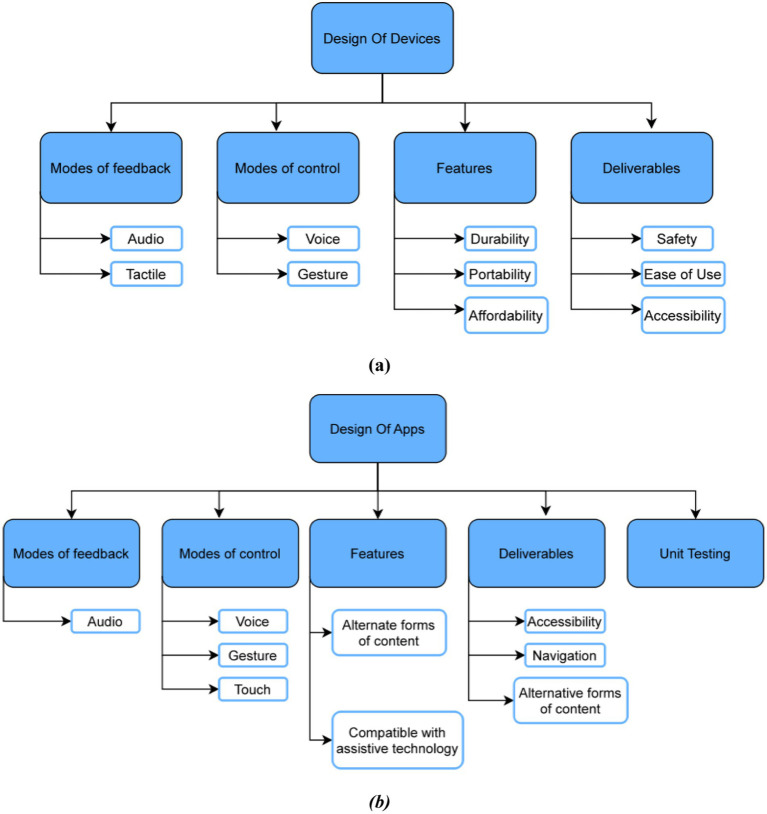
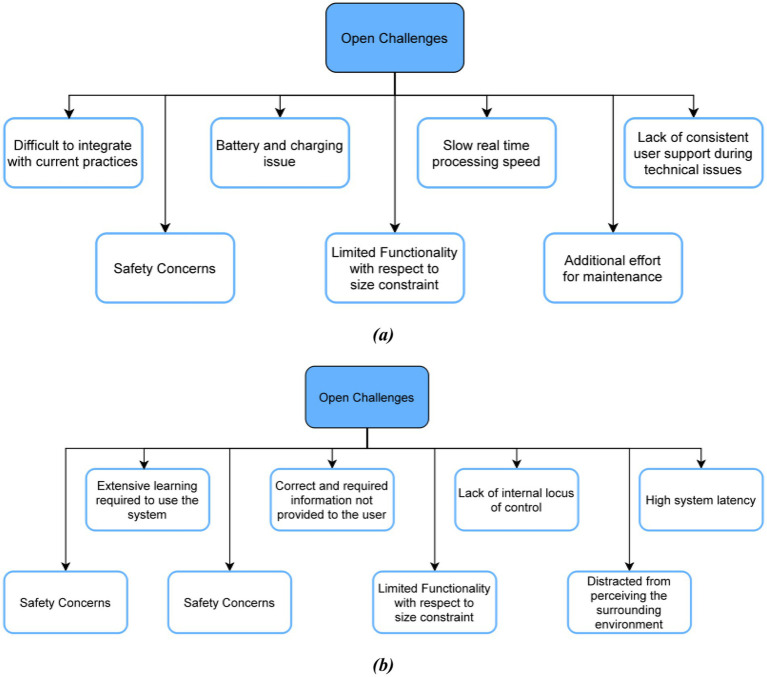
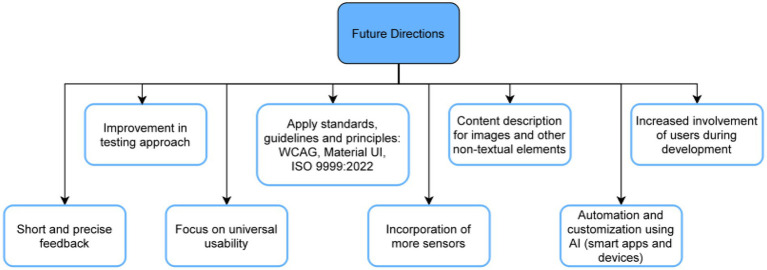
In today’s world, there has been a significant increase in the use of devices, gadgets, and mobile applications in our daily activities. Although this has had a significant impact on the lives of the general public, people who are Partially Visually Impaired SPVI, which includes a much broader range of vision loss that includes mild to severe impairments, and Completely Visually Impaired (CVI), who have no light perception, still face significant obstacles when trying to access and use these technologies. This review article aims to provide an overview of the NUI, Multi-sensory Interfaces and UX Design (NMUD) of apps and devices specifically tailored CVI and PVI individuals. The article begins by emphasizing the importance of accessible technology for the visually impaired and the need for a human-centered design approach. It presents a taxonomy of essential design components that were considered during the development of applications and gadgets for individuals with visual impairments. Furthermore, the article sheds light on the existing challenges that need to be addressed to improve the design of apps and devices for CVI and PVI individuals. These challenges include usability, affordability, and accessibility issues. Some common problems include battery life, lack of user control, system latency, and limited functionality. Lastly, the article discusses future research directions for the design of accessible apps and devices for visually impaired individuals. It emphasizes the need for more user-centered design approaches, adherence to guidelines such as the Web Content Accessibility Guidelines, the application of e-accessibility principles, the development of more accessible and affordable technologies, and the integration of these technologies into the wider assistive technology ecosystem.
Overview
The claims and statistics of this paper haven’t been checked yet.
Free: it reads the open-access text and checks the first 5 claims that cite a source we can check. Create a free account to check every claim.
Integrity signals
Registry
Cites
Statistics
Figures
Verification
Claims the paper makes
The claims and statistics of this paper haven’t been checked yet.
Free: it reads the open-access text and checks the first 5 claims that cite a source we can check. Create a free account to check every claim.
Self-check
Percentages, sums and reported differences re-computed from the paper’s own numbers.
The self-check needs the paper’s full text.
Citations
Cites
Csapó, Á., Wersényi, G., Nagy, H., & Stockman, T. (2015) · Journal on Multimodal User Interfaces · doi:10.1007/s12193-015-0182-7 · Cited by 181
Khan, A., & Khusro, S. (2021) · Universal Access in the Information Society · doi:10.1007/s10209-020-00733-8 · Cited by 177
Simple Smartphone-Based Guiding System for Visually Impaired People
Lin, B.-S., Lee, C.-C., & Chiang, P.-Y. (2017) · Sensors · doi:10.3390/s17061371 · Cited by 153
BrailleTouch: Mobile Texting for the Visually Impaired
Frey, B., Southern, C., & Romero, M. (2011) · Lecture notes in computer science · doi:10.1007/978-3-642-21666-4_3 · Cited by 130
Gurcan, F., Cagiltay, N. E., & Cagiltay, K. (2021) · International Journal of Human–Computer Interaction · doi:10.1080/10447318.2020.1819668 · Cited by 116
Head-Mounted Display Technology for Low-Vision Rehabilitation and Vision Enhancement
Ehrlich, J. R., Ojeda, L. V., Wicker, D., Day, S., Howson, A., Lakshminarayanan, V., & Moroi, S. E. (2017) · American Journal of Ophthalmology · doi:10.1016/j.ajo.2016.12.021 · Cited by 95
Usability and Design Guidelines of Smart Canes for Users with Visual Impairments
Kim, S. Y., & Cho, K. (2013) · International journal of design · Cited by 90
Antimalarial Plants Used across Kenyan Communities
Omara, T. (2020) · Evidence-based Complementary and Alternative Medicine · doi:10.1155/2020/4538602 · Cited by 88
Chaudary, B., Pohjolainen, S., Aziz, S., Arhippainen, L., & Pulli, P. J. (2021) · Virtual Reality · doi:10.1007/s10055-021-00536-z · Cited by 82
Kim, H. K., Han, S. H., Park, J., & Park, J. (2016) · International Journal of Industrial Ergonomics · doi:10.1016/j.ergon.2016.07.002 · Cited by 80
Research works printed but not linked: 38
- Pohjolainen S. (2020). Usability and user experience evaluation model for investigating coordinated assistive technologies with blind and visually impaired (Doctoral dissertation, Master's thesis, University of Oulu).
- Torres-Carazo M. I., Rodriguez-Fortiz M. J., Hurtado M. V. (2016). "Analysis and review of apps and serious games on mobile devices intended for people with visual impairment. " 2016 IEEE international conference on serious games and applications for health (SeGAH), serious games and applications for health (SeGAH), 1-8.
- Kim W. J., Kim I. K., Jeon M. K., Kim J. (2016). "UX design guideline for health Mobile application to improve accessibility for the visually impaired. " 2016 international conference on platform technology and service (PlatCon), platform technology and service (PlatCon), 1-5.
- Crow KL. Universal design principles: An overview. Annual Proceedings Anaheim. (2007) 2:99.
- Buzzi Marina, Leporini Barbara, Meattini Clara. (2018). Simple smart HomesWeb interfaces for blind people. 223-230.
- Helal A., Moore S. E., Ramachandran B. (2001). "Drishti: an integrated navigation system for visually impaired and disabled. " Proceedings fifth international symposium on wearable computers, wearable computers, 2001. Proceedings. Fifth International Symposium on, Wearable Computers, 149-156.
- Harjumaa M., Isomursu M., Muuraiskangas S., Konttila A. (2011). "HearMe: a touch-to-speech UI for medicine identification. " 2011 5th international conference on pervasive computing Technologies for Healthcare (PervasiveHealth) and workshops, pervasive computing Technologies for Healthcare (PervasiveHealth), 85-92.
- Devkar S., Lobo S., Doke P. (2015). "A grounded theory approach for designing communication and collaboration system for visually impaired chess players. " In Universal access in human-computer interaction. Access to Today's technologies: 9th international conference, UAHCI 2015, held as part of HCI international 2015, Los Angeles, CA, USA, august 2-7, 2015, proceedings, part I 9 (pp. 415-425). Springer International Publishing.
- Aiordachioae A., Schipor O.-A., Vatavu R.-D. (2020). "An inventory of voice input commands for users with visual impairments and assistive smart glasses applications. " 2020 international conference on development and application systems (DAS), development and application systems (DAS), 146-150.
- Chen H.-E., Chen C.-H., Lin Y.-Y., Wang I.-F. (2015). "BlindNavi: a navigation app for the visually impaired smartphone user. " Conference on Human Factors in Computing Systems -Proceedings, 18, 19-24.
- Landazabal N. P., Andres Mendoza Rivera O., Martınez M.H, Uchida B. T. (2019). "Design and implementation of a mobile app for public transportation services of persons with visual impairment (TransmiGuia). " 2019 22nd symposium on image, signal processing and artificial vision, STSIVA 2019 -conference proceedings.
- Albraheem L., Almotiry H., Abahussain H., AlHammad L., Alshehri M. (2014). "Toward designing efficient application to identify objects for visually impaired. " In 2014 IEEE international conference on computer and information technology (pp. 345-350). IEEE
- Al-Busaidi A., Kumar P., Jayakumari C., Kurian P. (2017). "User experiences system design for visually impaired and blind users in Oman. " In 2017 6th international conference on information and communication technology and accessibility (ICTA) (pp. 1-5). IEEE.
- Liimatainen J., Nousiainen T., Kankaanranta M. (2012). "A mobile application concept to encourage independent mobility for blind and visually impaired students. " In Computers helping people with special needs: 13th international conference, ICCHP 2012, Linz, Austria, July 11-13, 2012, proceedings, part II 13 (pp. 552-559). Springer Berlin Heidelberg.
- Ferati M., Vogel B., Kurti A., Raufi B., Astals D. S. (2016). "Web accessibility for visually impaired people: requirements and design issues. " In Usability-and accessibility- focused requirements engineering: First international workshop, UsARE 2012, held in conjunction with ICSE 2012, Zurich, Switzerland, June 4, 2012 and second international workshop, UsARE 2014, held in conjunction with RE 2014, Karlskrona, Sweden, august 25, 2014, revised selected papers 1 (pp. 79-96). Springer International Publishing.
- Alvarez Robles T, Sanchez Orea A., Alvarez Rodriguez F. J. (2019). "User eXperience (UX) evaluation of a Mobile geolocation system for people with visual impairments. " 2019 international conference on inclusive technologies and education (CONTIE), inclusive technologies and education (CONTIE), 28-286.
- Francis H., Al-Jumeily D., Lund T. O. (2013). "A framework to support ECommerce development for people with visual impairment. " 2013 sixth international conference on developments in ESystems engineering, developments in ESystems engineering (DeSE), 2010, 335-341.
- Matusiak K., Skulimowski P., Strumillo P. (2013). "Object recognition in a mobile phone application for visually impaired users. " 2013 6th international conference on human system interactions (HSI), human system interaction (HSI), 479-484.
- Garg S., Singh R. K., Saxena R. R., Kapoor R. (2014). "Doppler effect: UIInput method using gestures for the visually impaired. " 2014 Texas Instruments India educators' conference (TIIEC), India educators' conference (TIIEC), 86-92.
- Pandey D., Pandey K. (2021). "An assistive technology-based approach towards helping visually impaired people." 2021 9th international conference on reliability, Infocom technologies and optimization (trends and future directions) (ICRITO), 1-5.
- Mon C. S., Meng Yap K., Ahmad A. (2019). "A preliminary study on requirements of olfactory, haptic and audio enabled application for visually impaired in edutainment. " 2019 IEEE 9th symposium on computer applications & industrial electronics (ISCAIE), computer applications & industrial electronics (ISCAIE), 249-253.
- Zouhaier L., Hlaoui Y. B., Ben Ayed L. J. (2017). "Users interfaces adaptation for visually impaired users based on meta-model transformation. " 2017 IEEE 41st annual computer software and applications conference (COMPSAC), computer software and applications conference (COMPSAC), 881-886.
- Rizan T., Siriwardena V., Raleen M., Perera L., Kasthurirathna D. (2021). "Guided vision: a high efficient and low latent Mobile app for visually impaired. " 2021 3rd international conference on advancements in computing (ICAC), advancements in computing (ICAC), 246-251.
- Rose M. M., Ghazali M. (2023). Improving navigation for blind people in the developing countries: A UI/UX perspective. Journal of Human Centered Technology.
- Kasthuri R., Nivetha B., Shabana S., Veluchamy M., Sivakumar S. (2017). "Smart device for visually impaired people. " In 2017 third international conference on Science Technology Engineering & Management (ICONSTEM) (pp. 54-59). IEEE.
- Huppert F., Hoelzl G., Kranz M. (2021). "GuideCopter-A precise drone based haptic guidance interface for blind or visually impaired people. " In Proceedings of the 2021 CHI conference on human factors in computing systems (pp. 1-14).
- Vanderheiden G., Tobias J. (2000). "Universal design of consumer products: current industry practice and perceptions. " In Proceedings of the human factors and ergonomics society annual meeting (Vol. 44, pp. 6-19). Sage CA: Los Angeles, CA: SAGE Publications.
- Power C., Pimenta Freire A., Petrie H., Swallow D. (2012). Guidelines are only half of the story: Accessibility problems encountered by blind users on the web. Association for Computing Machinery, CHI '12: Proceedings of the SIGCHI Conference on Human Factors in Computing Systems, 2012. 433-442.
- Stein V., Nebelrath R., Alexandersson J. (2011). "Designing with and for the visually impaired: vocabulary, spelling and the screen reader. " CSEDU 2011 -proceedings of the 3rd international conference on computer supported education, 2, 462-467.
- Russ K. C. W. (2017). "An assistive mobile application i-AIM app with accessibleUI implementation for visually-impaired and aging users." 2017 6th international conference on information and communication technology and accessibility (ICTA), 1-6.
- Marvin E. (2020). "Digital assistant for the visually impaired. " 2020 international conference on artificial intelligence in information and communication (ICAIIC), 723-728.
- Wang R, Yu C, He W, Shi Y, Yang X.-D. (2019). "Eartouch: facilitating smartphone use for visually impaired people in mobile and public scenarios. " Conference on Human Factors in Computing Systems Proceedings.
- Zhang M. R., Wang R. (2021). "Voicemoji: emoji entry using voice for visually impaired people." Conference on Human Factors in Computing Systems - Proceedings. 100.
- Yusril AN. E-accessibility analysis in user experience for people with disabilities.
- Sierra J. S., Togores J. (2012). "Designing mobile apps for visually impaired and blind users. " In The fifth international conference on advances in computer-human interactions (pp. 47-52). 112. Liu K.-C., Wu C.-H., Tseng S.-Y., Tsai Y.-T. (2015). "Voice helper: a Mobile assistive system for visually impaired persons." 2015 IEEE international conference on computer and information technology; ubiquitous computing and communications; dependable, autonomic and secure computing; pervasive intelligence and computing, computer and information technology; ubiquitous computing and communications; dependable, autonomic and secure computing; pervasive intelligence and computing (CIT/IUCC/DASC/PICOM), 1400-1405. 113.
- Ghidini E., Almeida W. D. L., Manssour I. H., Silveira M. S. (2016). "Developing apps for visually impaired people: lessons learned from practice. " Proceedings of the annual Hawaii international conference on system sciences. 114.
- Jakhete S. A., Bagmar P., Dorle A., Rajurkar A., Pimplikar P. (2019). "Object recognition app for visually impaired. " 2019 IEEE Pune section international conference (PuneCon), Pune section international conference (PuneCon), 2019 IEEE, 1-4. 115.
- Calabro, 2010, Book4All: A tool to make an e-book more accessible to students with vision/visual-impairments, 236
Cited by
Hu, S., Song, D., Wan, S., Zhang, S., Luo, C., Li, N., Liu, G., Vasconcelos, J. D. G. E. S., de Carvalho, L. L. C., Neobísi, E., et al. (2025) · Frontiers in Public Health · doi:10.3389/fpubh.2025.1646802 · Cited by 83
AI-Driven Personalized Nutrition Apps and Platforms for Enhanced Diet and Wellness
Prasad, G., Padhiary, M., Hoque, A., & Kumar, K. (2025) · Advances in computational intelligence and robotics book series · doi:10.4018/979-8-3693-9025-2.ch006 · Cited by 42
Liu, L., Li, K., & Li, D. (2025) · Frontiers in Psychiatry · doi:10.3389/fpsyt.2024.1521926 · Cited by 23
Leveraging big data in health care and public health for AI driven talent development in rural areas
Zhou, J., Li, L., & Su, J. (2025) · Frontiers in Public Health · doi:10.3389/fpubh.2025.1524805 · Cited by 10
Exploring LLM Agents as Seamless and Context-aware UI Adjusters for the Visually Impaired
Tang, K., Quinlan, M., & Cho, Y. (2025) · ACM International Joint Conference on Pervasive and Ubiquitous Computing (UbiComp) · doi:10.1145/3714394.3754391 · Cited by 5
Lukyanenko, R. (2025) · Qeios · doi:10.32388/0386ck
Искусственный интеллект для управления всеми человеческими даннымиPreprint
Lukyanenko, R. (2025) · doi:10.24108/preprints-3113532
Psychosocial Approaches on Vision Loss Rehabilitation: A Comprehensive Review
Kumari, R. (2025) · Journal of Multiple Sclerosis Research · doi:10.4274/jmsr.galenos.2025.2025-9-2
Cox, W. R., Spann, B., & Huff, P. (2025) · Conference on Information Technology Education · doi:10.1145/3769694.3771111 · Cited by 1
Rahman, M. A., Ahmed, H., Hossain, M. M., Chaki, S., Suzuki, T., Shin, J., & Islam, M. N. (2026) · Multimedia Tools and Applications · doi:10.1007/s11042-026-21446-9
Hippy, K. R., Linduaji, M. G. P., & Jingga, F. (2026) · doi:10.1109/it67293.2026.11435688
“…the smartphone evolving into a modern necessity and the WHO estimating that 2.2 billion people globally suffer from vision impairment, application design must urgently shift towards inclusivity to ensure interfaces are not just feature-rich but fundamentally accessible for daily independence [4].”
InfluentialTechnical, Legal, and Health Aspects for Noise Disturbance Mitigation in Human-Centric Environments
Brasileiro, P. P. F., Brasileiro, M. C. S. L., Eloy, R. M., dos Santos, K. M. A., Sarubbo, L. A., & Cavalcanti, L. M. (2026) · Sustainability · doi:10.3390/su18083726
Сравнительный анализ характеристик алгоритмов детекции
Некрасов, Е., Дегтярь, А., Markina, T. A., & Государев, И. (2026) · Cifra LLC Journals · doi:10.60797/irj.2026.168.49.3
Некрасов, Е., Дегтярь, А., Markina, T. A., & Государев, И. (2026) · CyberLeninK (CyberLeninka) · doi:10.60797/irj.2026.168.48
Результат работы системы распознавания объектов
Некрасов, Е., Дегтярь, А., Markina, T. A., & Государев, И. (2026) · Cifra LLC Journals · doi:10.60797/irj.2026.168.49.2
Сравнительные характеристики алгоритмов
Некрасов, Е., Дегтярь, А., Markina, T. A., & Государев, И. (2026) · Cifra LLC Journals · doi:10.60797/irj.2026.168.49.1
Классификация элементов приложений для людей с нарушениями зрения
Некрасов, Е., Дегтярь, А., Markina, T. A., & Государев, И. (2026) · Cifra LLC Journals · doi:10.60797/irj.2026.168.48.2
Классификация мультимодальных интерфейсов и UX-дизайна приложений с учетом пользовательского опыта
Некрасов, Е., Дегтярь, А., Markina, T. A., & Государев, И. (2026) · Cifra LLC Journals · doi:10.60797/irj.2026.168.48.1
Некрасов, Е., Дегтярь, А., Markina, T. A., & Государев, И. (2026) · CyberLeninK (CyberLeninka) · doi:10.60797/irj.2026.168.49
Semiotics, Culture, and Design: A Comprehensive Survey of Restroom Signage
Iio, J. (2026) · Lecture notes in computer science · doi:10.1007/978-3-032-29593-4_28
Irianti, R. D., Dianta, A. F., Darmawan, Z. M. E., Alia, P. A., & Sari, C. (2026) · Jurnal Rekayasa Sistem Informasi dan Teknologi · doi:10.70248/jrsit.v3i4.3829
Panwar, V. S., Kumbhar, D., Kumbharkar, V., Karale, V., Mundhe, S., Tomar, D., Pandey, A., & Kumar, P. (2026) · Disability and Rehabilitation Assistive Technology · doi:10.1080/17483107.2026.2716561 · Cited by 1
A Secure Multi-Phase Accessible E-Voting System for Visually Impaired Users
Shat Mohammed, Z. M., & Mocanu, M. (2026) · International Conference on Computer Systems and Technologies (CompSysTech) · doi:10.1109/compsystech69798.2026.11683151
“Arora et al. reached similar conclusions in a broader review of multi-sensory NUI design, finding that audio-tactile feedback working in sync makes a measurable difference to task completion [8].”
Cinar, O. E., Yılmaz, Y., Keskin, S., & Yaşar, Y. E. (2026) · Fırat Üniversitesi Mühendislik Bilimleri Dergisi · doi:10.35234/fumbd.1970791
Metadata
- Authors
- Arora, L., Choudhary, A., Bhatt, M., Kaliappan, J., & Srinivasan, K.
- Affiliations
- Vellore Institute of Technology University (IN)
- Corresponding author
- Kaliappan, Jayakumar
- Venue
- Frontiers in Public Health
- Publisher
- Frontiers Media SA
- Published
- 2024-10-25
- Volume
- 12
- Pages
- 1357160-1357160
- ISSN
- 2296-2565 (ISSN-L)
- PMC
- PMC11543423
- OpenAlex
- W4403779250
- Cited by
- 22
- References
- 57
- Citations by year
- 2026: 13 · 2025: 9
- FWCI
- 4.13
- Type
- journal article
- Language
- en
- Open access
- gold
- doi.org
- Licence
- Locations
- Frontiers in Public Health (publishedVersion, cc-by)
- PubMed Central (publishedVersion, cc-by)
- PubMed (publishedVersion)
- DOAJ (DOAJ: Directory of Open Access Journals) (submittedVersion)
- Funders
- VIT University
- Topics
- Social Sciences › Human Factors and Ergonomics › Digital Accessibility for Disabilities
- Health Sciences › Health Professions › Occupational Therapy › Assistive Technology in Communication and Mobility
- Physical Sciences › Computer Science › Human-Computer Interaction › Usability and User Interface Design
- Keywords
- user experience design, visual impairment, accessible technology, assistive technology, human-centered design, Web Content Accessibility Guidelines, digital accessibility, usability, affordability
- MeSH terms
- Equipment Design, Humans, Self-Help Devices, User-Computer Interface, Persons with Visual Disabilities, Mobile Applications
About these checks
Registry, retraction, Cites and statistics results are computed, not judged, with one exception: a printed reference that no index lists is read once by a model before it counts as a citation error. Claims are extracted by a model and kept only when their quote appears verbatim in the text; each cited source is then checked, with a model’s help, for whether it says what the claim relies on. Those verdicts can be wrong — read the claim’s quote and the cited source before relying on one.
Statistics and arithmetic are recomputed, not judged.
Confidence bands are shown only for fields calibrated on our annotated test set. None is calibrated yet, so no band is shown.
What counts as a claim ›How we measure confidence ›How we check this ›
Are you an author, or do you see a problem with this page? Request a review
Data sources
Bibliographic data: Semantic Scholar, OpenAlex, Crossref.
Contains information from the Semantic Scholar Academic Graph Datasets, made available under the ODC Attribution License (ODC-BY 1.0).
Semantic Scholar’s data is described in: Kinney, R., et al. (2023). The Semantic Scholar Open Data Platform. arXiv:2301.10140.
