

The DOI matches its Crossref record; 23 of the 23 references it cites were found in a registry or an index.
Analysis of epidemiological characteristics of extrapulmonary tuberculosis from South-Central China
Open accessAbstract
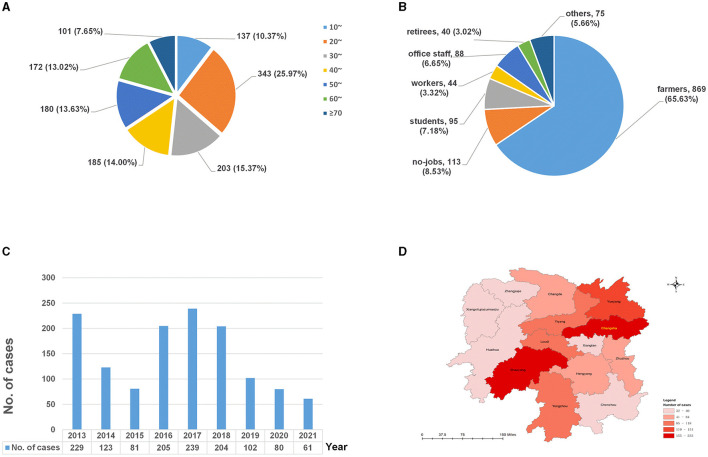
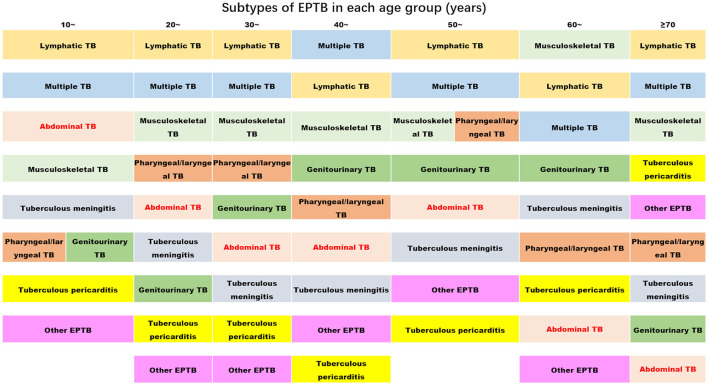
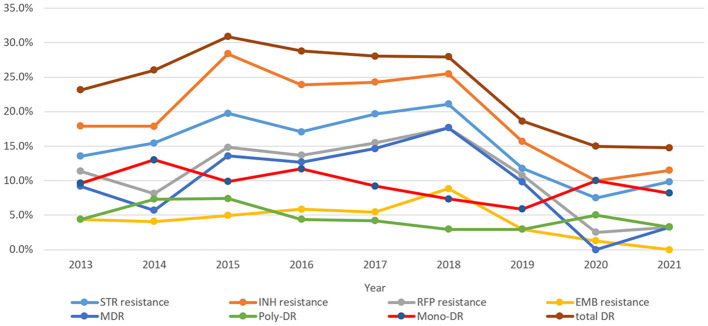
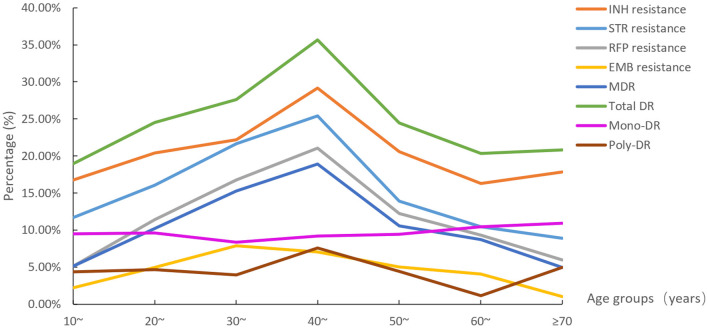
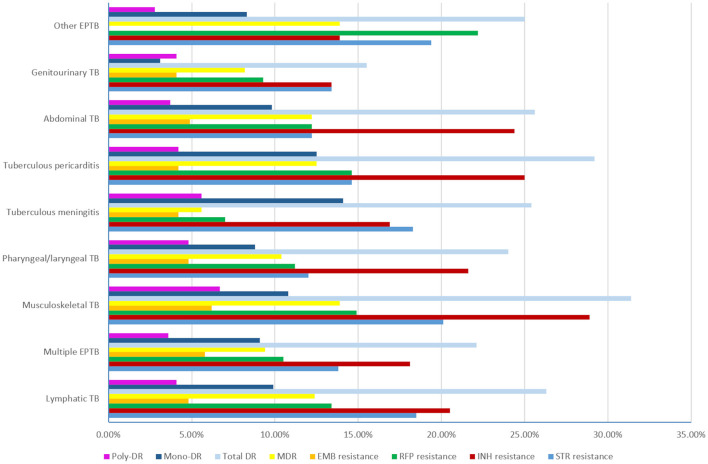
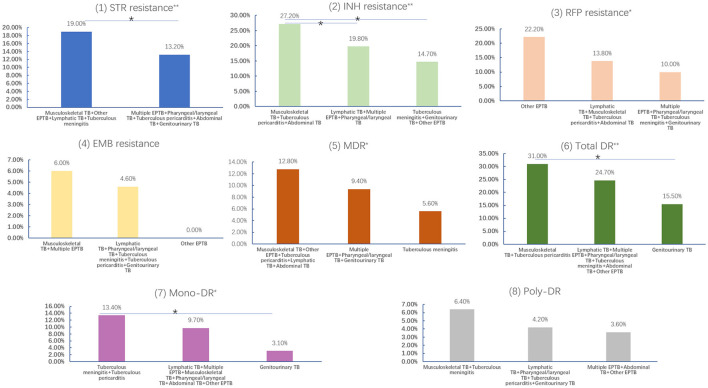
Objectives: This study aimed to investigate the epidemiological and drug resistance (DR) characteristics of extrapulmonary tuberculosis (EPTB) in South-Central China. Methods: EPTB inpatients who were culture-positive for Mycobacterium tuberculosis were retrospectively included in a study at a provincial TB hospital in Hunan, a province in South-Central China, from January 2013 to December 2021. Demographic, clinical, and drug susceptibility data were retrieved from TB treatment records. Descriptive statistical methods and a Chi-squared test were used to analyze the epidemiological and DR characteristics of EPTB patients. A logistic regression model was used to explore the risk factors of rifampicin-resistant/multidrug-resistant (RR/MDR)-EPTB. Results: A total of 1,324 cases were included. The majority of EPTB patients were in the age range of 20–29 years, were predominantly men (male-to-female ratio: 2.03), and were farmers (65.63%). Most EPTB cases were found in 2013 and 2017 from 2013 to 2021. The most prevalent subtypes of EPTB were lymphatic TB (29.83%, 395/1,324), multiple EPTB (20.85%, 276/1,324), and musculoskeletal TB (14.65%, 194/1,324). Musculoskeletal TB and genitourinary TB predominantly presented as exclusive EPTB forms, while lymphatic TB and pharyngeal/laryngeal TB often co-occurred with pulmonary TB (PTB). Drug susceptibility testing results showed that total DR rates (resistance to any of RFP, isoniazid [INH], streptomycin [STR], and/or ethambutol [EMB]) and RR/MDR rates in EPTB were 25.23% and 12.39%, respectively. Musculoskeletal TB exhibited the highest rates of total DR (31.40%), INH resistance (28.90%), STR resistance (20.10%), EMB resistance (6.20%), MDR (13.90%), and poly-DR (6.70%). The multivariable logistic regression model showed that patients aged from 20 to 59 years (compared to those aged 10 years), workers (compared to retirees), and EPTB patients from the south and west of Hunan (compared to those from the east of Hunan) were at an increased risk of developing RR/MDR EPTB (all OR values > 1). Conclusion: Our study provided a detailed account of the epidemiological and DR characteristics of EPTB in Hunan province, China. The significant DR rates, particularly in musculoskeletal TB cases, highlight the need for timely diagnosis, effective drug susceptibility testing, and the development of more effective treatment regimens for EPTB, especially targeting musculoskeletal TB treatments.
Overview
The claims and statistics of this paper haven’t been checked yet.
Run the check — free, no account needed. It reads the open-access text and checks the sources it cites.
Integrity signals
Registry
Cites
Statistics
Figures
Verification
Claims the paper makes
The claims and statistics of this paper haven’t been checked yet.
Run the check — free, no account needed. It reads the open-access text and checks the sources it cites.
Claims other papers make about this one
Each is checked against this paper’s own text: does it say what the citing paper says it does?
The source backs part of the claim, not all of it — or backs it for a different population, condition or comparison.
In the citing paper
“The results of a meta-analysis showed that EPTB represents almost 15% of TB cases, and approximately 10–35% of cases can be found in the head and neck region, most frequently in lymph nodes (87.9%), the other most common location being the larynx [23,26,27].”
From Head and Neck Tuberculosis: A Rare Diagnosis and the Role of Surgical Biopsy and Histopathological Evaluation in Extrapulmonary Disease (2025) · cites this paper as [27]
Experimental — accuracy not yet measured
Self-check
Percentages, sums and reported differences re-computed from the paper’s own numbers.
The self-check needs the paper’s full text.
Citations
Cites
National survey of drug-resistant tuberculosis in China.
Zhao, Y.-L., Xu, S., Wang, L.-X., Chin, D., Wang, S.-F., Jiang, G., Xia, H., Zhou, Y., Li, Q., Ou, X.-C., et al. (2012) · New England Journal of Medicine · doi:10.1056/nejmoa1108789 · Cited by 637
Extrapulmonary Tuberculosis: Pathophysiology and Imaging Findings
Rodriguez-Takeuchi, S. Y., Renjifo, M. E., & Medina, F. J. (2019) · Radiographics · doi:10.1148/rg.2019190109 · Cited by 328
Epidemiology of Extrapulmonary Tuberculosis among Inpatients, China, 2008–2017
Pang, Y., An, J., Shu, W., Huo, F., Chu, N., Gao, M., Qin, S., Huang, H., Chen, X., & Xu, S. (2019) · Emerging infectious diseases · doi:10.3201/eid2503.180572 · Cited by 285
Kang, W., Yu, J., Du, J., Yang, S., Chen, H., Liu, J., Ma, J., Li, M., Qin, J., Shu, W., et al. (2020) · PLoS ONE · doi:10.1371/journal.pone.0237753 · Cited by 117
Self-citationThe impact of the COVID-19 epidemic on tuberculosis control in China
Huang, F., Xia, Y., Chen, H., Wang, N., Du, X., Chen, W., Li, T., Shitong, H., Sun, M., Mingting, C., et al. (2020) · The Lancet Regional Health - Western Pacific · doi:10.1016/j.lanwpc.2020.100032 · Cited by 115
Extrapulmonary tuberculosis in China: a national survey
Li, T., Yan, X., Du, X., Huang, F., Wang, N., Ni, N., Ren, J., Zhao, Y., & Jia, Z. (2022) · International Journal of Infectious Diseases · doi:10.1016/j.ijid.2022.12.005 · Cited by 86
Liu, B., Shen, M., Xiong, J., Yuan, Y., Wu, X., Gao, X., Xu, J., Guo, F. H., & Jian, X. (2015) · Oral Surgery Oral Medicine Oral Pathology and Oral Radiology · doi:10.1016/j.oooo.2015.04.013 · Cited by 66
Self-citationExtra-pulmonary tuberculosis in Saudi Arabia
Alotaibi, F. E., & Hazmi, M. E. (2010) · Indian Journal of Pathology and Microbiology · doi:10.4103/0377-4929.64327 · Cited by 58
Ding, P., Li, X., Jia, Z., & Lu, Z. (2017) · BMC Infectious Diseases · doi:10.1186/s12879-016-2151-5 · Cited by 58
Güler, S., Bozkuş, F., İnci, M. F., Kökoğlu, Ö. F., Uçmak, H., Özden, S., & Yüksel, M. (2014) · Medical Principles and Practice · doi:10.1159/000365511 · Cited by 55
Research works printed but not linked: 4
- 2023
- 2020
- Cao, 2013, The analysis of clinical characteristics on 683 cases with extrapulmonary tuberculosis, Nat Med Front China, 8, 29, 10.3969/j.issn.1673-5552.2013.09.0015 · DOI
- 2012 Updated Critical Concentrations for First-Line and Second-Line DST (as of May 2012).
Cited by
Sex as a Biological Variable in Tuberculosis Pathogenesis
Gupta, M., Klein, S. L., & Bishai, W. R. (2026) · Immunological Reviews · doi:10.1111/imr.70116 · Cited by 3
Mogoantă, C. A., Osman, A., Georgescu, A.-M., Mitroi, A. M., Busuioc, C. I., Tănase, I., Cioboată, R., Liliac, I. M., Cimpeanu, O. L., & Ciolofan, M. S. (2025) · Pathogens · doi:10.3390/pathogens14050479 · Cited by 2
“The results of a meta-analysis showed that EPTB represents almost 15% of TB cases, and approximately 10–35% of cases can be found in the head and neck region, most frequently in lymph nodes (87.9%), the other most common location being the larynx [23,26,27].”
InfluentialLiu, Y., Wang, X., Peng, X., Lu, L., Yang, H., Feng, G., Guo, Y., Fan, J., & Lu, J. L. (2025) · BMC Infectious Diseases · doi:10.1186/s12879-025-11571-5 · Cited by 2
Common comorbidities among tuberculosis patients in Western Sudan during the Sudan armed conflict
Mohammed, A. K. Y., Humida, E. H. M., Ali, A. M. O., & Ahmed, H. G. (2025) · Kordofan Journal of Medical & Health Sciences · doi:10.70946//kjmhs.2.0142025 · Cited by 1
Epidemiology of drug–resistant tuberculosis in Hunan China over a 10–year period
Liu, Y., Wang, J., Wan, X., Peng, W., Guo, J., Yang, X., Zhou, D., Li, W., Duan, J., Zeng, X., et al. (2026) · Frontiers in Public Health · doi:10.3389/fpubh.2026.1771140 · Cited by 1
Self-citation
Metadata
- Authors
- Yu, Y., Xiang, Y., Liu, H., Yang, S., Li, M., Liu, B., Xu, D., Wu, Y., Li, W., Fang, T., Li, J., Xu, D., Wan, K., Tan, Y., Yuan, X., & Li, G.
- Affiliations
- Central South University (CN)
- Chinese Center For Disease Control and Prevention (CN)
- Hunan Province Chest Hospital (CN)
- University of South China (CN)
- Corresponding author
- Yuan, Xiuqin
- Li, Guilian
- Venue
- Frontiers in Public Health
- Publisher
- Frontiers Media SA
- Published
- 2024-07-17
- Volume
- 12
- Pages
- 1405358-1405358
- ISSN
- 2296-2565 (ISSN-L)
- PMC
- PMC11288871
- OpenAlex
- W4400746139
- Cited by
- 11
- References
- 23
- Citations by year
- 2026: 8 · 2025: 3
- FWCI
- 3.78
- Type
- journal article
- Language
- en
- Open access
- gold
- doi.org
- Licence
- Locations
- Frontiers in Public Health (publishedVersion, cc-by)
- PubMed Central (publishedVersion, cc-by)
- PubMed (publishedVersion)
- DOAJ (DOAJ: Directory of Open Access Journals) (submittedVersion, cc-by-sa)
- Funders
- Chinese Center for Disease Control and Prevention
- Topics
- Health Sciences › Medicine › Infectious Diseases › Tuberculosis Research and Epidemiology
- Health Sciences › Medicine › Infectious Diseases › Diagnosis and treatment of tuberculosis
- Health Sciences › Medicine › Infectious Diseases › Infectious Diseases and Tuberculosis
- Keywords
- extrapulmonary tuberculosis, Mycobacterium tuberculosis, drug resistance, multidrug-resistant tuberculosis, rifampicin resistance, tuberculous lymphadenitis, musculoskeletal tuberculosis, urogenital tuberculosis, risk factors, isoniazid resistance, streptomycin resistance, ethambutol resistance, south-central China, Hunan Province
- MeSH terms
- Tuberculosis, Extrapulmonary, Adolescent, Adult, Antitubercular Agents, Child, China, Female, Humans, Male, Microbial Sensitivity Tests, Middle Aged, Mycobacterium tuberculosis, Retrospective Studies, Rifampin, Risk Factors, Tuberculosis, Multidrug-Resistant, Young Adult
About these checks
Registry, retraction, Cites and statistics results are computed, not judged, with one exception: a printed reference that no index lists is read once by a model before it counts as a citation error. Claims are extracted by a model and kept only when their quote appears verbatim in the text; each cited source is then checked, with a model’s help, for whether it says what the claim relies on. Those verdicts can be wrong — read the claim’s quote and the cited source before relying on one.
Statistics and arithmetic are recomputed, not judged.
Confidence bands are shown only for fields calibrated on our annotated test set. None is calibrated yet, so no band is shown.
What counts as a claim ›How we measure confidence ›How we check this ›
Are you an author, or do you see a problem with this page? Request a review
How to cite
Cite CoChat for the checks on this page, and the paper for its own findings.
- This page
- CoChat. (2026). Citation check: Analysis of epidemiological characteristics of extrapulmonary tuberculosis from South-Central China. https://app.cochat.ai/papers/10.3389/fpubh.2024.1405358
- The paper
- Yu, Y., Xiang, Y., Liu, H., Yang, S., Li, M., Liu, B., Xu, D., Wu, Y., Li, W., Fang, T., Li, J., Xu, D., Wan, K., Tan, Y., Yuan, X., & Li, G. (2024). Analysis of epidemiological characteristics of extrapulmonary tuberculosis from South-Central China. Frontiers in Public Health. https://doi.org/10.3389/fpubh.2024.1405358
