

Editorial: Impact evaluation using the translational science benefits model framework in the national center for advancing translational science clinical and translational science award program
Open accessThe DOI matches its Crossref record; 3 of the 3 references it cites were found in a registry or an index.
Abstract
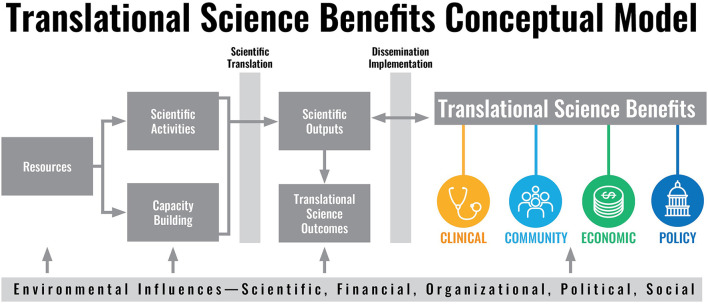
Introduction Over the past several years, a new discipline has emerged called translational science. Translational science, championed by the National Center for Advancing Translational Science (NCATS), is defined as '…the field that generates innovations that overcome longstanding challenges along the translational research pipeline. These include scientific, operational, financial, and administrative innovations that transform the way that research is done, making it faster, more efficient, and more impactful' (1). In this sense, translational science is quite similar to the discipline of implementation science, which studies how evidence-based scientific knowledge is translated, adopted, implemented, and maintained in communities and healthcare settings (2). Knowledge translation is a critical dissemination activity that transforms research results into new products, practices, and policies to benefit health and society. Yet, effectively bridging the gap between clinical research and practical applications is challenging. The US National Institutes of Health (NIH) and NCATS address this challenge through the Clinical and Translational Science Award (CTSA) Program. The charge of the CTSA Program is to transform the organization and infrastructure of the academic research enterprise to accelerate the movement of discoveries from clinical science to the bedside and community. Documenting the results of these efforts is a necessary component to assess outcomes, health and social impacts, and support continuous improvement. Within the CTSA program, more than 60 CTSA hubs, primarily located at academic health sciences research institutes across the nation, are beginning to systematically measure and evaluate the impacts of their activities. One model used to track and assess impact is the Translational Science Benefits Model (TSBM), introduced in 2018, see Figure 1 (3). TSBM is one of the pioneering frameworks for standardized documentation and dissemination of data on outcomes and impacts of translational science and translational research. Although translational science is still in its infancy, much work is being conducted nationally within CTSA hubs, communities, and research partners. The recent Frontiers in Public Health Research Topic (Impact Evaluation using the Translational Science Benefits Model Framework in the National Center for Advancing Translational Science, Clinical, and Translational Science Award Program [4]) included eleven articles, written by more than 60 co-authors based at a wide range of CTSA hubs, contexts, and settings. Based on these papers, this editorial presents three crosscutting themes for reflecting on the TSBM research collection and state of the evolving science: 1) Versatility and methodological insights of the TSBM, 2) Knowledge translation as a pathway to longer-term impacts, and 3) Advancing translational science. 3 Versatility and Methodological Insights of the TSBM Articles in this edition demonstrate the versatility and methodological advancements of the TSBM. The TSBM began as a structured framework designed to assess the health and societal impacts of translational science. Over time, substantial advancements in methodology and operationalization have transformed TSBM into a dynamic tool for measuring the outcomes of translational science at multiple levels within the research enterprise, that also supports continuous improvement in scientific evaluation. This framework has been applied in various aspects such as setting strategic direction, operations management, continuous quality improvement (CQI), and tracking organizational contributions to advancing human health. The integration of the TSBM framework has proven effective in eliciting recommendations for measures of significance on the contributions of the CTSA environment and consortium (5). By integrating concept mapping with the TSBM framework, measures can be selected at both individual, organization and consortium levels, aiding strategic resource allocation. For day-to-day management, the TSBM framework combined with the balanced scorecard and project management tools has supported organizational performance measurement at the program level, ensuring efficient allocation of resources and effective tracking of contributions to advancing priorities (6). Similarly, an adaptation of the TSBM framework in assessing performance has applied CQI tools to achieve performance improvements (7). Methodological enhancements include real-time performance monitoring systems, balanced scorecards, and project management platforms, supporting frequent updates and comprehensive tracking aligned with strategic institutional goals (8). Methodologies like Plan-Do-Study-Act cycles, inclusive leadership in team science, and automation through natural language processing (NLP) and artificial intelligence (AI) have further expanded the operational capabilities of the TSBM (9). Concept mapping has aligned program goals with evaluat
Overview
The claims and statistics of this paper haven’t been checked yet.
Free: it reads the open-access text and checks the first 5 claims that cite a source we can check. Create a free account to check every claim.
Integrity signals
Registry
Cites
Statistics
Figures
Verification
Claims the paper makes
The claims and statistics of this paper haven’t been checked yet.
Free: it reads the open-access text and checks the first 5 claims that cite a source we can check. Create a free account to check every claim.
Self-check
Percentages, sums and reported differences re-computed from the paper’s own numbers.
The self-check needs the paper’s full text.
Citations
Cites
Dissemination and Implementation Research in Health: Translating Science to Practice
Chambers, D. (2023) · doi:10.1093/oso/9780197660690.001.0001 · Cited by 243
Luke, D. A., Sarli, C. C., Suiter, A. M., Carothers, B. J., Combs, T. B., Allen, J. L., Beers, C. E., & Evanoff, B. A. (2018) · Clinical and Translational Science · doi:10.1111/cts.12495 · Cited by 131
Self-citationSchneider, M. L., Woodworth, A., Ericson, M., Boerger, L. L., Denne, S. C., Dillon, P., Duguid, P., Ghanem, E., Hunt, J. D., Li, J. S., et al. (2023) · Journal of Clinical and Translational Science · doi:10.1017/cts.2023.700 · Cited by 10
Self-citation
Cited by
Data Quality in the Age of AI: A Review of Governance, Ethics, and the FAIR Principles
Guillen-Aguinaga, M., Aguinaga-Ontoso, E., Guillen-Aguinaga, L., Guillen-Grima, F., & Aguinaga-Ontoso, I. (2025) · Data · doi:10.3390/data10120201 · Cited by 37
“The financial, operational, and strategic costs of poor data quality far exceed the investments required to prevent and maintain continuous quality assurance [191,193].”
Hively, A., Manna, A. L., Clark, E., Luke, D., de Silva, A., Agarwal, M., Huffman, M. D., Salam, A., Agarwal, A., & Tetteh, E. (2026) · Journal of Clinical and Translational Science · doi:10.1017/cts.2026.10699
Self-citationOpioid prescribing practices in the U.S. and subsequent falls: a scoping review protocol
Lovato, V. I., Torres, M., McClelland, D. J., Lee, J. K., Saljuqi, A. T., & Murphy, B. S. (2026) · Systematic Reviews · doi:10.1186/s13643-026-03150-9
Metadata
- Authors
- Davidson, P. L., Hunt, J., La Manna, A., & Luke, D. A.
- Affiliations
- University of California, Los Angeles (US)
- Indiana Clinical and Translational Sciences Institute (US)
- Washington University in St. Louis (US)
- Corresponding author
- Luke, Douglas A.
- ORCID
- Luke, Douglas A.
- Venue
- Frontiers in Public Health
- Publisher
- Frontiers Media SA
- Published
- 2025-10-08
- Volume
- 13
- Pages
- 1707595-1707595
- ISSN
- 2296-2565 (ISSN-L)
- PMC
- PMC12540335
- OpenAlex
- W4414949934
- Cited by
- 1
- References
- 3
- Citations by year
- 2025: 1
- Type
- journal article
- Language
- en
- Open access
- gold
- doi.org
- Licence
- Locations
- Frontiers in Public Health (publishedVersion, cc-by)
- Europe PMC (PubMed Central) (publishedVersion, cc-by)
- PubMed (publishedVersion)
- DOAJ (DOAJ: Directory of Open Access Journals) (submittedVersion, cc-by-sa)
- IUScholarWorks (Indiana University) (submittedVersion, cc-by)
- Funders
- National Institute of Diabetes and Digestive and Kidney Diseases (P30DK092950)
- Topics
- Health Sciences › Medicine › Public Health, Environmental and Occupational Health › Health and Medical Research Impacts
- Health Sciences › Health Professions › General Health Professions › Health Policy Implementation Science
- Social Sciences › Arts and Humanities › History and Philosophy of Science › Interdisciplinary Research and Collaboration
- Keywords
- translational research, impact evaluation, knowledge translation, implementation science, research infrastructure, CTSA hubs, evidence-based practice adoption, research impact assessment, research capacity building, research collaboration
About these checks
Registry, retraction, Cites and statistics results are computed, not judged, with one exception: a printed reference that no index lists is read once by a model before it counts as a citation error. Claims are extracted by a model and kept only when their quote appears verbatim in the text; each cited source is then checked, with a model’s help, for whether it says what the claim relies on. Those verdicts can be wrong — read the claim’s quote and the cited source before relying on one.
Statistics and arithmetic are recomputed, not judged.
Confidence bands are shown only for fields calibrated on our annotated test set. None is calibrated yet, so no band is shown.
What counts as a claim ›How we measure confidence ›How we check this ›
Are you an author, or do you see a problem with this page? Request a review
How to cite
Cite CoChat for the checks on this page, and the paper for its own findings.
- This page
- CoChat. (2026). Citation check: Editorial: Impact evaluation using the translational science benefits model framework in the national center for advancing translational science clinical and translational science award program. https://app.cochat.ai/papers/10.3389/fpubh.2025.1707595
- The paper
- Davidson, P. L., Hunt, J., La Manna, A., & Luke, D. A. (2025). Editorial: Impact evaluation using the translational science benefits model framework in the national center for advancing translational science clinical and translational science award program. Frontiers in Public Health. https://doi.org/10.3389/fpubh.2025.1707595
Data sources
Bibliographic data: Semantic Scholar, OpenAlex, Crossref.
Contains information from the Semantic Scholar Academic Graph Datasets, made available under the ODC Attribution License (ODC-BY 1.0).
Semantic Scholar’s data is described in: Kinney, R., et al. (2023). The Semantic Scholar Open Data Platform. arXiv:2301.10140.
