

Policies and strategies on active and healthy ageing: a scoping review of the recommendations of European and international agencies
Open accessThe DOI matches its Crossref record; 18 of the 18 references it cites were found in a registry or an index.
Abstract
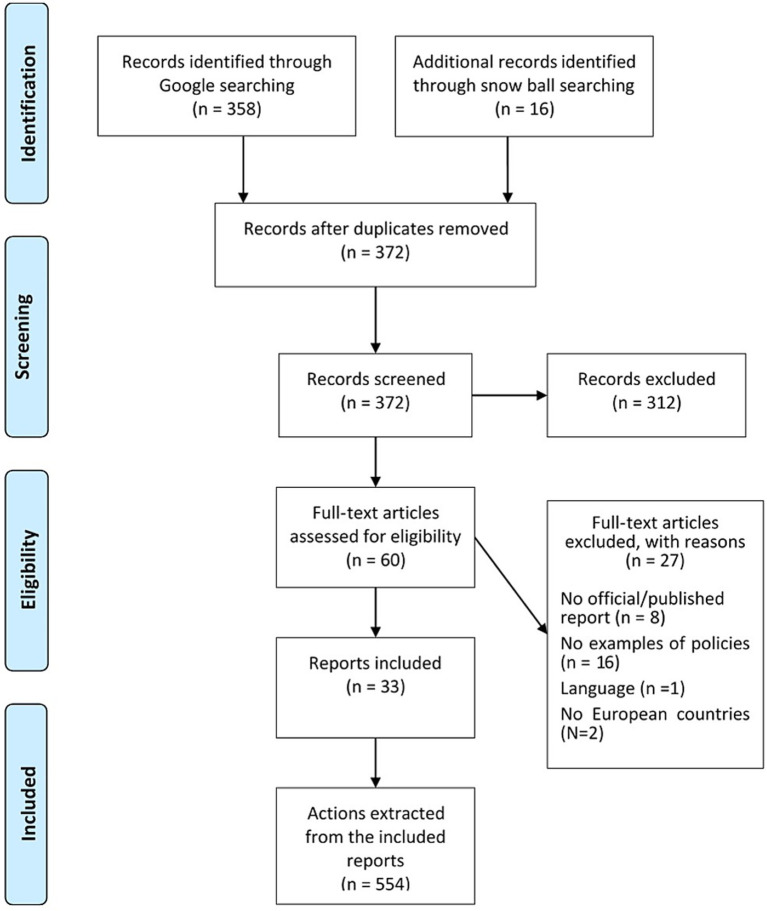
Background: Over the past six decades, life expectancy has significantly increased, with a concurrent decline in fertility rates, leading to unprecedented demographic shifts. These changes have deeply changed population structures and presented challenges for welfare systems, particularly regarding sustainability and intergenerational equity. Aim: This study aimed to review recommendations from major international organizations [e.g., the World Health Organisation (WHO), Organisation for Economic Co-operation and Development (OECD), European Union (EU)] to promote active and healthy ageing (AHA). Methods: A scoping review was conducted to identify policy-relevant documents published between 2008 and 2023 by major international and European organizations. The search strategy, carried out via Google using targeted search strings and snowballing methods, identified 33 reports to be included. Inclusion criteria required that documents be targeted to policymakers and present recommendations for promoting AHA. Documents focused solely on treatment, frailty, or child/youth interventions were excluded. Data extraction was carried out independently by two reviewers. Results: The elaboration of the 33 included policy-oriented reports published between 2008 and 2023 yielded 554 actions. These were classified across 19 policy sectors and grouped into 14 cross-sectoral strategies to support healthy ageing. The most represented sectors were health (37.5% of actions), labor, social welfare, and civil rights. Strategies included enhancing access to quality services, reducing non-communicable diseases, supporting prolonged working lives, enabling ageing in place, tackling socio-economic divides, and fostering better laws. Specific interventions ranged from tax incentives for a healthy diet to flexible retirement policies, caregiver support, and urban planning for inclusive environments. Conclusion: There is a need for a multi-sectoral approach to policymaking, as healthy ageing promotion cannot rely solely on health policy. Focusing on preventive rather than disease-oriented actions, AHA policies must be grounded in equity, sustainability, and long-term planning. Despite limited rigorous evidence—often based on expert consensus—the study offers a practical classification system to guide national and local policy development. It provides a comprehensive framework to help governments shift from reactive healthcare to proactive, integrated approaches that promote lifelong wellbeing and support the sustainability of welfare systems amid demographic and epidemiological transitions.
Overview
The claims and statistics of this paper haven’t been checked yet.
Free: it reads the open-access text and checks the first 5 claims that cite a source we can check. Create a free account to check every claim.
Integrity signals
Registry
Cites
Statistics
Figures
Verification
Claims the paper makes
The claims and statistics of this paper haven’t been checked yet.
Free: it reads the open-access text and checks the first 5 claims that cite a source we can check. Create a free account to check every claim.
Claims other papers make about this one
Each is checked against this paper’s own text: does it say what the citing paper says it does?
The cited source says what the claim attributes to it.
In the citing paper
“This area of research is highly needed [117], as the identified studies in Lebanon seem to rarely examine how social policies shape aging experiences or how systems of protection, pensions, healthcare coverage, and social assistance respond to the needs of older adults.”
From Toward Holistic Aging in Lebanon: A Mapping of Gerontology and Geriatrics Research Trends, Gaps, and Future Directions (2026) · cites this paper as [117]
Self-check
Percentages, sums and reported differences re-computed from the paper’s own numbers.
The self-check needs the paper’s full text.
Citations
Cites
Social Foundations of Postindustrial Economies
Esping-Andersen, G. (1999) · doi:10.1093/0198742002.001.0001 · Cited by 6,253
Bengtson, V. L. (2001) · Journal of Marriage and Family · doi:10.1111/j.1741-3737.2001.00001.x · Cited by 1,635
Reducing Health Care Costs by Reducing the Need and Demand for Medical Services
Fries, J. F., Koop, C. E., Beadle, C. E., Cooper, P. P., England, M. J., Greaves, R. F., Sokolov, J. J., & Wright, D. (1993) · New England Journal of Medicine · doi:10.1056/nejm199307293290506 · Cited by 404
Active Aging and Public Health: Evidence, Implications, and Opportunities
Dogra, S., Dunstan, D. W., Sugiyama, T., Stathi, A., Gardiner, P. A., & Owen, N. (2022) · Annual Review of Public Health · doi:10.1146/annurev-publhealth-052620-091107 · Cited by 334
Social investment as a policy paradigm
Hemerijck, A. (2018) · Journal of European Public Policy · doi:10.1080/13501763.2017.1401111 · Cited by 299
Implementing collaborative governance: models, experiences, and challenges
Bianchi, C., Nasi, G., & Rivenbark, W. C. (2021) · Public Management Review · doi:10.1080/14719037.2021.1878777 · Cited by 291
Strong Family and Low Fertility: A Paradox?
Zuanna, G. D., & Micheli, G. (2004) · European studies of population · doi:10.1007/1-4020-2837-7 · Cited by 151
Tomassini, C., Kalogirou, S., Grundy, E. M. D., Fokkema, T., Martikainen, P., Groenou, M. I. B. V., & Karisto, A. (2004) · European Journal of Ageing · doi:10.1007/s10433-004-0003-4 · Cited by 147
A critique of the Active Ageing Index
José, J. D. S., Timonen, V., Amado, C. A. F., & Santos, S. P. (2017) · Journal of Aging Studies · doi:10.1016/j.jaging.2017.01.001 · Cited by 144
Implementation of Evidence-Based Practices in Intergenerational Programming: A Scoping Review
Jarrott, S. E., Scrivano, R. M., Park, C., & Mendoza, N. (2021) · Research on Aging · doi:10.1177/0164027521996191 · Cited by 117
Thiagarajan, S., Muraleedharan, V. R., & Ranjan, A. (2021) · Journal of Social and Economic Development · doi:10.1007/s40847-020-00133-x · Cited by 111
Seizing the moment to rethink health systems
Nimako, K. T., & Kruk, M. E. (2021) · The Lancet Global Health · doi:10.1016/s2214-109x(21)00356-9 · Cited by 64
Ageing and Health: The Politics of Better Policies
Greer, S. L., Lynch, J. F., Reeves, A., Falkenbach, M., Gingrich, J. R., Cylus, J., & Bambra, C. L. (2021) · Cambridge University Press eBooks · doi:10.1017/9781108973236 · Cited by 48
Lucantoni, D., Principi, A., Socci, M., Zannella, M., & Barbabella, F. (2022) · International Journal of Environmental Research and Public Health · doi:10.3390/ijerph19052746 · Cited by 27
Active Ageing: The Need to Address Sub-National Diversity. An Evidence-Based Approach for Italy
Zannella, M., Principi, A., Lucantoni, D., Barbabella, F., Rosa, M. D., Domínguez-Rodríguez, A., & Socci, M. (2021) · International Journal of Environmental Research and Public Health · doi:10.3390/ijerph182413319 · Cited by 24
Ping, W., & Cheng, X. (2024) · Frontiers in Public Health · doi:10.3389/fpubh.2024.1392900 · Cited by 18
Smith, R. (2023) · BMJ · doi:10.1136/bmj.p107 · Cited by 5
Growney, C. M., Zaloom, C., & Carstensen, L. L. (2025) · Daedalus · doi:10.1162/daed_a_02126 · Cited by 5
Research works printed but not linked: 4
- Künemund H. Chapter 5: intergenerational relations within the family and the state In: Saraceno C, editor. Families, ageing and social policy. Intergenerational solidarity in European welfare states globalization and welfare series. Cheltenham, UK: Edward Elgar Publishing (2008) 105– 22.
- Institute for Health Metrics and Evaluation (IHME). Global burden of disease 2021: Findings from the GBD 2021 study. Seattle, WA: IHME (2024).
- OECD/European Commission. Health at a glance: Europe 2024: State of health in the EU cycle. Paris: OECD Publishing (2024).
- Vagni L Mariani S. Persone, comunità e territori: La promozione dell’invecchiamento attivo nel d. lgs. n. 29 del 2024. Macerata, IT: EUM (2024).
Cited by
Younes, R. S., Ziade, C., Rajha, F., & Abboud Mzawak, M. (2026) · Healthcare · doi:10.3390/healthcare14172857 · Cited by 1
“This area of research is highly needed [117], as the identified studies in Lebanon seem to rarely examine how social policies shape aging experiences or how systems of protection, pensions, healthcare coverage, and social assistance respond to the needs of older adults.”
Mallidou, A. A., Zioga, E., MAGRIPI, A., Roditi, E., PROVIDA, F. D., Apostolidi, T., Papathanasiou, I. V., & Sourtzi, P. (2026) · Frontiers in Aging · doi:10.3389/fragi.2026.1787365
Pathways to empowerment: a conceptual model for disabled older adults
Kumari, P., Pandita, D., & Bedarkar, M. M. (2026) · Working with Older People · doi:10.1108/wwop-06-2026-0057
ACTIVE AGEING AS POLICY: BETWEEN AUTONOMY AND COERCION IN CONDITIONS OF STRUCTURAL VULNERABILITY
Semigina, T. V. (2026) · Political Studies · doi:10.53317/2786-4774-2026-3-3
Metadata
- Authors
- Caristia, S., Viola, E., Kalemi, T., Servetti, D., Poy, S., & Faggiano, F.
- Affiliations
- Università degli Studi del Piemonte Orientale “Amedeo Avogadro” (IT)
- Corresponding author
- Faggiano, Fabrizio
- Venue
- Frontiers in Public Health
- Publisher
- Frontiers Media SA
- Published
- 2026-01-07
- Volume
- 13
- Pages
- 1712417-1712417
- ISSN
- 2296-2565 (ISSN-L)
- PMC
- PMC12819296
- OpenAlex
- W7119013665
- Cited by
- 4
- References
- 18
- Citations by year
- 2026: 4
- FWCI
- 7.17
- Type
- journal article
- Language
- en
- Open access
- gold
- doi.org
- Licence
- Locations
- Frontiers in Public Health (publishedVersion, cc-by)
- PubMed (publishedVersion)
- PubMed Central (publishedVersion, cc-by)
- Funders
- European Commission
- Topics
- Social Sciences › Life-span and Life-course Studies › Aging, Elder Care, and Social Issues
- Health Sciences › Medicine › Public Health, Environmental and Occupational Health › Aging, Health, and Disability
- Social Sciences › Psychology › Developmental and Educational Psychology › Aging and Gerontology Research
- Keywords
- active and healthy ageing, aging policy, policy recommendations, multisectoral approach, population aging, intergenerational equity, non-communicable diseases, aging in place, socioeconomic disparities, flexible retirement, caregiver support, WHO guidelines, OECD recommendations, European Union recommendations
- MeSH terms
- Healthy Aging, Aged, Europe, Health Policy, Health Promotion, Humans, Life Expectancy, World Health Organization
About these checks
Registry, retraction, Cites and statistics results are computed, not judged, with one exception: a printed reference that no index lists is read once by a model before it counts as a citation error. Claims are extracted by a model and kept only when their quote appears verbatim in the text; each cited source is then checked, with a model’s help, for whether it says what the claim relies on. Those verdicts can be wrong — read the claim’s quote and the cited source before relying on one.
Statistics and arithmetic are recomputed, not judged.
Confidence bands are shown only for fields calibrated on our annotated test set. None is calibrated yet, so no band is shown.
What counts as a claim ›How we measure confidence ›How we check this ›
Are you an author, or do you see a problem with this page? Request a review
Data sources
Bibliographic data: Semantic Scholar, OpenAlex, Crossref.
Contains information from the Semantic Scholar Academic Graph Datasets, made available under the ODC Attribution License (ODC-BY 1.0).
Semantic Scholar’s data is described in: Kinney, R., et al. (2023). The Semantic Scholar Open Data Platform. arXiv:2301.10140.
