

Machine learning-based strategies for improving healthcare data quality: an evaluation of accuracy, completeness, and reusability
Open accessThe DOI matches its Crossref record; 40 of the 40 references it cites were found in a registry or an index.
Abstract
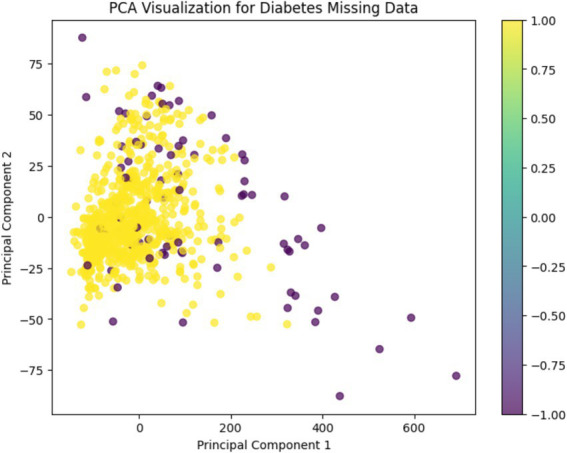
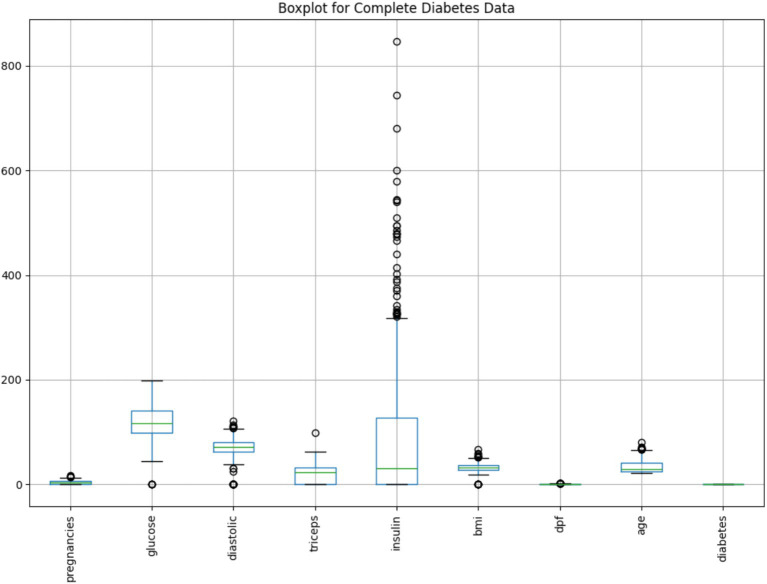
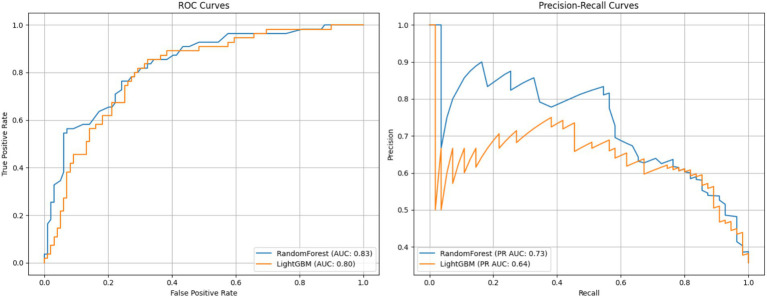
Healthcare data quality is a critical factor in clinical decision-making, diagnostic accuracy, and the overall efficacy of healthcare systems. This study addresses key challenges such as missing values and anomalies in healthcare datasets, which can result in misdiagnoses and inefficient resource use. The objective is to develop and evaluate a machine learning-based strategy to improve healthcare data quality, with a focus on three core dimensions: accuracy, completeness, and reusability. A publicly available diabetes dataset comprising 768 records and 9 variables was used. The methodology involved a comprehensive data preprocessing workflow, including data acquisition, cleaning, and exploratory analysis using established Python tools. Missing values were addressed using K-nearest neighbors imputation, while anomaly detection was performed using ensemble techniques. Principal Component Analysis (PCA) and correlation analysis were applied to identify key predictors of diabetes, such as Glucose, BMI, and Age. The results showed significant improvements in data completeness (from 90.57% to nearly 100%), better accuracy by mitigating anomalies, and enhanced reusability for downstream machine learning tasks. In predictive modeling, Random Forest outperformed LightGBM, achieving an accuracy of 75.3% and an AUC of 0.83. The process was fully documented, and reproducibility tools were integrated to ensure the methodology could be replicated and extended. These findings demonstrate the potential of machine learning to support robust data quality improvement frameworks in healthcare, ultimately contributing to better clinical outcomes and predictive capabilities.
Overview
The claims and statistics of this paper haven’t been checked yet.
Free: it reads the open-access text and checks the first 5 claims that cite a source we can check. Create a free account to check every claim.
Integrity signals
Registry
Cites
Statistics
Figures
Verification
Claims the paper makes
The claims and statistics of this paper haven’t been checked yet.
Free: it reads the open-access text and checks the first 5 claims that cite a source we can check. Create a free account to check every claim.
Self-check
Percentages, sums and reported differences re-computed from the paper’s own numbers.
The self-check needs the paper’s full text.
Citations
Cites
A Unified Approach to Interpreting Model Predictions
Lundberg, S., & Lee, S.-I. (2017) · arXiv · doi:10.48550/arxiv.1705.07874 · Cited by 23,707 · cited 1×
“Feature selection and dimensionality reduction not only improve learning efficiency but also enhance interpretability, especially when combined with model explanation techniques (Lundberg and Lee, 2017).”
An introduction to ROC analysis
Fawcett, T. (2006) · Pattern Recognition Letters · doi:10.1016/j.patrec.2005.10.010 · Cited by 21,879 · cited 2×
“Model performance was evaluated using metrics like accuracy, ROC AUC, and precision-recall curves-especially useful for imbalanced datasets (Fawcett, 2006) ensuring both predictive performance and methodological robustness (Li et al., 2021; James et al., 2013).”
Gauriat, C.-M., Pencolé, Y., Ribot, P., & Brouillet, G. (2024) · HAL (Le Centre pour la Communication Scientifique Directe) · doi:10.4230/oasics.dx.2024.27 · Cited by 12,586
An Introduction to Statistical Learning
James, G., Witten, D., Hastie, T., & Tibshirani, R. (2013) · Springer Texts in Statistics · doi:10.1007/978-1-4614-7138-7 · Cited by 12,106 · cited 1×
“Model performance was evaluated using metrics like accuracy, ROC AUC, and precision-recall curves-especially useful for imbalanced datasets (Fawcett, 2006) ensuring both predictive performance and methodological robustness (Li et al., 2021; James et al., 2013).”
Principal component analysis: A review and recent developments
Jolliffe, I. T., & Cadima, J. (2016) · Philosophical Transactions of the Royal Society A: Mathematical, Physical and Engineering Sciences · doi:10.1098/rsta.2015.0202 · Cited by 10,117
(2012) · Cited by 8,009
seaborn: statistical data visualization
Waskom, M. (2021) · Journal of Open Source Software · doi:10.21105/joss.03021 · Cited by 7,310 · cited 1×
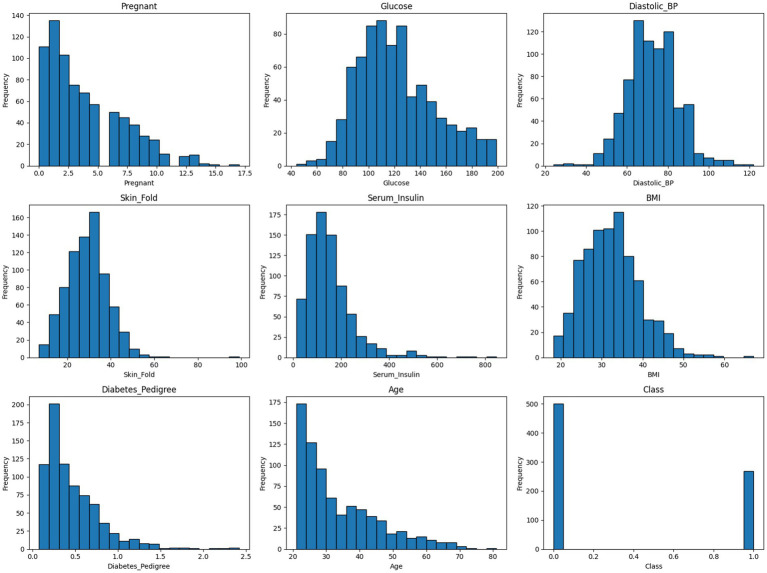
“Visualization libraries such as matplotlib and seaborn were employed to generate preliminary insights into the distribution of variables and the extent of missing data (Waskom, 2021).”
Liu, F. T., Ting, K. M., & Zhou, Z.-H. (2008) · 2008 Eighth IEEE International Conference on Data Mining · doi:10.1109/icdm.2008.17 · Cited by 6,601 · cited 10×
“Outlier detection was performed using Isolation Forest and LOF.”
InfluentialChiang, L. H., Russell, E. L., & Braatz, R. D. (2001) · Advanced Textbooks in Control and Signal Processing · doi:10.1007/978-1-4471-0347-9_4 · Cited by 6,594
Quality Is Free: The Art of Making Quality Certain
Crosby, P. B. (1979) · Andalas University Repository (Andalas University) · Cited by 3,719
On hyperparameter optimization of machine learning algorithms: Theory and practice
Yang, L., & Shami, A. (2020) · Neurocomputing · doi:10.1016/j.neucom.2020.07.061 · Cited by 3,232 · cited 1×
“Advanced optimization strategies such as Grid Search, Random Search, and Bayesian Optimization were applied to identify optimal parameter combinations (Yang and Shami, 2020).”
Bisong, E. (2019) · doi:10.1007/978-1-4842-4470-8 · Cited by 895 · cited 1×
“This cloud-based environment is well-suited for data science workflows and supports the seamless integration of key Python libraries such as pandas, numpy, scikit-learn, LightGBM, and seaborn, enabling collaborative and reproducible research (Bisong, 2019; Raschka et al., 2022).”
Introduction to Machine Learning with Python: A Guide for Data Scientists
Müller, A., & Guido, S. (2016) · Cited by 840
Unsupervised Machine Learning for Networking: Techniques, Applications and Research Challenges
Usama, M., Qadir, J., Raza, A., Arif, H., Yau, K.-L. A., Elkhatib, Y., Hussain, A., & Al-Fuqaha, A. (2019) · IEEE Access · doi:10.1109/access.2019.2916648 · Cited by 575
Sarker, I. H. (2021) · SN Computer Science · doi:10.1007/s42979-021-00765-8 · Cited by 570 · cited 1×
“Sarker (2021) notes that ML techniques enable the extraction of hidden patterns, trend forecasting, and informed decision-making through data-driven insights.”
Stacked generalization: an introduction to super learning
Naimi, A. I., & Balzer, L. B. (2018) · European Journal of Epidemiology · doi:10.1007/s10654-018-0390-z · Cited by 430 · cited 1×
“In addition, ensemble learning techniques, including stacking (e.g., combining logistic regression and gradient boosting models), were explored to reduce overfitting and improve accuracy (Naimi and Balzer, 2018).”
A survey on dataset quality in machine learning
Gong, Y., Liu, G., Xue, Y., Li, R., & Meng, L. (2023) · Information and Software Technology · doi:10.1016/j.infsof.2023.107268 · Cited by 354 · cited 2×
“Prior studies have highlighted that data quality is intrinsically linked to dimensions such as accuracy, completeness, consistency, and timeliness (Liu et al., 2023).”
Machine learning for metabolic engineering: A review
Lawson, C. E., Martí, J. M., Radivojevic, T., Jonnalagadda, S. V. R., Gentz, R., Hillson, N. J., Peisert, S., Kim, J., Simmons, B. A., Petzold, C. J., et al. (2021) · Metabolic Engineering · doi:10.1016/j.ymben.2020.10.005 · Cited by 313
MRI noise estimation and denoising using non-local PCA
Manjón, J. V., Coupé, P., & Buades, A. (2015) · Medical Image Analysis · doi:10.1016/j.media.2015.01.004 · Cited by 186 · cited 1×
“PCA analysis conducted after preprocessing revealed a clearer separation between anomalous and normal observations (Manjón et al., 2015).”
Pan, R., Yang, T., Cao, J., Lü, K., & Zhang, Z. (2015) · Applied Intelligence · doi:10.1007/s10489-015-0666-x · Cited by 183 · cited 2×
“This finding aligns with previous studies (Pan et al., 2015; Emery et al., 2024) that emphasize the importance of balancing the number of neighbors to obtain a representative imputation.”
Data management for production quality deep learning models: Challenges and solutions
Munappy, A. R., Bosch, J., Olsson, H. H., Arpteg, A., & Brinne, B. (2022) · Journal of Systems and Software · doi:10.1016/j.jss.2022.111359 · Cited by 177
Data Evaluation and Enhancement for Quality Improvement of Machine Learning
Chen, H., Chen, J., & Ding, J. (2021) · IEEE Transactions on Reliability · doi:10.1109/tr.2021.3070863 · Cited by 166 · cited 1×
“Compared to Chen et al. (2021), who used transfer learning and observed an ~11% increase in model performance after data cleaning, our results demonstrate a similarly strong performance uplift with added transparency and traceability.”
Data driven: profiting from your most important business asset
(2009) · Choice Reviews Online · doi:10.5860/choice.46-3345 · Cited by 152 · cited 1×
“Early definitions of quality, including Crosby’s concept of “fit for purpose” (Crosby, 1979) and Redman’s focus on data suitability (Redman, 2016), have evolved into more nuanced frameworks.”
The Practitioner's Guide to Data Quality Improvement
(2011) · Elsevier eBooks · doi:10.1016/c2009-0-17212-4 · Cited by 152 · cited 2×
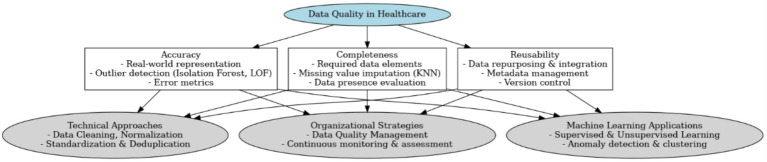
“…by data cleaning, normalization, and deduplication (Brownlee, 2020), continuous monitoring and assessment within an organizational strategy (Loshin, 2010), and the incorporation of machine learning methods—both supervised and unsupervised—to automate anomaly detection and clustering…”
A systematic review of machine learning-based missing value imputation techniques
Thomas, T., & Rajabi, E. (2021) · Data Technologies and Applications · doi:10.1108/dta-12-2020-0298 · Cited by 147
Schmidt, C. O., Struckmann, S., Enzenbach, C., Reineke, A., Stausberg, J., Damerow, S., Huebner, M., Schmidt, B., Sauerbrei, W., & Richter, A. (2021) · BMC Medical Research Methodology · doi:10.1186/s12874-021-01252-7 · Cited by 126
Xie, J., Sun, L., & Zhao, Y. F. (2025) · Engineering · doi:10.1016/j.eng.2024.04.024 · Cited by 112
Encyclopedia of Data Science and Machine Learning
(2023) · IGI Global eBooks · doi:10.4018/978-1-7998-9220-5 · Cited by 93
A Framework for Current and New Data Quality Dimensions: An Overview
Miller, R., Whelan, H., Chrubasik, M., Whittaker, D., Duncan, P., & Gregório, J. (2024) · Data · doi:10.3390/data9120151 · Cited by 33 · cited 3×
“Miller et al. (2024) propose a revised framework that includes traceability, reproducibility, and governability—factors that are increasingly critical in data-intensive environments such as healthcare and machine learning.”
InfluentialA Review of the State of the Art of Data Quality in Healthcare
Liu, C., Talaei‐Khoei, A., Storey, V. C., & Peng, G. (2023) · Journal of Global Information Management · doi:10.4018/jgim.316236 · Cited by 31
A Survey of Data Quality Measurement and Monitoring Tools
Ehrlinger, L., & Wöß, W. (2022) · Frontiers in Big Data · doi:10.3389/fdata.2022.850611 · Cited by 25 · cited 2×
“…develop a machine learning-based strategy focusing on accuracy, completeness, and reusability—aligns with these approaches, emphasizing that a balanced improvement across these dimensions is essential for successful data-driven healthcare solutions (Ehrlinger and Wöß, 2022; Moses et al., 2021).”
Wei, S., Dong, H., Yao, W., Chen, Y., Wang, X., ji, W., Zhang, Y., & Guo, S. (2025) · BMC Medical Informatics and Decision Making · doi:10.1186/s12911-025-03033-4 · Cited by 18
Data Pre-Processing Technique for Enhancing Healthcare Data Quality Using Artificial Intelligence
Kale, P. A. K., & Pandey, D. R. (2024) · International Journal of Scientific Research in Science and Technology · doi:10.32628/ijsrst52411130 · Cited by 14
Anomaly analytics in data-driven machine learning applications
Azimi, S., & Pahl, C. (2024) · International Journal of Data Science and Analytics · doi:10.1007/s41060-024-00593-y · Cited by 14 · cited 2×
“For example, Azimi and Pahl (2024) highlight the potential of ML-driven anomaly detection and correction, while Stanley and Schwartz (2024) stress the need for flexible, real-time monitoring systems that can adapt to evolving data landscapes.”
A Model Combining Seq2Seq Network and LightGBM Algorithm for Industrial Soft Sensor
Li, Y., Yang, C., Zhang, H., & Jia, C. (2020) · IFAC-PapersOnLine · doi:10.1016/j.ifacol.2020.12.753 · Cited by 12 · cited 2×
“These results are in agreement with other studies that have found ensemble methods, particularly Random Forest, to be effective in complex clinical settings (Li et al., 2021).”
Comparison of imputation methods for univariate categorical longitudinal data
Emery, K., Studer, M., & Berchtold, A. (2024) · Quality & Quantity · doi:10.1007/s11135-024-02028-z · Cited by 10 · cited 3×
“This finding aligns with previous studies (Pan et al., 2015; Emery et al., 2024) that emphasize the importance of balancing the number of neighbors to obtain a representative imputation.”
Data Quality: Empowering Businesses with Analytics and AI
Southekal, P. H. (2023) · doi:10.1002/9781394320547 · Cited by 9 · cited 1×
“(Southekal, 2023).”
An efficient local outlier detection approach using kernel density estimation
Rakhi, Gupta, B., & Lamba, S. S. (2024) · Franklin Open · doi:10.1016/j.fraope.2024.100162 · Cited by 8
Traceability and reuse mechanisms, the most important properties of model transformation languages
Höppner, S., & Tichy, M. (2024) · Empirical Software Engineering · doi:10.1007/s10664-023-10428-2 · Cited by 4 · cited 1×
“This is in line with insights from software engineering, where reuse mechanisms and traceability are identified as key drivers of transformation quality (Höppner and Tichy, 2024).”
Machine Learning Experiment Management With MLFlow
Erden, C. (2023) · IGI Global eBooks · doi:10.4018/978-1-7998-9220-5.ch071 · Cited by 2
Research works printed but not linked: 8
- 5. Brownlee, J. (2020). Data preparation for machine learning: Data cleaning, feature selection, and data transforms in Python. New York, NY: Machine Learning Mastery.
- 13. Hawker, R. (2023). Practical data quality: Learn practical, real-world strategies to transform the quality of data in your organization. 1st Edn. Mumbai: Packt Publishing.
- 15. ISO (2015). ISO 9000:2015-quality management systems -fundamentals and vocabulary. London: International Organization for Standardization.
- 27. McKinney, W. (2010). "Data structures for statistical computing in Python, " in Proceedings of the 9th Python in Science Conference, Austin, 28 June-3 July 2010, 56-61.
- 29. Moses, B., Gavish, L., and Vorwerck, M. (2021). Data quality fundamentals: A practitioner's guide to building trustworthy data pipelines. Sebastopol, CA: O'Reilly Media, Inc.
- 35. Raschka, S., Liu, Y., Mirjalili, V., and Dzhulgakov, D. (2022). Machine learning with PyTorch and Scikit-learn: Develop machine learning and deep learning models with Python. Mumbai: Packt Publishing.
- 39. Southekal, P. (2017). Data for business performance: The goal-question-metric (GQM) model to transform business data into an enterprise asset. London: Technics.
- 41. Stanley, J., and Schwartz, P. (2024). Automating data quality monitoring: Scaling beyond rules with machine learning. 1st Edn. London: O'Reilly Media.
Cited by
Data Quality in the Age of AI: A Review of Governance, Ethics, and the FAIR Principles
Guillen-Aguinaga, M., Aguinaga-Ontoso, E., Guillen-Aguinaga, L., Guillen-Grima, F., & Aguinaga-Ontoso, I. (2025) · Data · doi:10.3390/data10120201 · Cited by 37
“AI for Data Quality: Advanced automated tools, including machine learning algorithms, enable continuous monitoring, anomaly detection, and large-scale validation that surpasses manual methods [113,154,184,273].”
Jabeen, S., Bibi, M., Shah, S., Ali, A. A., & Bahloul, M. A. (2025) · Biomedical Signal Processing and Control · doi:10.1016/j.bspc.2025.108816 · Cited by 2
Date, M., Mohan, D., Chakraborty, A., Scott, K., Ummer, O., & LeFevre, A. E. (2026) · doi:10.2196/preprints.109155
From Medical Records to AI-Ready Datasets: A Practical Guide for Clinical Researchers
Anghel, C., Anghel, A. A., Crăciun, M., Moldovanu, S., Cocu, A., Vulpe, D. E., Maier, C., Potop, V., Dragosloveanu, C. D. M., Andrei, C. A., et al. (2026) · Journal of Clinical Medicine · doi:10.3390/jcm15166297
Russu, E.-A., Ilinca, R., Popa, L. G., Dumitriu, A. S., Păunica, S., Giurcăneanu, C., & Albu, C.-C. (2026) · Pharmaceuticals · doi:10.3390/ph19081292
“Predictor eligibility must be determined according to the predefined index time, ensuring that variables measured after rituximab initiation are not incorporated into the Pretreatment Prediction Component [62].”
Metadata
- Authors
- Jarmakovica, A.
- Affiliations
- Riga Technical University (LV)
- Corresponding author
- Jarmakovica, Agate
- Venue
- Frontiers in Artificial Intelligence
- Publisher
- Frontiers Media SA
- Published
- 2025-07-21
- Volume
- 8
- Pages
- 1621514-1621514
- ISSN
- 2624-8212 (ISSN-L)
- PMC
- PMC12319021
- OpenAlex
- W4412506896
- Cited by
- 10
- References
- 39
- Citations by year
- 2026: 8 · 2025: 2
- FWCI
- 7.87
- Type
- journal article
- Language
- en
- Open access
- gold
- doi.org
- Licence
- Locations
- Frontiers in Artificial Intelligence (publishedVersion, cc-by)
- PubMed Central (publishedVersion, cc-by)
- PubMed (publishedVersion)
- DOAJ (DOAJ: Directory of Open Access Journals) (submittedVersion, cc-by-sa)
- Topics
- Health Sciences › Health Professions › Health Information Management › Artificial Intelligence in Healthcare
- Physical Sciences › Computer Science › Information Systems › Data Quality and Management
- Physical Sciences › Computer Science › Artificial Intelligence › Machine Learning and Data Classification
- Keywords
- healthcare data quality, missing data imputation, k-nearest neighbors imputation, anomaly detection, ensemble anomaly detection, diabetes prediction, data completeness, data reusability, data preprocessing, random forest, LightGBM, reproducibility
About these checks
Registry, retraction, Cites and statistics results are computed, not judged, with one exception: a printed reference that no index lists is read once by a model before it counts as a citation error. Claims are extracted by a model and kept only when their quote appears verbatim in the text; each cited source is then checked, with a model’s help, for whether it says what the claim relies on. Those verdicts can be wrong — read the claim’s quote and the cited source before relying on one.
Statistics and arithmetic are recomputed, not judged.
Confidence bands are shown only for fields calibrated on our annotated test set. None is calibrated yet, so no band is shown.
What counts as a claim ›How we measure confidence ›How we check this ›
Are you an author, or do you see a problem with this page? Request a review
Data sources
Bibliographic data: Semantic Scholar, OpenAlex, Crossref.
Contains information from the Semantic Scholar Academic Graph Datasets, made available under the ODC Attribution License (ODC-BY 1.0).
Semantic Scholar’s data is described in: Kinney, R., et al. (2023). The Semantic Scholar Open Data Platform. arXiv:2301.10140.
