

Counting what goes uncounted: strengthening measurement of financial protection in health after the 2025 revision of SDG indicator 3.8.2, with evidence from India
Open accessThe DOI matches its Crossref record; 16 of the 16 references it cites were found in a registry or an index; none of the 74 sources its claims cite is checked for support yet.
Abstract
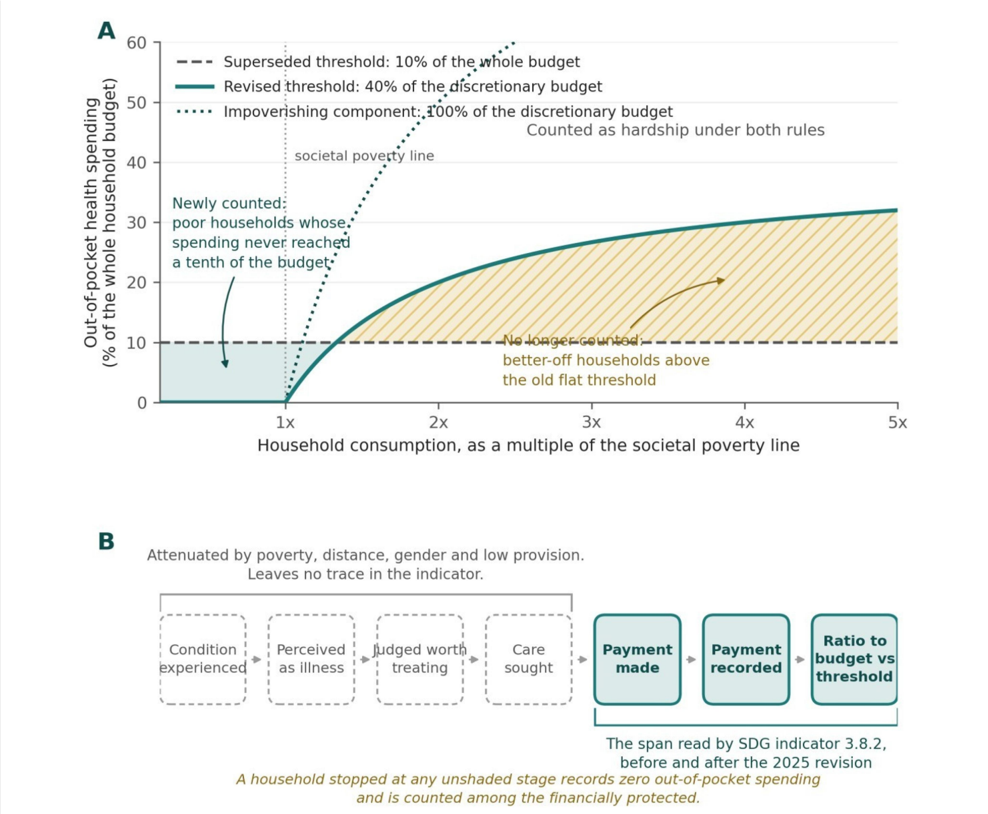
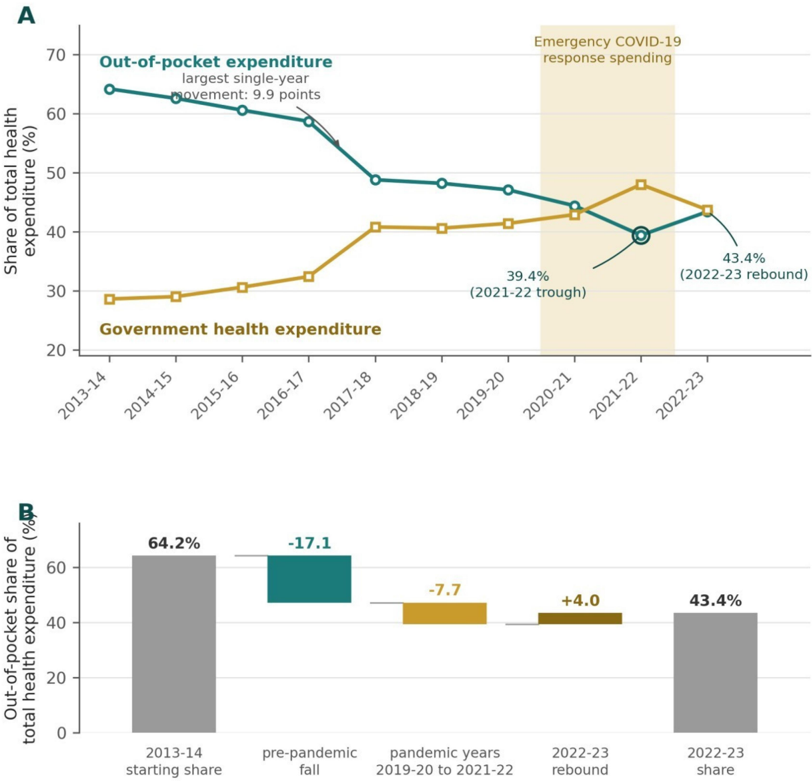
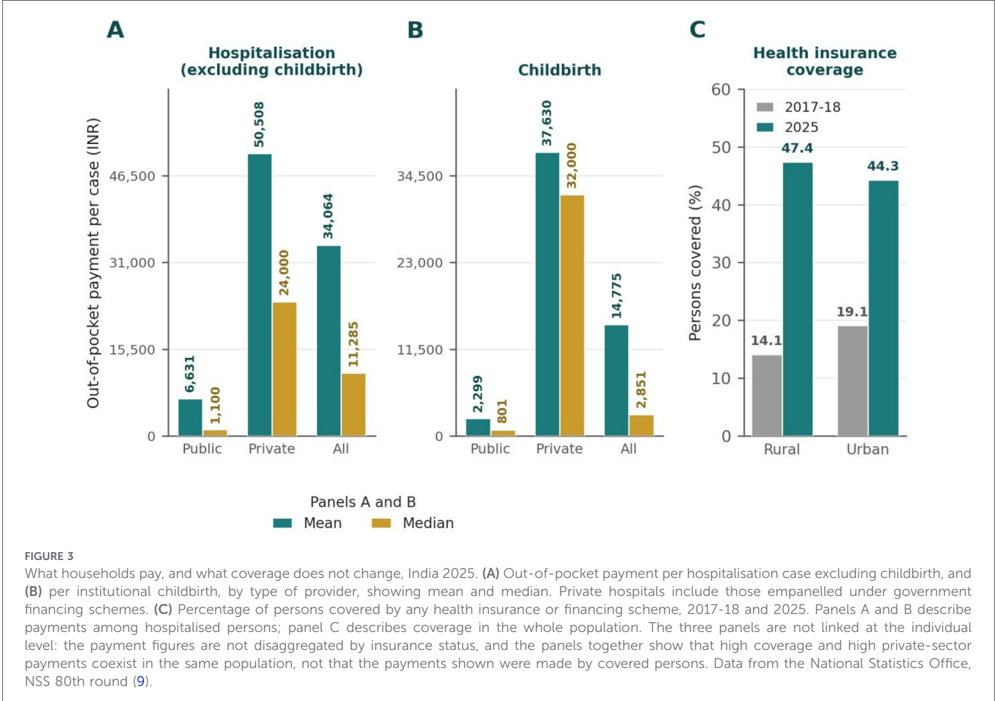
SDG indicator 3.8.2, the global measure of financial protection in health, is a household-level indicator computed from survey microdata. In March 2025 the UN Statistical Commission replaced its flat thresholds, which under-detected hardship among the poorest households, with a rule that counts out-of-pocket spending above 40% of a discretionary budget net of a societal poverty line, and any spending by households at or below that line. The revised architecture restores, in modified form, the capacity-to-pay approach proposed in 2003: it keeps the 40% threshold and the residual-budget logic, but replaces a food-based subsistence deduction with a poverty line and changes how the poorest households are treated. India's headline statistic, out-of-pocket expenditure (OOPE) as a share of total health expenditure (THE), is a different instrument: a national-accounts ratio of aggregates that says nothing directly about how many households face hardship. It fell to 39.4% in 2021-22, a year the health ministry describes as containing one-off pandemic outlays, and rose to 43.4% in 2022-23. Because government spending sits in its denominator, the ratio can move without any change in household payments; this brief does not establish how much of the movement this explains. India's 2025 national survey reports insurance reaching nearly half the population and a median private-hospitalisation payment of INR 24,000; these are separate population-level statistics, not linked at the individual level. Neither instrument counts households that never seek care, so forgone treatment leaves no trace. Six recommendations follow, for custodian agencies, statistical offices, health ministries and journals; four can be implemented with data already collected.
Overview
CoChat Summary
TL;DR
The March 2025 revision of SDG indicator 3.8.2 replaced flat 10%/25% budget-share thresholds with a rule counting out-of-pocket spending above 40% of a discretionary budget net of a societal poverty line, plus any spending by households at or below that line, restoring in modified form the 2003 capacity-to-pay approach. Using India as a worked example, the brief argues that the revised household indicator, the national-accounts OOPE/THE ratio, and unmeasured forgone care are three distinct instruments that are routinely conflated, and offers six reporting recommendations, four of which use data already collected.
Key findings
- Rebuilding the 2019 global estimate on the revised basis added 773 million people to the count of those facing financial hardship, and the revised share was 12.7 percentage points higher than the superseded measure implied; at current progress rates 24% of the world's population would still face hardship in 2030.
- India's OOPE share of THE fell from 64.2% in 2013-14 to 39.4% in 2021-22 and rebounded to 43.4% in 2022-23, while nominal household out-of-pocket spending rose every year from 2017-18 onward (INR 3.28 to 3.56 lakh crore in 2021-22, then 3.83 lakh crore in 2022-23). The 2021-22 trough coincided with THE rising 22.3% and government health expenditure 37.2%; the 2022-23 rebound with GHE falling 11.2% and THE 2.6%. The ministry attributes the trough to one-off pandemic outlays; the brief does not establish the magnitude.
- NSS 80th round (2025): mean out-of-pocket payment per hospitalisation excluding childbirth was INR 6,631 in public and INR 50,508 in private facilities (median across all hospitals INR 11,285; INR 24,000 for private hospitalisations excluding childbirth); for childbirth, INR 2,299 public vs INR 37,630 private. Insurance enrolment rose from 14.1% rural / 19.1% urban in 2017-18 to 47.4% / 44.3% in 2025, but enrolment and payment figures are separate population-level statistics not linked at the individual level.
- Reported illness rose from 7.5% (2017-18) to 13.1% (2025) in a fifteen-day window, a change the brief says cannot be read as a change in need; forgone care remains unmeasured by either indicator.
Methods
- Documentary analysis producing no new estimates; sources selected purposively (not systematically) in four groups: 2025 SDG Comprehensive Review indicator metadata and revision documentation; WHO/World Bank global monitoring reports; India's NHA estimates 2013-14 to 2022-23 and the NSS 80th round press note; and the peer-reviewed measurement literature. Searches covered January 2003 to July 2026.
- Inclusion criteria: documents defining, revising or documenting indicator 3.8.2 or predecessors; reporting official Indian aggregates or survey estimates relied on; or making a methodological contribution on catastrophic/impoverishing expenditure, forgone care, self-reported morbidity, or insurance effects on OOPE in India. Studies only applying an existing definition were excluded.
- No microdata analysed and no statistical models fitted; claims are descriptive and mechanistic rather than causal. Figures 1–3 are author-constructed schematics or arrangements of published aggregates.
Limitations
- Stated: the analysis is documentary and estimates no quantity itself — the change in India's OOPE share is not decomposed into numerator and denominator contributions in real per-capita terms, and no counterfactual share without emergency spending is calculated, so the mechanism is described but its magnitude is not established.
- Stated: NHA estimates for 2020-21 and 2021-22 were published as provisional, and the OOPE series is itself estimated from non-annual survey rounds, so the trough may move again.
- Stated: the survey statistics used are population-level and cannot speak to the association between insurance and payment within individuals; the cited evaluation literature carries its own limitations. Evident from the text: the empirical claims are confined to India, the deliberative record behind the 2025 revision was not examined (the "settlement between competing values" reading is offered as interpretation), and the proposed forgone-care companion measure is conditional on self-reported morbidity and would yield only a lower bound.
Model-written summary. Check it against the paper before relying on it.
Integrity signals
Registry
Cites
Statistics
Figures
Verification
Claims the paper makes
0 Valid · 0 Not valid · 53 Not checked · 73 Own results and interpretations
A result the paper states — it cites no source for it, so there is none to check. The quote shows it is in the paper.
In the paper
“Most of the decade's decline predates the pandemic.”
§ Counting what goes uncounted: strengthening measurement of financial protection in health after the 2025 revision of SDG indicator 3.8.2, with evidence from India > Policy options and implications > When the denominator is policy-sensitive
plainstates an association- Asserted: passes — The authors put it forward as true.
- Checkable: passes — It can be checked against evidence.
- Load-bearing: passes — The paper’s conclusions depend on it.
- Based: passes — The paper gives a reason why it holds.
In the paper
“Then the estimates for 2022-23, released in May 2026, put the share back at 43.4% (8).”
§ Counting what goes uncounted: strengthening measurement of financial protection in health after the 2025 revision of SDG indicator 3.8.2, with evidence from India > Policy options and implications > When the denominator is policy-sensitive
What the sources say
- Not checked yetcites [8] Ministry of Health and Family Welfare. National Health Accounts Estimates for India 2022-23. New Delhi: Press Information Bureau, Government of India (2026). Available online at: https://www.pib.gov.in/PressReleasePage.aspx?PRID=2265816 (Accessed July 30, 2026).
plain- Asserted: passes — The authors put it forward as true.
- Checkable: passes — It can be checked against evidence.
- Load-bearing: passes — The paper’s conclusions depend on it.
- Based: passes — The paper gives a reason why it holds.
In the paper
“SDG indicator 3.8.2, the global measure of financial protection in health, is a household-level indicator computed from survey microdata.”
- Also stated in: § When the denominator is policy-sensitive · plain
“Indicator 3.8.2 is a household-level measure built from survey microdata.”
§ Counting what goes uncounted: strengthening measurement of financial protection in health after the 2025 revision of SDG indicator 3.8.2, with evidence from India > Abstract
What the sources say
- Not checked yetcites [2] United Nations Statistical Division. SDG Indicator Metadata: Indicator 3.8.2 - Proportion of Population with Positive Out-of-Pocket Household Expenditures on Health Exceeding 40 per Cent of Household Discretionary Budget. Metadata After the 2025 Comprehensive Review, Last Updated 27 March 2026. New York: United Nations (2026). Available online at: https://unstats.un.org/sdgs/metadata/files/Metadata-03-08-02.pdf (Accessed July 30, 2026).
plain- Asserted: passes — The authors put it forward as true.
- Checkable: passes — It can be checked against evidence.
- Load-bearing: passes — The paper’s conclusions depend on it.
- Based: passes — The paper gives a reason why it holds.
- Also stated in: § When the denominator is policy-sensitive · plain
In the paper
“these are separate population-level statistics, not linked at the individual level.”
§ Counting what goes uncounted: strengthening measurement of financial protection in health after the 2025 revision of SDG indicator 3.8.2, with evidence from India > Abstract
What the sources say
- Not checked yetcites [9] National Statistics Office. Press Note on Survey on Household Social Consumption: Health, NSS 80th Round (January-December 2025). New Delhi: Ministry of Statistics and Programme Implementation, Government of India (2026). Available online at: https://static.pib.gov.in/WriteReadData/specificdocs/documents/2026/apr/doc2026420852401.pdf (Accessed July 30, 2026).
plain- Asserted: passes — The authors put it forward as true.
- Checkable: passes — It can be checked against evidence.
- Load-bearing: passes — The paper’s conclusions depend on it.
- Based: passes — The paper gives a reason why it holds.
A conclusion the paper draws from its own results — it cites no other source for it, so there is none to check. The quote shows it is in the paper.
In the paper
“Because government spending sits in its denominator, the ratio can move without any change in household payments; this brief does not establish how much of the movement this explains.”
§ Counting what goes uncounted: strengthening measurement of financial protection in health after the 2025 revision of SDG indicator 3.8.2, with evidence from India > Abstract
plainstates a cause- Asserted: passes — The authors put it forward as true.
- Checkable: passes — It can be checked against evidence.
- Load-bearing: passes — The paper’s conclusions depend on it.
- Based: passes — The paper gives a reason why it holds.
25 more claims
Create a free account to see all 126 claims and to verify the 74 references still open.
- It may state two separate claims as one. 83
- Probably not a substantial claim. 38
- The quote only partly states this claim. 1
Self-check
Percentages, sums and reported differences re-computed from the paper’s own numbers.
Each contradiction between two passages listed here was confirmed by an independent check.
Rated minor: it would not touch a result — a value no result rests on, a p-value that stays on the same side of the significance level, or a conflict that is clerical, resolved elsewhere in the paper, or outside its own findings.
In the paper
§ Counting what goes uncounted: strengthening measurement of financial protection in health after the 2025 revision of SDG indicator 3.8.2, with evidence from India > Policy options and implications > When the denominator is policy-sensitive
“from INR 3.28 to 3.56 lakh crore between 2021-22 and 2021-22 (8.5%)”
§ Counting what goes uncounted: strengthening measurement of financial protection in health after the 2025 revision of SDG indicator 3.8.2, with evidence from India > Policy options and implications > What the revision changed
“| 2020-21 | 3.28 | 3.17 | 7.39 | 44.4 | 42.8 | | 2021-22 | 3.56 | 4.34 | 9.04 | 39.4 | 48.0 |”
Rated minor: it would not touch a result — a value no result rests on, a p-value that stays on the same side of the significance level, or a conflict that is clerical, resolved elsewhere in the paper, or outside its own findings.
In the paper
“its largest single-year movement, 9.9 percentage points between 2017-18 and 2017-18”
§ Counting what goes uncounted: strengthening measurement of financial protection in health after the 2025 revision of SDG indicator 3.8.2, with evidence from India > Policy options and implications > When the denominator is policy-sensitive
Reported 9.9 · recomputed 0
Rated minor: it would not touch a result — a value no result rests on, a p-value that stays on the same side of the significance level, or a conflict that is clerical, resolved elsewhere in the paper, or outside its own findings.
In the paper
§ Counting what goes uncounted: strengthening measurement of financial protection in health after the 2025 revision of SDG indicator 3.8.2, with evidence from India > Actionable recommendations
“it separates a country in which hardship is deepening among those already poor from one in which it is spreading to households above the poverty line.”
§ Counting what goes uncounted: strengthening measurement of financial protection in health after the 2025 revision of SDG indicator 3.8.2, with evidence from India > Policy options and implications > What the revision changed
“| D | 4.00 | 1.10 | 27.5 | 0.85 | 0.34 | Counted (also at 25%) | Counted | Impoverishing (c−o = 2.90, below the SPL) |”
Citations
Cites
Rankings and Reactivity: How Public Measures Recreate Social Worlds
Espeland, W. N., & Sauder, M. (2007) · American Journal of Sociology · doi:10.1086/517897 · Cited by 2,416
Household catastrophic health expenditure: a multicountry analysis
Xu, K., Evans, D. B., Kawabata, K., Zeramdini, R., Klavus, J., & Murray, C. J. (2003) · The Lancet · doi:10.1016/s0140-6736(03)13861-5 · Cited by 2,309
Catastrophe and impoverishment in paying for health care: with applications to Vietnam 1993–1998
Wagstaff, A., & Doorslaer, E. V. (2003) · Health Economics · doi:10.1002/hec.776 · Cited by 1,222
The Seductions of Quantification: Measuring Human Rights, Gender Violence, and Sex Trafficking
Merry, S. E. (2016) · University of Chicago Press eBooks · doi:10.7208/chicago/9780226261317.001.0001 · Cited by 919
Sen, A. (2002) · BMJ · doi:10.1136/bmj.324.7342.860 · Cited by 702
Indicators as a Technology of Global Governance
Davis, K. E., Kingsbury, B., & Merry, S. E. (2012) · Law & Society Review · doi:10.1111/j.1540-5893.2012.00473.x · Cited by 501
Flores, G., Krishnakumar, J., O'Donnell, O., & van Doorslaer, E. (2008) · Health Economics · doi:10.1002/hec.1338 · Cited by 355
Global Monitoring Report on Financial Protection in Health 2021
World Health Organization, & Bank, W. (2021) · doi:10.1596/36723 · Cited by 221
Are self-reports of health and morbidities in developing countries misleading? Evidence from India
Subramanian, S. V., Subramanyam, M. A., Selvaraj, S., & Kawachi, I. (2009) · Social Science & Medicine · doi:10.1016/j.socscimed.2008.10.017 · Cited by 158
Towards Improved Measurement of Financial Protection in Health
Moreno-Serra, R., Millett, C., & Smith, P. C. (2011) · PLoS Medicine · doi:10.1371/journal.pmed.1001087 · Cited by 100
Research works printed but not linked: 6
- National Health Systems Resource Centre. National Health Accounts Estimates for India: Provisional Estimates. New Delhi: Ministry of Health and Family Welfare, Government of India (2024). Available online at: https://nhsrcindia.org/sites/default/files/2024-04/Provisional%20NHA%20Estimates.pdf (Accessed July 30, 2026).
- National Health Systems Resource Centre. National Health Accounts Estimates for India 2022-23. New Delhi: Ministry of Health and Family Welfare, Government of India (2026). Available online at: https://nhsrcindia.org/sites/default/files/2026-05/NHA%202022-23%20Report.pdf (Accessed October 3, 2026).
- National Health Systems Resource Centre. National Health Accounts Estimates for India 2021-22. New Delhi: Ministry of Health and Family Welfare, Government of India (2024). Available online at: https://nhsrcindia.org/sites/default/files/2024-09/NHA%202021-22.pdf (Accessed October 3, 2026).
- National Health Systems Resource Centre. National Health Accounts Estimates for India 2020-21. New Delhi: Ministry of Health and Family Welfare, Government of India (2024). Available online at: https://nhsrcindia.org/sites/default/files/2024-09/NHA%202020-21.pdf (Accessed October 3, 2026).
- National Health Systems Resource Centre. National Health Accounts Estimates for India 2017-18. New Delhi: Ministry of Health and Family Welfare, Government of India (2021). Available online at: https://nhsrcindia.org/sites/default/files/2021-11/National%20Health%20Accounts-%202017-18.pdf (Accessed October 3, 2026).
- National Health Systems Resource Centre. National Health Accounts Estimates for India 2013-14. New Delhi: Ministry of Health and Family Welfare, Government of India (2016). Available online at: https://nhsrcindia.org/sites/default/files/2021-06/NATIONAL%20HEALTH%20ACCOUNTS-%20Estimates%20for%20India-2013-14.pdf (Accessed October 3, 2026).
Cited by
Still being checked.
Metadata
- Authors
- Sriram, S.
- Affiliations
- University of North Texas (US)
- Corresponding author
- Sriram, Shyamkumar
- Venue
- Frontiers in Health Services
- Publisher
- Frontiers Media SA
- Published
- 2026-10-22
- Volume
- 6
- Pages
- 1955057-1955057
- ISSN
- 2813-0146 (ISSN-L)
- PMC
- PMC13736768
- OpenAlex
- W7223181872
- Semantic Scholar
- 63c39fd85a74a27642990a95ffa6df6132d0c3d1
- Cited by
- 0
- References
- 16
- FWCI
- 0.00
- Type
- journal article
- Language
- en
- Open access
- gold
- doi.org
- Licence
- Locations
- Frontiers in Health Services (publishedVersion, cc-by)
- PubMed Central (publishedVersion, cc-by)
- PubMed (publishedVersion)
- DOAJ (DOAJ: Directory of Open Access Journals) (submittedVersion)
- Topics
- Health Sciences › Medicine › Public Health, Environmental and Occupational Health › Healthcare Systems and Reforms
- Social Sciences › Economics, Econometrics and Finance › Economics and Econometrics › Economic and Financial Impacts of Cancer
- Social Sciences › Economics, Econometrics and Finance › Economics and Econometrics › Healthcare Policy and Management
- Keywords
- out-of-pocket costs, poverty line, health care costs, health insurance coverage, India, health statistics
About these checks
Registry, retraction, Cites and statistics results are computed, not judged, with one exception: a printed reference that no index lists is read once by a model before it counts as a citation error. Claims are extracted by a model and kept only when their quote appears verbatim in the text; each cited source is then checked, with a model’s help, for whether it says what the claim relies on. Those verdicts can be wrong — read the claim’s quote and the cited source before relying on one.
A language model drew the claims from the paper on 2026-11-20, under version 3 of the claim definition (model deepseek-v4.1-flash, prompt extract-v3).
A second model labelled each claim on 2026-11-20 (model jev-1.13-20260917, definition revision gold-guideline-v0.2).
Statistics and arithmetic are recomputed, not judged.
Confidence bands are shown only for fields calibrated on our annotated test set. None is calibrated yet, so no band is shown.
What counts as a claim ›How we measure confidence ›How we check this ›
Are you an author, or do you see a problem with this page? Request a review
How to cite
Cite CoChat for the checks on this page, and the paper for its own findings.
- This page
- CoChat. (2026). Citation check: Counting what goes uncounted: strengthening measurement of financial protection in health after the 2025 revision of SDG indicator 3.8.2, with evidence from India. https://app.cochat.ai/papers/10.3389/frhs.2026.1955057
- The paper
- Sriram, S. (2026). Counting what goes uncounted: strengthening measurement of financial protection in health after the 2025 revision of SDG indicator 3.8.2, with evidence from India. Frontiers in Health Services. https://doi.org/10.3389/frhs.2026.1955057
Data sources
Bibliographic data: Semantic Scholar, OpenAlex, Crossref.
Contains information from the Semantic Scholar Academic Graph Datasets, made available under the ODC Attribution License (ODC-BY 1.0).
Semantic Scholar’s data is described in: Kinney, R., et al. (2023). The Semantic Scholar Open Data Platform. arXiv:2301.10140.
