

The DOI matches its Crossref record; 234 of the 236 references it cites were found in a registry or an index.
Ethical issues raised by artificial intelligence and big data in population health: a scoping review
Open accessAbstract
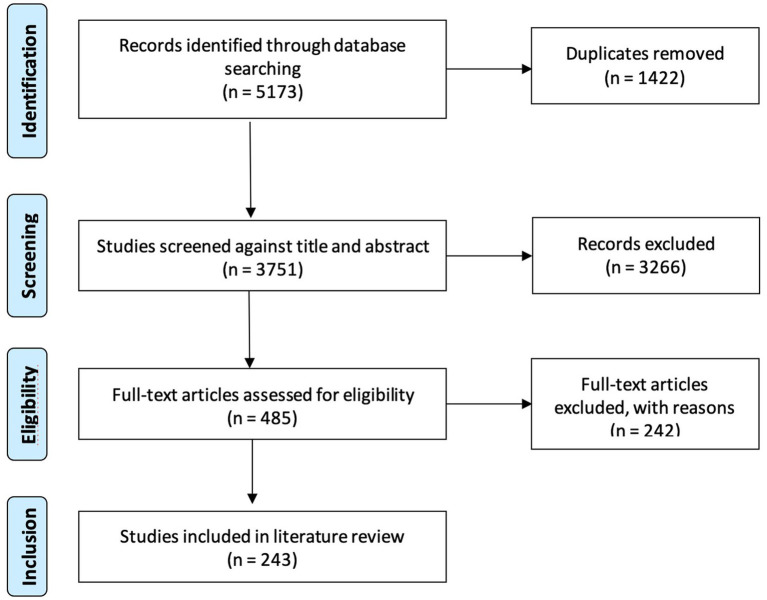
Introduction: Artificial intelligence systems (AIS) powered by big data (BD) are more and more common in the healthcare sector and many anticipate that they will have a substantial effect on population health. Facing the disruptive potential of these transformations, there is a need to keep the pace with the ethical reflection accompanying the uses of AIS and the BD systems enabling such innovations. Methods: To carry out this task, we conducted a scoping review of the ethical issues of AIS and BD, in population health, based on 243 scholarly articles. Results: Our results show the explosion of publications on the subject in recent years. Our qualitative analysis of this literature highlights the potential issues of AIS and BD on the three components of population health: (1) the health outcomes and their distribution in the population and between populations; (2) the patterns of health determinants; (3) the policies and interventions developed to connect the previous components. Discussion: Our conclusions show the uncertainty of the positive outcomes of these technologies and their potential for unequal distribution. Authors consider that AIS and BD will affect determinants of health either in their understanding and by transforming the structure of these determinants. At last, this review points that the policies and interventions developed to attain population health goals will have to answer to numerous ethical expectations. This review offers a comprehensive mapping of ethical issues raised by the uses of AIS in the global field of population health.
Overview
The claims and statistics of this paper haven’t been checked yet.
Run the check — free, no account needed. It reads the open-access text and checks the sources it cites.
Integrity signals
Registry
Cites
Statistics
Figures
Verification
Claims the paper makes
The claims and statistics of this paper haven’t been checked yet.
Run the check — free, no account needed. It reads the open-access text and checks the sources it cites.
Claims other papers make about this one
Each is checked against this paper’s own text: does it say what the citing paper says it does?
The source backs part of the claim, not all of it — or backs it for a different population, condition or comparison.
In the citing paper
“A scoping review of 243 articles found that these technologies reshape health determinants and policies [2].”
From Artificial Intelligence and Machine Learning for Identifying Social Determinants of Health in Low‐Income Populations Within United States Health Systems: A Scoping Review (2026) · cites this paper as [2]
Experimental — accuracy not yet measuredThe source backs part of the claim, not all of it — or backs it for a different population, condition or comparison.
In the citing paper
“Big data systems influence population health outcomes by reshaping how providers understand health determinants and structure interventions [2].”
From Artificial Intelligence and Machine Learning for Identifying Social Determinants of Health in Low‐Income Populations Within United States Health Systems: A Scoping Review (2026) · cites this paper as [2]
Experimental — accuracy not yet measured
Self-check
Percentages, sums and reported differences re-computed from the paper’s own numbers.
The self-check needs the paper’s full text.
Citations
Cites
Items 201–234 of 234
Villongco, C., & Khan, F. (2020) · AJOB Neuroscience · doi:10.1080/21507740.2020.1740355 · Cited by 11
Thorpe, J. H., & Gray, E. A. (2014) · Journal of Ambulatory Care Management · doi:10.1097/jac.0000000000000059 · Cited by 11
Role of Public Health Ethics for Responsible Use of Artificial Intelligence Technologies.
Bhattacharya, S., y Hossain, Juyal, R., Sharma, N., Pradhan, K. B., & Singh, A. (2021) · PubMed Central · doi:10.4103/ijcm.ijcm_62_20 · Cited by 11
Unlocking data: Where is the key?
Sánchez, M. C., & Sarría‐Santamera, A. (2019) · Bioethics · doi:10.1111/bioe.12565 · Cited by 10
Ngan, O. M. Y., & Kelmenson, A. M. (2020) · Asia Pacific Journal of Public Health · doi:10.1177/1010539520984360 · Cited by 10
Big data or bust: realizing the microbial genomics revolution
Raza, S., & Luheshi, L. M. (2015) · Microbial Genomics · doi:10.1099/mgen.0.000046 · Cited by 10
Johnson, W. G. (2020) · The Journal of Law Medicine & Ethics · doi:10.1177/1073110520979374 · Cited by 9
Li, X., & Cong, Y. (2021) · Journal of Empirical Research on Human Research Ethics · doi:10.1177/15562646211040299 · Cited by 9
The promise and perils of AI in medicine
Sparrow, R., & Hatherley, J. J. (2025) · PhilPapers (PhilPapers Foundation) · doi:10.48550/arxiv.2505.06971 · Cited by 9
Data collection requirements for mobile connected health: an end user development approach
Veiga, J. J. D., & Ward, T. E. (2016) · doi:10.1145/3001854.3001856 · Cited by 8
Policy strategies for personalising medicine “in the data moment”
Neethu, R. (2020) · Health Policy and Technology · doi:10.1016/j.hlpt.2020.07.003 · Cited by 8
Conflicting roles for humans in learning health systems and AI‐enabled healthcare
Kasperbauer, T. J. (2020) · Journal of Evaluation in Clinical Practice · doi:10.1111/jep.13510 · Cited by 8
Ethical implications of emotion mining in medicine
Straw, I. (2020) · Health Policy and Technology · doi:10.1016/j.hlpt.2020.11.006 · Cited by 8
Changing the mindset for precision medicine: from incentivized biobanking models to genomic data
Tigard, D. W. (2019) · Genetics Research · doi:10.1017/s0016672319000077 · Cited by 8
Mootz, J. J., Evans, H., Tocco, J. U., Ramon, C. V., Gordon, P. C., Wainberg, M. L., & Yin, M. T. (2020) · mHealth · doi:10.21037/mhealth.2019.10.03 · Cited by 7
Human Rights of Users of Humanlike Care Automata
Miller, L. F. (2020) · Human Rights Review · doi:10.1007/s12142-020-00581-2 · Cited by 7
Santé et Big Data : l’Etat et les individus, impuissants face aux pouvoirs des réseaux
Colloc, J. (2015) · L’Espace Politique · doi:10.4000/espacepolitique.3493 · Cited by 7
Althobaiti, K. (2021) · The New Bioethics · doi:10.1080/20502877.2021.1993055 · Cited by 7
Early AI Lifecycle Co-Reasoning: Ethics Through Integrated and Diverse Team Science
Pacia, D. M., Ravitsky, V., Hansen, J. N., Lundberg, E. K., Schulz, W. L., & Bélisle‐Pipon, J. (2024) · The American Journal of Bioethics · doi:10.1080/15265161.2024.2377106 · Cited by 6
Self-citationPriming the Pump for Big Data at Sentara Healthcare
Kern, H. P., Reagin, M. J., & Reese, B. S. (2016) · Frontiers of Health Services Management · doi:10.1097/01974520-201604000-00003 · Cited by 6
Health ‘Big Data’ Value, Benefit, and Control: The Patient eHealth Equity Gap
DeMuro, P. R., Petersen, C. C., & Paul, T. (2020) · Studies in health technology and informatics · doi:10.3233/shti200337 · Cited by 6
Public Health Research, Practice, and Ethics for Justice-Involved Persons in the Big Data Era
Rosen, D. L., Buchbinder, M. H., Juengst, E. T., & Rennie, S. (2020) · American Journal of Public Health · doi:10.2105/ajph.2019.305456 · Cited by 6
Le rôle des Méga données dans l’évolution de la pratique médicale
Lajonchère, J.-P. (2018) · Bulletin de l Académie Nationale de Médecine · doi:10.1016/s0001-4079(19)30353-x · Cited by 3
Le médicament connecté, entre bienveillance et surveillance
Moutel, G., Grandazzi, G., Duchange, N., & Darquy, S. (2018) · médecine/sciences · doi:10.1051/medsci/20183408019 · Cited by 3
The Ethics of Translating High‐Throughput Science into Clinical Practice
Ossorio, P. N. (2014) · The Hastings Center Report · doi:10.1002/hast.351 · Cited by 3
Barreto, M. L., & Rodrigues, L. C. (2018) · Current Epidemiology Reports · doi:10.1007/s40471-018-0177-5 · Cited by 3
Ladner, J., & Abdelaziz, A. B. (2018) · PubMed · Cited by 3
Park, J. (2021) · PARTECIPAZIONE E CONFLITTO · doi:10.1285/i20356609v14i1p79 · Cited by 2
Nakada, H., Inoue, Y., Yamamoto, K., Matsui, K., Ikka, T., & Tashiro, S. (2020) · Therapeutic Innovation & Regulatory Science · doi:10.1007/s43441-019-00105-2 · Cited by 2
Laparoscopic Surgery, Robots, and Surgical Simulation: Moral and Ethical Issues
Satava, R. M. (2002) · Surgical Innovation · doi:10.1177/155335060200900408 · Cited by 2
Conversations and connections: improving real-time health data on behalf of public interest
Babyar, J. C. (2019) · Health and Technology · doi:10.1007/s12553-019-00296-6 · Cited by 1
Leviathan, or the Rudder of Public Health
Horgan, D., & Ricciardi, W. (2017) · Biomedicine Hub · doi:10.1159/000479490 · Cited by 1
Precision medicine and sharing medical data in real time: opportunities and barriers.
Yang, Y. T., & Chen, B. (2018) · PubMed · Cited by 1
Research works printed but not linked: 8
- Balas, 2015, Big data clinical research: validity, ethics, and regulation, 448
- Couture, 2023, Artificial intelligence as a threat for global health, BMJ Glob. Health
- Fjeld, 2019, Principled artificial intelligence: a map of ethical and rights-based approaches
- Leonelli, 2019, Data-centric biology: a philosophical study
- 2019, Recommendation of the council on artificial intelligence
- 2017, NVivo
- 2024, Recommendation on the ethics of artificial intelligence
- 2021, Ethics and governance of artificial intelligence for health: WHO guidance
Cited by
Sorted by citations
AI and longevity medicine: Unlocking predictive and preventive strategies for healthy aging
Green, J. B., & Haykal, D. (2026) · La Presse Médicale · doi:10.1016/j.lpm.2026.104359 · Cited by 2
Razzano, A. V. (2026) · Health Science Reports · doi:10.1002/hsr2.73083
Big Problems, Big Data, Big Answers
Rider, N. L. (2026) · Immunology and Allergy Clinics of North America · doi:10.1016/j.iac.2026.08.010
Metadata
- Authors
- Couture, V., Roy, M.-C., Dez, E., Tremblay, F., & Bélisle-Pipon, J.-C.
- Affiliations
- Université Laval (CA)
- Université de Montréal (CA)
- Institut d'Etudes Politiques de Paris (FR)
- Corresponding author
- Couture, Vincent
- Venue
- Frontiers in Sociology
- Publisher
- Frontiers Media SA
- Published
- 2025-09-09
- Volume
- 10
- Pages
- 1536389-1536389
- ISSN
- 2297-7775 (ISSN-L)
- PMC
- PMC12454051
- OpenAlex
- W4414148133
- Cited by
- 3
- References
- 236
- Citations by year
- 2026: 3
- FWCI
- 0.46
- Type
- journal article
- Language
- en
- Open access
- gold
- doi.org
- Licence
- Locations
- Frontiers in Sociology (publishedVersion, cc-by)
- Europe PMC (PubMed Central) (publishedVersion, cc-by)
- PubMed (publishedVersion)
- PubMed Central (publishedVersion, cc-by)
- DOAJ (DOAJ: Directory of Open Access Journals) (submittedVersion, cc-by-sa)
- Topics
- Physical Sciences › Computer Science › Artificial Intelligence › Ethics and Social Impacts of AI
- Health Sciences › Medicine › Health Informatics › Artificial Intelligence in Healthcare and Education
- Health Sciences › Health Professions › Health Information Management › Artificial Intelligence in Healthcare
- Keywords
- artificial intelligence, big data, population health, ethics, health outcomes, health disparities, health determinants, health policy, health interventions, health technology
About these checks
Registry, retraction, Cites and statistics results are computed, not judged, with one exception: a printed reference that no index lists is read once by a model before it counts as a citation error. Claims are extracted by a model and kept only when their quote appears verbatim in the text; each cited source is then checked, with a model’s help, for whether it says what the claim relies on. Those verdicts can be wrong — read the claim’s quote and the cited source before relying on one.
Statistics and arithmetic are recomputed, not judged.
Confidence bands are shown only for fields calibrated on our annotated test set. None is calibrated yet, so no band is shown.
What counts as a claim ›How we measure confidence ›How we check this ›
Are you an author, or do you see a problem with this page? Request a review
