

Burden of Disease Methods: A Guide to Calculate COVID-19 Disability-Adjusted Life Years
Published version of a preprint
The DOI matches its Crossref record; 4 of the 4 references it cites were found in a registry or an index.
Abstract
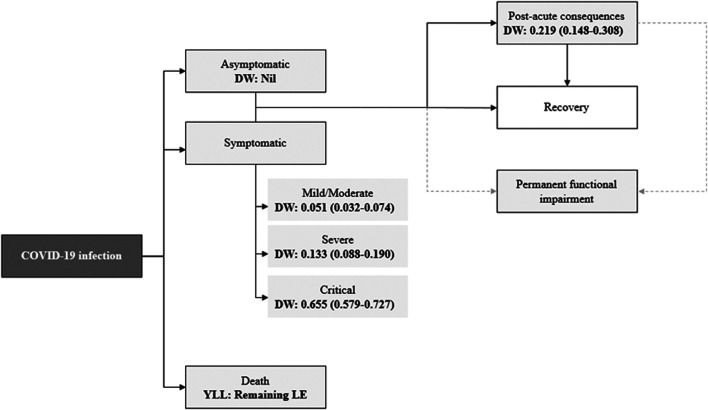
BackgroundTo date, most efforts to understand the comparative population health impact of COVID-19 have been made using mortality-based metrics (Hanlon et al. 2020; McCartney et al. 2020). This has intensified discussion over methodological choices; in particular, how we value the life-years prematurely lost due to COVID-19 (Devleesschauwer et al. 2020). So far, the direct impact of COVID-19 on population health has varied across countries, with wide variation in incidence and infection fatality rates (European Centre for Disease Prevention and Control 2020). Understanding and quantifying the combined impact of morbidity and mortality is a key step to standardising comparisons across countries, and to quantify the within-country impact of COVID-19 relative to other causes of disease and injury, sub-national areas or demographics (Murray and Lopez 1996). This can be achieved by estimating summary measures of population health like disability-adjusted life years (DALYs). The estimation of DALYs is useful to provide comprehensive and comparative public health intelligence to inform decision-making for the management of the COVID-19 pandemic, particularly around the extent of direct and indirect consequences (Douglas et al. 2020). At present, the Global Burden of Disease (GBD) study has not integrated COVID-19. Some studies have already estimated DALYs due to COVID-19. The first published assessment was performed for Korea, up until the end of April 2020 (Jo et al. 2020). An assessment, using a similar time frame, followed for Italy (Nurchis et al. 2020). To date, published studies have only included one COVID-19 related health state, or disability weights were country-specific (Jo et al. 2020; Nurchis et al. 2020; Mohanaty et al. 2020).AimOur paper provides a step-by-step guide to define COVID-19 as a cause of disease burden, which can be used to calculate DALYs. Additionally, we suggest pragmatic data inputs, reflecting that availability and quality of data inputs will vary by country. This paper builds on previous DALY calculation guides (Devleesschauwer et al. 2014a, 2014b). As our paper provides suggestions for different solutions, we recommend that users should be clear about their methodological choices to aid comparisons and knowledge translation.MethodologyThe impact of COVID-19 on health occurs through two main pathways: directly, as an infectious disease; and indirectly, as a risk factor, for example, through increases in mental health issues due to national lockdowns or delays to surgery, follow-ups and diagnoses through restrictions to vital healthcare services (Douglas et al. 2020). A group within COST Action (European Cooperation in Science and Technology) CA18218 – European Burden of Disease Network – convened to establish a common methodological approach to estimate DALYs directly due to COVID-19.This paper presents the developed consensus approach in three steps. The first relates to defining study parameters. The steps that follow relate to estimating the impact of morbidity, in terms of years lived with disability (YLD); and mortality, in terms of years lost to premature mortality (YLL). DALYs quantify the full population health impact and are calculated by summing YLD and YLL. DALYs can be estimated based on grouped characteristics of interest, such as demographics (e.g. age, sex, socioeconomic status, and ethnicity), geographical region, or time.Step 1: Defining study parametersThe first step in estimating DALYs is to define the space and time for which the burden of disease assessment will take place. This involves clear definitions of the population, which is being studied, for example a country, or sub-national region of a country. The time period is usually defined as a specific year or grouped years. However as COVID-19 is a new disease, only shorter time periods will initially be available.Step 2: Morbidity – estimating YLDThe second step in defining morbidity due to COVID-19 is to establish the direct health states, which are experienced by individuals infected by COVID-19 in an incidence-based model. For each health state, there are three parameters, which require data inputs: incidence; duration; and disability. YLD are calculated by summing the product of the number of cases, duration (in years) and disability weight, across all health states:YLD= ∑_(h=1)^l▒〖YLD〗_h = ∑_(h=1)^l▒〖Number of cases〗_h × 〖duration〗_h×〖disability weight〗_h.with h=health state and l=number of health states. The COVID-19 outcomes model is outlined in Figure 1, with detailed information on health states, data input proxies and corresponding disability weights outlined in Table 1. Health state names, descriptions and disability weights are currently based on those from the GBD 2019 study for infectious diseases of the lower respiratory tract, with the exception of those requiring intensive care, which was defined by the European Disability Weight study (Salomon et al. 2015; Global Burden of Disease Collabor
Overview
The claims and statistics of this paper haven’t been checked yet.
Free: it reads the open-access text and checks the first 5 claims that cite a source we can check. Create a free account to check every claim.
Integrity signals
Registry
Cites
Statistics
Figures
Verification
Claims the paper makes
The claims and statistics of this paper haven’t been checked yet.
Free: it reads the open-access text and checks the first 5 claims that cite a source we can check. Create a free account to check every claim.
Claims other papers make about this one
Each is checked against this paper’s own text: does it say what the citing paper says it does?
In the citing paper
“There is a plausibility of underreporting and missing cases of COVID-19 disease [47] while collating COVID-19 data by various government and non-government organisations.”
From Impact of COVID-19 on life expectancy at birth in India: a decomposition analysis (2021) · cites this paper as [47]
Self-check
Percentages, sums and reported differences re-computed from the paper’s own numbers.
The self-check needs the paper’s full text.
Citations
Cites
Vos, T., Lim, S. S., Abbafati, C., Abbas, K. M., Abbasi, M., Abbasifard, M., Abbasi-Kangevari, M., Abbastabar, H., Abd-Allah, F., Abdelalim, A., et al. (2020) · The Lancet · doi:10.1016/s0140-6736(20)30925-9 · Cited by 19,358
Self-citationSepanlou, S. G., Safiri, S., Bisignano, C., Ikuta, K. S., Merat, S., Saberifiroozi, M., Poustchi, H., Tsoi, D., Colombara, D. V., Abdoli, A., et al. (2020) · The Lancet Gastroenterology & Hepatology · doi:10.1016/s2468-1253(19)30349-8 · Cited by 1,714
Disability weights for the Global Burden of Disease 2013 study
Salomon, J. A., Haagsma, J. A., Davis, A., de Noordhout, C. M., Polinder, S., Havelaar, A. H., Cassini, A., Devleesschauwer, B., Kretzschmar, M., Speybroeck, N., et al. (2015) · The Lancet Global Health · doi:10.1016/s2214-109x(15)00069-8 · Cited by 1,217
Self-citationMitigating the wider health effects of covid-19 pandemic response
Douglas, M., Katikireddi, S. V., Taulbut, M., McKee, M., & McCartney, G. (2020) · BMJ · doi:10.1136/bmj.m1557 · Cited by 1,105 · cited 2×
“The estimation of DALYs is useful to provide comprehensive and comparative public health intelligence to inform decision-making for the management of the COVID-19 pandemic, particularly around the extent of direct and indirect consequences [6].”
Background
Research works printed but not linked: 18
- Hanlon P Chadwick F Shah A Wood R Minton J McCartney G COVID-19—exploring the implications of long-term condition type and extent of multimorbidity on years of life lost: a modelling study. Wellcome Open Res (2020). 5: 75. 10.12688/wellcomeopenres.15849.1 33709037 PMC7927210 · DOI · Paper page
- McCartney G Leyland A Walsh D Dundas R Scaling COVID-19 against inequalities: should the policy response consistently match the mortality challenge? J Epidemiol Community Health (2020). 10.1136/jech-2020-214373 PMC7958082 33144334 · DOI
- Devleesschauwer B McDonald SA Speybroeck N Wyper GMA Valuing the years of life lost due to COVID-19: the differences and pitfalls. Int J Public Health (2020). 65: 719– 20. 10.1007/s00038-020-01430-2 32691080 PMC7370635 · DOI
- European Centre for Disease Prevention and Control. Coronavirus disease 2019 (COVID-19) in the EU/EEA and the UK—eleventh update. Solna Municipality, Sweden: European Centre for Disease Prevention and Control (2020).
- Murray CJL Lopez AD. The Global Burden of Disease: a comprehensive assessment of mortality and disability from diseases, injuries and risk factors in 1990 and projected to 2020. Cambridge, MA: Harvard University Press on behalf of the World Health Organization and the World Bank (1996).
- Jo MW Go DS Kim R Lee SW Ock M Kim YE The burden of disease due to COVID-19 in Korea using disability-adjusted life years. J Korean Med Sci (2020). 35(21): e199. 10.3346/jkms.2020.35.e199 32476305 PMC7261698 · DOI
- Nurchis MC Pascucci D Sapienza M Villani L D’Ambrosio F Castrini F Impact of the burden of COVID-19 in Italy: results of disability-adjusted life years (DALYs) and productivity loss. Ijerph (2020). 17: 4233. 10.3390/ijerph17124233 PMC7345321 32545827 · DOI · Paper page
- Mohanty SK Dubey M Mishra US Sahoo U Impact of COVID-19 attributable deaths on longevity, premature mortality and DALY: Estimates of USA, Italy, Sweden and Germany. medRxiv (2020). 10.1101/2020.07.06.20147009 · DOI
- Devleesschauwer B Havelaar AH Maertens de Noordhout C Haagsma JA Praet N Dorny P Calculating disability-adjusted life years to quantify burden of disease. Int J Public Health (2014). 59: 565– 9. 10.1007/s00038-014-0552-z 24752429 · DOI · Paper page
- Devleesschauwer B Havelaar AH Maertens de Noordhout C Haagsma JA Praet N Dorny P DALY calculation in practice: a stepwise approach. Int J Public Health (2014). 59: 571– 4. 10.1007/s00038-014-0553-y 24748107 · DOI · Paper page
- Global Burden of Disease Collaborative Network. Global burden of disease study 2019 (GBD 2019) disability weights. Seattle, United States: Institute for Health Metrics and Evaluation (IHME) (2020).
- Haagsma JA Maertens de Noordhout C Polinder S Vos T Havelaar AH Cassini A Assessing disability weights based on the responses of 30,660 people from four European countries. Popul Health Metr (2015). 13: 10. 10.1186/s12963-015-0042-4 26778920 PMC4715333 · DOI · Paper page
- Wyper GMA Grant I Fletcher E Chalmers N McCartney G Stockton DL Prioritising the development of severity distributions in burden of disease studies for countries in the European region. Arch Public Health (2020). 78: 3. 10.1186/s13690-019-0385-6 31921418 PMC6950931 · doi:10.1186/s13690-019-0385-6
- Gibbons CL Mangen MJ Plass D Havelaar AH Brooke RJ Kramarz P Measuring underreporting and under-ascertainment in infectious disease datasets: a comparison of methods. BMC Public Health (2014). 14: 147.. 10.1186/1471-2458-14-147 24517715 PMC4015559 · DOI · Paper page
- Greenhalgh T Knight M A'Court C Buxton M Husain L Management of post-acute covid-19 in primary care. BMJ (2020). 370: m3026. 10.1136/bmj.m3026 32784198 · DOI · Paper page
- Perrin R Riste L Hann M Walther A Mukherjee A Heald A Into the looking glass: post-viral syndrome post COVID-19. Med Hypotheses (2020). 144: 110055. 10.1016/j.mehy.2020.110055 32758891 PMC7320866 · DOI · Paper page
- Mangen MJ Plass D Havelaar AH Gibbons CL Cassini A Mühlberger N The pathogen- and incidence-based DALY approach: an appropriate methodology for estimating the burden of infectious diseases. Plos One (2013). 8(11): e79740. 10.1371/journal.pone.0079740 24278167 PMC3835936 · DOI
- Cassini A Colzani E Pini A Mangen M-JJ Plass D McDonald SA Impact of infectious diseases on population health using incidence-based disability-adjusted life years (DALYs): results from the Burden of Communicable Diseases in Europe study, European Union and European Economic Area countries. Euro Surveill (2018). 23(16): 00454. 10.2807/1560-7917.ES.2018.23.16.17-00454 PMC5915974 29692315 · DOI · Paper page
Cited by
Impact of COVID-19 on life expectancy at birth in India: a decomposition analysis
Yadav, S., Yadav, P. K., & Yadav, N. (2021) · BMC Public Health · doi:10.1186/s12889-021-11690-z · Cited by 32
Metadata
- Authors
- Wyper, G. M. A., Assunção, R. M. A., Colzani, E., Grant, I., Haagsma, J. A., Lagerweij, G., Von der Lippe, E., McDonald, S. A., Pires, S. M., Porst, M., Speybroeck, N., & Devleesschauwer, B.
- Venue
- International Journal of Public Health
- Publisher
- Frontiers Media SA
- Published
- 2021-03-05
- Volume
- 66
- ISSN
- 1661-8564
- PMC
- PMC8565264
- Semantic Scholar
- 54209754d49fb24145622829fd2463f33ba7c3dd
- Cited by
- 70
- References
- 4
- Funders
- European Cooperation in Science and Technology (CA18218)
About these checks
Registry, retraction, Cites and statistics results are computed, not judged, with one exception: a printed reference that no index lists is read once by a model before it counts as a citation error. Claims are extracted by a model and kept only when their quote appears verbatim in the text; each cited source is then checked, with a model’s help, for whether it says what the claim relies on. Those verdicts can be wrong — read the claim’s quote and the cited source before relying on one.
Statistics and arithmetic are recomputed, not judged.
Confidence bands are shown only for fields calibrated on our annotated test set. None is calibrated yet, so no band is shown.
What counts as a claim ›How we measure confidence ›How we check this ›
Are you an author, or do you see a problem with this page? Request a review
Data sources
Bibliographic data: Semantic Scholar, OpenAlex, Crossref.
Contains information from the Semantic Scholar Academic Graph Datasets, made available under the ODC Attribution License (ODC-BY 1.0).
Semantic Scholar’s data is described in: Kinney, R., et al. (2023). The Semantic Scholar Open Data Platform. arXiv:2301.10140.
