

The DOI matches its Crossref record; 40 of the 41 references it cites were found in a registry or an index.
Autonomous Task Planning Method for Multi-Satellite System Based on a Hybrid Genetic Algorithm
Open accessAbstract
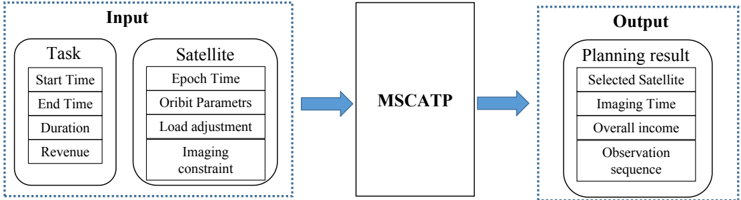
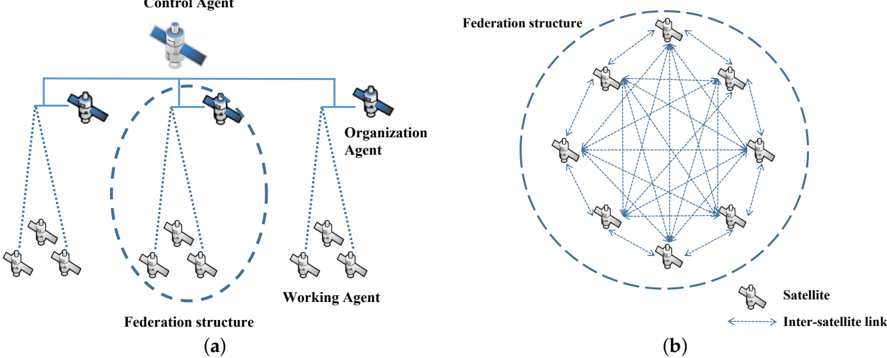
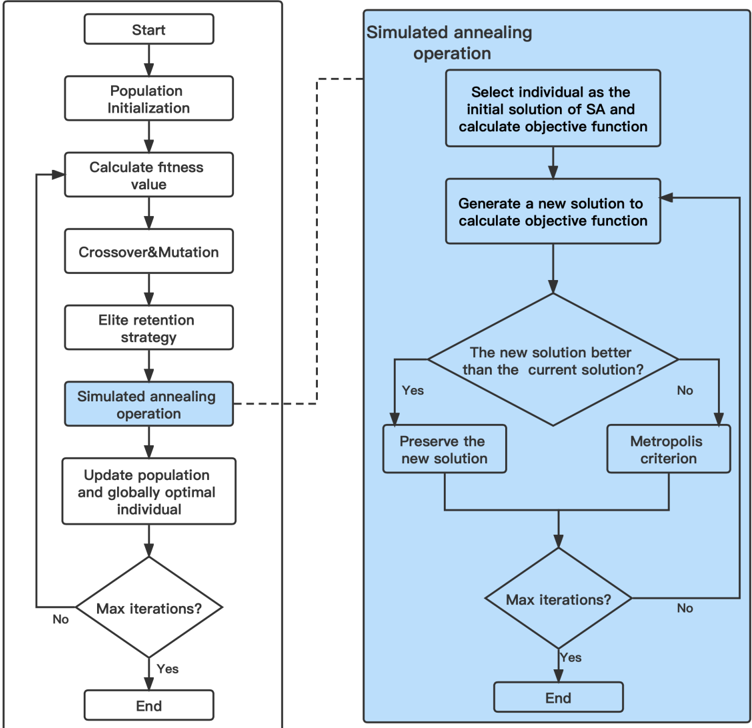
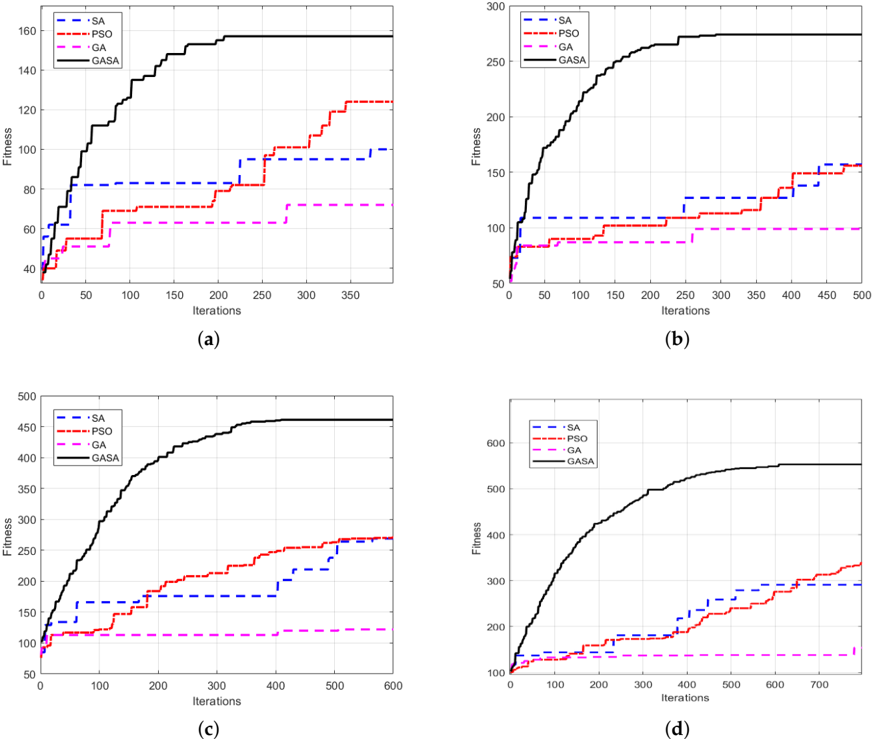
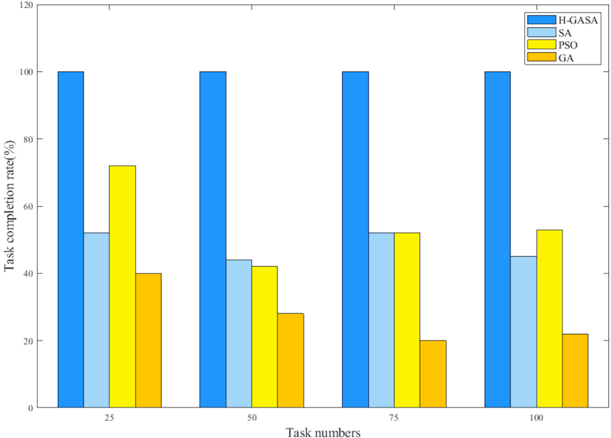
The increasing number of satellites for specific space tasks makes it difficult for traditional satellite task planning that relies on ground station planning and on-board execution to fully exploit the overall effectiveness of satellites. Meanwhile, the complex and changeable environment in space also poses challenges to the management of multi-satellite systems (MSS). To address the above issues, this paper formulates a mixed integer optimization problem to solve the autonomous task planning for MSS. First, we constructed a multi-agent-based on-board autonomous management and multi-satellite collaboration architecture. Based on this architecture, we propose a hybrid genetic algorithm with simulated annealing (H-GASA) to solve the multi-satellite cooperative autonomous task planning (MSCATP). With the H-GASA, a heuristic task scheduling scheme was developed to deal with possible task conflicts in MSCATP. Finally, a simulation scenario was established to validate our proposed H-GASA, which exhibits a superior performance in terms of computational power and success rate compared to existing algorithms.
Overview
The claims and statistics of this paper haven’t been checked yet.
Free: it reads the open-access text and checks the first 5 claims that cite a source we can check. Create a free account to check every claim.
Integrity signals
Registry
Cites
Statistics
Figures
Verification
Claims the paper makes
The claims and statistics of this paper haven’t been checked yet.
Free: it reads the open-access text and checks the first 5 claims that cite a source we can check. Create a free account to check every claim.
Self-check
Percentages, sums and reported differences re-computed from the paper’s own numbers.
The self-check needs the paper’s full text.
Citations
Cites
Viewing control structures as patterns of passing messages
Hewitt, C. (1977) · Artificial Intelligence · doi:10.1016/0004-3702(77)90033-9 · Cited by 1,161
A survey of multi-agent organizational paradigms
HORLING, B., & LESSER, V. (2004) · The Knowledge Engineering Review · doi:10.1017/s0269888905000317 · Cited by 709
Vasquez, M., & Hao, J.-K. (2001) · Computational Optimization and Applications · doi:10.1023/a:1011203002719 · Cited by 239
Simulated Annealing for Convex Optimization
Kalai, A. T., & Vempala, S. (2006) · Mathematics of Operations Research · doi:10.1287/moor.1060.0194 · Cited by 158
A novel hybrid particle swarm optimization for multi-UAV cooperate path planning
He, W., Qi, X., & Liu, L. (2021) · Applied Intelligence · doi:10.1007/s10489-020-02082-8 · Cited by 156
Self-citationA dynamic load-balancing policy with a central job dispatcher (LBC)
Lin, H.-C., & Raghavendra, C. S. (1992) · IEEE Transactions on Software Engineering · doi:10.1109/32.121756 · Cited by 148
Gabrel, V., & Vanderpooten, D. (2002) · European Journal of Operational Research · doi:10.1016/s0377-2217(01)00188-6 · Cited by 124
Multiple agent-based autonomy for satellite constellations
Schetter, T., Campbell, M., & Surka, D. M. (2003) · Artificial Intelligence · doi:10.1016/s0004-3702(02)00382-x · Cited by 109
Miao, Y., Hwang, I., Liu, M., & Wang, F. (2019) · Aerospace Science and Technology · doi:10.1016/j.ast.2019.105312 · Cited by 97
A new multi-satellite autonomous mission allocation and planning method
Du, B., & Li, S. (2018) · Acta Astronautica · doi:10.1016/j.actaastro.2018.11.001 · Cited by 81
Research works printed but not linked: 3
- Bai, 2009, Scheduling satellites observation and task merging based on decomposition optimization algorithm, Acta Autom. Sin., 35, 596
- Geng, 2020, Optimal mission planning with task clustering for intensive point targets observation of staring mode agile satellite, J. Control Decis., 35, 613
- Bai, 2009, Satellite single-orbit mission synthesis observation problem and its dynamic programming algorithm, Syst. Eng. Electron., 31, 1738
Cited by
Review of sensor tasking methods in Space Situational Awareness
Xue, C., Cai, H., Gehly, S., Jah, M. K., & Zhang, J. (2024) · Progress in Aerospace Sciences · doi:10.1016/j.paerosci.2024.101017 · Cited by 43
Liu, Y., Wen, Z., Zhang, S., & Hu, H. (2024) · Advances in Space Research · doi:10.1016/j.asr.2024.02.013 · Cited by 16
Neuro-Evolutionary Framework for Design Optimization of Two-Phase Transducer with Genetic Algorithms
Zameer, A., Naz, S., Raja, M. A. Z., Hafeez, J., & Ali, N. (2023) · Micromachines · doi:10.3390/mi14091677 · Cited by 11
“…lung cancer prognosis [32], wind power prediction [33], social networks [34], combustion engine [35], photovoltaic systems [36], task scheduling [37], traffic flow model [38], automotives [39], heat transfer [40], Complex networks [41], traffic management [42], Plasticity Echo State Network [43],…”
BackgroundQin, C., Gao, Y., & Wang, Y. (2025) · Scientific Reports · doi:10.1038/s41598-025-16815-7 · Cited by 9
Self-citationLarge-Scale Multi-Objective Imaging Satellite Task Planning Algorithm for Vast Area Mapping
Chen, Y., Shen, X., Guo Zhang, A., & Lu, Z. (2023) · Remote Sensing · doi:10.3390/rs15174178 · Cited by 9
Metadata
- Authors
- Long, J., Wu, S., Han, X., Wang, Y., & Liu, L.
- Affiliations
- Central South University (CN)
- China Academy of Space Technology (CN)
- Corresponding author
- Wang, Yunbo
- Liu, Limin
- Venue
- Aerospace
- Publisher
- MDPI AG
- Published
- 2023-01-10
- Volume
- 10
- Issue
- 1
- Pages
- 70
- ISSN
- 2226-4310 (ISSN-L)
- OpenAlex
- W4315491621
- Semantic Scholar
- 19486c9c7b9c33682524130be23eb0c7825cba91
- Cited by
- 39
- References
- 41
- Citations by year
- 2026: 6 · 2025: 19 · 2024: 9 · 2023: 5
- FWCI
- 4.75
- Type
- journal article
- Language
- en
- Open access
- gold
- doi.org
- Licence
- Locations
- Aerospace (publishedVersion, cc-by)
- DOAJ (DOAJ: Directory of Open Access Journals) (submittedVersion, cc-by-sa)
- Funders
- National Natural Science Foundation of China (U2003208, 61972398, 2016TP1003, 2021YFB3900902, 2019-JCJQ-ZD-342-00)
- Science and Technology Plan of Hunan (U2003208, 61972398, 2016TP1003, 2021YFB3900902, 2019-JCJQ-ZD-342-00)
- National Key R&D Program of China (U2003208, 61972398, 2016TP1003, 2021YFB3900902, 2019-JCJQ-ZD-342-00)
- Theory and Method of Multi-Satellite Collaborative Application (U2003208, 61972398, 2016TP1003, 2021YFB3900902, 2019-JCJQ-ZD-342-00)
- Topics
- Physical Sciences › Engineering › Aerospace Engineering › Satellite Communication Systems
- Physical Sciences › Engineering › Aerospace Engineering › Spacecraft Design and Technology
- Physical Sciences › Engineering › Aerospace Engineering › Space Satellite Systems and Control
- Keywords
- multi-satellite systems, hybrid genetic algorithm, simulated annealing, multi-agent systems, task scheduling, mixed integer programming
About these checks
Registry, retraction, Cites and statistics results are computed, not judged, with one exception: a printed reference that no index lists is read once by a model before it counts as a citation error. Claims are extracted by a model and kept only when their quote appears verbatim in the text; each cited source is then checked, with a model’s help, for whether it says what the claim relies on. Those verdicts can be wrong — read the claim’s quote and the cited source before relying on one.
Statistics and arithmetic are recomputed, not judged.
Confidence bands are shown only for fields calibrated on our annotated test set. None is calibrated yet, so no band is shown.
What counts as a claim ›How we measure confidence ›How we check this ›
Are you an author, or do you see a problem with this page? Request a review
How to cite
Cite CoChat for the checks on this page, and the paper for its own findings.
- This page
- CoChat. (2026). Citation check: Autonomous Task Planning Method for Multi-Satellite System Based on a Hybrid Genetic Algorithm. https://app.cochat.ai/papers/10.3390/aerospace10010070
- The paper
- Long, J., Wu, S., Han, X., Wang, Y., & Liu, L. (2023). Autonomous Task Planning Method for Multi-Satellite System Based on a Hybrid Genetic Algorithm. Aerospace. https://doi.org/10.3390/aerospace10010070
Data sources
Bibliographic data: Semantic Scholar, OpenAlex, Crossref.
Contains information from the Semantic Scholar Academic Graph Datasets, made available under the ODC Attribution License (ODC-BY 1.0).
Semantic Scholar’s data is described in: Kinney, R., et al. (2023). The Semantic Scholar Open Data Platform. arXiv:2301.10140.
