

Towards Multi-Satellite Collaborative Computing via Task Scheduling Based on Genetic Algorithm
Open accessThe DOI matches its Crossref record; 51 of the 51 references it cites were found in a registry or an index.
Abstract
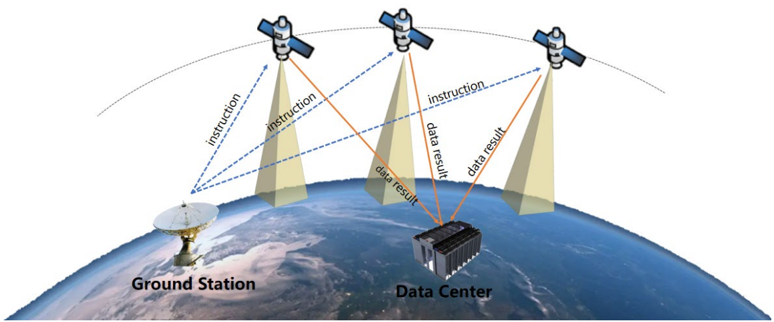
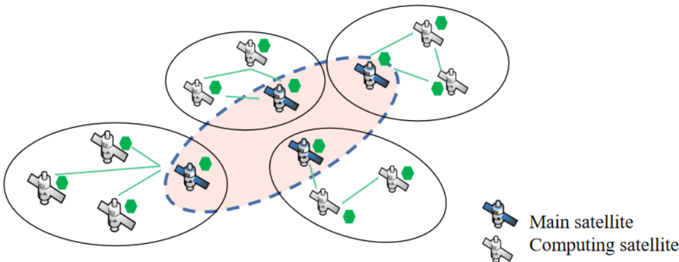
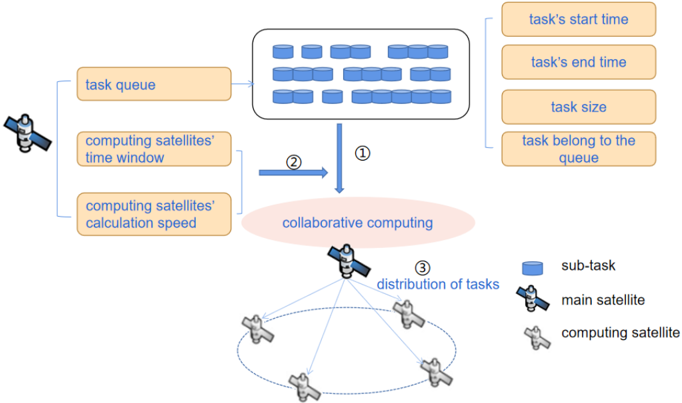
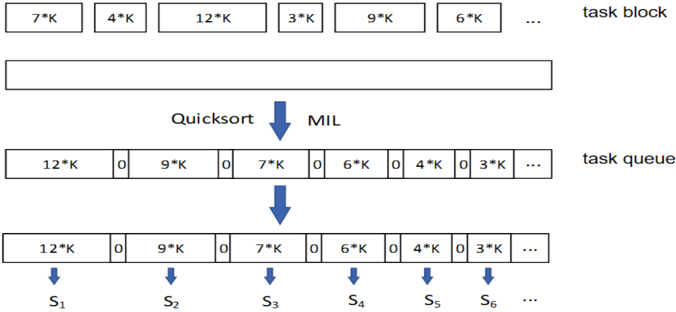
With satellite systems rapidly developing in multiple satellites, multiple tasks, and high-speed response speed requirements, existing computing techniques face the following challenges: insufficient computing power, limited computing resources, and weaker coordination ability. Meanwhile, most methods have more significant response speed and resource utilization limitations. To solve the above problem, we propose a distributed collaborative computing framework with a genetic algorithm-based task scheduling model (DCCF-GA), which can realize the collaborative computing between multiple satellites through genetic algorithm. Specifically, it contains two aspects of work. First, a distributed architecture of satellites is constructed where the main satellite is responsible for distribution and scheduling, and the computing satellite is accountable for completing the task. Then, we presented a genetic algorithm-based task scheduling model that enables multiple satellites to collaborate for completing the tasks. Experiments show that the proposed algorithm has apparent advantages in completion time and outperforms other algorithms in resource efficiency.
Overview
The claims and statistics of this paper haven’t been checked yet.
Free: it reads the open-access text and checks the first 5 claims that cite a source we can check. Create a free account to check every claim.
Integrity signals
Registry
Cites
Statistics
Figures
Verification
Claims the paper makes
The claims and statistics of this paper haven’t been checked yet.
Free: it reads the open-access text and checks the first 5 claims that cite a source we can check. Create a free account to check every claim.
Self-check
Percentages, sums and reported differences re-computed from the paper’s own numbers.
The self-check needs the paper’s full text.
Citations
Cites
Radhakrishnan, R., Edmonson, W. W., Afghah, F., Rodriguez-Osorio, R. M., Pinto, F., & Burleigh, S. C. (2016) · IEEE Communications Surveys & Tutorials · doi:10.1109/comst.2016.2564990 · Cited by 367
Analysis of Inter-Satellite Link Paths for LEO Mega-Constellation Networks
Chen, Q., Giambene, G., Yang, L., Fan, C., & Chen, X. (2021) · IEEE Transactions on Vehicular Technology · doi:10.1109/tvt.2021.3058126 · Cited by 335
Bianchessi, N., Cordeau, J.-F., Desrosiers, J., Laporte, G., & Raymond, V. (2007) · European Journal of Operational Research · doi:10.1016/j.ejor.2005.12.026 · Cited by 252
Collaborative Data Downloading by Using Inter-Satellite Links in LEO Satellite Networks
Jia, X., Lv, T., He, F., & Huang, H. (2017) · IEEE Transactions on Wireless Communications · doi:10.1109/twc.2017.2647805 · Cited by 191
Satellite Edge Computing for the Internet of Things in Aerospace
Wang, Y., Yang, J. J., Guo, X., & Qu, Z. (2019) · Sensors · doi:10.3390/s19204375 · Cited by 102
Self-citationCollaborative Multi-Resource Allocation in Terrestrial-Satellite Network Towards 6G
Fu, S., Gao, J., & Zhao, L. Y. (2021) · IEEE Transactions on Wireless Communications · doi:10.1109/twc.2021.3080578 · Cited by 95
Yang, Z., Yang, R., Yu, F. R., Li, M., Zhang, Y., & Teng, Y. (2022) · IEEE Internet of Things Journal · doi:10.1109/jiot.2022.3152188 · Cited by 89
A Dynamic Resource Scheduling Scheme in Edge Computing Satellite Networks
Wang, F., Jiang, D., Qi, S., Chen, Q., & Shi, L. (2020) · Mobile Networks and Applications · doi:10.1007/s11036-019-01421-5 · Cited by 83
A new multi-satellite autonomous mission allocation and planning method
Du, B., & Li, S. (2018) · Acta Astronautica · doi:10.1016/j.actaastro.2018.11.001 · Cited by 81
Distributed onboard mission planning for multi-satellite systems
Zheng, Z., Guo, J., & Gill, E. (2019) · Aerospace Science and Technology · doi:10.1016/j.ast.2019.03.054 · Cited by 66
Research works printed but not linked: 3
- Shangguan, 2019, An Approach of Spatial Information Network Oriented Satellite-Ground Collaborative Computing Migration, Geomat. Inf. Sci. Wuhan Univ., 44, 459
- Song, 2022, Computation Offloading and Resource Allocation Algorithm for Collaborative LEO Satellite Multi-Access Edge Computing, Acta Electonica Sin., 50, 567
- Hu, 2019, Development trend analysis of remote sensing small satellite of surveying and mapping application, Sci. Surv. Mapp., 44, 136
Cited by
A comprehensive survey of orbital edge computing: Systems, applications, and algorithms
Yin, Z., Wu, C., Guo, C., Yuanchun, L. I., Mengwei, X. U., Weiwei, G. A. O., & Chuanxiu, C. H. I. (2024) · Chinese Journal of Aeronautics · doi:10.1016/j.cja.2024.11.026 · Cited by 79
Deep reinforcement learning-based resource allocation method for multi-satellite scheduling
Chen, X., Tian, T., Dai, G., Wang, M., Song, Z., & Xing, L. (2025) · Computers & Operations Research · doi:10.1016/j.cor.2025.107088 · Cited by 18
Chen, X., Tian, T., Dai, G., Wang, M., Song, Z., Zheng, W., & Zhou, Q. (2025) · IEEE Transactions on Aerospace and Electronic Systems · doi:10.1109/taes.2025.3538476 · Cited by 9
A Multi-Satellite Multi-Target Observation Task Planning and Replanning Method Based on DQN
Xing, X., Wang, S., Liu, W., & Liu, C. (2025) · Sensors · doi:10.3390/s25061856 · Cited by 6
RSBEV-Mamba: 3-D BEV Sequence Modeling for Multiview Remote Sensing Scene Segmentation
Lin, B., Zou, Z., & Shi, Z. (2025) · IEEE Transactions on Geoscience and Remote Sensing · doi:10.1109/tgrs.2025.3543200 · Cited by 5
Metadata
- Authors
- Fei, H., Zhang, X., Long, J., Liu, L., & Wang, Y.
- Affiliations
- Central South University (CN)
- Corresponding author
- Liu, Limin
- Wang, Yunbo
- Venue
- Aerospace
- Publisher
- MDPI AG
- Published
- 2023-01-17
- Volume
- 10
- Issue
- 2
- Pages
- 95
- ISSN
- 2226-4310 (ISSN-L)
- OpenAlex
- W4317391262
- Semantic Scholar
- 2155588d85c0df1e1e383a72d813778a97177aa5
- Cited by
- 17
- References
- 51
- Citations by year
- 2026: 3 · 2025: 12 · 2024: 2
- FWCI
- 2.07
- Type
- journal article
- Language
- en
- Open access
- gold
- doi.org
- Licence
- Locations
- Aerospace (publishedVersion, cc-by)
- DOAJ (DOAJ: Directory of Open Access Journals) (submittedVersion, cc-by-sa)
- Topics
- Physical Sciences › Engineering › Aerospace Engineering › Satellite Communication Systems
- Physical Sciences › Computer Science › Computer Networks and Communications › Distributed and Parallel Computing Systems
- Physical Sciences › Engineering › Industrial and Manufacturing Engineering › Scheduling and Optimization Algorithms
- Keywords
- task scheduling, genetic algorithm, distributed computing framework, task allocation, resource utilization, completion time
About these checks
Registry, retraction, Cites and statistics results are computed, not judged, with one exception: a printed reference that no index lists is read once by a model before it counts as a citation error. Claims are extracted by a model and kept only when their quote appears verbatim in the text; each cited source is then checked, with a model’s help, for whether it says what the claim relies on. Those verdicts can be wrong — read the claim’s quote and the cited source before relying on one.
Statistics and arithmetic are recomputed, not judged.
Confidence bands are shown only for fields calibrated on our annotated test set. None is calibrated yet, so no band is shown.
What counts as a claim ›How we measure confidence ›How we check this ›
Are you an author, or do you see a problem with this page? Request a review
How to cite
Cite CoChat for the checks on this page, and the paper for its own findings.
- This page
- CoChat. (2026). Citation check: Towards Multi-Satellite Collaborative Computing via Task Scheduling Based on Genetic Algorithm. https://app.cochat.ai/papers/10.3390/aerospace10020095
- The paper
- Fei, H., Zhang, X., Long, J., Liu, L., & Wang, Y. (2023). Towards Multi-Satellite Collaborative Computing via Task Scheduling Based on Genetic Algorithm. Aerospace. https://doi.org/10.3390/aerospace10020095
Data sources
Bibliographic data: Semantic Scholar, OpenAlex, Crossref.
Contains information from the Semantic Scholar Academic Graph Datasets, made available under the ODC Attribution License (ODC-BY 1.0).
Semantic Scholar’s data is described in: Kinney, R., et al. (2023). The Semantic Scholar Open Data Platform. arXiv:2301.10140.
