

Benchmarking the Agronomic Performance of Biodegradable Mulches against Polyethylene Mulch Film: A Meta-Analysis
Open accessThe DOI matches its Crossref record; 52 of the 54 references it cites were found in a registry or an index.
Abstract
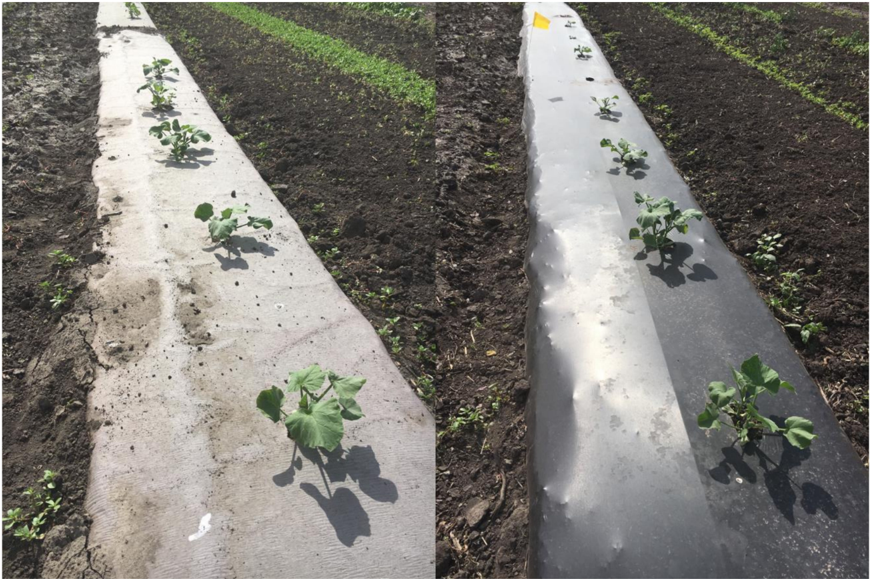
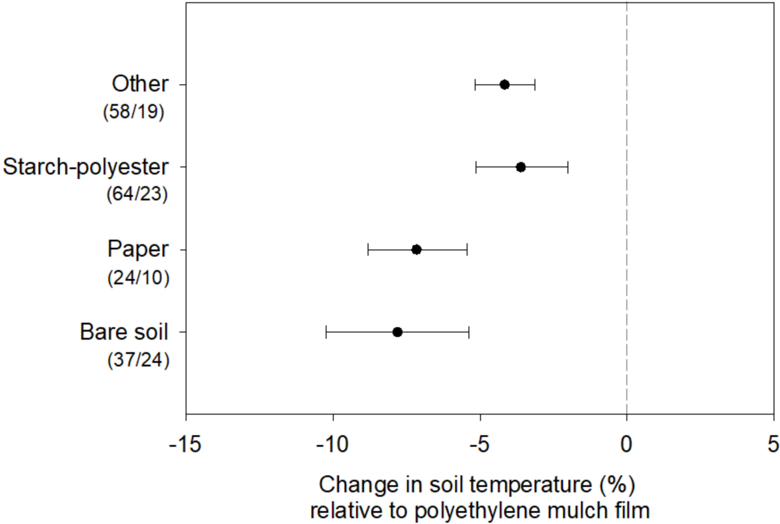
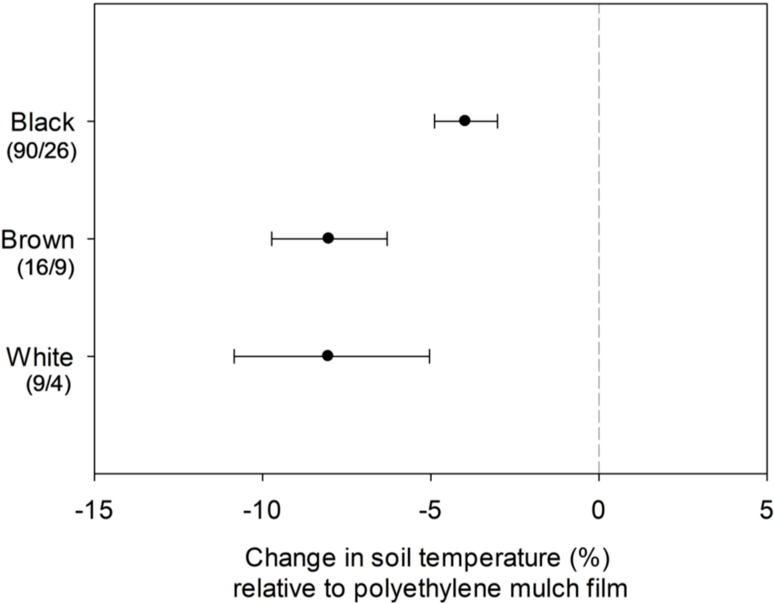
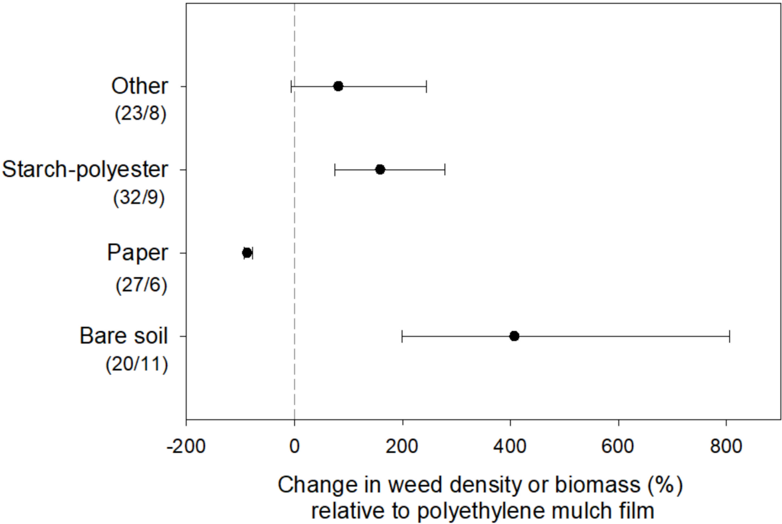
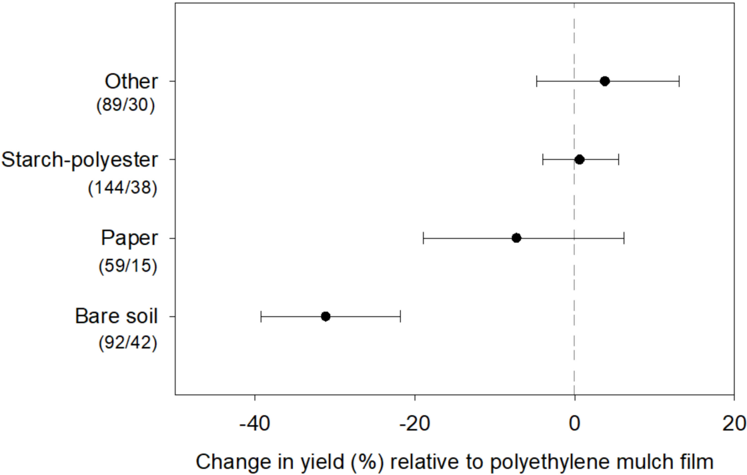
Growers are interested in biodegradable alternatives to petroleum-based polyethylene mulch film (PEM). However, many growers cite limited knowledge about biodegradable mulch films (BDMs) as a significant barrier to adoption. Agronomic field tests of BDMs are often limited temporally or spatially, and the variability of performance results relative to PEM may be contributing to this perceived knowledge gap. Our objective was to use data available in the scientific literature to provide the first quantitative performance benchmark of BDMs against PEM. We extracted data from 66 articles for meta-analysis. Response ratios were calculated for comparison of BDMs relative to black PEM, and differences among categorical groups were determined using 95% bootstrap confidence intervals. Overall, BDMs reduced soil temperature by 4.5% ± 0.8% (±one standard error) compared to PEM, and temperatures were coolest beneath paper-based BDM. Starch-polyester BDM was less effective than PEM for weed control, but paper-based BDM reduced weed density and biomass by 85.7% ± 9.2%. Paper-based BDMs were particularly useful for controlling Cyperus spp. weeds. Despite differences in soil temperature and weed suppression, crop yields were not different between BDMs and PEM. Future research should focus on reducing costs, adding functional value, and increasing the biodegradability of BDMs.
Overview
The claims and statistics of this paper haven’t been checked yet.
Free: it reads the open-access text and checks the first 5 claims that cite a source we can check. Create a free account to check every claim.
Integrity signals
Registry
Cites
Statistics
Figures
Verification
Claims the paper makes
The claims and statistics of this paper haven’t been checked yet.
Free: it reads the open-access text and checks the first 5 claims that cite a source we can check. Create a free account to check every claim.
Claims other papers make about this one
Each is checked against this paper’s own text: does it say what the citing paper says it does?
The source backs part of the claim, not all of it — or backs it for a different population, condition or comparison.
In the citing paper
“The slightly lower soil temperatures observed under Kraft® paper in the present study are likely attributable to its lighter colour and higher reflectance, which reduced heat absorption and led to the lowest annual thermal accumulation [5,16]”
From Linking Polymer Transformation and Soil Microclimate to Mulch (Bio)Degradation: A Field-Based Approach Using Mesh Bags and FTIR (2026) · cites this paper as [5]
Experimental — accuracy not yet measuredThe source backs part of the claim, not all of it — or backs it for a different population, condition or comparison.
In the citing paper
“But biodegradable mulches must be manufactured from 100% bio-based materials (no fossil-derived materials or synthetic polymers), and also without the use of genetically modified organisms including feedstock and processing microorganisms [5].”
From Linking Polymer Transformation and Soil Microclimate to Mulch (Bio)Degradation: A Field-Based Approach Using Mesh Bags and FTIR (2026) · cites this paper as [5]
Experimental — accuracy not yet measured
Self-check
Percentages, sums and reported differences re-computed from the paper’s own numbers.
The self-check needs the paper’s full text.
Citations
Cites
Conducting Meta-Analyses in R with the metafor Package
Viechtbauer, W. (2010) · Journal of Statistical Software · doi:10.18637/jss.v036.i03 · Cited by 20,464 · cited 2×
“Funnel plots were evaluated by regression analysis to identify any data asymmetry, and sensitivity analysis was conducted using the “influence” function in the “metafor” package to identify influential observations [27,30].”
MethodBorenstein, M., Hedges, L. V., Higgins, J. P. T., & Rothstein, H. R. (2009) · doi:10.1002/9780470743386 · Cited by 14,225
Eriksen, M., Lebreton, L. C. M., Carson, H. S., Thiel, M., Moore, C. J., Borerro, J. C., Galgani, F., Ryan, P. G., & Reisser, J. (2014) · PLoS ONE · doi:10.1371/journal.pone.0111913 · Cited by 4,710
The meta-analysis of response ratios in experimental ecology
Hedges, L. V., Gurevitch, J., & Curtis, P. S. (1999) · Ecology · doi:10.1890/0012-9658(1999)080[1150:tmaorr]2.0.co;2 · Cited by 4,704
Polyethylene and biodegradable mulches for agricultural applications: A review
Kasirajan, S., & Ngouajio, M. (2012) · Agronomy for Sustainable Development · doi:10.1007/s13593-011-0068-3 · Cited by 1,353 · cited 3×
“decades have been invested in the development and evaluation of biodegradable mulch (BDM) alternatives to PEM [7,12].”
BackgroundResultMethodological issues and advances in biological meta-analysis
Nakagawa, S., & Santos, E. S. A. (2012) · Evolutionary Ecology · doi:10.1007/s10682-012-9555-5 · Cited by 1,032 · cited 1×
“, mulch type), and then to assess potential effects of non‐independence [29].”
BackgroundRecent advances in mulching materials and methods for modifying soil environment
Kader, M. A., Senge, M., Mojid, M. A., & Ito, K. (2017) · Soil and Tillage Research · doi:10.1016/j.still.2017.01.001 · Cited by 694
Effects of plastic mulching and plastic residue on agricultural production: A meta-analysis
Gao, H., Yan, C., Liu, Q., Ding, W., Chen, B., & Li, Z. (2019) · Science of The Total Environment · doi:10.1016/j.scitotenv.2018.09.105 · Cited by 690
RESAMPLING TESTS FOR META-ANALYSIS OF ECOLOGICAL DATA
Adams, D. C., Gurevitch, J., & Rosenberg, M. S. (1997) · Ecology · doi:10.1890/0012-9658(1997)078[1277:rtfmao]2.0.co;2 · Cited by 688 · cited 1×
“weight = (nagronomic response × ncontrol)/(nagronomic response + ncontrol) [25].”
Is Biodegradable Plastic Mulch the Solution to Agriculture’s Plastic Problem?
Sintim, H. Y., & Flury, M. (2017) · Environmental Science & Technology · doi:10.1021/acs.est.6b06042 · Cited by 387 · cited 3×
“The most common mulch used in commercial agricultural systems is polyethylene plastic film [6].”
Background
Research works printed but not linked: 3
- Bhattacharya, S.; Das, S.; Saha, T. Application of plasticulture in horticulture: A review. TPI Int. J. 2018, 7, 584-585.
- Nalayini, P.; Sankaranarayanan, K.; Velmourougane, K.; Suveetha, M. Biodegradable mulching for moisture conservation, weed control and enhanced productivity of winter irrigated cotton maize system. J. Cott. Res. Develop. 2017, 31, 205-212.
- Saraiva, A.; Costa, R.; Carvalho, L.; Duarte, E. The use of biodegradable mulch films in muskmelon crop production. Basic Res. J. Agric. Sci. Rev. 2012, 1, 88-95.
Cited by
Items 101–115 of 115
Williams, A. R., Goldberger, J. R., & DeVetter, L. W. (2026) · Renewable Agriculture and Food Systems · doi:10.1017/s1742170526100477
“Although these films offer many of the same agronomic benefits as PE mulch, grower adoption has been limited (Dentzman and Gold-berger, 2020; Goldberger et al., 2015; Tofanelli and Wortman, 2020).”
Kassem, H. S., Mosa, A. A., Bhattacharya, M., AbouElnaga, M., Elagamy, M., Atiya, D., Elgamal, B., & Osbahr, H. (2026) · Sustainability · doi:10.3390/su18136899
Wehrbein, C. D., Kadoma, I., Kaiser, M., Proctor, C., & Wortman, S. E. (2026) · HortScience · doi:10.21273/hortsci19559-26
Self-citationHu, R., Huang, M., Jiang, A., Zong, H., Liu, J., Wang, F., Huang, X., Guo, J., Song, N., & Wang, X. (2026) · Agronomy · doi:10.3390/agronomy16141373
Akram, M. E. (2026) · Lincoln (University of Nebraska)
Pereira, P., Ramos, A. C., Machado, R., de Oliveira, P. B., Pedra, F., Cotta, J., Brunetto, G., & Carranca, C. (2026) · SSRN Electronic Journal · doi:10.2139/ssrn.7244096
Biodegradable Plastics: An Ideal Solution for Sustainable Development
Verma, V., Dixit, V., Prerna, & Joshi, H. (2026) · Springer proceedings in physics · doi:10.1007/978-981-92-4005-0_10
Escrig, C., Gil, C. S., Solera, E. D., de Ferrer, J. A., Bellas, J., & Bertucci, J. I. (2026) · Microplastics · doi:10.3390/microplastics5030175
Toward Plastic‐Free Vineyards: The Role of Bioplastics in Sustainable Viticulture—A Review
Rossi, D., Rossi, S., Pedrotti, C., Gallorini, R., Citernesi, A. S., Cinelli, P., & Seggiani, M. (2026) · Polymers for Advanced Technologies · doi:10.1002/pat.70746
“Although less common in viticul-ture than in horticulture, mulching is used in young vineyards, on steep slopes, and in arid or semi-arid regions where water conservation is essential [17].”
Saratale, G. D., Saratale, R. G., Kumar, R., Shin, H. S., & Jeon, B. (2026) · Polymers · doi:10.3390/polym18192343
“…amylose to amylopectin, granule size, crystallinity, gelatinization temperature, lipids, proteins, phosphate groups, and other minor constituents can significantly affect gelatinization-related behavior, film formation, transparency, mechanical strength, flexibility, and barrier properties [67–70].”
DeVetter, L. W., Gull, N., Weiss, B., Ahmad, W., Gramig, G., Bajwa, D., Durado, A., Wortman, S. E., Agehara, S., Ghasemi, H. F., et al. (2026) · Acta Horticulturae · doi:10.17660/actahortic.2026.1465.34
Self-citationBenefits and drawbacks of soil-biodegradable plastic mulch for soil health
Flury, M., Jiang, R., Wang, C., Wilder, M., & Sintim, H. (2026) · Acta Horticulturae · doi:10.17660/actahortic.2026.1465.32
Madin, M. B. (2025) · K-State Research Exchange (Kansas State University)
Falco, F. D., Nacci, T., Burgevin, F., Courtene‐Jones, W., Fullarton, A., Coppock, R., Degano, I., Modugno, F., & Thompson, R. C. (2026) · Environmental Science & Technology · doi:10.1021/acs.est.6c11149
Pagliarini, E., Minichiello, C., Baffoni, L., Sisti, L., Ferri, M., Vannini, M., Saccani, A., & Gioia, D. D. (2026) · Bioresource Technology Reports · doi:10.1016/j.biteb.2026.103158
Metadata
- Authors
- Tofanelli, M. B. D., & Wortman, S. E.
- Affiliations
- Universidade Federal do Paraná (BR)
- University of Nebraska–Lincoln (US)
- Corresponding author
- Wortman, Sam E.
- Venue
- Agronomy
- Publisher
- MDPI AG
- Published
- 2020-10-21
- Volume
- 10
- Issue
- 10
- Pages
- 1618
- ISSN
- 2073-4395 (ISSN-L)
- OpenAlex
- W3094587832
- Cited by
- 101
- References
- 54
- Citations by year
- 2026: 16 · 2025: 25 · 2024: 15 · 2023: 19 · 2022: 17 · 2021: 9
- FWCI
- 0.94
- Type
- journal article
- Language
- en
- Open access
- gold
- doi.org
- Licence
- Locations
- Agronomy (publishedVersion, cc-by)
- Lincoln (University of Nebraska) (submittedVersion)
- DOAJ (DOAJ: Directory of Open Access Journals) (submittedVersion, cc-by-sa)
- Funders
- National Institute of Food and Agriculture (Hatch Act)
- Fulbright Scholar Program (N/A)
- Topics
- Life Sciences › Agricultural and Biological Sciences › Agronomy and Crop Science › Polymer-Based Agricultural Enhancements
- Life Sciences › Agricultural and Biological Sciences › Soil Science › Irrigation Practices and Water Management
- Life Sciences › Agricultural and Biological Sciences › Plant Science › Weed Control and Herbicide Applications
- Keywords
- biodegradable mulch, soil temperature, weed control, crop yield, biodegradable alternatives, agricultural plastic waste
About these checks
Registry, retraction, Cites and statistics results are computed, not judged, with one exception: a printed reference that no index lists is read once by a model before it counts as a citation error. Claims are extracted by a model and kept only when their quote appears verbatim in the text; each cited source is then checked, with a model’s help, for whether it says what the claim relies on. Those verdicts can be wrong — read the claim’s quote and the cited source before relying on one.
Statistics and arithmetic are recomputed, not judged.
Confidence bands are shown only for fields calibrated on our annotated test set. None is calibrated yet, so no band is shown.
What counts as a claim ›How we measure confidence ›How we check this ›
Are you an author, or do you see a problem with this page? Request a review
Data sources
Bibliographic data: Semantic Scholar, OpenAlex, Crossref.
Contains information from the Semantic Scholar Academic Graph Datasets, made available under the ODC Attribution License (ODC-BY 1.0).
Semantic Scholar’s data is described in: Kinney, R., et al. (2023). The Semantic Scholar Open Data Platform. arXiv:2301.10140.
