

The DOI matches its Crossref record; 26 of the 26 references it cites were found in a registry or an index.
Effects of Water Temperature on Gonads Growth in Ambystoma mexicanum Axolotl Salamanders
Open accessAbstract
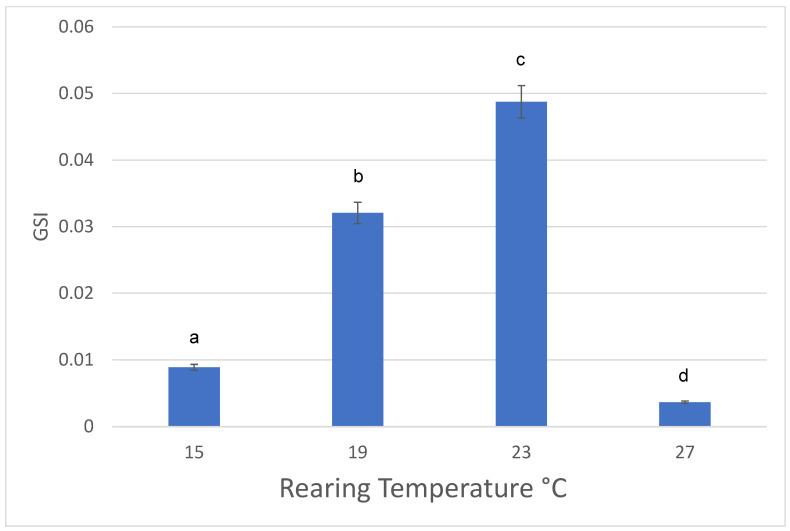
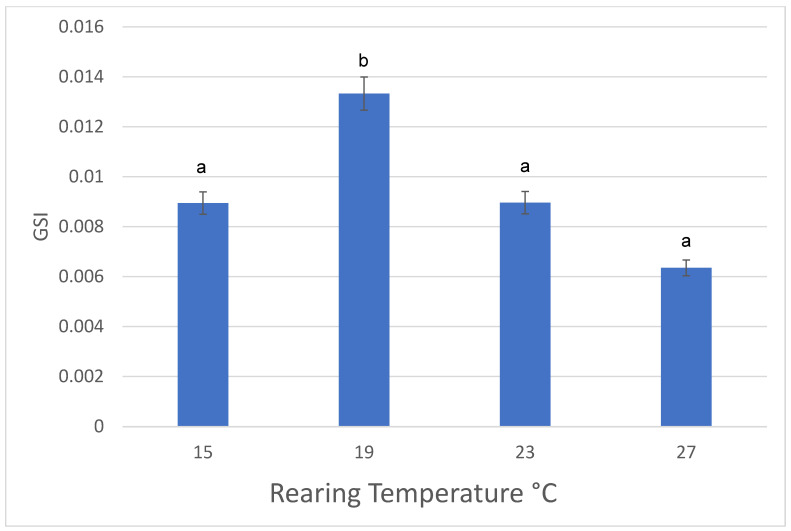
The thermal environment is a major factor influencing amphibians. For example, amphibian reproduction occurs in specific temperatures, and minor changes in this aspect could have negative impacts on this biological process. Understanding the potential effects of temperature on reproductive output is important from both an ecological and captive breeding colony point of view. I examined temperature effects on reproduction in axolotl reared from egg to adult at 4 temperatures (15 °C, 19 °C, 23 °C, and 27 °C) These adult axolotls (n = 174) were measured and weighed, dissected, and their gonads were removed and weighed to obtain an individual’s reproductive allocation. Female axolotls reared at 23 °C had a greater Gonadosomatic Index (GSI) compared to axolotl reared at each of the other temperatures with axolotls reared at 27 °C having the lowest reproductive output. Moreover, all GSI pair-wise comparisons in the four temperature treatments were significantly different from each other (ANOVA, F (3, 66) = 61.681, p < 0.0001). Additionally male rearing temperature significantly influenced GSI (ANOVA, F (3, 89) = 10.441, p < 0.0001). Male axolotls reared at 19 °C had significantly greater GSI compared to males reared at the three other temperatures. There were no statistical differences among each of the other pair-wise comparisons. As seen in this experiment, axolotls may be especially sensitive to climate-driven warming due to their highly permeable skin and paedomorphic life history. Understanding how axolotls and other amphibian species adjust to the challenges of climate change is important in the management of this imperiled taxa.
Overview
The claims and statistics of this paper haven’t been checked yet.
Run the check — free, no account needed. It reads the open-access text and checks the sources it cites.
Integrity signals
Registry
Cites
Statistics
Figures
Verification
Claims the paper makes
The claims and statistics of this paper haven’t been checked yet.
Run the check — free, no account needed. It reads the open-access text and checks the sources it cites.
Self-check
Percentages, sums and reported differences re-computed from the paper’s own numbers.
The self-check needs the paper’s full text.
Citations
Cites
Time and Size at Metamorphosis Related to Adult Fitness in Ambystoma Talpoideum
Semlitsch, R. D., Scott, D. E., & Pechmann, J. H. K. (1988) · Ecology · doi:10.2307/1943173 · Cited by 893
Effects of temperature and food quality on anuran larval growth and metamorphosis
Álvarez, D., & Nicieza, A. G. (2002) · Functional Ecology · doi:10.1046/j.1365-2435.2002.00658.x · Cited by 237
Developmental Biology of the Axolotl
Bagnara, J. T., Armstrong, J. B., & Malacinski, G. M. (1989) · Copeia · doi:10.2307/1445526 · Cited by 199
Merilä, J., Laurila, A., Laugen, A. T., Räsänen, K., & Pahkala, M. (2000) · Ecography · doi:10.1111/j.1600-0587.2000.tb00302.x · Cited by 128
Earl, J. E., & Whiteman, H. H. (2015) · Copeia · doi:10.1643/ch-14-128 · Cited by 104
Contreras, V., Martínez‐Meyer, E., Valiente, E., & Zambrano, L. (2009) · Biological Conservation · doi:10.1016/j.biocon.2009.07.008 · Cited by 81
Patterns of temperature induced developmental plasticity in anuran larvae
Ruthsatz, K., Peck, M. A., Dausmann, K. H., Sabatino, N. M., & Glos, J. (2018) · Journal of Thermal Biology · doi:10.1016/j.jtherbio.2018.03.005 · Cited by 80
Flament, S. (2016) · Sexual Development · doi:10.1159/000448797 · Cited by 66
Ruthsatz, K., Dausmann, K. H., Peck, M. A., & Glos, J. (2022) · Journal of Experimental Zoology Part A Ecological and Integrative Physiology · doi:10.1002/jez.2582 · Cited by 63
Ontogeny of Temperature Selection in Larval Amphibians
Dupré, R. K., Petranka, J. W., & Dupré, R. K. (1985) · Copeia · doi:10.2307/1444859 · Cited by 63
Research works printed but not linked: 12
- Fontenot, 2011, Thermal Selection and Temperature Preference of the Aquatic Salamander, Amphiuma tridactylum, Herp. Cons. Biol., 6, 395
- Hutchison, 1976, Thermal Selection in the Hellbender, Cryptobranchus alleganiensis, and the Mudpuppy, Necturus maculosus, Herpetologica, 32, 327
- Moore, F.L. (1987). Hormones and Reproduction in Fishes, Amphibians, and Reptiles, Springer.
- Heatwole, 2005, Hormonal regulation of reproductive cycles in amhibians, Amphibian Biology, Volume 6, 2045
- Rastogi, R.K., Pinelli, C., Polese, G., D’Aniello, B., and Chieffi-Baccari, G. (2011). Hormones and Reproduction of Vertebrates, Academic Press.
- Figiel, 2013, Cryopreservation of Sperm from the Axolotl Ambystoma mexicanum: Implications for Conservation, Herp. Cons. Biol., 8, 748
- Figiel, 2020, Cold Storage of Sperm from the Axolotl, Ambystoma mexicanum, Herp. Cons. Biol., 15, 367
- Bordzilovskaya, 1979, Table of stages of the normal development of axolotl embryos, Axolotl Newsl., 7, 2
- Rodriguezb, 2001, Gonadosomatic index and seasonal variations of plasma sex steroids in skipjack tuna (Katsuwonus pelamis) and yellowfin tuna (Thunnus albacares) from the western Indian Ocean, Aquat. Living Resour., 14, 313
- Snedecor, G.W., and Cochran, W.G. (1989). Statist. Methods, Iowa State University Press.
- Dadras, 2017, Effect of water temperature on the physiology of fish spermatozoon function: A brief review Aquacul, Res., 48, 729
- Tsutsui, 1931, Notes on the Behavior of the Japanese newt, Diemyctylus pyrrhogaster Boie; (1) Breeding habits, Mem. Coll. Sci. Kyoto. Imp. Univ., 7, 159
Cited by
Sorted by citations
Browne, R. K., Luo, Q., Wang, P., Mansour, N., Kaurova, S. A., Gakhova, E. N., Shishova, N. V., Uteshev, V. K., Kramarova, L. I., Venu, G., et al. (2024) · Animals · doi:10.3390/ani14233395 · Cited by 17
Zhang, X., Du, H., Zhao, Z., Wu, Y., Cao, Z., Zhou, Y., & Sun, Y. (2023) · Animals · doi:10.3390/ani13122035 · Cited by 9
Browne, R. K., Luo, Q., Wang, P., Mansour, N., Kaurova, S. A., Gakhova, E. N., Shishova, N. V., Uteshev, V. K., Kramarova, L. I., Bolton, R. L., et al. (2024) · Animals · doi:10.3390/ani14101455 · Cited by 8
THE EFFECT OF TEMPERATURE MANIPULATION ON THE GROWTH OF AXOLOTL (Ambystoma mexicanum)
Afnan, N. I., Faqih, A. R., & Dailami, M. (2025) · Jurnal Perikanan Unram · doi:10.29303/jp.v15i2.1463 · Cited by 1
Ambient Temperature Modifies Physiological Plasticity in a Tailed AmphibianPreprint
Zhang, C.-Y., Fang, Z., Cao, Z., Wang, Z., Guo, R.-Y., Zhao, Y., Ji, X. S., & Lin, L. (2024) · SSRN Electronic Journal · doi:10.2139/ssrn.4902641
Metadata
- Authors
- Figiel, C. R.
- Affiliations
- United States Fish and Wildlife Service (US)
- Corresponding author
- Figiel, Chester R.
- ORCID
- Figiel, Chester R.
- Venue
- Animals
- Publisher
- MDPI AG
- Published
- 2023-02-28
- Volume
- 13
- Issue
- 5
- Pages
- 874
- ISSN
- 2076-2615 (ISSN-L)
- PMC
- PMC10000224
- OpenAlex
- W4322715869
- Cited by
- 5
- References
- 26
- Citations by year
- 2025: 1 · 2024: 2 · 2023: 2
- FWCI
- 0.93
- Type
- journal article
- Language
- en
- Open access
- gold
- doi.org
- Licence
- Locations
- Animals (publishedVersion, cc-by)
- PubMed Central (publishedVersion, cc-by)
- PubMed (publishedVersion)
- DOAJ (DOAJ: Directory of Open Access Journals) (submittedVersion, cc-by-sa)
- Funders
- U.S. Department of Agriculture
- National Institutes of Health (P40OD019794)
- U.S. Fish and Wildlife Service
- Topics
- Life Sciences › Biochemistry, Genetics and Molecular Biology › Physiology › Reproductive biology and impacts on aquatic species
- Life Sciences › Agricultural and Biological Sciences › Ecology, Evolution, Behavior and Systematics › Amphibian and Reptile Biology
- Physical Sciences › Environmental Science › Ecology › Physiological and biochemical adaptations
- Keywords
- axolotl, water temperature, gonadosomatic index, gonad growth, reproductive investment, amphibian reproduction, climate change, captive breeding, paedomorphosis, thermal sensitivity
About these checks
Registry, retraction, Cites and statistics results are computed, not judged, with one exception: a printed reference that no index lists is read once by a model before it counts as a citation error. Claims are extracted by a model and kept only when their quote appears verbatim in the text; each cited source is then checked, with a model’s help, for whether it says what the claim relies on. Those verdicts can be wrong — read the claim’s quote and the cited source before relying on one.
Statistics and arithmetic are recomputed, not judged.
Confidence bands are shown only for fields calibrated on our annotated test set. None is calibrated yet, so no band is shown.
What counts as a claim ›How we measure confidence ›How we check this ›
Are you an author, or do you see a problem with this page? Request a review
How to cite
Cite CoChat for the checks on this page, and the paper for its own findings.
- This page
- CoChat. (2026). Citation check: Effects of Water Temperature on Gonads Growth in Ambystoma mexicanum Axolotl Salamanders. https://app.cochat.ai/papers/10.3390/ani13050874
- The paper
- Figiel, C. R. (2023). Effects of Water Temperature on Gonads Growth in Ambystoma mexicanum Axolotl Salamanders. Animals. https://doi.org/10.3390/ani13050874
