

Transcriptomic Analysis of Tachypleus tridentatus Larval Response to Vibrio parahaemolyticus Infection
Open accessThe DOI matches its Crossref record; 56 of the 56 references it cites were found in a registry or an index; 6 of the 31 sources its claims cite were checked for support.
Abstract
Tachypleus tridentatus is a rare and endangered marine organism with considerable scientific and economic value. It has existed on Earth for about 450 million years and its continuation to the present day may be related to its unique immune system. Owing to its drastic population decline, diverse technical approaches are required for its recovery, and the development and growth of its larvae are crucial in this context. Vibrio parahaemolyticus is a common marine pathogen that impairs the healthy growth of marine organisms. The peak period of V. parahaemolyticus occurrence is from May to November, which significantly overlaps with the T. tridentatus spawning period from April to September. However, the response mechanisms of juvenile T. tridentatus to V. parahaemolyticus stress remain unknown. Hence, in this study, we aimed to investigate these response mechanisms through acute toxicity assays, histological observations, and transcriptome analysis. The results showed that the 48 h LD50 of V. parahaemolyticus-infected T. tridentatus larvae was determined to be 1.31 × 10⁸ CFU/g. Histological analysis showed that V. parahaemolyticus damaged the larval tissue. In addition, RNA sequencing (RNA-Seq) identified 2347 differentially expressed genes (DEGs; 1440 upregulated and 907 downregulated genes) and 243 enriched signaling pathways. Functional enrichment analysis revealed the enrichment of immunoregulatory pathways, including the Wnt signaling pathway, ECM-receptor interaction, aminoacyl-tRNA biosynthesis, and Toll and Imd signaling pathways. Seventeen DEGs were randomly selected for real-time RT-PCR (RT-qPCR) validation, and their expression patterns were consistent with those obtained via RNA-Seq. The study of the response mechanism of T. tridentatus larvae to V. parahaemolyticus stress provides scientific references for the protection of T. tridentatus habitats and the recovery of its population size.
Overview
CoChat Summary
## TL;DR
This study combined acute toxicity tests, histopathology, and RNA-seq to examine how *Tachypleus tridentatus* larvae respond to *Vibrio parahaemolyticus* infection. Infection caused clear tissue damage, increased apoptosis, and 2,347 differentially expressed genes (DEGs), with strong enrichment of immune-related pathways such as Wnt and Toll/Imd.
## Key findings
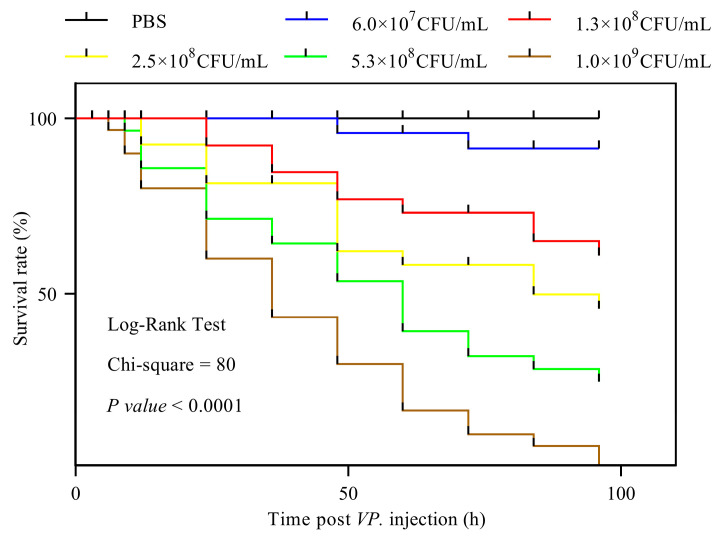
- The 48 h LD50 of *V. parahaemolyticus* for *T. tridentatus* larvae was 1.31 × 10^8 CFU/g.
- Mean survival times decreased as bacterial dose increased: 8 h, 28.8 h, 51.2 h, 64 h, 89.6 h, and 96 h across the five bacterial concentrations plus PBS control, with chi-square = 80, p < 0.0001 for survival differences.
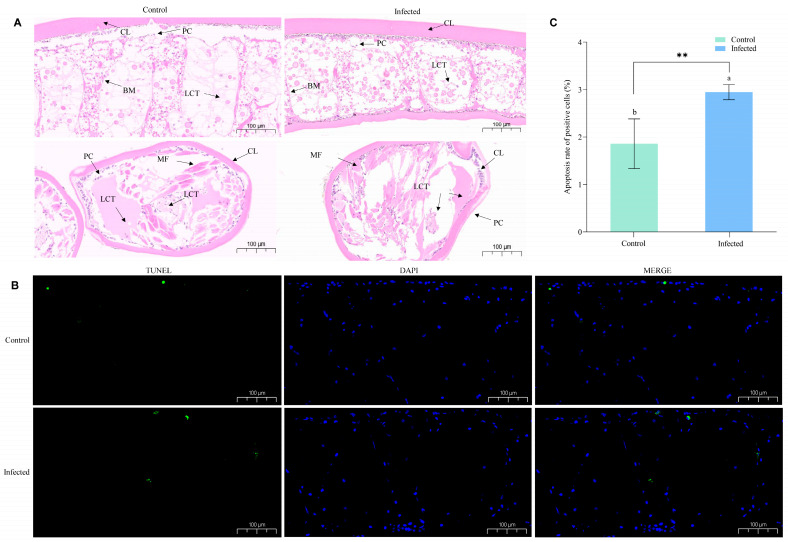
- Histopathology showed deformed tissues in infected larvae, and apoptosis increased from 1.86% in controls to 2.95% in infected larvae.
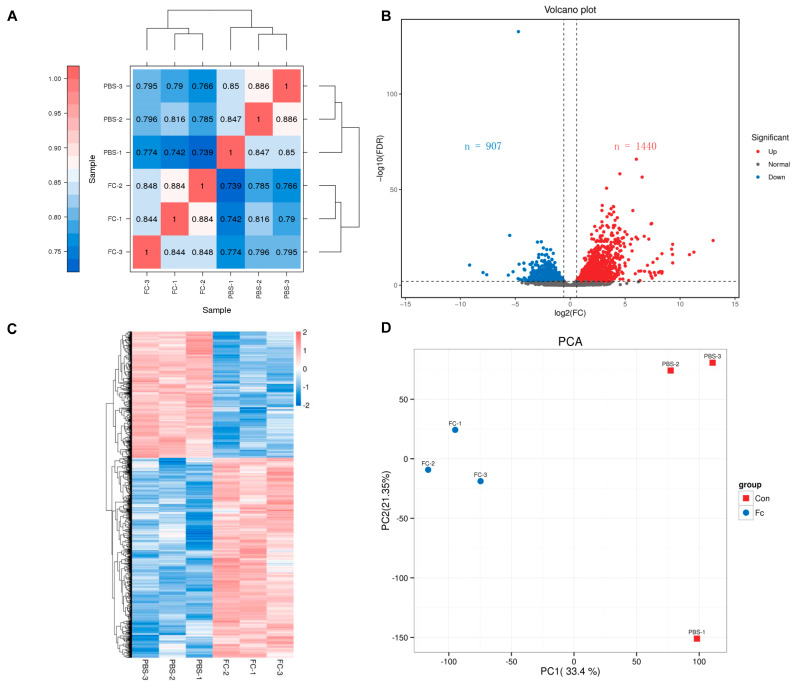
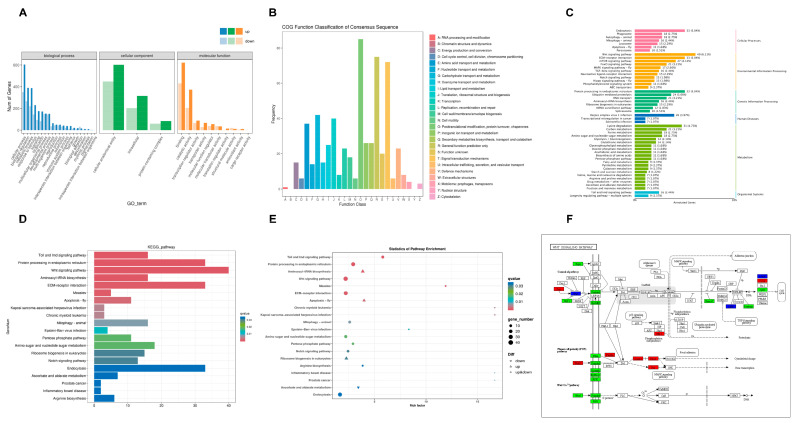
- RNA-seq identified 2,347 DEGs: 1,440 upregulated and 907 downregulated; KEGG analysis assigned 1,580 DEGs to 243 pathways, with notable enrichment in the Wnt signaling pathway (40 DEGs), endocytosis (33), ECM-receptor interaction (33), and Toll and Imd signaling pathway (16).
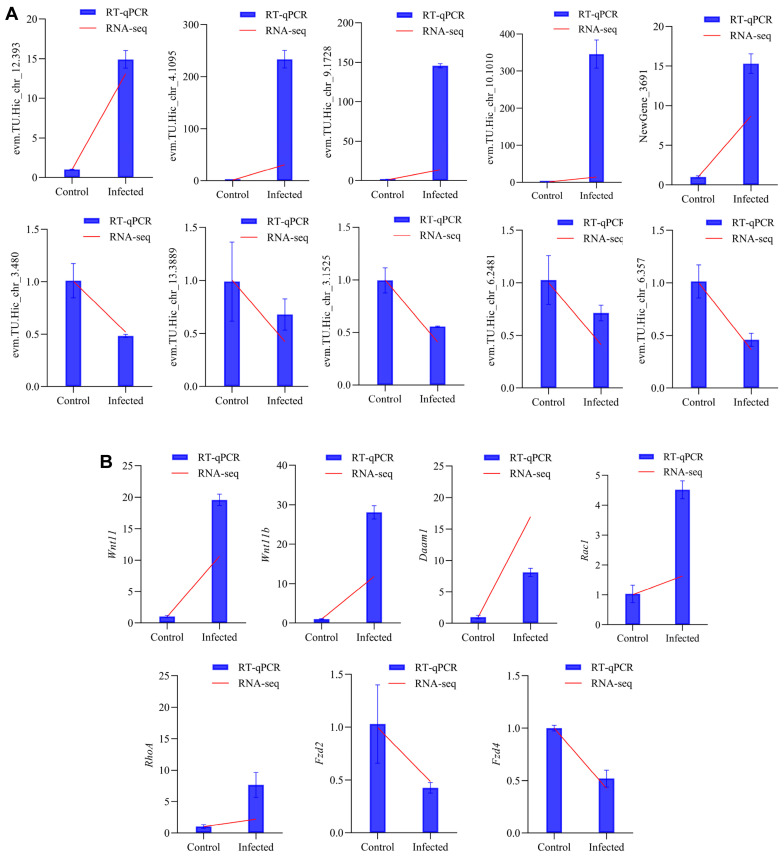
- RT-qPCR validation of 17 DEGs (10 random DEGs plus 7 Wnt-pathway DEGs) was consistent with RNA-seq results.
## Methods
- Design: Experimental infection study comparing *T. tridentatus* larvae injected with *V. parahaemolyticus* versus PBS control, followed by acute toxicity assessment, histopathology, transcriptome sequencing, and RT-qPCR validation.
- Sample/data: 360 healthy 7-day-post-hatching larvae were acclimated; 180 were used for acute toxicity testing across five bacterial doses and a control, and 180 were used for downstream sampling, with 3 survivors per group for histology and 3 per group for RNA-seq.
- Analysis: Survival curves were analyzed with the log-rank test; DEGs were identified using DESeq2 with thresholds FC ≥ 1.5 and FDR = 0.01; functional interpretation used GO, COG, and KEGG enrichment, and RT-qPCR used the 2−ΔΔCT method.
## Limitations
- The paper states that current technologies have not been able to successfully extract natural immune effector proteins from newly hatched *T. tridentatus* larvae and validate their biological function.
- The text makes evident that the transcriptome comparison is based on a small number of RNA-seq samples (3 per group); this is not stated as a limitation by the authors, but it may limit generalizability.
- The paper notes that the work provides a foundation for future study, but it does not experimentally validate the functional roles of the highlighted pathways/genes beyond expression and enrichment analysis; this is evident from the text.
Model-written summary. Check it against the paper before relying on it.
Integrity signals
Registry
Cites
Statistics
Figures
Verification
Claims the paper makes
4 Valid · 3 Not valid · 15 Not checked · 39 Own results and interpretations
The cited sources that could be checked couldn’t confirm or dispute this claim.
In the paper
“The Beibu Gulf is an essential spawning habitat for T. tridentatus, and V. parahaemolyticus has been isolated from both seawater and aquatic products in this area [26,27].”
§ Transcriptomic Analysis of Tachypleus tridentatus Larval Response to Vibrio parahaemolyticus Infection > 1. Introduction
What the sources say
- Could not verifycites [26] Huang B.Y. Peng S. Liu S.F. Zhang Y.T. Wei Y.X. Xu X.Y. Gao C.H. Liu Y.H. Luo X.W. Isolation, Screening, and Active Metabolites Identification of Anti-Vibrio Fungal Strains Derived From the Beibu Gulf Coral Front. Microbiol. 2022 13 930981 10.3389/fmicb.2022.930981 35722281 PMC9201449 sourceExperimental — accuracy not yet measured
The Introduction says the study isolated fungi from Beibu Gulf coral, and the Anti-Vibrio Assay methods say its V. parahaemolyticus strain was provided by another researcher. The Discussion mentions seafood and seawater as general routes of Vibrio exposure, but does not report isolation of V. parahaemolyticus from either in the Beibu Gulf. Searches for that specific isolation claim found no supporting passage; page numbers were not available in our copy. (LLM, conf=0.78)
- Not checked — no full text of the sourcecites [27] Xu Q.S. Wang P.B. Huangleng J.H. Su H.Q. Chen P.Y. Chen X. Zhao H.X. Kang Z.J. Tang J.L. Jiang G.L.X. Co-occurrence of chromophytic phytoplankton and the Vibrio community during Phaeocystis globosa blooms in the Beibu Gulf Sci. Total Environ. 2022 805 150303 10.1016/j.scitotenv.2021.150303 34537702 source
plain- Asserted: passes — The authors put it forward as true.
- Checkable: passes — It can be checked against evidence.
- Load-bearing: unclear — It is unclear whether the paper’s conclusions depend on it.
- Based: passes — The paper gives a reason why it holds.
- Could not verify
The cited sources that could be checked couldn’t confirm or dispute this claim.
In the paper
“The Beibu Gulf is an essential spawning habitat for T. tridentatus, and V. parahaemolyticus has been isolated from both seawater and aquatic products in this area [26,27].”
§ Transcriptomic Analysis of Tachypleus tridentatus Larval Response to Vibrio parahaemolyticus Infection > 1. Introduction
What the sources say
- Could not verifycites [26] Huang B.Y. Peng S. Liu S.F. Zhang Y.T. Wei Y.X. Xu X.Y. Gao C.H. Liu Y.H. Luo X.W. Isolation, Screening, and Active Metabolites Identification of Anti-Vibrio Fungal Strains Derived From the Beibu Gulf Coral Front. Microbiol. 2022 13 930981 10.3389/fmicb.2022.930981 35722281 PMC9201449 sourceExperimental — accuracy not yet measured
The Introduction describes the Beibu Gulf’s marine biodiversity, and the Methods describe collecting coral there, but neither addresses T. tridentatus or spawning habitat. Searches for the species and for spawning habitat found no relevant passage in our copy. (LLM, conf=0.75)
- Not checked — no full text of the sourcecites [27] Xu Q.S. Wang P.B. Huangleng J.H. Su H.Q. Chen P.Y. Chen X. Zhao H.X. Kang Z.J. Tang J.L. Jiang G.L.X. Co-occurrence of chromophytic phytoplankton and the Vibrio community during Phaeocystis globosa blooms in the Beibu Gulf Sci. Total Environ. 2022 805 150303 10.1016/j.scitotenv.2021.150303 34537702 source
plain- Asserted: passes — The authors put it forward as true.
- Checkable: passes — It can be checked against evidence.
- Load-bearing: unclear — It is unclear whether the paper’s conclusions depend on it.
- Based: passes — The paper gives a reason why it holds.
- Could not verify
The paper states this without a source or data behind it here, so there is nothing to check it against. The quote shows it is in the paper.
In the paper
“KEGG pathway analysis assigned 1580 DEGs to 243 pathways across six categories (Figure 5C).”
§ Transcriptomic Analysis of Tachypleus tridentatus Larval Response to Vibrio parahaemolyticus Infection > 3. Results > 3.6. GO, COG, KEGG Enrichment Analysis of DEGs
- Asserted: passes — The authors put it forward as true.
- Checkable: passes — It can be checked against evidence.
- Load-bearing: unclear — It is unclear whether the paper’s conclusions depend on it.
- Based: unclear — It is unclear why the paper says it holds.
A result the paper reports from its own data — it cites no other source for it, so there is none to check. The quote shows it is in the paper.
In the paper
“Injection of 5 μL of V. parahaemolyticus solution into each 20 mg juvenile resulted in reduced vitality or death over time.”
§ Transcriptomic Analysis of Tachypleus tridentatus Larval Response to Vibrio parahaemolyticus Infection > 4. Discussion
plainstates a cause- Asserted: passes — The authors put it forward as true.
- Checkable: passes — It can be checked against evidence.
- Load-bearing: passes — The paper’s conclusions depend on it.
- Based: passes — The paper gives a reason why it holds.
A result the paper reports from its own data — it cites no other source for it, so there is none to check. The quote shows it is in the paper.
In the paper
“The survival time of T. tridentatus larvae was inversely proportional to the V. parahaemolyticus concentration.”
§ Transcriptomic Analysis of Tachypleus tridentatus Larval Response to Vibrio parahaemolyticus Infection > 3. Results > 3.1. Statistical Analysis of Survival
plainstates an association- Asserted: passes — The authors put it forward as true.
- Checkable: passes — It can be checked against evidence.
- Load-bearing: passes — The paper’s conclusions depend on it.
- Based: passes — The paper gives a reason why it holds.
22 more claims
Create a free account to see all 61 claims and to verify the 10 references still open.
- Probably not a substantial claim. 24
- It may state two separate claims as one. 27
Citations
Cites
Analysis of Relative Gene Expression Data Using Real-Time Quantitative PCR and the 2−ΔΔCT Method
Livak, K. J., & Schmittgen, T. D. (2001) · Methods · doi:10.1006/meth.2001.1262 · Cited by 180,860
Moderated estimation of fold change and dispersion for RNA-seq data with DESeq2
Love, M. I., Huber, W., & Anders, S. (2014) · Genome Biology · doi:10.1186/s13059-014-0550-8 · Cited by 95,106
RNA-Seq: a revolutionary tool for transcriptomics
Wang, Z., Gerstein, M., & Snyder, M. (2009) · Nature Reviews Genetics · doi:10.1038/nrg2484 · Cited by 13,174 · cited 1×
“The transcriptome, the central molecular label characterizing the functional state of an organism, is the collection of all RNAs transcribed from a particular cell or tissue at a particular time or state [42].”
Probiotics, prebiotics, and synbiotics used to control vibriosis in fish: A review
Yilmaz, S., Yilmaz, E., Dawood, M. A. O., Ringø, E., Ahmadifar, E., & Abdel-Latif, H. M. R. (2022) · Aquaculture · doi:10.1016/j.aquaculture.2021.737514 · Cited by 243 · cited 1×
“It also causes foodborne diseases [22,23], resulting in gastrointestinal symptoms such as diarrhea, nausea, vomiting, and abdominal cramps in humans, and may also lead to wound infections [24].”
The Two NF-κB Pathways Regulating Bacterial and WSSV Infection of Shrimp
Li, C., Wang, S., & He, J. (2019) · Frontiers in Immunology · doi:10.3389/fimmu.2019.01785 · Cited by 230 · cited 1×
“Activation of these two pathways induces translocation of nuclear factor-κ B (NF-κ B) family transcription factors to the nucleus and subsequent alteration of AMP expression [58].”
Antimicrobial peptides in marine invertebrate health and disease
Destoumieux-Garzón, D., Rosa, R. D., Schmitt, P., Barreto, C., Vidal-Dupiol, J., Mitta, G., Gueguen, Y., & Bachère, E. (2016) · Philosophical Transactions of the Royal Society B: Biological Sciences · doi:10.1098/rstb.2015.0300 · Cited by 160 · cited 1×
“The transcript levels of three AMPs were significantly upregulated in V. parahaemolyticus -infected Macrobrachium nipponense when tested in vivo [59], suggesting the central role of AMPs in crustacean defense mechanism against invading pathogens [60].”
Sony, M., Sumithra, T. G., Anusree, V. N., Amala, P. V., Reshma, K. J., Alex, S., & Sanil, N. K. (2021) · Aquaculture · doi:10.1016/j.aquaculture.2021.736608 · Cited by 106 · cited 1×
“It infects aquatic organisms and causes significant losses to the aquaculture industry [14–17].”
Dong, X., Bi, D., Wang, H., Zou, P., Xie, G., Wan, X., Yang, Q., Zhu, Y., Chen, M., Guo, C., et al. (2017) · Frontiers in Microbiology · doi:10.3389/fmicb.2017.01859 · Cited by 105 · cited 1×
“Its highly virulent strains (carrying the plasmid-encoded PirA / PirB toxin genes) have spread to China, Vietnam, Thailand, Malaysia, Singapore, Mexico, and other countries [13].”
Self-citationSekiguchi, K., & Shuster, C. N. (2009) · Springer eBooks · doi:10.1007/978-0-387-89959-6_1 · Cited by 101
Hua, Y., Yang, Y., Li, Q., He, X., Zhu, W., Wang, J., & Gan, X. (2018) · Journal of Biological Chemistry · doi:10.1074/jbc.ra118.004434 · Cited by 75
Research works printed but not linked: 5
- Li W.X. Huang J.R. Ye H.H. Huang H.Y. Li S.J. Cloning and tissue expression of β-actin gene in the Chinese horseshoe crab (Tachypleus tridentatus) Xiamen Daxue Xuebao Ziran Kexueban 2015 54 188 193 10.6043/j.issn.0438-0479.2015.02.007 · doi:10.6043/j.issn.0438-0479.2015.02.007
- Chen X.L. Cheng C.H. Deng Y.Q. Ma H.L. Su Y.L. Feng J. Guo Z.X. Isolation, identification and drug sensitivity of pathogenic Vibrio parahemolyticus of mud crab (Scylla paramamosain) Nanfang Nongye Xuebao 2020 51 2846 2855 10.3969/j.issn.2095-1191.2020.11.029 · doi:10.3969/j.issn.2095-1191.2020.11.029
- Wei Z. Chen X.Y. Wang S. Ye X.L. Huang L.P. Wei Y.Y. Liu M. Hu T.J. Yu M.L. Protective effect of Chinese herbal compound preparations on hepatopancreas necrosis of Penaeus vannamei induced by Vibrio parahaemolyticus Heilongjiang Xumu Shouyi 2022 16 108 140 108–115+139–140 10.13881/j.cnki.hljxmsy.2021.10.0267 · doi:10.13881/j.cnki.hljxmsy.2021.10.0267
- Sun Y.X. Chang H.J. Yang X.X. Wu M.W. Li J. Vibriosis caused by Vibrio parahaemolyticus in aquatic animals and bacteriophage therapy: A review Weishengwuxue Tongbao 2023 50 3620 3634 10.13344/j.microbiol.china.221017 · doi:10.13344/j.microbiol.china.221017
- Li Y. Li P.H. Liu C.H. Ma Q.J. Characterization of pathogenicity and drug resistance in Vibrio parahaemolyticus D3112 Haiyang Kexue 2019 43 25 33 10.11759/hykx20190324001 · doi:10.11759/hykx20190324001
Cited by
Chen, B., Wu, R., Zhu, P., Liu, J., Liu, Y., Yan, L., Ma, Z., Gao, F., Liu, Z., Zhang, Z., et al. (2026) · Marine Pollution Bulletin · doi:10.1016/j.marpolbul.2026.119339 · Cited by 1
Self-citation
Metadata
- Authors
- Yan, L., Liu, J., Chen, B., Gao, F., Liu, Z., Zhang, Z., Li, S., Zhang, Y., Jia, J., Zhu, P., & Liao, Y.
- Affiliations
- Beibu Gulf University (CN)
- Corresponding author
- Zhu, Peng
- Liao, Yongyan
- Venue
- Animals
- Publisher
- MDPI AG
- Published
- 2025-08-30
- Volume
- 15
- Issue
- 17
- Pages
- 2556
- ISSN
- 2076-2615 (ISSN-L)
- PMC
- PMC12427568
- OpenAlex
- W4413893551
- Semantic Scholar
- 91c4c7129594320048ec0104ea86b744bc7b3274
- Cited by
- 2
- References
- 56
- Citations by year
- 2026: 2
- FWCI
- 0.74
- Type
- journal article
- Language
- en
- Open access
- gold
- doi.org
- Licence
- Locations
- Animals (publishedVersion, cc-by)
- PubMed (publishedVersion)
- PubMed Central (publishedVersion, cc-by)
- DOAJ (DOAJ: Directory of Open Access Journals) (submittedVersion, cc-by-sa)
- Funders
- National Natural Science Foundation of China (NSFC32260918, 20242405, 2023B03, Guike AB24010084)
- Qinzhou Scientific Research and Development Program Project (NSFC32260918, 20242405, 2023B03, Guike AB24010084)
- Counterpart Aid for Discipline Construction Project of Guangxi University (NSFC32260918, 20242405, 2023B03, Guike AB24010084)
- Key Research and Development Program of Guangxi (NSFC32260918, 20242405, 2023B03, Guike AB24010084)
- Topics
- Life Sciences › Immunology and Microbiology › Immunology › Invertebrate Immune Response Mechanisms
- Life Sciences › Immunology and Microbiology › Immunology › Aquaculture disease management and microbiota
- Physical Sciences › Environmental Science › Health, Toxicology and Mutagenesis › Environmental Toxicology and Ecotoxicology
- Keywords
- Tachypleus tridentatus, Vibrio parahaemolyticus, larval infection, transcriptome, differentially expressed genes, immune response, Wnt signaling, Toll pathway, Imd pathway, ECM-receptor interaction, aminoacyl-tRNA biosynthesis, acute toxicity, endangered species conservation, crustacean immunity
About these checks
Registry, retraction, Cites and statistics results are computed, not judged, with one exception: a printed reference that no index lists is read once by a model before it counts as a citation error. Claims are extracted by a model and kept only when their quote appears verbatim in the text; each cited source is then checked, with a model’s help, for whether it says what the claim relies on. Those verdicts can be wrong — read the claim’s quote and the cited source before relying on one.
The claim verdicts this report counts are experimental: their accuracy is not yet measured.
A language model drew the claims from the paper on 2026-10-10, under version 3 of the claim definition (model deepseek-v4.1-flash, prompt extract-v3).
A second model labelled each claim on 2026-10-10 (model jev-1.13-20260917, definition revision gold-guideline-v0.2).
Cited sources are checked with a language model’s help (gpt-6-sol).
Statistics and arithmetic are recomputed, not judged.
Confidence bands are shown only for fields calibrated on our annotated test set. None is calibrated yet, so no band is shown.
What counts as a claim ›How we measure confidence ›How we check this ›
Are you an author, or do you see a problem with this page? Request a review
Data sources
Bibliographic data: Semantic Scholar, OpenAlex, Crossref.
Contains information from the Semantic Scholar Academic Graph Datasets, made available under the ODC Attribution License (ODC-BY 1.0).
Semantic Scholar’s data is described in: Kinney, R., et al. (2023). The Semantic Scholar Open Data Platform. arXiv:2301.10140.
