

The DOI matches its Crossref record.
Epidemiology of Dog and Cat Abandonment in Spain (2008–2013)
Abstract
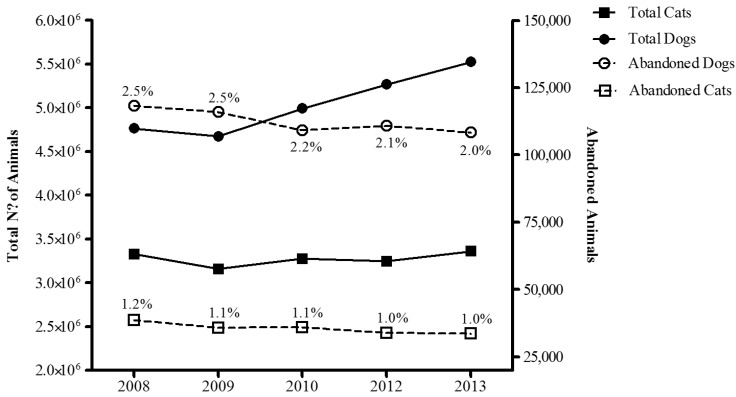
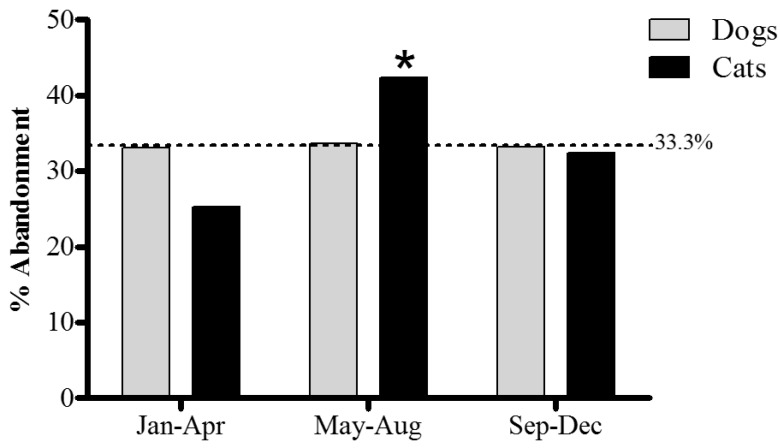
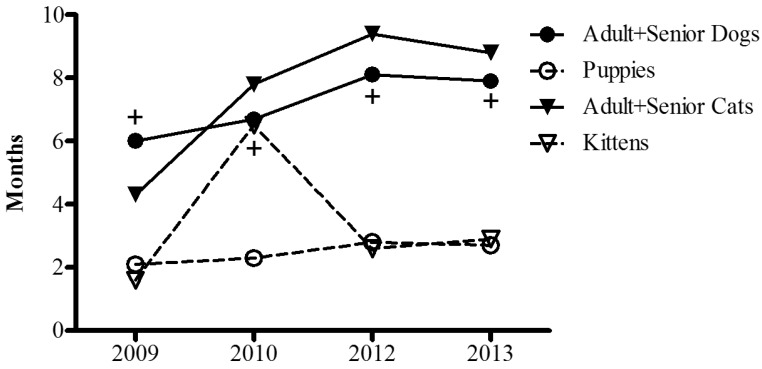
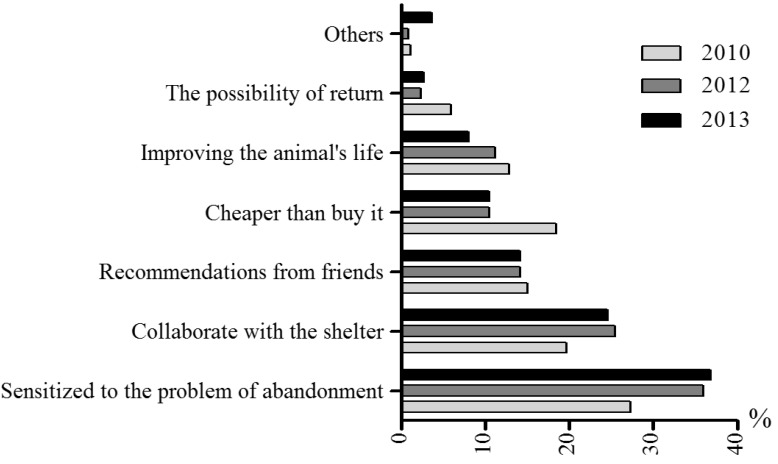
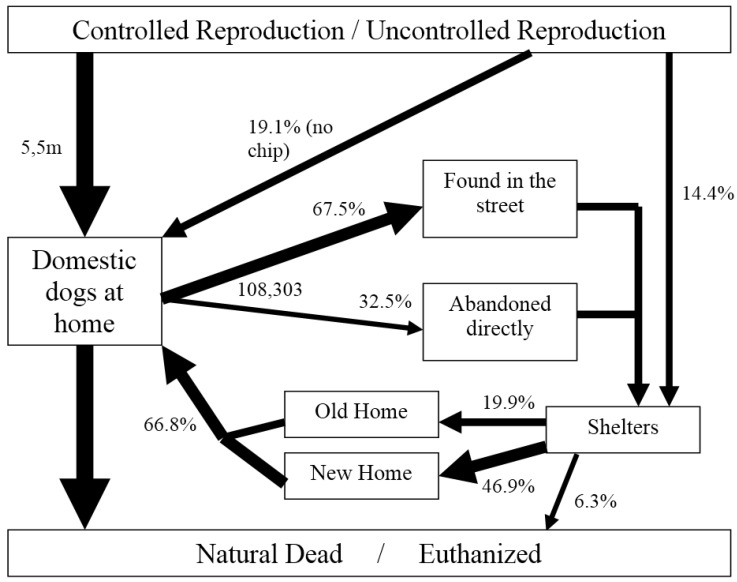
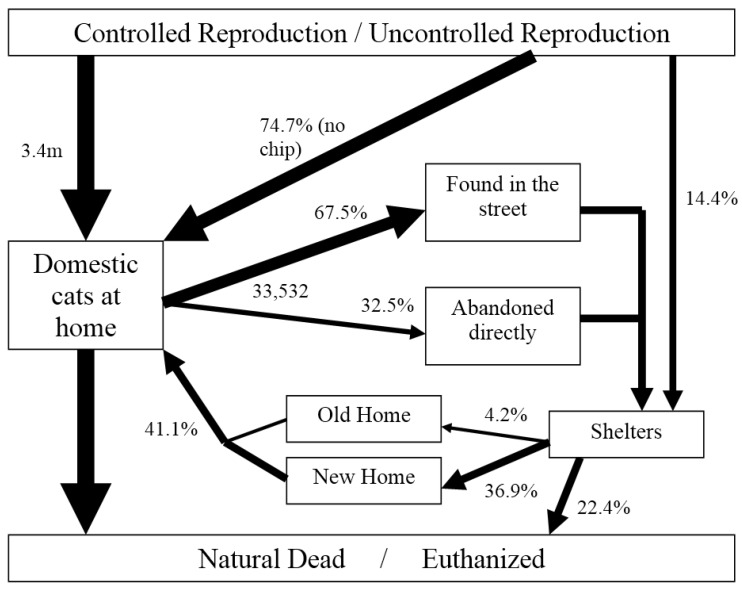
Millions of pets are abandoned worldwide every year, which is an important animal welfare and financial problem. This paper was divided into three studies. Our first two studies were designed as a national survey of animal shelters to profile the population of stray dogs and cats, as well as to gather information on both relinquishment and adoption. The aim of our third study was to test the impact of identification on the recovery of dogs entering animal shelters. Studies one and two indicate that more than 100,000 dogs and more than 30,000 cats enter animal shelters annually in Spain. We observed a seasonal effect in the number of admissions in cats. Two-thirds of dogs and cats entering shelters were found as strays, while the rest were relinquished directly to the shelter. Most pets admitted to animal shelters were adult, non-purebred, and without a microchip, with the majority of dogs being medium sized. Adult dogs spent significantly more time in shelters than puppies. While most animals were either adopted or recovered by their owner, a considerable percentage remained at the shelter or was euthanized. The identification of dogs with a microchip increased by 3-fold the likelihood of them being returned to the owner.
Overview
The claims and statistics of this paper haven’t been checked yet.
Run the check — free, no account needed. It reads the open-access text and checks the sources it cites.
Integrity signals
Registry
Cites
Statistics
Figures
Verification
Claims the paper makes
The claims and statistics of this paper haven’t been checked yet.
Run the check — free, no account needed. It reads the open-access text and checks the sources it cites.
Claims other papers make about this one
Each is checked against this paper’s own text: does it say what the citing paper says it does?
The source backs part of the claim, not all of it — or backs it for a different population, condition or comparison.
In the citing paper
“Keeping wild species under unnatural conditions for leisure or personal gratification, exploiting farm animals through intensive farming causing them high levels of distress and pain, and abandoning domestic animals mostly for trivial reasons are only a few examples of poor and dysfunctional relationships that are topics of research and debate in the human–animal relationship literature [47,83,84,”
From The Complexity of the Human–Animal Bond: Empathy, Attachment and Anthropomorphism in Human–Animal Relationships and Animal Hoarding (2022) · cites this paper as [47]
Experimental — accuracy not yet measuredIn the citing paper
“Moreover, in many Western countries, cats and dogs are the most popular and beloved companion animals, but, at the same time, a huge number of them (and other pets) are abandoned, neglected, abused and needlessly euthanized every year [46,47,48].”
From The Complexity of the Human–Animal Bond: Empathy, Attachment and Anthropomorphism in Human–Animal Relationships and Animal Hoarding (2022) · cites this paper as [47]
Self-check
Percentages, sums and reported differences re-computed from the paper’s own numbers.
The self-check needs the paper’s full text.
Citations
Cites
No references could be resolved yet.
Research works printed but not linked: 20
- Albert, 1998, Pets, Families, and the Life Course, J. Marriage Fam., 50, 543, 10.2307/352019 · DOI
- Houpt, 2007, Proceedings of a workshop to identify dog welfare issues in the US, Japan, Czech Republic, Spain and the UK, Appl. Anim. Behav. Sci., 106, 221, 10.1016/j.applanim.2007.01.005 · DOI
- Oxford-Lafayette Humane Society Available online: http://www.oxfordpets.com/index.php?option=com_content&view=article&id=61.
- Stavisky, 2012, Demographics and economic burden of un-owned cats and dogs in the UK: Results of a 2010 census, BMC Vet. Res., 8, 163, 10.1186/1746-6148-8-163 · DOI
- Marston, 2004, What Happens to Shelter Dogs? An Analysis of Data for 1 Year from Three Australian Shelters, J. Appl. Anim. Welf. Sci., 7, 27, 10.1207/s15327604jaws0701_2 · DOI
- Marston, 2005, What happens to shelter dogs? Part 2.Comparing three Melbourne welfare shelters for nonhuman animals, J. Appl. Anim. Welf. Sci., 8, 25, 10.1207/s15327604jaws0801_3 · DOI
- Marston, 2009, Admissions of Cats to Animal Welfare Shelters in Melbourne, Australia, J. Appl. Anim. Welf. Sci., 12, 189, 10.1080/10888700902955948 · DOI
- Diesel, 2008, Factors affecting the success of rehoming dogs in the UK during 2005, Prev. Vet. Med., 84, 228, 10.1016/j.prevetmed.2007.12.004 · DOI
- Manners, 1990, The Development of Computer Assisted Interviewing for Household Surveys: The Case of the British Labour Force Survey, OPCS, Surv. Methodol. Bull., 27, 1
- Beaver, B.V. (2003). Feline Behaviour a Guide for Veterinarians, Saunders. [2nd ed.].
- Mornement, 2012, What Do Current and Potential Australian Dog Owners Believe about Shelter Practices and Shelter Dogs?, Anthrozoös, 25, 457, 10.2752/175303712X13479798785850 · DOI
- Gazzano, 2013, Dogs’ features strongly affect people’s feelings and behavior toward them, J. VET. BEHAV., 8, 213, 10.1016/j.jveb.2012.10.005 · DOI
- Riemer, S., Müller, C., Virányi, Z., Huber, L., and Range, F. (2014). The predictive value of early behavioural assessments in pet dogs–A longitudinal study from neonates to adults. PLoS ONE, 7. · DOI
- McMillan, 2013, Differences in behavioural characteristics between dogs obtained as puppies from pet stores and those obtained from noncommercial breeders, JAVMA, 242, 1359, 10.2460/javma.242.10.1359 · DOI
- Weng, 2006, Risk factors for unsuccessful dog ownership: An epidemiologic study in Taiwan, Prev. Vet. Med., 77, 82, 10.1016/j.prevetmed.2006.06.004 · DOI
- Lord, 2007, Search and identification methods that owners use to find a lost dog, JAVMA, 230, 211, 10.2460/javma.230.2.211 · DOI
- Bollen, 2008, Behavioural evaluation and demographic information in the assessment of aggressiveness in shelter dogs, Appl. Anim. Behav. Sci., 112, 120, 10.1016/j.applanim.2007.07.007 · DOI
- Mondelli, 2004, The bond that never developed: Adoption and relinquishment of dogs in a rescue shelter, J. Appl. Anim. Welf. Sci., 7, 253, 10.1207/s15327604jaws0704_3 · DOI · Paper page
- Marston, 2003, Reforging the bond—Towards successful canine adoption, Appl. Anim. Behav. Sci., 83, 227, 10.1016/S0168-1591(03)00135-7 · DOI
- Miklosi, A. (2007). Dog, Behaviour Evolution and Condition, Oxford Biology. · DOI
Cited by
Sorted by citations
Human–dog relationships during the COVID-19 pandemic: booming dog adoption during social isolation
Morgan, L., Protopopova, A., Birkler, R. I. D., Itin-Shwartz, B., Sutton, G. A., Gamliel, A., Yakobson, B., & Raz, T. (2020) · Humanities and Social Sciences Communications · doi:10.1057/s41599-020-00649-x · Cited by 165
Prato-Previde, E., Basso Ricci, E., & Colombo, E. S. (2022) · Animals · doi:10.3390/ani12202835 · Cited by 121
Metadata
- Authors
- Fatjó, J., Bowen, J., García, E., Calvo, P., Rueda, S., Amblás, S., & Lalanza, J.
- Affiliations
- Chair Affinity Foundation Animals and Health, Department of Psychiatry and Forensic Medicine, School of Medicine, Universitat Autònoma de Barcelona, 08193 Bellaterra, Barcelona, Spain
- DEP Institute, C/Aragó 631-633, Local 1-2, 08026 Barcelona, Spain
- Venue
- Animals
- Publisher
- MDPI AG
- Published
- 2015-06-12
- Volume
- 5
- Issue
- 2
- Pages
- 426-441
- ISSN
- 2076-2615
- PMC
- PMC4494419
- Cited by
- 55
- References
- 0
- Language
- en
About these checks
Registry, retraction, Cites and statistics results are computed, not judged, with one exception: a printed reference that no index lists is read once by a model before it counts as a citation error. Claims are extracted by a model and kept only when their quote appears verbatim in the text; each cited source is then checked, with a model’s help, for whether it says what the claim relies on. Those verdicts can be wrong — read the claim’s quote and the cited source before relying on one.
Statistics and arithmetic are recomputed, not judged.
Confidence bands are shown only for fields calibrated on our annotated test set. None is calibrated yet, so no band is shown.
What counts as a claim ›How we measure confidence ›How we check this ›
Are you an author, or do you see a problem with this page? Request a review
How to cite
Cite CoChat for the checks on this page, and the paper for its own findings.
- This page
- CoChat. (2026). Citation check: Epidemiology of Dog and Cat Abandonment in Spain (2008–2013). https://app.cochat.ai/papers/10.3390/ani5020364
- The paper
- Fatjó, J., Bowen, J., García, E., Calvo, P., Rueda, S., Amblás, S., & Lalanza, J. (2015). Epidemiology of Dog and Cat Abandonment in Spain (2008–2013). Animals. https://doi.org/10.3390/ani5020364
