

The DOI matches its Crossref record.
First Bacteremia Due to Corynebacterium gottingense in an Immunocompromised Child: A Case Report, 16S rDNA-Based Phylogenetic Analyses and Review of the Literature
Abstract
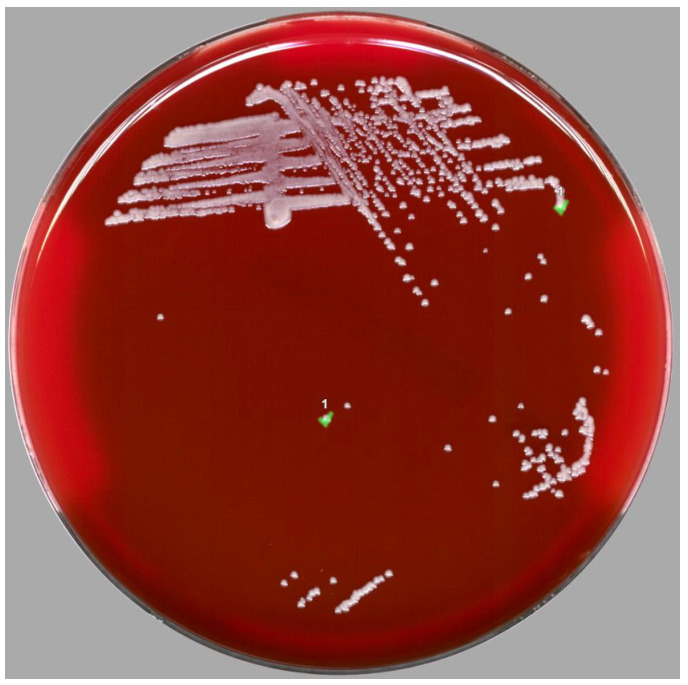
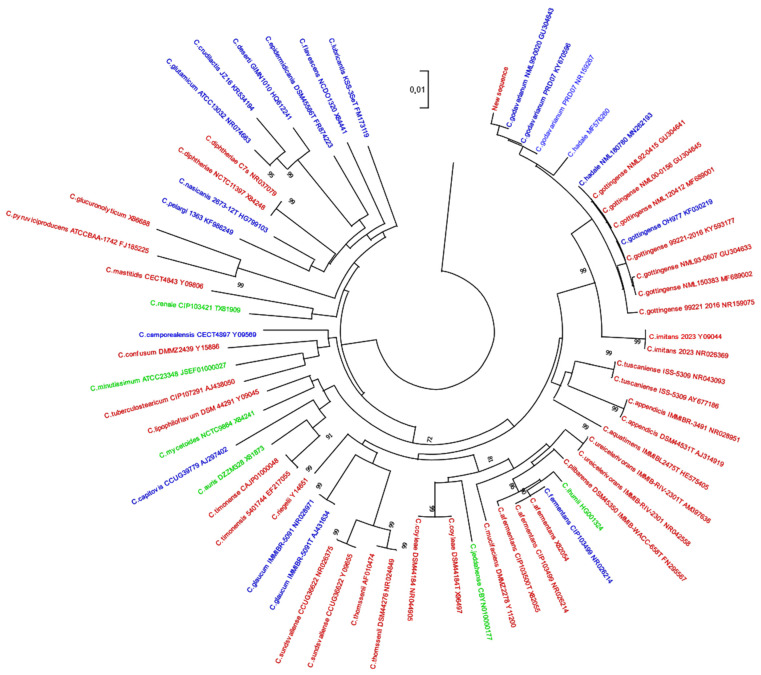
Corynebacterium gottingense is a Gram-positive bacillus that has not been reported as pathogenic in pediatric patients. Herein, a case of catheter-associated bloodstream infection by C. gottingense in a 13-year-old immunocompromised child with febrile neutropenia induced for osteosarcoma is reported. The species was identified by Sanger sequencing of the 16s rRNA sequence of the bacterial strain and was compared phylogenetically with published sequences. As suggested in the literature, the presented strain was multi-susceptible, particularly to amoxicillin. The patient was treated with piperacillin/tazobactam for seven days in the context of a urinary co-infection, resulting in resolution of fever within 48 h and then relaunched with oral amoxicillin for 3 days (for a total of 10 days of antibiotic therapy). Phylogenetic analyses based on 16S rDNA demonstrated the complexity of the genus Corynebacterium spp. but failed to demonstrate a direct benefit in predicting clinical outcome based on this single information.
Overview
The claims and statistics of this paper haven’t been checked yet.
Run the check — free, no account needed. It reads the open-access text and checks the sources it cites.
Integrity signals
Registry
Cites
Statistics
Figures
Verification
Claims the paper makes
The claims and statistics of this paper haven’t been checked yet.
Run the check — free, no account needed. It reads the open-access text and checks the sources it cites.
Claims other papers make about this one
Each is checked against this paper’s own text: does it say what the citing paper says it does?
In the citing paper
“Among these taxa, Corynebacterium matruchotii is a calcifying bacterium that has been associated with urinary tract infections [40] and bacteremia [41], and in rare cases, fluoride-related bone pathology such as tibial osteomyelitis [42].”
From Severity-dependent alterations in oral microbiota and antibiotic resistance in children with dental fluorosis (2026) · cites this paper as [41]
Self-check
Percentages, sums and reported differences re-computed from the paper’s own numbers.
The self-check needs the paper’s full text.
Citations
Cites
No references could be resolved yet.
Research works printed but not linked: 18
- Atasayar, 2017, Corynebacterium gottingense sp. Nov., Isolated from a Clinical Patient, Int. J. Syst. Evol. Microbiol., 67, 4494, 10.1099/ijsem.0.002322 · DOI
- Bernard, 2020, Corynebacterium Godavarianum Jani et al. 2018 and Corynebacterium Hadale Wei et al. 2018 Are Both Later Heterotypic Synonyms of Corynebacterium Gottingense Atasayar et al. 2017, Proposal of an Emended Description of Corynebacterium Gottingense Atasayar et al. 2017, Int. J. Syst. Evol. Microbiol., 70, 3534, 10.1099/ijsem.0.004153 · DOI
- Tozzo, P., Delicati, A., and Caenazzo, L. (2022). Skin Microbial Changes during Space Flights: A Systematic Review. Life, 12. · DOI
- Bernard, 2012, The Genus Corynebacterium and Other Medically Relevant Coryneform-like Bacteria, J. Clin. Microbiol., 50, 3152, 10.1128/JCM.00796-12 · DOI
- Jani, 2018, Corynebacterium godavarianum sp. Nov., Isolated from the Godavari River, India, Int. J. Syst. Evol. Microbiol., 68, 241, 10.1099/ijsem.0.002491 · DOI
- Wei, 2018, Corynebacterium hadale sp. Nov. Isolated from Hadopelagic Water of the New Britain Trench, Int. J. Syst. Evol. Microbiol., 68, 1474, 10.1099/ijsem.0.002695 · DOI
- Broutin, 2020, First Description of Bacteremia Caused by Oscillibacter Valericigenes in a Patient Hospitalized for Leg Amputation, Anaerobe, 64, 102244, 10.1016/j.anaerobe.2020.102244 · DOI
- Cabrol, M., Rammaert, B., Plouzeau, C., Burucoa, C., and Pichon, M. (2021). Phylogeny of Catabacter Hongkongensis Strains Responsible for Bacteremia Is Not Associated with Clinical Outcomes or Therapeutic Efficacy. Diseases, 9. · DOI
- Flandrois, J.-P., Perrière, G., and Gouy, M. (2015). LeBIBIQBPP: A Set of Databases and a Webtool for Automatic Phylogenetic Analysis of Prokaryotic Sequences. BMC Bioinform., 16. · DOI
- Gouy, 2010, SeaView Version 4: A Multiplatform Graphical User Interface for Sequence Alignment and Phylogenetic Tree Building, Mol. Biol. Evol., 27, 221, 10.1093/molbev/msp259 · DOI
- Minh, 2020, IQ-TREE 2: New Models and Efficient Methods for Phylogenetic Inference in the Genomic Era, Mol. Biol. Evol., 37, 1530, 10.1093/molbev/msaa015 · DOI · Paper page
- Hu, 2019, Sequence Similarity Searching, Curr. Protoc. Protein Sci., 95, e71, 10.1002/cpps.71 · DOI
- Tamura, 2021, MEGA11: Molecular Evolutionary Genetics Analysis Version 11, Mol. Biol. Evol., 38, 3022, 10.1093/molbev/msab120 · DOI
- Sharma, 2019, Diphtheria, Nat. Rev. Dis. Prim., 5, 81, 10.1038/s41572-019-0131-y · DOI
- Costales, 2019, Corynebacterium Urealyticum: Rare Urinary Tract Infection with Serious Complications, Can. J. Urol., 26, 9680
- Gupta, 2021, Corynebacterium Jeikeium Endocarditis: A Review of the Literature, Cardiol. Rev., 29, 259, 10.1097/CRD.0000000000000355 · DOI
- Yamamuro, 2021, Clinical Characteristics of Corynebacterium Bacteremia Caused by Different Species, Japan, 2014–2020, Emerg. Infect. Dis., 27, 2981, 10.3201/eid2712.210473 · DOI
- Park, 2021, Comparison of 16S RRNA Gene Based Microbial Profiling Using Five Next-Generation Sequencers and Various Primers, Front. Microbiol., 12, 715500, 10.3389/fmicb.2021.715500 · DOI
Cited by
Sorted by citations
Xia, Y., Peng, S., Yu, J., Wang, Y., Ye, Y., Liu, M., Shang, L., Cui, X., Wang, P., & Ding, Z. (2026) · Journal of Oral Microbiology · doi:10.1080/20002297.2026.2714622
Metadata
- Authors
- Bouguerra, L., Dupraz, C., Plouzeau, C., Michaud, A., Broutin, L., Cremniter, J., Burucoa, C., & Pichon, M.
- Affiliations
- Université de Poitiers, Faculté de Médecine et Pharmacie, 86000 Poitiers, France
- CHU de Poitiers, Service d’oncologie et Hématologie Pédiatrique, 86021 Poitiers, France
- CHU de Poitiers, Département des Agents Infectieux, 86021 Poitiers, France
- ORCID
- Pichon, Maxime
- Venue
- Antibiotics
- Publisher
- MDPI AG
- Published
- 2023-03-06
- Volume
- 12
- Issue
- 3
- Pages
- 528
- ISSN
- 2079-6382
- PMC
- PMC10044508
- Cited by
- 3
- References
- 0
- Language
- en
About these checks
Registry, retraction, Cites and statistics results are computed, not judged, with one exception: a printed reference that no index lists is read once by a model before it counts as a citation error. Claims are extracted by a model and kept only when their quote appears verbatim in the text; each cited source is then checked, with a model’s help, for whether it says what the claim relies on. Those verdicts can be wrong — read the claim’s quote and the cited source before relying on one.
Statistics and arithmetic are recomputed, not judged.
Confidence bands are shown only for fields calibrated on our annotated test set. None is calibrated yet, so no band is shown.
What counts as a claim ›How we measure confidence ›How we check this ›
Are you an author, or do you see a problem with this page? Request a review
How to cite
Cite CoChat for the checks on this page, and the paper for its own findings.
- This page
- CoChat. (2026). Citation check: First Bacteremia Due to Corynebacterium gottingense in an Immunocompromised Child: A Case Report, 16S rDNA-Based Phylogenetic Analyses and Review of the Literature. https://app.cochat.ai/papers/10.3390/antibiotics12030528
- The paper
- Bouguerra, L., Dupraz, C., Plouzeau, C., Michaud, A., Broutin, L., Cremniter, J., Burucoa, C., & Pichon, M. (2023). First Bacteremia Due to Corynebacterium gottingense in an Immunocompromised Child: A Case Report, 16S rDNA-Based Phylogenetic Analyses and Review of the Literature. Antibiotics. https://doi.org/10.3390/antibiotics12030528
