

The DOI matches its Crossref record; 28 of the 28 references it cites were found in a registry or an index.
Community Emergence of Cefixime-Resistant Escherichia coli Belonging to ST12 with Chromosomal AmpC Hyperproduction
Open accessAbstract
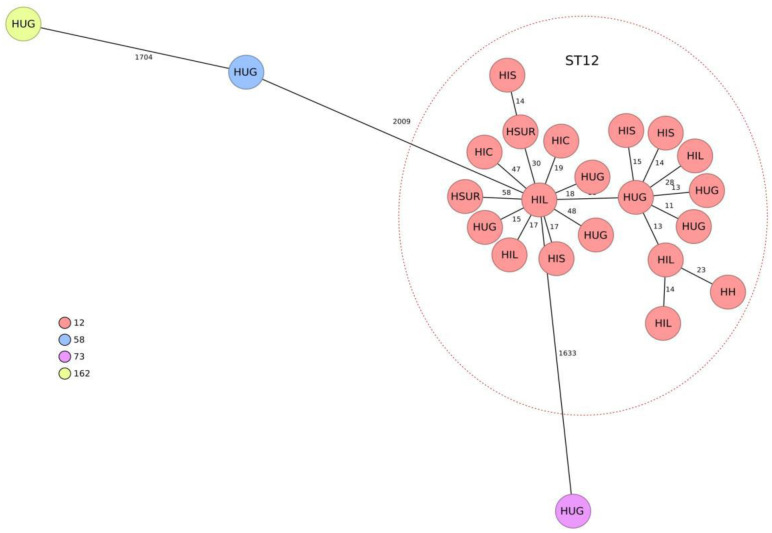
Escherichia coli isolates that are resistant to cefixime and amoxicillin/clavulanic acid, but apparently susceptible to cefuroxime, with no ESBL identified, were initially detected in Madrid from urine samples in 2019. Throughout 2020 and 2021, all cases of community UTI by E. coli from six health areas in Madrid were studied. A representative sample of 23 cases was selected for further studies. The broth microdilution method and the agar diffusion method were performed to determine the antibiotic susceptibility. WGS was carried out for phylogeny, resistome and virulome analysis. Community consumption of third-generation oral cephalosporins in Madrid (2017–2021) was analyzed. A total of 582 (1.3%) E. coli isolates had the mentioned resistance profile. The mutation at position –32 (T > A) of the AmpC promoter was found in 21 isolates. No plasmid AmpC- or ESBL-encoding genes were detected. A cluster of 20 ST12 isolates was detected by cgMLST. A 6.2% increase in the consumption of third-generation oral cephalosporins, especially cefixime, was observed in Madrid. Chromosomal AmpC-hyperproducing ST12 E. coli isolates could be implicated in the increase in community UTI cases by cefixime-resistant isolates, which correlates with an increasing trend of cefixime consumption.
Overview
The claims and statistics of this paper haven’t been checked yet.
Run the check — free, no account needed. It reads the open-access text and checks the sources it cites.
Integrity signals
Registry
Cites
Statistics
Figures
Verification
Claims the paper makes
The claims and statistics of this paper haven’t been checked yet.
Run the check — free, no account needed. It reads the open-access text and checks the sources it cites.
Claims other papers make about this one
Each is checked against this paper’s own text: does it say what the citing paper says it does?
The check wasn’t confident either way, so it gives no verdict — never disputed.
In the citing paper
“versus cefixime, a representative of the cephalosporin class not included in the EFSA panel, the strains resulted to be susceptible according to a set cut-off recently demonstrated [112].”
From Selection, Comparative Genomics, and Potential Probiotic Features of Escherichia coli 5C, a pks-Negative Strain Isolated from Healthy Infant Donor Feces (2026) · cites this paper as [112]
Experimental — accuracy not yet measured
Self-check
Percentages, sums and reported differences re-computed from the paper’s own numbers.
The self-check needs the paper’s full text.
Citations
Cites
Prokka: rapid prokaryotic genome annotation
Seemann, T. (2014) · Bioinformatics · doi:10.1093/bioinformatics/btu153 · Cited by 18,937
Unicycler: Resolving bacterial genome assemblies from short and long sequencing reads
Wick, R. R., Judd, L. M., Gorrie, C. L., & Holt, K. E. (2017) · PLoS Computational Biology · doi:10.1371/journal.pcbi.1005595 · Cited by 8,728
Jacoby, G. A. (2009) · Clinical Microbiology Reviews · doi:10.1128/cmr.00036-08 · Cited by 2,277
An Enzyme from Bacteria able to Destroy Penicillin
Abraham, E. P., & Chain, E. B. (1940) · Nature · doi:10.1038/146837a0 · Cited by 1,335
Escherichia coli ST131, an Intriguing Clonal Group
Nicolas-Chanoine, M.-H., Bertrand, X., & Madec, J.-Y. (2014) · Clinical Microbiology Reviews · doi:10.1128/cmr.00125-13 · Cited by 943
Intercontinental emergence of Escherichia coli clone O25:H4-ST131 producing CTX-M-15
Nicolas-Chanoine, M.-H., Blanco, J., Leflon‐Guibout, V., Demarty, R., Alonso, M. P., Caniça, M., Park, Y. J., Lavigne, J., Pitout, J. D. D., & Johnson, J. R. (2007) · Journal of Antimicrobial Chemotherapy · doi:10.1093/jac/dkm464 · Cited by 815
Sarowska, J., Futoma-Kołoch, B., Jama−Kmiecik, A., Frej−Mądrzak, M., Książczyk, M., Bugla‐Płoskońska, G., & Choroszy−Król, I. (2019) · Gut Pathogens · doi:10.1186/s13099-019-0290-0 · Cited by 788
An enzyme from bacteria able to destroy penicillin. 1940.
Abraham, E. P., & Chain, E. (1988) · PubMed · Cited by 341
Mughini‐Gras, L., Dorado-García, A., van Duijkeren, E., van den Bunt, G., Dierikx, C. M., Bonten, M. J. M., Bootsma, M., Schmitt, H., Hald, T., Evers, E. G., et al. (2019) · The Lancet Planetary Health · doi:10.1016/s2542-5196(19)30130-5 · Cited by 304
Bezabih, Y. M., Sabiiti, W., Alamneh, E. A., Bezabih, A., Peterson, G. M., Bezabhe, W. M. M., & Roujeinikova, A. (2020) · Journal of Antimicrobial Chemotherapy · doi:10.1093/jac/dkaa399 · Cited by 261
Cited by
Sorted by citations
Di Pierro, F., Sagheddu, V., Galletti, S., Casaroli, A., Labrini, E., Soldi, S., Cazzaniga, M., Bertuccioli, A., Matera, M., Cavecchia, I., et al. (2026) · Probiotics and Antimicrobial Proteins · doi:10.1007/s12602-025-10522-5 · Cited by 5
“Also, versus cefixime, a representative of the cephalosporin class not included in the EFSA panel, the strains resulted to be susceptible according to a set cut-off recently demonstrated [112].”
Recent Advances in Cefixime-Loaded Nanomaterials for Treating Bacterial Infections
Omrani, Z., Pourmadadi, M., Rahdar, A., & Ghotekar, S. K. (2025) · BioNanoScience · doi:10.1007/s12668-025-02087-y · Cited by 3
Walusansa, A., Elmi, A. S., Ssenku, J. E., Nansikombi, N., Kudamba, A., Okurut, S. A., Omar, A. M., Lunkuse, S., & Kafeero, H. M. (2026) · Scientific Reports · doi:10.1038/s41598-026-47699-w · Cited by 1
Sami, A., & Ahmad, M. H. (2025) · Journal of the Turkish Chemical Society Section A Chemistry · doi:10.18596/jotcsa.1739097
Adami, D., Zarif, B. R., & Hosseini, F. (2026) · BioNanoScience · doi:10.1007/s12668-026-02425-8
Metadata
- Authors
- Zaragoza, G., Pérez-Vázquez, M., Villar-Gómara, L., González-Prieto, A., Oteo-Iglesias, J., & Alós, J.-I.
- Affiliations
- Hospital Universitario de Getafe (ES)
- Laboratorio de Resistencia a Antibióticos, Centro Nacional de Microbiología, Instituto de Salud Carlos III, 28222 Majadahonda, Spain
- Agencia Española de Medicamentos y Productos Sanitarios (ES)
- Hospital Universitario Infanta Sofía (ES)
- Corresponding author
- Alós, Juan-Ignacio
- Venue
- Antibiotics
- Publisher
- MDPI AG
- Published
- 2024-02-27
- Volume
- 13
- Issue
- 3
- Pages
- 218
- ISSN
- 2079-6382 (ISSN-L)
- PMC
- PMC10967553
- OpenAlex
- W4392198067
- Cited by
- 5
- References
- 28
- Citations by year
- 2026: 2 · 2025: 3
- FWCI
- 0.62
- Type
- journal article
- Language
- en
- Open access
- gold
- doi.org
- Licence
- Locations
- Antibiotics (publishedVersion, cc-by)
- PubMed Central (publishedVersion, cc-by)
- PubMed (publishedVersion)
- DOAJ (DOAJ: Directory of Open Access Journals) (submittedVersion)
- Funders
- CIBER—Consorcio Centro de Investigación Biomédica en Red (CB21/13/00095, CIBERINFEC, PMP22/00092)
- Instituto de Salud Carlos III, Ministerio de Ciencia e Innovación and Unión Europea–NextGenerationEU (CB21/13/00095, CIBERINFEC, PMP22/00092)
- Instituto de Salud Carlos III (CB21/13/00095, CIBERINFEC, PMP22/00092)
- Topics
- Health Sciences › Medicine › Microbiology (medical) › Antibiotic Resistance in Bacteria
- Life Sciences › Immunology and Microbiology › Microbiology › Escherichia coli research studies
- Health Sciences › Medicine › Urology › Urinary Tract Infections Management
- Keywords
- cefixime resistance, community-acquired urinary tract infections, third-generation cephalosporins, antibiotic use, antimicrobial resistance emergence, Madrid, resistome, virulome, phylogeny
About these checks
Registry, retraction, Cites and statistics results are computed, not judged, with one exception: a printed reference that no index lists is read once by a model before it counts as a citation error. Claims are extracted by a model and kept only when their quote appears verbatim in the text; each cited source is then checked, with a model’s help, for whether it says what the claim relies on. Those verdicts can be wrong — read the claim’s quote and the cited source before relying on one.
Statistics and arithmetic are recomputed, not judged.
Confidence bands are shown only for fields calibrated on our annotated test set. None is calibrated yet, so no band is shown.
What counts as a claim ›How we measure confidence ›How we check this ›
Are you an author, or do you see a problem with this page? Request a review
How to cite
Cite CoChat for the checks on this page, and the paper for its own findings.
- This page
- CoChat. (2026). Citation check: Community Emergence of Cefixime-Resistant Escherichia coli Belonging to ST12 with Chromosomal AmpC Hyperproduction. https://app.cochat.ai/papers/10.3390/antibiotics13030218
- The paper
- Zaragoza, G., Pérez-Vázquez, M., Villar-Gómara, L., González-Prieto, A., Oteo-Iglesias, J., & Alós, J.-I. (2024). Community Emergence of Cefixime-Resistant Escherichia coli Belonging to ST12 with Chromosomal AmpC Hyperproduction. Antibiotics. https://doi.org/10.3390/antibiotics13030218
