

Halofantrine Hydrochloride Acts as an Antioxidant Ability Inhibitor That Enhances Oxidative Stress Damage to Candida albicans
Open accessThe DOI matches its Crossref record; 44 of the 44 references it cites were found in a registry or an index.
Abstract
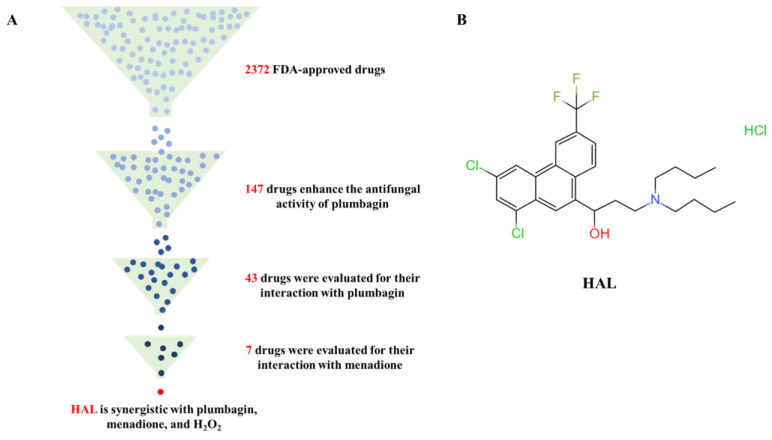
Candida albicans, a prominent opportunistic pathogenic fungus in the human population, possesses the capacity to induce life-threatening invasive candidiasis in individuals with compromised immune systems despite the existence of antifungal medications. When faced with macrophages or neutrophils, C. albicans demonstrates its capability to endure oxidative stress through the utilization of antioxidant enzymes. Therefore, the enhancement of oxidative stress in innate immune cells against C. albicans presents a promising therapeutic approach for the treatment of invasive candidiasis. In this study, we conducted a comprehensive analysis of a library of drugs approved by the Food and Drug Administration (FDA). We discovered that halofantrine hydrochloride (HAL) can augment the antifungal properties of oxidative damage agents (plumbagin, menadione, and H2O2) by suppressing the response of C. albicans to reactive oxygen species (ROS). Furthermore, our investigation revealed that the inhibitory mechanism of HAL on the oxidative response is dependent on Cap1. In addition, the antifungal activity of HAL has been observed in the Galleria mellonella infection model. These findings provide evidence that targeting the oxidative stress response of C. albicans and augmenting the fungicidal capacity of oxidative damage agents hold promise as effective antifungal strategies.
Overview
The claims and statistics of this paper haven’t been checked yet.
Free: it reads the open-access text and checks the first 5 claims that cite a source we can check. Create a free account to check every claim.
Integrity signals
Registry
Cites
Statistics
Figures
Verification
Claims the paper makes
The claims and statistics of this paper haven’t been checked yet.
Free: it reads the open-access text and checks the first 5 claims that cite a source we can check. Create a free account to check every claim.
Self-check
Percentages, sums and reported differences re-computed from the paper’s own numbers.
The self-check needs the paper’s full text.
Citations
Cites
Global incidence and mortality of severe fungal disease
Denning, D. W. (2024) · The Lancet Infectious Diseases · doi:10.1016/s1473-3099(23)00692-8 · Cited by 1,640 · cited 1×
“Candida albicans , a significant opportunistic pathogenic fungus in humans, has the potential to cause fatal invasive candidiasis in immunocompromised patients [1,2], despite the availability of antifungal drugs such as polyenes, azoles, and echinocandins [3].”
BackgroundKilling activity of neutrophils is mediated through activation of proteases by K+ flux
Reeves, E. P., Lu, H., Jacobs, H. L., Messina, C. G. M., Bolsover, S., Gabella, G., Potma, E. O., Warley, A., Roes, J., & Segal, A. W. (2002) · Nature · doi:10.1038/416291a · Cited by 1,153 · cited 1×
“Cationic stress, resulting from an increased influx of K + into the phagosome of innate immune cells [15], has been shown to inhibit C. albicans ’ response to oxidative stress and render it highly susceptible [16,17].”
BackgroundSelf-citationNoble, S. M., French, S., Kohn, L. A., Chen, V., & Johnson, A. D. (2010) · Nature Genetics · doi:10.1038/ng.605 · Cited by 678
Interactions of fungal pathogens with phagocytes
Erwig, L. P., & Gow, N. A. R. (2016) · Nature Reviews Microbiology · doi:10.1038/nrmicro.2015.21 · Cited by 626 · cited 1×
“…with profound innate immunodeficiency, such as those suffering from cancer, organ transplantation, and acquired immune deficiency syndrome (AIDS), C. albicans can persist in the bloodstream and establish colonies within internal organs, leading to the development of invasive candidiasis [8].”
BackgroundNoble, S. M., & Johnson, A. D. (2005) · Eukaryotic Cell · doi:10.1128/ec.4.2.298-309.2005 · Cited by 592 · cited 1×
“Fusion PCR methodology was utilized to generate null mutants of genes of interest from the C. albicans ’ strain SN152, as previously described in reference [21].”
MethodCombination antifungal therapy
Johnson, M. D., MacDougall, C., Ostrosky-Zeichner, L., Perfect, J. R., & Rex, J. H. (2004) · Antimicrobial Agents and Chemotherapy · doi:10.1128/aac.48.3.693-715.2004 · Cited by 541 · cited 1×
“Synergism is indicated by an FICI value of ≤ 0.5, additive effects by an FICI value of 0.5 FICI ≤ 1, indifference by an FICI value of 1 < FICI ≤ 4, and antagonism by an FICI value greater than 4 [23].”
MethodInfluentialPerspectives on medicinal properties of plumbagin and its analogs
Padhye, S., Dandawate, P., Yusufi, M., Ahmad, A., & Sarkar, F. H. (2012) · Medicinal Research Reviews · doi:10.1002/med.20235 · Cited by 324
Oxidative Stress Responses in the Human Fungal Pathogen, Candida albicans
Dantas, A., Day, A., Ikeh, M., Kos, I., Achan, B., & Quinn, J. (2015) · Biomolecules · doi:10.3390/biom5010142 · Cited by 281 · cited 7×
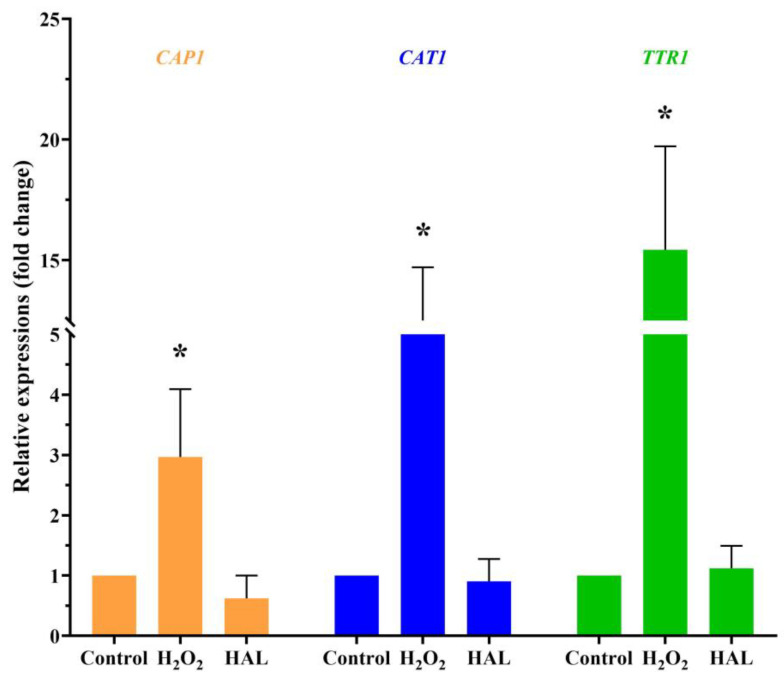
“This includes the activation of specific genes, such as the CAP1 gene (C3_02220W_A), encoding an AP-1 bZIP transcription factor, the CAT1 gene (C1_06810W_A), encoding catalase, and the TTR1 gene (C1_00490C_A), encoding glutaredoxin [5].”
BackgroundInfluentialFungicidal Drugs Induce a Common Oxidative-Damage Cellular Death Pathway
Belenky, P., Camacho, D., & Collins, J. J. (2013) · Cell Reports · doi:10.1016/j.celrep.2012.12.021 · Cited by 199 · cited 2×
“…HAL has recently been reported to enhance the antifungal activity of amphotericin B against Cryptococcus and Candida species [42], suggesting that HAL may affect the fungal oxidative stress system since amphotericin B culminates C. albicans in death through the production of cytotoxic ROS [9].”
BackgroundCross‐species discovery of syncretic drug combinations that potentiate the antifungal fluconazole
Spitzer, M., Griffiths, E., Blakely, K. M., Wildenhain, J., Ejim, L., Rossi, L., De Pascale, G., Curak, J., Brown, E., Tyers, M., et al. (2011) · Molecular Systems Biology · doi:10.1038/msb.2011.31 · Cited by 183 · cited 1×
“Numerous studies have demonstrated that FDA-approved non-antifungal drugs, such as statins and sertraline, can exhibit anti-fungal properties [37,38].”
Background
Cited by
Mechanisms of Azole Potentiation: Insights from Drug Repurposing Approaches
Xiong, J., Lu, H., & Jiang, Y. (2025) · ACS Infectious Diseases · doi:10.1021/acsinfecdis.4c00657 · Cited by 20
Self-citationMarine-Derived Metabolites Act as Promising Antifungal Agents
Hang, S., Lu, H., & Jiang, Y. (2024) · Marine Drugs · doi:10.3390/md22040180 · Cited by 23
Self-citationWu, H., Ji, Z., Huang, X., Li, L., Hang, S., Yu, J., Lu, H., & Jiang, Y. (2024) · ACS Infectious Diseases · doi:10.1021/acsinfecdis.4c00399 · Cited by 16
Self-citationXiong, J., Wang, L., Feng, Y., Zhen, C., Hang, S., Yu, J., Lu, H., & Jiang, Y. (2024) · Life Sciences · doi:10.1016/j.lfs.2024.122699 · Cited by 15
Self-citationLi, W., Whiteway, M., Hang, S., Yu, J., Lu, H., & Jiang, Y. (2025) · Nature Communications · doi:10.1038/s41467-025-62131-z · Cited by 13
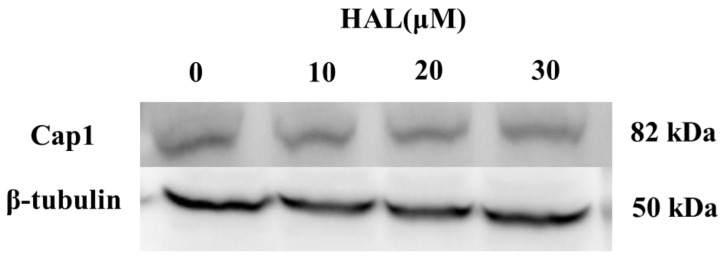
“Afterincubating with an anti-mouse IgG secondary antibody m-IgG κ BP-HRP (Santa Cruz, sc-516102) at a dilution of 1:10,000, the Omni-ECL ™ Femto Light Chemiluminescence Kit (Epizyme Biotech, SQ201) was utilized to reveal the chemiluminescence signal, which was captured by an automatic chemiluminescence image analyzer…”
InfluentialSelf-citation
Metadata
- Authors
- Xiong, J., Wang, L., Feng, Z., Hang, S., Yu, J., Feng, Y., Lu, H., & Jiang, Y.
- Affiliations
- Tongji University (CN)
- Corresponding author
- Lu, Hui
- Jiang, Yuanying
- Venue
- Antioxidants
- Publisher
- MDPI AG
- Published
- 2024-02-09
- Volume
- 13
- Issue
- 2
- Pages
- 223
- ISSN
- 2076-3921 (ISSN-L)
- PMC
- PMC10886025
- OpenAlex
- W4391678508
- Cited by
- 14
- References
- 44
- Citations by year
- 2026: 3 · 2025: 6 · 2024: 5
- FWCI
- 4.84
- Type
- journal article
- Language
- en
- Open access
- gold
- doi.org
- Licence
- Locations
- Antioxidants (publishedVersion, cc-by)
- PubMed Central (publishedVersion, cc-by)
- PubMed (publishedVersion)
- DOAJ (DOAJ: Directory of Open Access Journals) (submittedVersion, cc-by-sa)
- Funders
- National Key Research and Development Program of China (2022YFC2303004, 2021YFC2300404, 82020108032, 202101070007-E00094)
- National Natural Science Foundation of China (2022YFC2303004, 2021YFC2300404, 82020108032, 202101070007-E00094)
- Innovation Program of Shanghai Municipal Education Commission (2022YFC2303004, 2021YFC2300404, 82020108032, 202101070007-E00094)
- Topics
- Health Sciences › Medicine › Infectious Diseases › Antifungal resistance and susceptibility
- Life Sciences › Biochemistry, Genetics and Molecular Biology › Molecular Biology › Fungal and yeast genetics research
- Health Sciences › Medicine › Infectious Diseases › Fungal Infections and Studies
- Keywords
- Candida albicans, invasive candidiasis, oxidative stress, reactive oxygen species, antioxidant enzymes, CAP1, plumbagin, menadione, hydrogen peroxide, Galleria mellonella, antifungal drug repurposing, innate immune cells
About these checks
Registry, retraction, Cites and statistics results are computed, not judged, with one exception: a printed reference that no index lists is read once by a model before it counts as a citation error. Claims are extracted by a model and kept only when their quote appears verbatim in the text; each cited source is then checked, with a model’s help, for whether it says what the claim relies on. Those verdicts can be wrong — read the claim’s quote and the cited source before relying on one.
Statistics and arithmetic are recomputed, not judged.
Confidence bands are shown only for fields calibrated on our annotated test set. None is calibrated yet, so no band is shown.
What counts as a claim ›How we measure confidence ›How we check this ›
Are you an author, or do you see a problem with this page? Request a review
How to cite
Cite CoChat for the checks on this page, and the paper for its own findings.
- This page
- CoChat. (2026). Citation check: Halofantrine Hydrochloride Acts as an Antioxidant Ability Inhibitor That Enhances Oxidative Stress Damage to Candida albicans. https://app.cochat.ai/papers/10.3390/antiox13020223
- The paper
- Xiong, J., Wang, L., Feng, Z., Hang, S., Yu, J., Feng, Y., Lu, H., & Jiang, Y. (2024). Halofantrine Hydrochloride Acts as an Antioxidant Ability Inhibitor That Enhances Oxidative Stress Damage to Candida albicans. Antioxidants. https://doi.org/10.3390/antiox13020223
Data sources
Bibliographic data: Semantic Scholar, OpenAlex, Crossref.
Contains information from the Semantic Scholar Academic Graph Datasets, made available under the ODC Attribution License (ODC-BY 1.0).
Semantic Scholar’s data is described in: Kinney, R., et al. (2023). The Semantic Scholar Open Data Platform. arXiv:2301.10140.
