

The DOI matches its Crossref record; 38 of the 41 references it cites were found in a registry or an index; none of the 51 sources its claims cite is checked for support yet.
A Review of Time-Scale Modification of Music Signals
Open accessAbstract
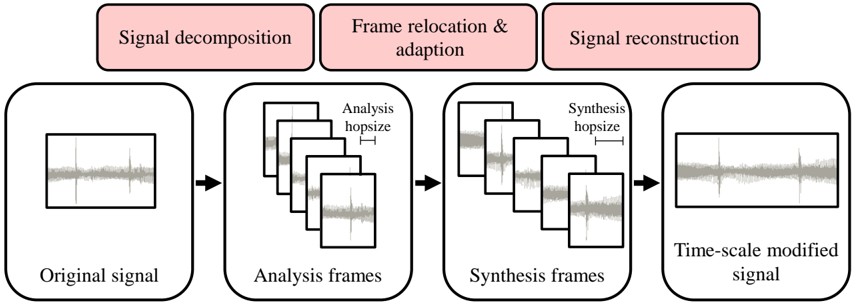
Time-scale modification (TSM) is the task of speeding up or slowing down an audio signal’s playback speed without changing its pitch. In digital music production, TSM has become an indispensable tool, which is nowadays integrated in a wide range of music production software. Music signals are diverse—they comprise harmonic, percussive, and transient components, among others. Because of this wide range of acoustic and musical characteristics, there is no single TSM method that can cope with all kinds of audio signals equally well. Our main objective is to foster a better understanding of the capabilities and limitations of TSM procedures. To this end, we review fundamental TSM methods, discuss typical challenges, and indicate potential solutions that combine different strategies. In particular, we discuss a fusion approach that involves recent techniques for harmonic-percussive separation along with time-domain and frequency-domain TSM procedures.
Overview
CoChat Summary
TL;DR
This review explains time-scale modification (TSM) for music, covering OLA, WSOLA, PV-TSM, and a fusion approach using harmonic-percussive separation. It argues no single TSM method handles all music signals well, and that combining methods can reduce artifacts.
Key findings
- No single TSM method copes equally well with all audio signals because music contains harmonic, percussive, and transient components with contrasting requirements.
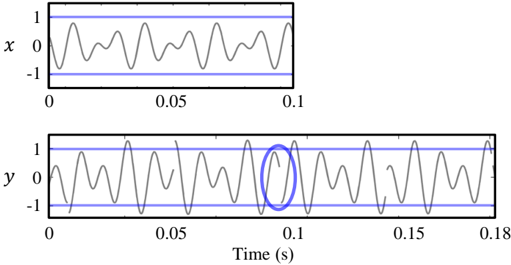
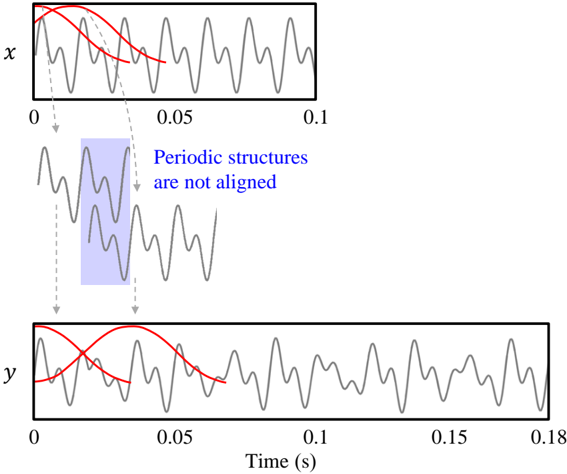
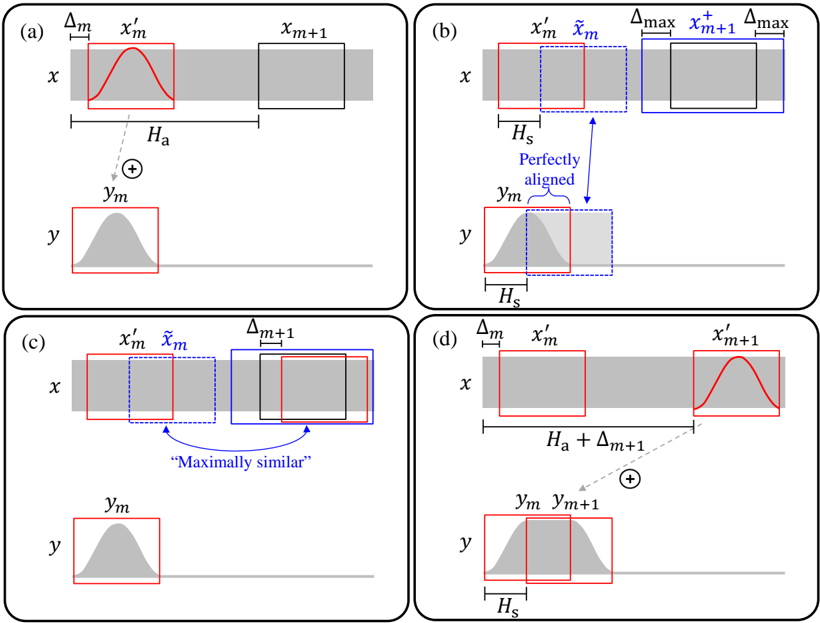
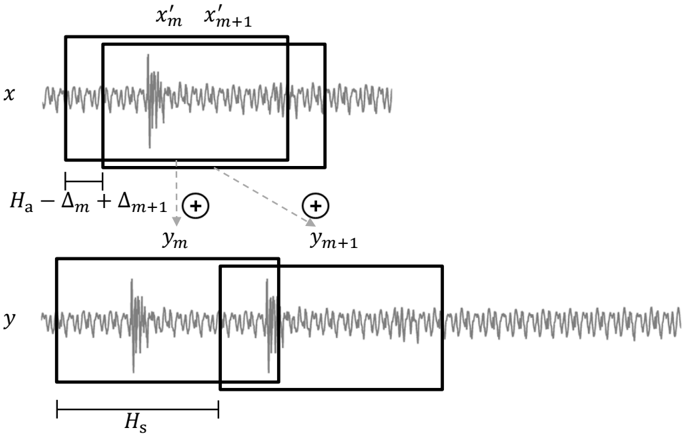
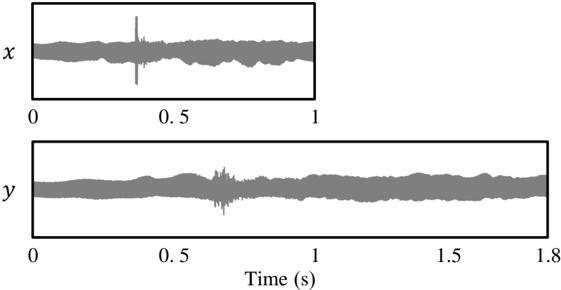
- OLA is suited to purely percussive signals but causes phase jump artifacts and warbling on harmonic signals; WSOLA preserves the most prominent periodicity but can produce transient doubling/skipping and still warbles on polyphonic inputs.
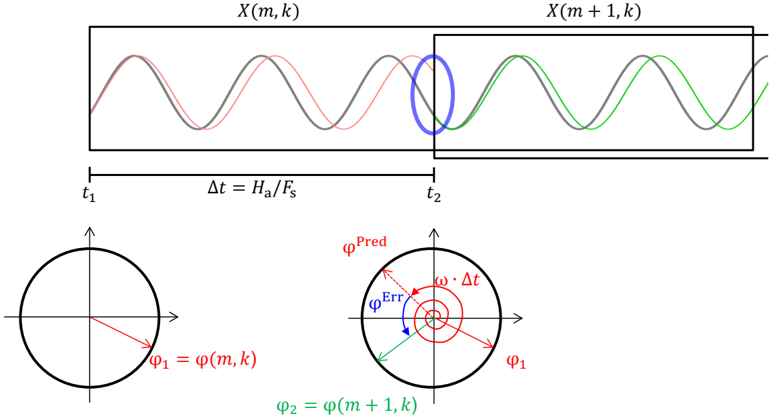
- PV-TSM achieves horizontal phase coherence but often smears transients and introduces phasiness due to loss of vertical phase coherence.
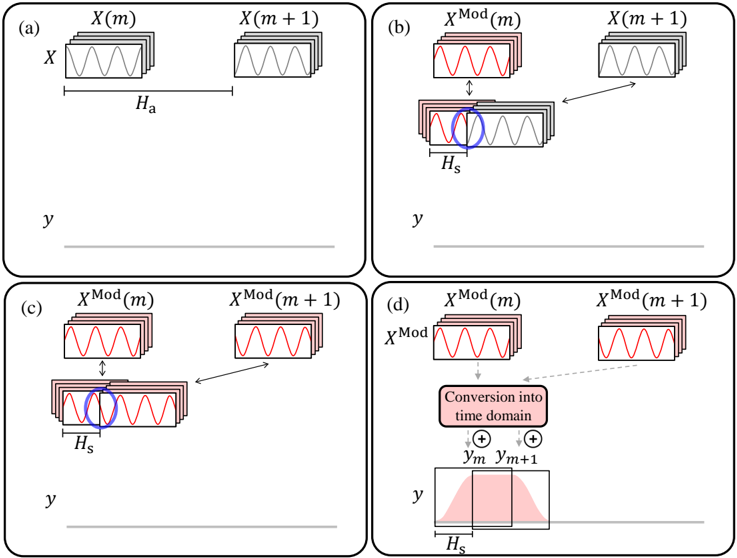
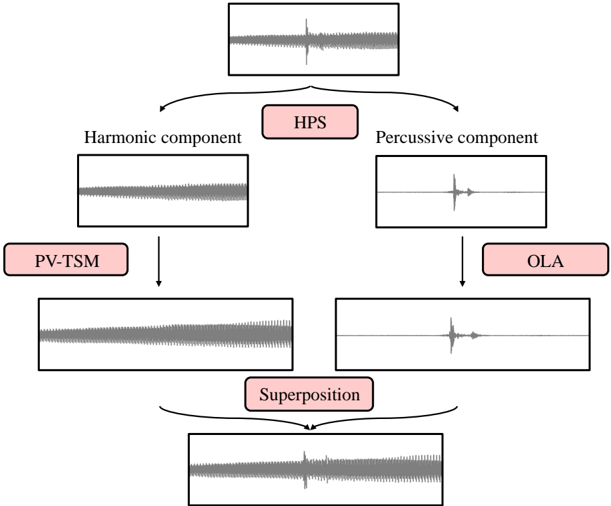
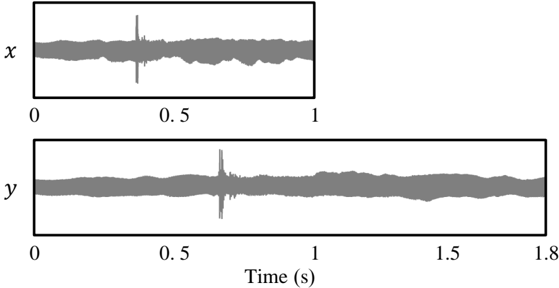
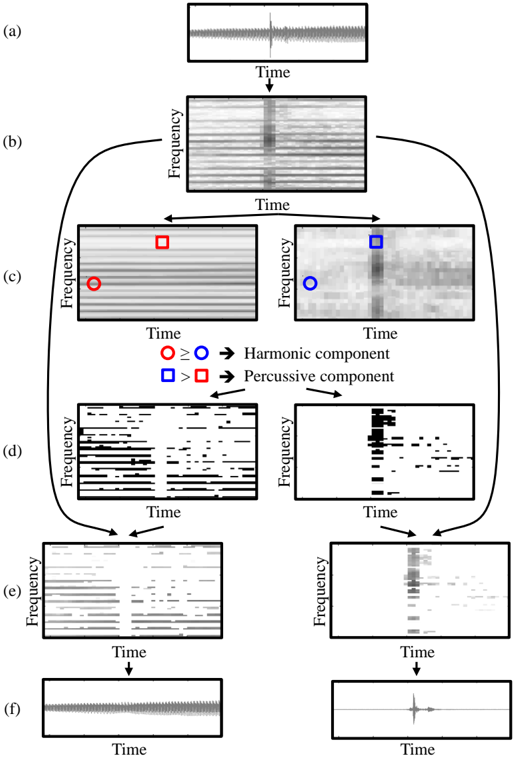
- A fusion approach using harmonic-percussive separation applies PV-TSM with identity phase locking to the harmonic component and OLA with a very short frame length to the percussive component; in the shown example with stretch factor α = 1.8, it preserves a transient without explicit transient detection.
Methods
- Review/tutorial article, not a new empirical study; it reviews fundamental TSM procedures and discusses typical challenges and potential solutions.
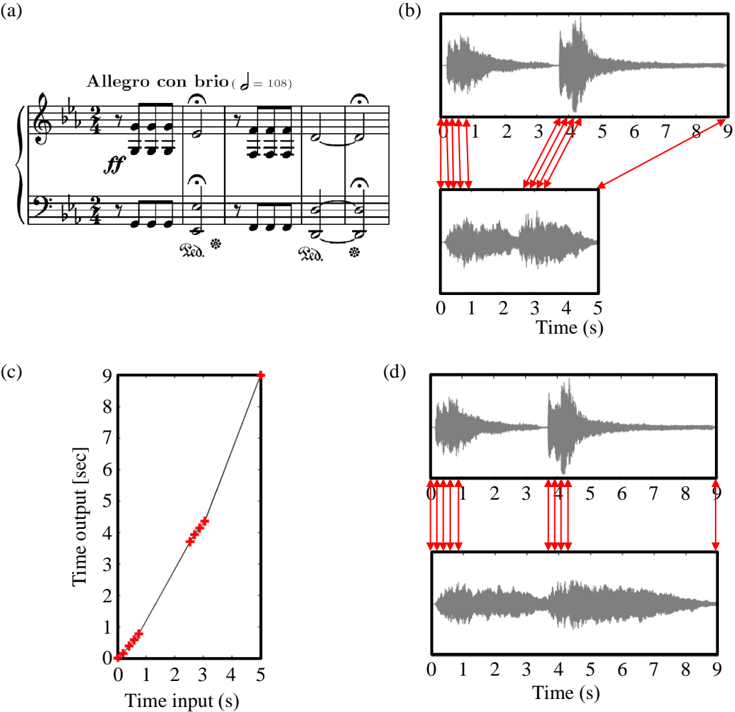
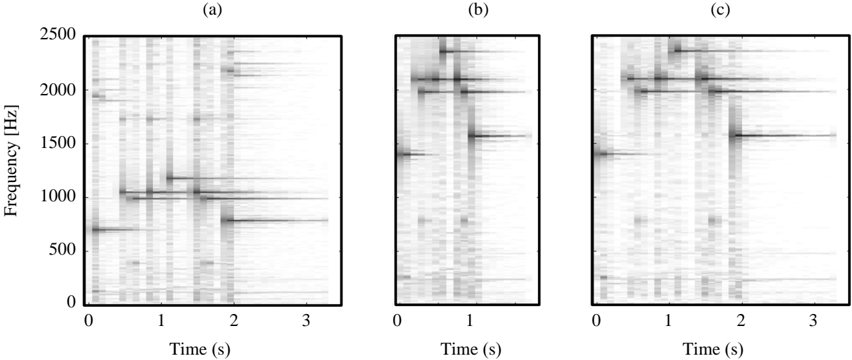
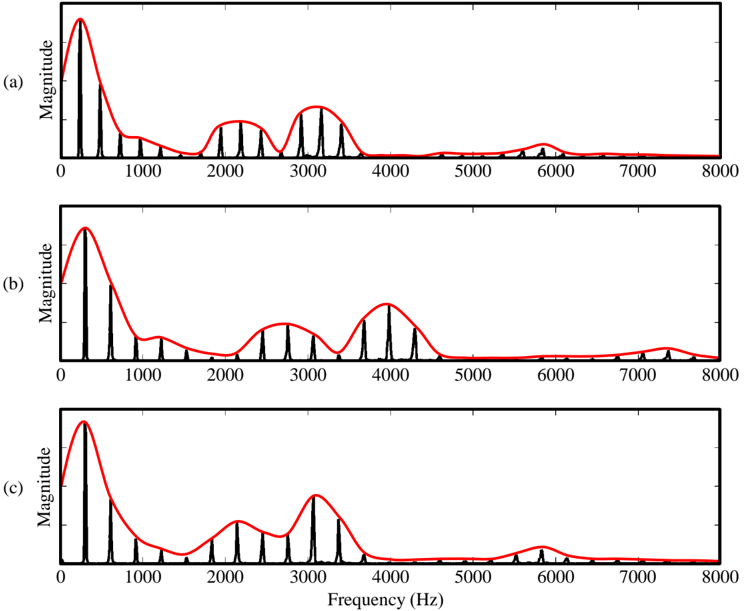
- Covers OLA, WSOLA, PV-TSM, and TSM based on harmonic-percussive separation, with illustrative examples such as violin plus castanets, Beethoven’s Symphony No. 5 onset synchronization, and singing-voice spectra.
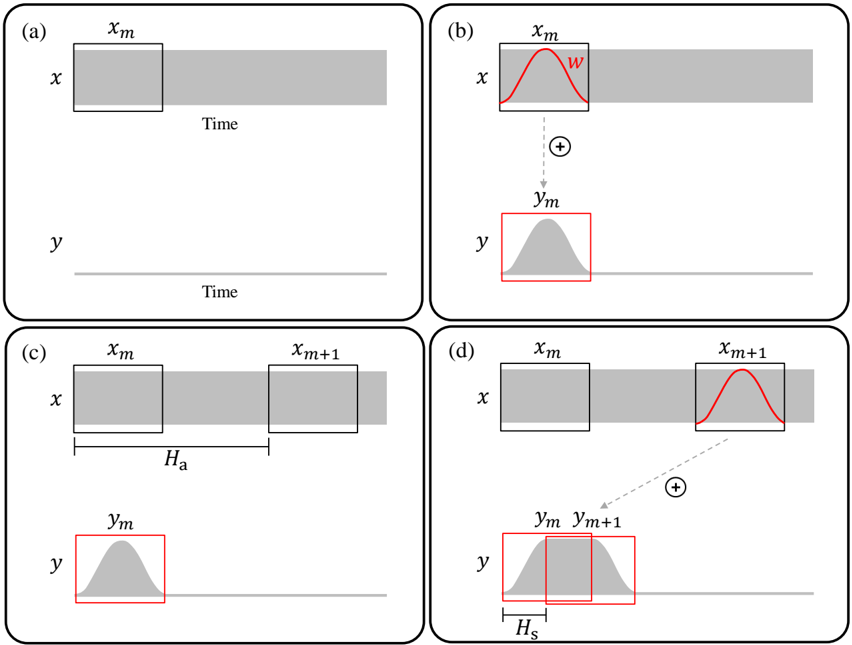
- Main analysis is conceptual and algorithmic: derivations of frame-based TSM, artifact explanations, parameter choices, and qualitative comparisons.
Limitations
- The paper states no formal limitations.
- Evident from the text: it is a review/tutorial without new experiments, listening tests, or quantitative benchmark; perceptual claims are supported by illustrative figures and prior literature rather than systematic evaluation.
- Evident from the text: examples often use a single stretch factor such as α = 1.8, so they do not establish general performance across all signals or parameter settings.
Model-written summary. Check it against the paper before relying on it.
Integrity signals
Registry
Cites
Statistics
Figures
Verification
Claims the paper makes
0 Valid · 6 Not valid · 28 Not checked · 51 Own results and interpretations
A result the paper states — it cites no source for it, so there is none to check. The quote shows it is in the paper.
In the paper
“The mapping between the note onsets of the two performances is therefore non-linear.”
§ A Review of Time-Scale Modification of Music Signals † > 6.2. Harmonic-Percussive Separation
plainstates an association- Asserted: passes — The authors put it forward as true.
- Checkable: passes — It can be checked against evidence.
- Load-bearing: unclear — It is unclear whether the paper’s conclusions depend on it.
- Based: passes — The paper gives a reason why it holds.
A statement the paper makes itself — it cites no source for it, so there is none to check. The quote shows it is in the paper.
In the paper
“However, the vertical phase coherence, i.e., the phase relationships of sinusoidal components within one frame, is usually destroyed in the phase propagation process.”
§ A Review of Time-Scale Modification of Music Signals † > 5.5. Artifacts
plainstates a cause- Asserted: passes — The authors put it forward as true.
- Checkable: passes — It can be checked against evidence.
- Load-bearing: passes — The paper’s conclusions depend on it.
- Based: passes — The paper gives a reason why it holds.
A statement the paper makes itself — it cites no source for it, so there is none to check. The quote shows it is in the paper.
In the paper
“A prominent problem with WSOLA-like methods is known as transient doubling or stuttering.”
§ A Review of Time-Scale Modification of Music Signals † > 4.2. Artifacts
boostedstates a cause- Asserted: passes — The authors put it forward as true.
- Checkable: passes — It can be checked against evidence.
- Load-bearing: unclear — It is unclear whether the paper’s conclusions depend on it.
- Based: passes — The paper gives a reason why it holds.
In the paper
“When applied to harmonic signals, the output signals of OLA have a characteristic warbling sound, which is a kind of periodic frequency modulation [6].”
§ A Review of Time-Scale Modification of Music Signals † > 3.2. Artifacts
What the sources say
- Not checked yetcites [6] Laroche, 1999, Improved phase vocoder time-scale modification of audio, IEEE Trans. Speech Audio Process. source
plainstates a cause- Asserted: passes — The authors put it forward as true.
- Checkable: passes — It can be checked against evidence.
- Load-bearing: passes — The paper’s conclusions depend on it.
- Based: passes — The paper gives a reason why it holds.
A conclusion the paper draws from its own results — it cites no other source for it, so there is none to check. The quote shows it is in the paper.
In the paper
“OLA is usually not suited to modify music.”
§ A Review of Time-Scale Modification of Music Signals † > 3.2. Artifacts
plain- Asserted: passes — The authors put it forward as true.
- Checkable: passes — It can be checked against evidence.
- Load-bearing: passes — The paper’s conclusions depend on it.
- Based: passes — The paper gives a reason why it holds.
47 more claims
Create a free account to see all 85 claims and to verify the 39 references still open.
- Probably not a substantial claim. 22
- It may state two separate claims as one. 15
- The quote only partly states this claim. 2
Claims other papers make about this one
Each is checked against this paper’s own text: does it say what the citing paper says it does?
In the citing paper
“This task becomes especially challenging with large stretching factors, where conventional methods, such as the phase vocoder, often introduce perceptual artifacts, e.g., transient smearing, loss of presence, and phasiness [3], [4], [10].”
From Noise Morphing for Audio Time Stretching (2024) · cites this paper as [3]
In the citing paper
“The best performing TSM methods apply the Short-Time Fourier Transform (STFT), manipulate the spectrogram of the signal to change its duration, and then apply the inverse STFT to reconstruct the time-scaled signal [3], [4], [12].”
From Noise Morphing for Audio Time Stretching (2024) · cites this paper as [3]
In the citing paper
“Furthermore, transients processed with the standard phase vocoder suffer from a softening of the perceived attack, often referred to as “transient smearing” [2,3,23].”
From Audio Time Stretching Using Fuzzy Classification of Spectral Bins (2017) · cites this paper as [3]
Self-check
Percentages, sums and reported differences re-computed from the paper’s own numbers.
Each contradiction between two passages listed here was confirmed by an independent check.
Rated minor: it would not touch a result — a value no result rests on, a p-value that stays on the same side of the significance level, or a conflict that is clerical, resolved elsewhere in the paper, or outside its own findings.
In the paper
§ A Review of Time-Scale Modification of Music Signals † > 3.1. The Procedure
“The Hann window has the nice property that ∑ n∈Z w r -n N 2 = 1 ,(4)”
§ A Review of Time-Scale Modification of Music Signals † > 3.1. The Procedure
“w(r) = 0.5 1 -cos 2π(r+N/2) N-1 , if r ∈ [-N/2 : N/2 -1], 0, otherwise.(3)”
Rated minor: it would not touch a result — a value no result rests on, a p-value that stays on the same side of the significance level, or a conflict that is clerical, resolved elsewhere in the paper, or outside its own findings.
In the paper
§ A Review of Time-Scale Modification of Music Signals † > 7.3. Websources
“PV-TSM implemented in Python is included in LibROSA [46].”
§ A Review of Time-Scale Modification of Music Signals † > References
“46. Ellis, D.P.W. A Phase Vocoder in Matlab. Available online: http://www.ee.columbia.edu/dpwe/resources/ matlab/pvoc/ (accessed on 3 December 2015).”
Citations
Cites
Габор, Д. (1946) · Journal of the IEE · Cited by 5,036
Signal estimation from modified short-time Fourier transform
Griffin, D., & Lim, J. (1984) · IEEE Transactions on Acoustics, Speech, and Signal Processing · doi:10.1109/tassp.1984.1164317 · Cited by 2,095
Markel, J. D., & Gray, A. H. (1976) · Communication and Cybernetics · doi:10.1007/978-3-642-66286-7 · Cited by 1,402
Pitch-synchronous waveform processing techniques for text-to-speech synthesis using diphones
Moulines, E., & Charpentier, F. (1990) · Speech Communication · doi:10.1016/0167-6393(90)90021-z · Cited by 1,244
Serra, X., & Smith, J. (1990) · Computer Music Journal · doi:10.2307/3680788 · Cited by 338
Dolson, M. (1986) · Computer Music Journal · doi:10.2307/3680093 · Cited by 278
Zoelzer, U. (2002) · Cited by 277
Improved phase vocoder time-scale modification of audio
Laroche, J., & Dolson, M. (1999) · IEEE Transactions on Speech and Audio Processing · doi:10.1109/89.759041 · Cited by 276
Fundamentals of Music Processing: Audio, Analysis, Algorithms, Applications
Müller, M. (2015) · doi:10.1007/978-3-319-21945-5 · Cited by 257
Self-citationFlanagan, J. L., & Golden, R. M. (1966) · Bell System Technical Journal · doi:10.1002/j.1538-7305.1966.tb01706.x · Cited by 226
Verhelst, W., & Roelands, M. (1993) · IEEE International Conference on Acoustics Speech and Signal Processing · doi:10.1109/icassp.1993.319366 · Cited by 217
Implementation of the digital phase vocoder using the fast Fourier transform
Portnoff, M. R. (1976) · IEEE Transactions on Acoustics Speech and Signal Processing · doi:10.1109/tassp.1976.1162810 · Cited by 209
High quality time-scale modification for speech
Roucos, S., & Wilgus, A. (2005) · ICASSP '85. IEEE International Conference on Acoustics, Speech, and Signal Processing · doi:10.1109/icassp.1985.1168381 · Cited by 143
Габор, Д. (1947) · Journal of the Institution of Electrical Engineers, Part 1, General · doi:10.1049/ji-1.1947.0015 · Cited by 127
Röebel, A., & Xavier Rodet, A. (2005) · HAL · Cited by 96
Improving Time-Scale Modification of Music Signals Using Harmonic-Percussive Separation
Driedger, J., Muller, M., & Ewert, S. (2014) · IEEE Signal Processing Letters · doi:10.1109/lsp.2013.2294023 · Cited by 64
Self-citationCanadas-Quesada, F. J., Vera-Candeas, P., Ruiz-Reyes, N., Carabias-Orti, J. J., & Cabañas‐Molero, P. (2014) · EURASIP Journal on Audio Speech and Music Processing · doi:10.1186/s13636-014-0026-5 · Cited by 43
Extending spectral modeling synthesis with transient modeling synthesis
Verma, T. S., & Meng, T. H. Y. (2000) · Computer Music Journal · doi:10.1162/014892600559317 · Cited by 35
Time-scale modification of audio signals using enhanced WSOLA with management of transients
Grofit, S., & Lavner, Y. (2008) · IEEE Transactions on Audio, Speech, and Language Processing · doi:10.1109/tasl.2007.909444 · Cited by 34
Audio Pitch Shifting Using the Constant-Q Transform
Schörkhuber, C., Klapuri, A. P., & Sontacchi, A. (2013) · Journal of the Audio Engineering Society · Cited by 33
Autocorrelation method for high-quality time/pitch-scaling
Laroche, J. (2002) · IEEE Workshop on Applications of Signal Processing to Audio and Acoustics (WASPAA) · doi:10.1109/aspaa.1993.379979 · Cited by 29
Phase-vocoder: about this phasiness business
Laroche, J., & Dolson, M. (2002) · Proceedings of 1997 Workshop on Applications of Signal Processing to Audio and Acoustics · doi:10.1109/aspaa.1997.625603 · Cited by 23
Harmonic/Percussive Sound Separation Based on Anisotropic Smoothness of Spectrograms
Tachibana, H., Ono, N., Kameoka, H., & Sagayama, S. (2014) · IEEE/ACM Transactions on Audio Speech and Language Processing · doi:10.1109/taslp.2014.2351131 · Cited by 22
Verma, T. S., & Meng, T. H. Y. (2002) · Proceedings of the 1998 IEEE International Conference on Acoustics, Speech and Signal Processing, ICASSP '98 (Cat. No.98CH36181) · doi:10.1109/icassp.1998.679647 · Cited by 22
(2002) · Wiley eBooks · doi:10.1002/0470846046 · Cited by 22
Harmonic-Percussive Source Separation Using Harmonicity And Sparsity Constraints.
0001, J. P., & Lee, K. (2015) · Zenodo (CERN European Organization for Nuclear Research) · doi:10.5281/zenodo.1417322 · Cited by 12
Data-Driven Sound Track Generation
Müller, M., & Driedger, J. (2012) · DROPS (Schloss Dagstuhl – Leibniz Center for Informatics) · doi:10.4230/dfu.vol3.11041.175 · Cited by 9
Self-citationREAL TIME SIGNAL TRANSPOSITION WITH ENVELOPE PRESERVATION IN THE PHASE VOCODER
Röebel, A., & Xavier Rodet, A. (2005) · HAL · Cited by 7
(1998)
(2009) · Publikationsdatenbank der Fraunhofer-Gesellschaft (Fraunhofer-Gesellschaft)
(2010) · Arrow@dit (Dublin Institute of Technology)
(2002) · Journal of the Audio Engineering Society
(2006) · Maynooth University ePrints and eTheses Archive (Maynooth University)
(2008)
(2007)
(1997) · University of Michigan Library Repository
Ishizaki, H., Hoashi, K., & Takishima, Y. (2009) · Zenodo · doi:10.5281/zenodo.1418230
(2014)
Self-citation
Research works printed but not linked: 5
- Moinet, A., Dutoit, T., and Latour, P. (2013, January 2–5). Audio time-scaling for slow motion sports videos. Proceedings of the International Conference on Digital Audio Effects (DAFx), Maynooth, Ireland.
- Kraft, S., Holters, M., von dem Knesebeck, A., and Zölzer, U. (2012, January 17–21). Improved PVSOLA time stretching and pitch shifting for polpyhonic audio. Proceedings of the International Conference on Digital Audio Effects (DAFx), York, UK.
- Moinet, A., and Dutoit, T. (2011, January 19–23). PVSOLA: A phase vocoder with synchronized overlapp-add. Proceedings of the International Conference on Digital Audio Effects (DAFx), Paris, France.
- Verma, T.S., and Meng, T.H. (1998, January 19–21). Time scale modification using a sines+transients+noise signal model. Proceedings of the Digital Audio Effects Workshop (DAFx98), Barcelona, Spain.
- Gkiokas, A., Papavassiliou, V., Katsouros, V., and Carayannis, G. (2012, January 17–21). Deploying nonlinear image filters to spectrograms for harmonic/percussive separation. Proceedings of the International Conference on Digital Audio Effects (DAFx), York, UK.
Cited by
Lung Sound Classification Using Co-Tuning and Stochastic Normalization
Nguyen, T. T. K., & Pernkopf, F. (2022) · IEEE Transactions on Biomedical Engineering · doi:10.1109/tbme.2022.3156293 · Cited by 192
Investigation of Data Augmentation Techniques for Disordered Speech Recognition
Geng, M., Xie, X., Liu, S., Yu, J., Hu, S., Liu, X., & Meng, H. M. L. (2020) · Interspeech (USB) · doi:10.21437/interspeech.2020-1161 · Cited by 71
Roy, A., & Satija, U. (2023) · IEEE Transactions on Instrumentation and Measurement · doi:10.1109/tim.2023.3292953 · Cited by 57
A comparison of data augmentation methods in voice pathology detection
Javanmardi, F., Kadiri, S. R., & Alku, P. (2023) · Computer Speech & Language · doi:10.1016/j.csl.2023.101552 · Cited by 50
Roy, A., & Satija, U. (2023) · IEEE Transactions on Instrumentation and Measurement · doi:10.1109/tim.2023.3256468 · Cited by 42
Metadata
- Authors
- Driedger, J., & Müller, M.
- Affiliations
- International Audio Laboratories Erlangen (DE)
- Corresponding author
- Driedger, Jonathan
- Müller, Meinard
- ORCID
- Müller, Meinard
- Venue
- Applied Sciences
- Publisher
- MDPI AG
- Published
- 2016-02-18
- Volume
- 6
- Issue
- 2
- Pages
- 57
- ISSN
- 2076-3417 (ISSN-L)
- OpenAlex
- W2278339107
- Cited by
- 71
- References
- 41
- Citations by year
- 2026: 4 · 2025: 7 · 2024: 11 · 2023: 8 · 2022: 12 · 2021: 6 · 2020: 4 · 2019: 5 · 2018: 8 · 2017: 4 · 2016: 1
- FWCI
- 4.14
- Type
- journal article
- Language
- en
- Open access
- gold
- doi.org
- Licence
- Locations
- Applied Sciences (publishedVersion, cc-by)
- DOAJ (DOAJ: Directory of Open Access Journals) (submittedVersion, cc-by-sa)
- Funders
- Friedrich-Alexander-Universität Erlangen-Nürnberg
- Deutsche Forschungsgemeinschaft (DFG MU 2686/6-1)
- Topics
- Physical Sciences › Computer Science › Signal Processing › Music and Audio Processing
- Social Sciences › Arts and Humanities › Music › Music Technology and Sound Studies
- Physical Sciences › Computer Science › Signal Processing › Speech and Audio Processing
- Keywords
- time-scale modification, music signal processing, music production software
About these checks
Registry, retraction, Cites and statistics results are computed, not judged, with one exception: a printed reference that no index lists is read once by a model before it counts as a citation error. Claims are extracted by a model and kept only when their quote appears verbatim in the text; each cited source is then checked, with a model’s help, for whether it says what the claim relies on. Those verdicts can be wrong — read the claim’s quote and the cited source before relying on one.
A language model drew the claims from the paper on 2026-11-14, under version 3 of the claim definition (model deepseek-v4.1-flash, prompt extract-v3).
A second model labelled each claim on 2026-11-14 (model jev-1.13-20260917, definition revision gold-guideline-v0.2).
Statistics and arithmetic are recomputed, not judged.
Confidence bands are shown only for fields calibrated on our annotated test set. None is calibrated yet, so no band is shown.
What counts as a claim ›How we measure confidence ›How we check this ›
Are you an author, or do you see a problem with this page? Request a review
Data sources
Bibliographic data: Semantic Scholar, OpenAlex, Crossref.
Contains information from the Semantic Scholar Academic Graph Datasets, made available under the ODC Attribution License (ODC-BY 1.0).
Semantic Scholar’s data is described in: Kinney, R., et al. (2023). The Semantic Scholar Open Data Platform. arXiv:2301.10140.
