

The DOI matches its Crossref record; 31 of the 35 references it cites were found in a registry or an index; none of the 29 sources its claims cite is checked for support yet.
Audio Time Stretching Using Fuzzy Classification of Spectral Bins
Open accessAbstract
A novel method for audio time stretching has been developed. In time stretching, the audio signal’s duration is expanded, whereas its frequency content remains unchanged. The proposed time stretching method employs the new concept of fuzzy classification of time-frequency points, or bins, in the spectrogram of the signal. Each time-frequency bin is assigned, using a continuous membership function, to three signal classes: tonalness, noisiness, and transientness. The method does not require the signal to be explicitly decomposed into different components, but instead, the computing of phase propagation, which is required for time stretching, is handled differently in each time-frequency point according to the fuzzy membership values. The new method is compared with three previous time-stretching methods by means of a listening test. The test results show that the proposed method yields slightly better sound quality for large stretching factors as compared to a state-of-the-art algorithm, and practically the same quality as a commercial algorithm. The sound quality of all tested methods is dependent on the audio signal type. According to this study, the proposed method performs well on music signals consisting of mixed tonal, noisy, and transient components, such as singing, techno music, and a jazz recording containing vocals. It performs less well on music containing only noisy and transient sounds, such as a drum solo. The proposed method is applicable to the high-quality time stretching of a wide variety of music signals.
Overview
CoChat Summary
TL;DR
The paper proposes a phase-vocoder time-stretching method that uses fuzzy classification of each STFT bin as tonal, noisy, or transient, then applies phase propagation and transient handling according to those continuous memberships. In a listening test, the proposed method was competitive with a state-of-the-art academic method and a commercial algorithm, with quality depending strongly on the audio excerpt.
Key findings
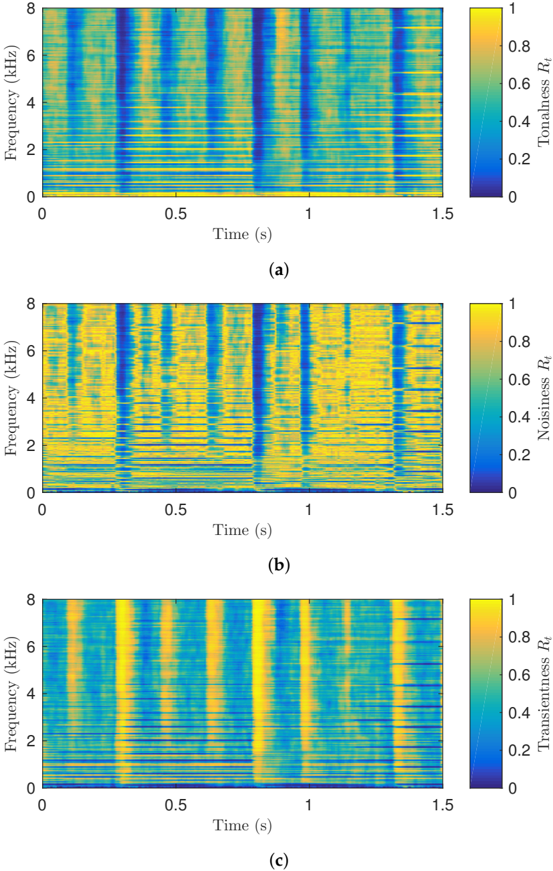
- The proposed method assigns each time-frequency bin continuous membership values for tonalness, noisiness, and transientness, avoiding explicit decomposition into separate signal components.
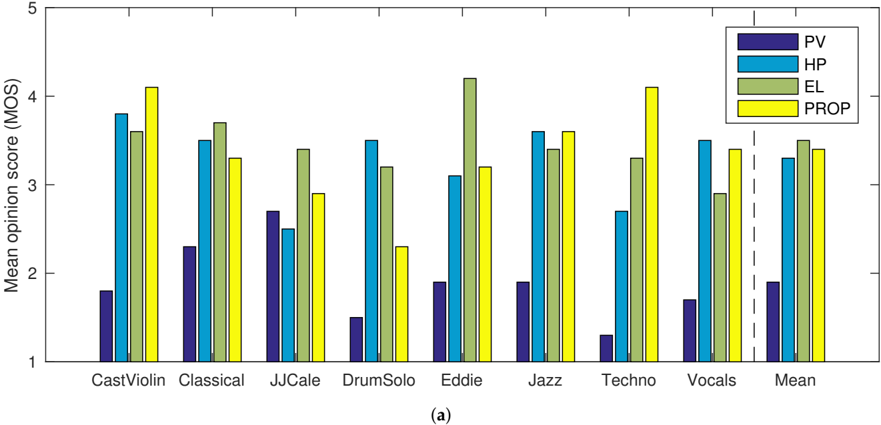
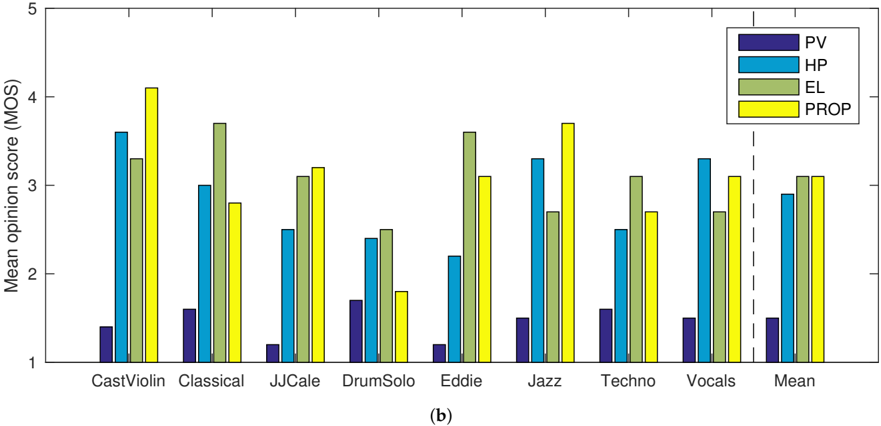
- Across all eight excerpts, mean opinion scores (MOS, 1–5) were: for α = 1.5, PV 1.9, HP 3.3, EL 3.5, PROP 3.4; for α = 2.0, PV 1.5, HP 2.9, EL 3.1, PROP 3.1. The standard phase vocoder (PV) performed worse than all other tested methods.
- The proposed method scored best on CastViolin (MOS 4.1 at both α = 1.5 and α = 2.0), Jazz (3.6 at α = 1.5; 3.7 at α = 2.0), Techno at α = 1.5 (4.1), and JJCale at α = 2.0 (3.2). It performed more poorly on DrumSolo (2.3 at α = 1.5; 1.8 at α = 2.0) and Classical (3.3 at α = 1.5; 2.8 at α = 2.0).
- The paper concludes the proposed method yields slightly better quality than HP and practically the same quality as EL overall, but performance depends on signal type.
Methods
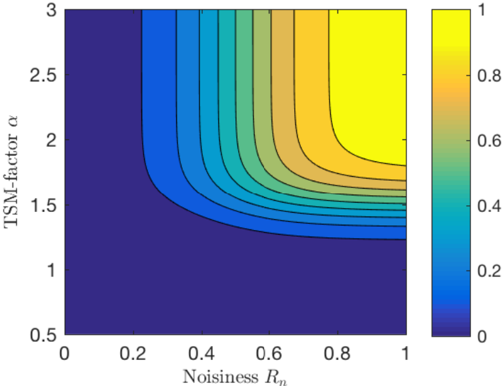
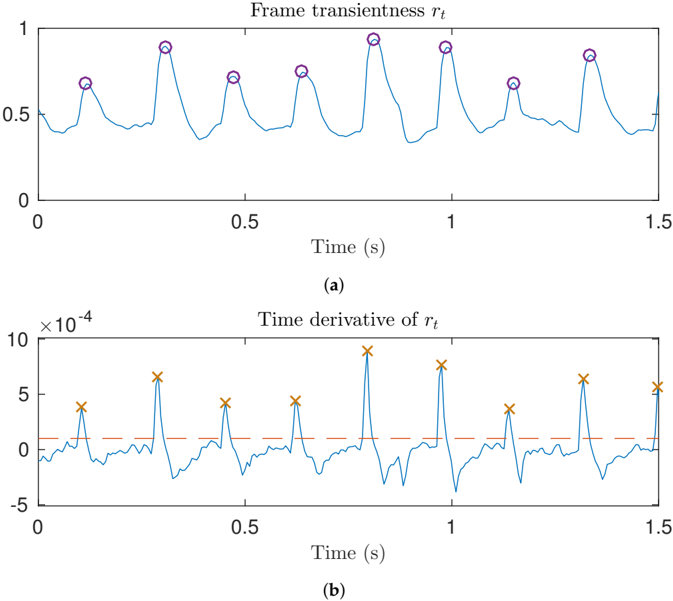
- The method uses STFT analysis/synthesis with sample rate 44.1 kHz, Hann window length N = 4096, synthesis hop size H_s = 512, and K = 4096 frequency bins. Median filtering lengths were 200 ms in time and 500 Hz (46 bins) in frequency; transient detection threshold was 10^-4; constants b_n = b_α = 4.
- A listening test was conducted online with the Web Audio Evaluation Tool. Eleven subjects participated (10 male, 1 female; ages 23–37, median 28; all had acoustics background, 10 had prior listening-test experience).
- Eight audio excerpts and two stretching factors (α = 1.5 and α = 2.0) were tested with four methods: proposed method (PROP), standard phase vocoder (PV), harmonic-percussive separation (HP), and élastique (EL). Each subject rated 64 samples on a 1–5 quality scale; mean opinion scores were computed.
Limitations
- The paper states the method still suffers to some extent from the fixed time and frequency resolution of the STFT, and suggests applying fuzzy classification to a multiresolution time-frequency transform. It also notes poorer performance on DrumSolo and Classical, likely because individual transients were not resolved due to the relatively long analysis window, and additional computational complexity compared with the standard phase-locked vocoder.
- Evident from the text: the listening test used only 11 subjects, mostly male and all with acoustics backgrounds, so results may not generalize to broader listeners; only eight excerpts and two stretching factors were tested; no statistical significance tests are reported.
Model-written summary. Check it against the paper before relying on it.
Integrity signals
Registry
Cites
Statistics
Figures
Verification
Claims the paper makes
0 Valid · 0 Not valid · 13 Not checked · 49 Own results and interpretations
A result the paper reports from its own data — it cites no other source for it, so there is none to check. The quote shows it is in the paper.
In the paper
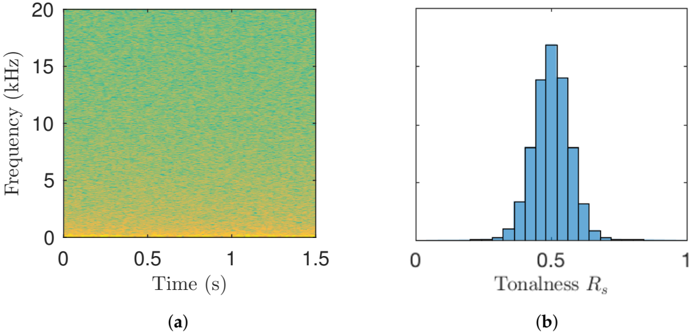
“It can be seen that the tonalness values are approximately normally distributed around the value 0.5.”
§ Audio Time Stretching Using Fuzzy Classification of Spectral Bins > 2. Fuzzy Classification of Bins in the Spectrogram
plain- Asserted: passes — The authors put it forward as true.
- Checkable: passes — It can be checked against evidence.
- Load-bearing: passes — The paper’s conclusions depend on it.
- Based: passes — The paper gives a reason why it holds.
A result the paper reports from its own data — it cites no other source for it, so there is none to check. The quote shows it is in the paper.
In the paper
“Experiments on noise signal analysis using the above median filtering method show that the tonalness value is often approximately R s = 0.5.”
§ Audio Time Stretching Using Fuzzy Classification of Spectral Bins > 2. Fuzzy Classification of Bins in the Spectrogram
hedged- Asserted: passes — The authors put it forward as true.
- Checkable: passes — It can be checked against evidence.
- Load-bearing: passes — The paper’s conclusions depend on it.
- Based: passes — The paper gives a reason why it holds.
A result the paper states — it cites no source for it, so there is none to check. The quote shows it is in the paper.
In the paper
“It performs less well on music containing only noisy and transient sounds, such as a drum solo.”
§ Audio Time Stretching Using Fuzzy Classification of Spectral Bins > Abstract
plainstates a cause- Asserted: passes — The authors put it forward as true.
- Checkable: passes — It can be checked against evidence.
- Load-bearing: passes — The paper’s conclusions depend on it.
- Based: passes — The paper gives a reason why it holds.
A result the paper reports from its own data — it cites no other source for it, so there is none to check. The quote shows it is in the paper.
In the paper
“According to this study, the proposed method performs well on music signals consisting of mixed tonal, noisy, and transient components, such as singing, techno music, and a jazz recording containing vocals.”
§ Audio Time Stretching Using Fuzzy Classification of Spectral Bins > Abstract
plain- Asserted: passes — The authors put it forward as true.
- Checkable: passes — It can be checked against evidence.
- Load-bearing: passes — The paper’s conclusions depend on it.
- Based: passes — The paper gives a reason why it holds.
A result the paper reports from its own data — it cites no other source for it, so there is none to check. The quote shows it is in the paper.
In the paper
“The sound quality of all tested methods is dependent on the audio signal type.”
§ Audio Time Stretching Using Fuzzy Classification of Spectral Bins > Abstract
plainstates an association- Asserted: passes — The authors put it forward as true.
- Checkable: passes — It can be checked against evidence.
- Load-bearing: unclear — It is unclear whether the paper’s conclusions depend on it.
- Based: passes — The paper gives a reason why it holds.
36 more claims
Create a free account to see all 62 claims and to verify the 27 references still open.
- It may state two separate claims as one. 13
- Probably not a substantial claim. 8
Claims other papers make about this one
Each is checked against this paper’s own text: does it say what the citing paper says it does?
In the citing paper
“Traditional TSM artifacts such as transient smearing, loss of presence, and phasiness are heavily accentuated and cause poor audio quality when the TSM factor is four or larger.”
From Extreme Audio Time Stretching Using Neural Synthesis (2023) · cites this paper as [9]
In the citing paper
“The weakness of established TSM methods, often based on a phase vocoder structure, lies in the poor description and scaling of the transient and noise components, or nuances, of a sound.”
From Extreme Audio Time Stretching Using Neural Synthesis (2023) · cites this paper as [9]
In the citing paper
“This task becomes especially challenging with large stretching factors, where conventional methods, such as the phase vocoder, often introduce perceptual artifacts, e.g., transient smearing, loss of presence, and phasiness [3], [4], [10].”
From Noise Morphing for Audio Time Stretching (2024) · cites this paper as [4]
In the citing paper
“Our test approach, a variation of the standard MUSHRA test [35], has been used earlier in TSM studies [4], [17], and employs a multiple-stimuli method with the original, unprocessed sound as the reference.”
From Noise Morphing for Audio Time Stretching (2024) · cites this paper as [4]
In the citing paper
“The noise component has been previously time stretched by randomizing the phase of each signal frame containing noise [4], [12]. However, this leads to an audible disturbance at large time-stretching factors [4].”
From Noise Morphing for Audio Time Stretching (2024) · cites this paper as [4]
2 more claims about this paper
Create a free account to see every claim other papers make about this one.
Citations
Cites
Pitch-synchronous waveform processing techniques for text-to-speech synthesis using diphones
Moulines, E., & Charpentier, F. (1990) · Speech Communication · doi:10.1016/0167-6393(90)90021-z · Cited by 1,244
MAKING COMPUTERS THINK LIKE PEOPLE
Zadeh, L. A. (1984) · IEEE Spectrum · Cited by 335
Making computers think like people [fuzzy set theory]
Zadeh, L. A. (1984) · IEEE Spectrum · doi:10.1109/mspec.1984.6370431 · Cited by 298
Non-parametric techniques for pitch-scale and time-scale modification of speech
Moulines, É., & Laroche, J. (1995) · Speech Communication · doi:10.1016/0167-6393(94)00054-e · Cited by 289
Improved phase vocoder time-scale modification of audio
Laroche, J., & Dolson, M. (1999) · IEEE Transactions on Speech and Audio Processing · doi:10.1109/89.759041 · Cited by 276
Verhelst, W., & Roelands, M. (1993) · IEEE International Conference on Acoustics Speech and Signal Processing · doi:10.1109/icassp.1993.319366 · Cited by 217
Dutilleux, P., Poli, G. D., & Zoelzer, U. (2011) · Wiley eBooks · doi:10.1002/9781119991298 · Cited by 204
Time-scale modification of speech based on short-time Fourier analysis
Portnoff, M. (1981) · IEEE Transactions on Acoustics, Speech, and Signal Processing · doi:10.1109/tassp.1981.1163581 · Cited by 126
Automatic Technique in Frequency Domain for Near-Lossless Time-Scale Modification of Audio
Bonada, J. (2000) · Cited by 77
A Review of Time-Scale Modification of Music Signals
Driedger, J., & Müller, M. (2016) · Applied Sciences · doi:10.3390/app6020057 · Cited by 71
Improving Time-Scale Modification of Music Signals Using Harmonic-Percussive Separation
Driedger, J., Muller, M., & Ewert, S. (2014) · IEEE Signal Processing Letters · doi:10.1109/lsp.2013.2294023 · Cited by 64
Web Audio Evaluation Tool: A Browser-Based Listening Test Environment
Jillings, N., Man, B. D., David, M., & Reiss, J. (2015) · Queen Mary Research Online (Queen Mary University of London) · doi:10.5281/zenodo.851156 · Cited by 61
Using audio time scale modification for video browsing
Amir, A., Ponceleon, D. B., Blanchard, B., Petković, D., Srinivasan, S., & Cohen, G. (2005) · Hawaii International Conference on System Sciences (HICSS) · doi:10.1109/hicss.2000.926728 · Cited by 54
Extending spectral modeling synthesis with transient modeling synthesis
Verma, T. S., & Meng, T. H. Y. (2000) · Computer Music Journal · doi:10.1162/014892600559317 · Cited by 35
A new approach to transient processing in the phase vocoder
Röebel, A. (2003) · HAL · Cited by 28
Variable time-scale modification of speech using transient information
Lee, S., Kim, H. D., & Kim, H. S. (2002) · IEEE International Conference on Acoustics Speech and Signal Processing · doi:10.1109/icassp.1997.596189 · Cited by 24
Adaptive Threshold Determination for Spectral Peak Classification
Zivanovic, M., Röebel, A., & Xavier Rodet, A. (2008) · Computer Music Journal · doi:10.1162/comj.2008.32.2.57 · Cited by 23
Verma, T. S., & Meng, T. H. Y. (2002) · Proceedings of the 1998 IEEE International Conference on Acoustics, Speech and Signal Processing, ICASSP '98 (Cat. No.98CH36181) · doi:10.1109/icassp.1998.679647 · Cited by 22
Speech-adaptive time-scale modification for computer assisted language-learning
Donnellan, O., Jung, E., & Coyle, E. (2004) · IEEE International Conference on Advanced Learning Technologies (ICALT) · doi:10.1109/icalt.2003.1215049 · Cited by 21
Hang the DJ Automatic sequencing and seamless mixing of dance-music tracks
Cliff, D., & Hewlett-Packard Laboratories, B. (. K. (2000) · Cited by 7
Spectral Envelope Transformation in Singing Voice for Advanced Pitch Shifting
Santacruz, J. L., Tardón, L. J., Barbancho, I., & Barbancho, A. M. (2016) · Applied Sciences · doi:10.3390/app6110368 · Cited by 6
On improving the intelligibility of synchronized over-lap-and-add (SOLA) at low TSM factor
Wong, P. H. W., Au, O. C., Wong, J. W. C., & Lau, W. H. B. (2002) · IEEE Region 10 Conference (TENCON) · doi:10.1109/tencon.1997.648251 · Cited by 4
(2008) · Arrow - TU Dublin (Technological University Dublin)
(1998)
(2009) · Publikationsdatenbank der Fraunhofer-Gesellschaft (Fraunhofer-Gesellschaft)
(2010) · Arrow@dit (Dublin Institute of Technology)
(2002) · Journal of the Audio Engineering Society
(2008)
(2007)
Self-citation(1997) · University of Michigan Library Repository
(2014)
Research works printed but not linked: 6
- Moinet, A., Dutoit, T., and Latour, P. (2013, January 2–5). Audio time-scaling for slow motion sports videos. Proceedings of the International Conference on Digital Audio Effects (DAFx), Maynooth, Ireland.
- Verma, T.S., and Meng, T.H. (1998, January 19–21). Time scale modification using a sines+transients+noise signal model. Proceedings of the Digital Audio Effects Workshop (DAFx), Barcelona, Spain.
- Roucos, S., and Wilgus, A. (1985, January 26–29). High quality time-scale modification for speech. Proceedings of the IEEE International Conference on Acoustics, Speech, and Signal Processing (ICASSP), Tampa, FL, USA.
- Röbel, A. (2010, January 6–10). A shape-invariant phase vocoder for speech transformation. Proceedings of the International Conference on Digital Audio Effects (DAFx), Graz, Austria.
- Del Amo, A., Montero, J., and Cutello, V. (1999, January 10–12). On the principles of fuzzy classification. Proceedings of the 18th International Conference of the North American Fuzzy Information Processing Society, New York, NY, USA.
- Kraft, S., Lerch, A., and Zölzer, U. (2013, January 2–5). The tonalness spectrum: Feature-based estimation of tonal components. Proceedings of the International Conference on Digital Audio Effects (DAFx), Maynooth, Ireland.
Cited by
Data augmentation on convolutional neural networks to classify mechanical noise
Abeysinghe, A. A. S. E., Tohmuang, S., Davy, J. L., & Fard, M. (2023) · Applied Acoustics · doi:10.1016/j.apacoust.2023.109209 · Cited by 35
BEHM-GAN: Bandwidth Extension of Historical Music Using Generative Adversarial Networks
Moliner, E., & Välimäki, V. (2022) · IEEE/ACM Transactions on Audio Speech and Language Processing · doi:10.1109/taslp.2022.3190726 · Cited by 32
Self-citationEnhanced Indonesian Ethnic Speaker Recognition using Data Augmentation Deep Neural Network
Nugroho, K., Noersasongko, E., Purwanto, P., Muljono, M., & Setiadi, D. R. I. M. (2021) · Journal of King Saud University - Computer and Information Sciences · doi:10.1016/j.jksuci.2021.04.002 · Cited by 28
Shahnawazuddin, S., Adiga, N., Sai, B. T., Ahmad, W., & Kathania, H. K. (2019) · Digital Signal Processing · doi:10.1016/j.dsp.2019.06.015 · Cited by 20
Significance of Pitch-Based Spectral Normalization for Children's Speech Recognition
Yadav, I. C., & Pradhan, G. (2019) · IEEE Signal Processing Letters · doi:10.1109/lsp.2019.2950763 · Cited by 19
Metadata
- Authors
- Damskägg, E.-P., & Välimäki, V.
- Affiliations
- Aalto University (FI)
- Corresponding author
- Damskägg, Eero-Pekka
- ORCID
- Välimäki, Vesa
- Venue
- Applied Sciences
- Publisher
- MDPI AG
- Published
- 2017-12-12
- Volume
- 7
- Issue
- 12
- Pages
- 1293
- ISSN
- 2076-3417 (ISSN-L)
- OpenAlex
- W2771971536
- Semantic Scholar
- b208760b17f0eb016f666494c0e1f3e7edc3545a
- Cited by
- 34
- References
- 35
- Citations by year
- 2026: 3 · 2025: 2 · 2024: 7 · 2023: 5 · 2022: 4 · 2021: 6 · 2020: 1 · 2019: 4 · 2018: 2
- FWCI
- 1.39
- Type
- journal article
- Language
- en
- Open access
- gold
- doi.org
- Licence
- Locations
- Applied Sciences (publishedVersion, cc-by)
- Aaltodoc (Aalto University) (submittedVersion, cc-by)
- DOAJ (DOAJ: Directory of Open Access Journals) (submittedVersion, cc-by-sa)
- Funders
- Aalto-Yliopisto
- Topics
- Physical Sciences › Computer Science › Signal Processing › Music and Audio Processing
- Physical Sciences › Computer Science › Signal Processing › Speech and Audio Processing
- Social Sciences › Arts and Humanities › Music › Music Technology and Sound Studies
- Keywords
- fuzzy classification, noisiness, transience, phase propagation, membership functions, sound quality, music signals, listening tests
About these checks
Registry, retraction, Cites and statistics results are computed, not judged, with one exception: a printed reference that no index lists is read once by a model before it counts as a citation error. Claims are extracted by a model and kept only when their quote appears verbatim in the text; each cited source is then checked, with a model’s help, for whether it says what the claim relies on. Those verdicts can be wrong — read the claim’s quote and the cited source before relying on one.
A language model drew the claims from the paper on 2026-11-14, under version 3 of the claim definition (model deepseek-v4.1-flash, prompt extract-v3).
A second model labelled each claim on 2026-11-14 (model jev-1.13-20260917, definition revision gold-guideline-v0.2).
Statistics and arithmetic are recomputed, not judged.
Confidence bands are shown only for fields calibrated on our annotated test set. None is calibrated yet, so no band is shown.
What counts as a claim ›How we measure confidence ›How we check this ›
Are you an author, or do you see a problem with this page? Request a review
Data sources
Bibliographic data: Semantic Scholar, OpenAlex, Crossref.
Contains information from the Semantic Scholar Academic Graph Datasets, made available under the ODC Attribution License (ODC-BY 1.0).
Semantic Scholar’s data is described in: Kinney, R., et al. (2023). The Semantic Scholar Open Data Platform. arXiv:2301.10140.
