

A Novel Method for Estimating the State of Health of Lithium-Ion Batteries Based on Physics-Informed Neural Network
Open accessThe DOI matches its Crossref record; 28 of the 28 references it cites were found in a registry or an index.
Abstract
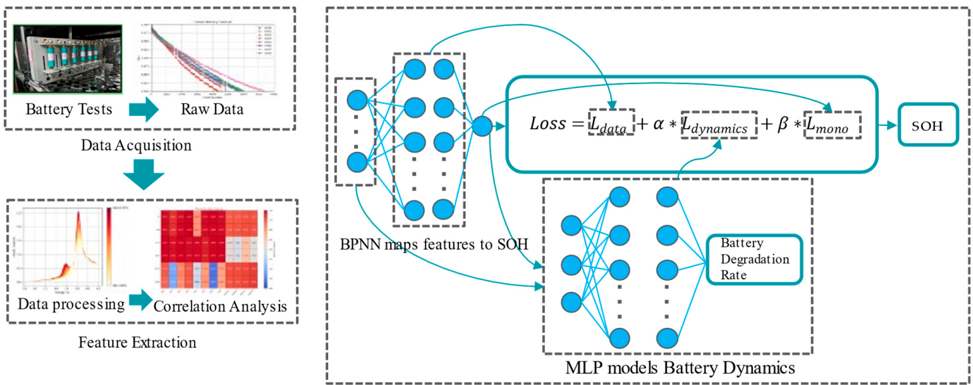
An accurate state of health (SOH) assessment of lithium-ion batteries is essential for ensuring the reliability and safety of electric vehicles (EVs). Data-driven SOH estimation methods have shown promise but face challenges in generalizing across diverse battery types and variable operating conditions. To address this, this study integrates physical information into data-driven approaches, enabling physically consistent inferences and a rapid adaptation to different battery chemistries and usage scenarios. Specifically, physical features correlated with battery degradation, such as the link between incremental capacity (IC) peaks and SOH, are used as constraints to guide model learning. A fully connected layer within a back-propagation neural network (BPNN) is employed to capture battery aging dynamics effectively. Experimental results on two datasets show that the proposed model outperforms traditional neural networks, reducing the RMSE by at least 1.1% and demonstrating strong generalizability in both single-dataset and transfer learning tasks.
Overview
The claims and statistics of this paper haven’t been checked yet.
Free: it reads the open-access text and checks the first 5 claims that cite a source we can check. Create a free account to check every claim.
Integrity signals
Registry
Cites
Statistics
Figures
Verification
Claims the paper makes
The claims and statistics of this paper haven’t been checked yet.
Free: it reads the open-access text and checks the first 5 claims that cite a source we can check. Create a free account to check every claim.
Claims other papers make about this one
Each is checked against this paper’s own text: does it say what the citing paper says it does?
The source backs part of the claim, not all of it — or backs it for a different population, condition or comparison.
In the citing paper
“This hybridization enhances physical plausibility and supports robust extrapolation to unseen operating scenarios.38”
From State of mission: Battery management with neural networks and electrochemical AI (2025) · cites this paper as [38]
Experimental — accuracy not yet measuredThe cited source says what the claim attributes to it.
In the citing paper
“Te SOH estimation error was reduced to less than 1% when compared with the actual values found in aging testing.”
Self-check
Percentages, sums and reported differences re-computed from the paper’s own numbers.
The self-check needs the paper’s full text.
Citations
Cites
Physics-informed neural network for lithium-ion battery degradation stable modeling and prognosis
Wang, F., Zhai, Z., Zhao, Z., Di, Y., & Chen, X. (2024) · Nature Communications · doi:10.1038/s41467-024-48779-z · Cited by 897 · cited 1×
“For example, Wang et al. [20] extracted health factors solely from charging curves and utilized PINNs to model battery degradation attributes from the perspectives of empirical degradation and state-space equations.”
Current Li-Ion Battery Technologies in Electric Vehicles and Opportunities for Advancements
Miao, Y., Hynan, P., von Jouanne, A., & Yokochi, A. (2019) · Energies · doi:10.3390/en12061074 · Cited by 874 · cited 1×
“With the rapid development of the electric vehicle (EV) industry, lithium-ion (Li-ion) batteries have become the primary energy source for EVs due to their high energy density, long lifespan, and efficient charging/discharging performance [1].”
Gao, Y., Liu, K., Zhu, C., Zhang, X., & Zhang, D. (2022) · IEEE Transactions on Industrial Electronics · doi:10.1109/tie.2021.3066946 · Cited by 418 · cited 1×
“For example, Gao et al. [9] used the Padé approximation to simplify the rigorous P2D electrochemical model and assess battery aging based on three key aging factors, lithium-ion loss, the loss of active material, and increased resistance, ultimately achieving better accuracy.”
Li, H., Zhang, Z., Li, T., & Si, X. (2024) · Mechanical Systems and Signal Processing · doi:10.1016/j.ymssp.2024.111120 · Cited by 374 · cited 1×
“To solve the above-mentioned problems, physics-informed neural networks (PINNs) integrate physical principles with data-driven approaches [18].”
Weng, C., Feng, X., Sun, J., & Peng, H. (2016) · Applied Energy · doi:10.1016/j.apenergy.2016.07.126 · Cited by 324 · cited 2×
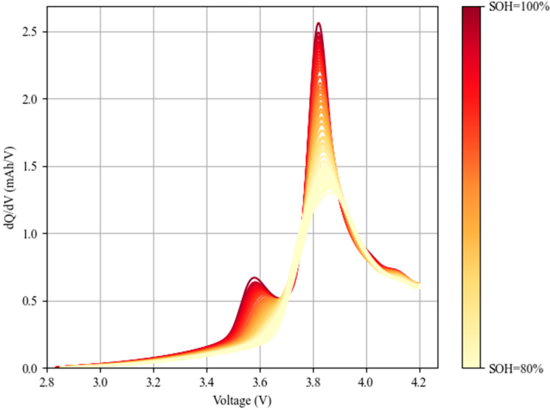
“…charging and discharging phases of LIBs, and the information such as the height and position of the wave peaks can present certain information [26,27]. mechanism of LiB, which can transform the plateau curve of voltage into the informative IC curve; the wave peaks in the IC curves represent…”
Ren, Z., & Du, C. (2023) · Energy Reports · doi:10.1016/j.egyr.2023.01.108 · Cited by 277 · cited 1×
“Model-based methods develop high-fidelity models, either from mathematical or physical perspectives, to assess the battery performance and lifespan [7].”
Self-citationXu, Z., Wang, J., Lund, P. D., & Zhang, Y. (2022) · Energy · doi:10.1016/j.energy.2021.122815 · Cited by 252 · cited 1×
“For instance, Xu et al. [10] employed an equivalent circuit model to represent the battery, applied the recursive least squares method for online parameter identification, and then used an unscented Kalman filter to estimate the battery state.”
Physics-Informed Neural Networks for Prognostics and Health Management of Lithium-Ion Batteries
Wen, P., Ye, Z.-S., Li, Y., Chen, S., Xie, P., & Zhao, S. (2024) · IEEE Transactions on Intelligent Vehicles · doi:10.1109/tiv.2023.3315548 · Cited by 205 · cited 1×
“• While there are multiple approaches to integrating neural networks with physical information [23], selecting the most suitable method based on HF selection strategies, battery materials, operating conditions, and the desired accuracy of results remains an open problem.”
Rahman, T., & Alharbi, T. (2024) · Batteries · doi:10.3390/batteries10070220 · Cited by 200 · cited 1×
“However, as the usage and number of Li-ion batteries continue to rise, their performance inevitably degrades during prolonged cycling and storage, particularly under the complex and dynamic operational environments of EVs [2].”
He, Y. S., Bai, W., Wang, L., Wu, H., & Ding, M. (2024) · Journal of Energy Storage · doi:10.1016/j.est.2024.110678 · Cited by 179 · cited 2×
“He et al. [15] introduced an SOH estimation method based on Gaussian process regression (GPR).”
Research works printed but not linked: 2
- 24. Christoph, R.B. Diagnosis and Prognosis of Degradation in Lithium-Ion Batteries; Department of Engineering Science University of Oxford: Oxford, UK, 2017.
- 25. Birkl, C. Project-Physics-Informed Neural Network for Lithium-Ion Battery Degradation Stable Modeling and Prognosis. Ph.D. Thesis, University of Oxford, Oxford, UK, 2017.
Cited by
Hong, S., Kim, H., Kim, J., & Baek, J. (2026) · Journal of Energy Storage · doi:10.1016/j.est.2026.120671 · Cited by 20
State estimation and remaining useful life prediction for lithium-ion batteries
Ekberg, J., Sridharan, N. V., Karim, R., & Atta, K. T. (2025) · Cell Reports Physical Science · doi:10.1016/j.xcrp.2025.102854 · Cited by 24
Li, X., Li, X., Dong, Y., Hang, H., Tian, Y., & Tian, J. (2025) · Energy · doi:10.1016/j.energy.2025.139376 · Cited by 24
Ding, T., von Jouanne, A., Dong, L. F., Fang, X., Fang, T., Rivas, P., & Yokochi, A. (2026) · Energies · doi:10.3390/en19020562 · Cited by 15
“PINNs address this trade-off by embedding governing equations— e.g., diffusion (Fick’s law) and charge-/mass-conservation from the P2D framework, along with degradation sub-models such as solid-electrolyte interphase (SEI) growth—into the learning objective [88,89].”
Ma, J., Xu, M. L., Du, W., Zhongzhi, Q., Jiahui, Z., Xiang, B., Peng-Fei, Q., & Wang, L. (2025) · Ionics · doi:10.1007/s11581-025-06805-0 · Cited by 9
Kumar, D., Nasimov, R., Singh, A., Jha, A., Jha, A., & Rizwan, M. (2025) · Applied Computational Intelligence and Soft Computing · doi:10.1155/acis/5516151 · Cited by 8
“To apply the SOH estimation, the study [45] combined the relationships between voltage and current and applied neural networks and incremental capacity (IC) analysis.”
State of mission: Battery management with neural networks and electrochemical AI
Ozkan, C. S., & Ozkan, M. (2025) · iScience · doi:10.1016/j.isci.2025.113593 · Cited by 7
“38 To further improve the ability to model temporal battery behavior, particularly when processing time-series data such as current, voltage, and temperature histories, advanced sequential architectures can be integrated with Neural ODEs.”
Kumar, P. N., Upadhya, P. R., Nischay, S., Kumar, G. P., Shobana, T. S., & Rashmi, K. B. (2026) · Scientific Reports · doi:10.1038/s41598-026-37850-y · Cited by 9
“This prevents the output from violating the actual physical behavior of the battery 6 .”
Bustos, J. E. G., Schiele, B. B., Baldo, L., Masserano, B., Jaramillo, F., Troncoso-Kurtovic, D., Orchard, M. E., Perez, A., & Silva, J. F. (2025) · Batteries · doi:10.3390/batteries11120451 · Cited by 7
“…regard, it is worth noting that, consistent with broader trends in Prognostics and Health Management (PHM), hybrid methodologies that combine data-driven and model-based approaches are emerging as a promising direction for SoH estimation, as emphasized by Zhang et al. [21] and Deng et al. [28].”
Rehman, F. U., Buccella, C., & Cecati, C. (2025) · Energies · doi:10.3390/en18205533 · Cited by 4
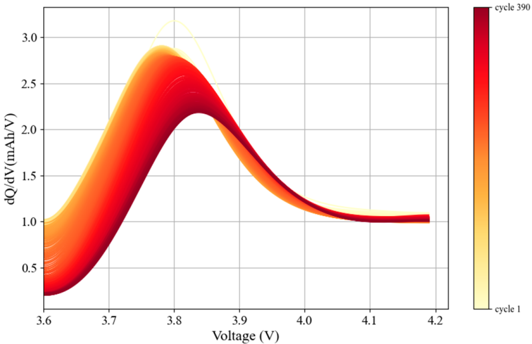
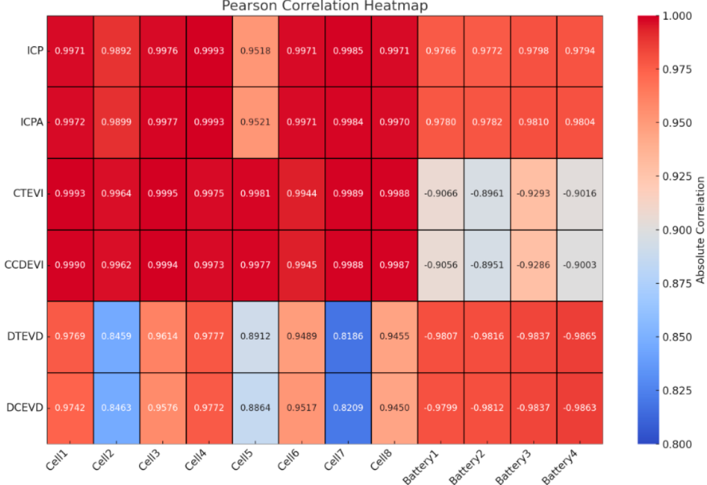
“Figure 9 presents the Pearson correlation matrix with SoH [45].”
Li, Y., Poudel, S., Sweta, K., Azqadan, E., Kunwar, A., & Moelans, N. (2026) · Energy storage materials · doi:10.1016/j.ensm.2026.105000 · Cited by 3
Hussain, A., & Hussain, T. (2026) · Discover Electronics · doi:10.1007/s44291-025-00152-0 · Cited by 2
“…for PHM and SOH/RUL estimation that incorporate battery dynamics directly into the loss function [52, 56, 58], small-sample SOH estimation where physical constraints mitigate overfitting [9, 12], and generic PINN formulations adaptable to different degradation scenarios and data modalities [48].”
Gan, C., Gui, R., Lv, X., Dong, Z., & Gao, M. (2025) · IEEE Transactions on Transportation Electrification · doi:10.1109/tte.2025.3645831 · Cited by 3
“Deng et al. [28] proposed a lightweight physics-informed method based on incremental capacity features and monotonic degradation constraints.”
A Model for State-of-Health, Swelling and Out-of-Plane Stress Evolution in Lithium-Ion Batteries
Mantelos, M., Gudmundson, P., & Kulachenko, A. (2026) · Batteries · doi:10.3390/batteries12030081 · Cited by 1
Physics-informed neural networks combined with SVR for battery health and charge state diagnostics
Sireesha, K., Deepa, K., Prabhakar, J. R., Mikkilineni, K. K., & Kolhe, M. L. (2026) · Discover Applied Sciences · doi:10.1007/s42452-026-08567-4 · Cited by 3
Obe, C. T., Ujah, C. O., Oti, S., & Nwulu, N. I. (2026) · Journal of Power Sources · doi:10.1016/j.jpowsour.2026.241071 · Cited by 1
Braun, C., Raible, J., & Huber, M. F. (2026) · Journal of Intelligent Manufacturing · doi:10.1007/s10845-026-02930-3 · Cited by 2
Choi, Y., Jang, P., & Yun, J.-J. (2026) · International Journal of Energy Research · doi:10.1155/er/5535455
Kumar, S. S., Kumar, D. M. V., & Deshmukh, R. (2025) · IEEE International Conference on Green Industrial Electronics and Sustainable Technologies (GIEST) · doi:10.1109/giest66547.2025.11387376
“Moreover they require huge computation, and struggle with model adaptability across different battery types and operating conditions [16], [17], [18].”
Popović, N. (2025) · IJEEC - INTERNATIONAL JOURNAL OF ELECTRICAL ENGINEERING AND COMPUTING · doi:10.7251/ijeec2502089p
Physics-Informed Transfer Learning for Cross-Scale SOC/SOE Co-Estimation in Battery Energy StoragePreprint
Wang, D., Li, Y., Liu, R., Ma, L., Wang, Z. F., & Hu, C. (2026) · SSRN Electronic Journal · doi:10.2139/ssrn.6793812
Isa, A. A. H., Sulthan, S. M., Dani, M. N., & Jiann, T. S. (2026) · IEEE Access · doi:10.1109/access.2026.3695274
“This leads to increased robustness against changes that are not explicitly represented in the limited training data [51], [52].”
Survey of energy management systems in hybrid electric vehicles
Boopathi, T., & Raglend, I. J. (2026) · Discover Sustainability · doi:10.1007/s43621-026-03469-2
Shelkes, R. D., Agarwal, A. K., Gautam, J., Garg, R., Katake, S. P., & Thakur, S. (2026) · International Conference on AI, Data Science, Cyber Security and Smart Manufacturing for Sustainable Development (ICADCS) · doi:10.1109/icadcs70036.2026.11583249
“Conventional battery management systems (BMS) are based on empirical models that do not reflect the multi-physics interactions in fast charging [2].”
ZHANG, R., Ruiqi, Y. E., Chongbin, G. U. O., Yang, D. U., Su, B., & Yifu, C. A. O. (2026) · Chinese Journal of Aeronautics · doi:10.1016/j.cja.2026.104368
Mustafa, R., Sander, M., Sturm, A. W., & Henze, R. (2026) · Energy Conversion and Management X · doi:10.1016/j.ecmx.2026.102156 · Cited by 1
Monotonic Physics-Consistent Regularization for Battery State of Health Estimation
Zhang, X., Wang, J., & Gao, Q. (2026) · IEEE China Conference on System Simulation Technology and its Applications (CCSSTA) · doi:10.1109/ccssta69471.2026.11635512
“The experimental results show that the proposed method improves physical consistency while maintaining or enhancing prediction accuracy [10].”
GhoshThakur, R., Pughat, A., & GonChaudhuri, S. (2026) · SSRN Electronic Journal · doi:10.2139/ssrn.7291013
Cross-Battery-Type SOH Prediction via a Degradation-Trend-Constrained Physics-Informed LSTM
Sun, Y., Shi, Y., & Zhong, P. (2026) · International Conference on Power System and Energy Technology (ICPSET) · doi:10.1109/icpset70907.2026.11689618
Naveeda, K., Perarasi, M., Karthick, T., Nageswari, D., Karthikeyan, C., & Whitin, P. (2026) · International Conference Computational Vision and Bio Inspired Computing · doi:10.1109/iccvbic71195.2026.11688521
AbdelMoety, A., Ali, A. M., & Nour, M. (2026) · Next Energy · doi:10.1016/j.nxener.2026.101037
A physics-guided transformer for robust state of health estimation in real-world electric vehicles
Guo, L., Li, Y., & Zhang, W. (2026) · Journal of Energy Storage · doi:10.1016/j.est.2026.124747
Çoban, H., Erhan, K., & Baysal, M. (2026) · International Journal of Automotive Science And Technology · doi:10.30939/ijastech..1995891
AI-driven lithium-ion battery health prediction: a review of SOC, SOH and RUL estimation techniques
Tamizharasi, G., & Rajini, G. K. R. (2026) · Frontiers in Artificial Intelligence · doi:10.3389/frai.2026.1858302
“The PINN architecture ensures physically consistent learning and enhances robustness under various battery operating situations by incorporating such physical knowledge into the optimization process (Deng et al., 2025).”
Philip, V., Dhumale, R. B., Patil, N. V., & Satdeve, M. M. (2026) · International Conference on Information, Implementation, and Innovation in Technology (I2ITCON) · doi:10.1109/i2itcon69735.2026.11747436
“%) and accuracy of 95–99% and the advanced hybrid and physics-informed techniques in [3] and lightweight explainable ML techniques in [4] are also effective in improving the robustness, explainability, computational efficiency, and deployment of BMS in real time by achieving low MSE, high accuracy,…”
Manoharan, A., Rehman, F. U., Utku, A. E., Aslakci, M. E., Qian, K., Paasch, K. M., Ebel, T., & Andersen, H. H. (2026) · Batteries · doi:10.3390/batteries12110475
Metadata
- Authors
- Deng, Y., Du, C., & Ren, Z.
- Affiliations
- Wuhan University of Technology (CN)
- Xihua University (CN)
- Corresponding author
- Du, Changqing
- Venue
- Batteries
- Publisher
- MDPI AG
- Published
- 2025-01-26
- Volume
- 11
- Issue
- 2
- Pages
- 49
- ISSN
- 2313-0105 (ISSN-L)
- OpenAlex
- W4406866547
- Cited by
- 32
- References
- 28
- Citations by year
- 2026: 23 · 2025: 9
- FWCI
- 7.79
- Type
- journal article
- Language
- en
- Open access
- gold
- doi.org
- Licence
- Locations
- Batteries (publishedVersion, cc-by)
- DOAJ (DOAJ: Directory of Open Access Journals) (submittedVersion, cc-by-sa)
- Funders
- Key R&D project of Guangxi Province, China (AA23062058, XHRD2024-11233100-01)
- Foshan Xianhu Laboratory of the Advanced Energy Science and Technology Guangdong Laboratory (AA23062058, XHRD2024-11233100-01)
- Topics
- Physical Sciences › Engineering › Automotive Engineering › Battery Modeling and Management
- Physical Sciences › Engineering › Electrical and Electronic Engineering › Advancements in Battery Materials
- Physical Sciences › Engineering › Automotive Engineering › Electric and Hybrid Vehicle Technologies
- Keywords
- lithium-ion batteries, state of health estimation, physics-informed neural networks, battery degradation, transfer learning, electric vehicles, data-driven battery modeling
About these checks
Registry, retraction, Cites and statistics results are computed, not judged, with one exception: a printed reference that no index lists is read once by a model before it counts as a citation error. Claims are extracted by a model and kept only when their quote appears verbatim in the text; each cited source is then checked, with a model’s help, for whether it says what the claim relies on. Those verdicts can be wrong — read the claim’s quote and the cited source before relying on one.
Statistics and arithmetic are recomputed, not judged.
Confidence bands are shown only for fields calibrated on our annotated test set. None is calibrated yet, so no band is shown.
What counts as a claim ›How we measure confidence ›How we check this ›
Are you an author, or do you see a problem with this page? Request a review
Data sources
Bibliographic data: Semantic Scholar, OpenAlex, Crossref.
Contains information from the Semantic Scholar Academic Graph Datasets, made available under the ODC Attribution License (ODC-BY 1.0).
Semantic Scholar’s data is described in: Kinney, R., et al. (2023). The Semantic Scholar Open Data Platform. arXiv:2301.10140.
