

Metabolic, Cardiac, and Hemorheological Responses to Submaximal Exercise under Light and Moderate Hypobaric Hypoxia in Healthy Men
Open accessThe DOI matches its Crossref record; 40 of the 41 references it cites were found in a registry or an index.
Abstract
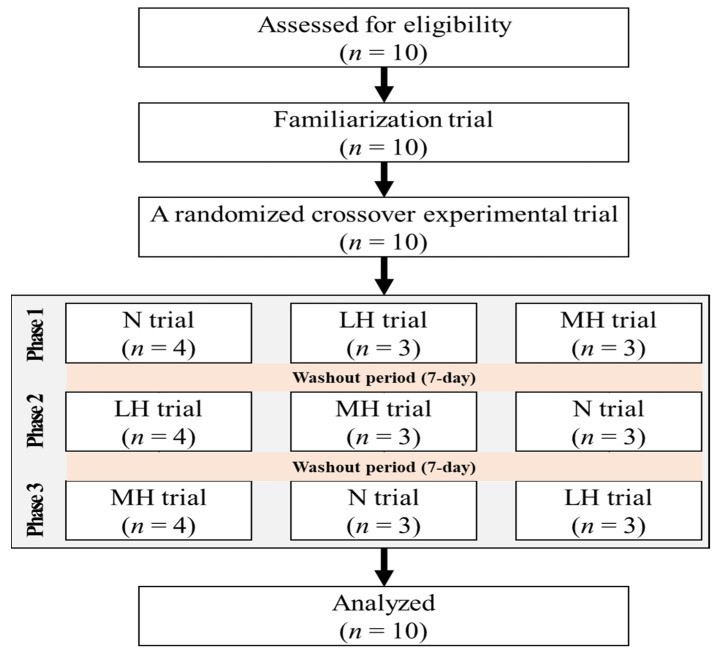
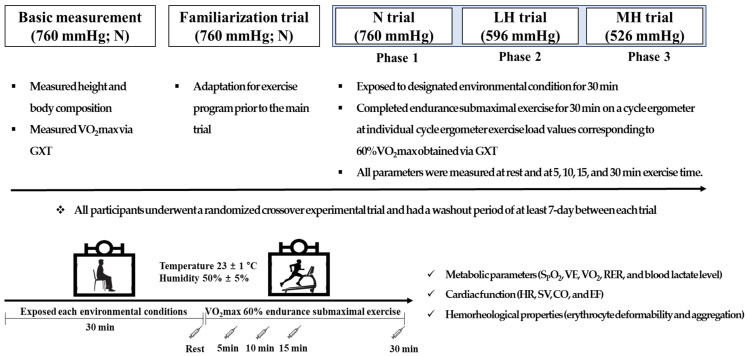
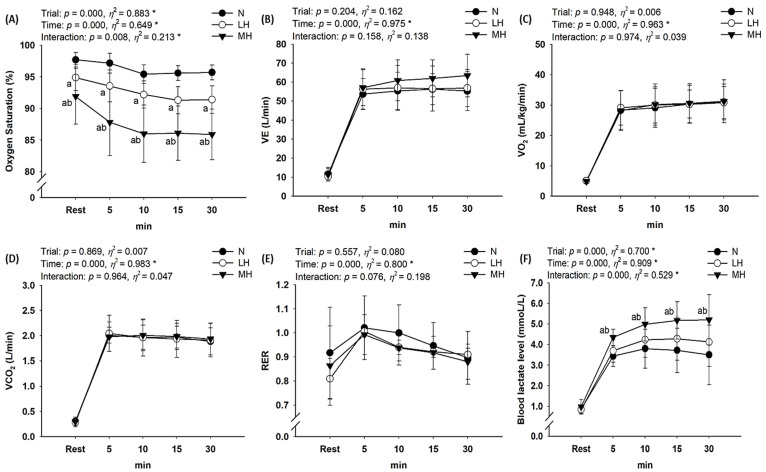
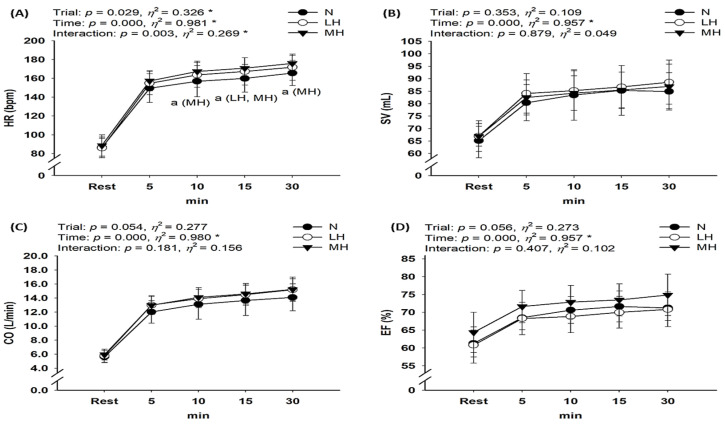
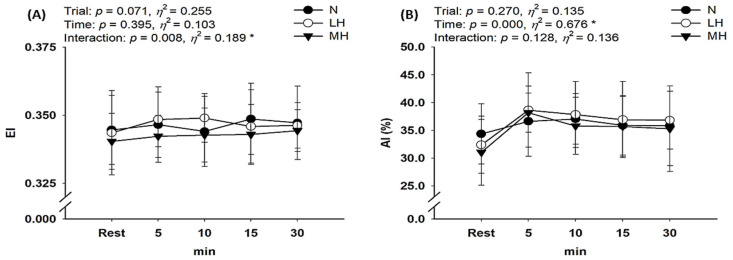
We compared the effects of metabolic, cardiac, and hemorheological responses to submaximal exercise under light hypoxia (LH) and moderate hypoxia (MH) versus normoxia (N). Ten healthy men (aged 21.3 ± 1.0 years) completed 30 min submaximal exercise corresponding to 60% maximal oxygen uptake at normoxia on a cycle ergometer under normoxia (760 mmHg), light hypoxia (596 mmHg, simulated 2000 m altitude), and moderate hypoxia (526 mmHg, simulated 3000 m altitude) after a 30 min exposure in the respective environments on different days, in a random order. Metabolic parameters (oxygen saturation (SPO2), minute ventilation, oxygen uptake, carbon dioxide excretion, respiratory exchange ratio, and blood lactate), cardiac function (heart rate (HR), stroke volume, cardiac output, and ejection fraction), and hemorheological properties (erythrocyte deformability and aggregation) were measured at rest and 5, 10, 15, and 30 min after exercise. SPO2 significantly reduced as hypoxia became more severe (MH > LH > N), and blood lactate was significantly higher in the MH than in the LH and N groups. HR significantly increased in the MH and LH groups compared to the N group. There was no significant difference in hemorheological properties, including erythrocyte deformability and aggregation. Thus, submaximal exercise under light/moderate hypoxia induced greater metabolic and cardiac responses but did not affect hemorheological properties.
Overview
The claims and statistics of this paper haven’t been checked yet.
Free: it reads the open-access text and checks the first 5 claims that cite a source we can check. Create a free account to check every claim.
Integrity signals
Registry
Cites
Statistics
Figures
Verification
Claims the paper makes
The claims and statistics of this paper haven’t been checked yet.
Free: it reads the open-access text and checks the first 5 claims that cite a source we can check. Create a free account to check every claim.
Claims other papers make about this one
Each is checked against this paper’s own text: does it say what the citing paper says it does?
The cited source says what the claim attributes to it.
In the citing paper
“Furthermore, at a corresponding workload bLa may be higher in moderate hypoxia, reflecting an increased reliance on anaerobic glycolysis to meet energy demands in the face of limited oxygen availability during submaximal intensity.”
From Transferability of Exercise Intensity Based on Muscle Oxygenation from Normoxia to Hypoxia in Ski-Mountaineering Athletes—Exploratory Study (2024) · cites this paper as [13]
Self-check
Percentages, sums and reported differences re-computed from the paper’s own numbers.
The self-check needs the paper’s full text.
Citations
Cites
The Science and Translation of Lactate Shuttle Theory
Brooks, G. A. (2018) · Cell Metabolism · doi:10.1016/j.cmet.2018.03.008 · Cited by 1,486 · cited 1×
“Acute exposure to hypoxia results in sympathetic activation that raises blood epinephrine [31,32] and consequently lactate turnover in resting men and those engaged in submaximal exercises at given exercise power outputs [32,33].”
BackgroundNew guidelines for hemorheological laboratory techniques
Baskurt, O. K., Boynard, M., Cokelet, G. C., Connes, P., Cooke, B. M., Forconi, S., Liao, F., Hardeman, M. R., Jung, F., Meiselman, H. J., et al. (2009) · Clinical Hemorheology and Microcirculation · doi:10.3233/ch-2009-1202 · Cited by 514
Wehrlin, J. P., & Hallén, J. (2006) · European Journal of Applied Physiology · doi:10.1007/s00421-005-0081-9 · Cited by 284
Determinants of maximal oxygen uptake in severe acute hypoxia
Calbet, J. A. L., Boushel, R., Rådegran, G., Søndergaard, H., Wagner, P. D., & Saltin, B. (2003) · American Journal of Physiology-Regulatory, Integrative and Comparative Physiology · doi:10.1152/ajpregu.00155.2002 · Cited by 253
Faiss, R., Girard, O., & Millet, G. P. (2013) · British Journal of Sports Medicine · doi:10.1136/bjsports-2013-092741 · Cited by 225
Hypoxic Conditioning as a New Therapeutic Modality
Vergès, S., Chacaroun, S., Godin‐Ribuot, D., & Baillieul, S. (2015) · Frontiers in Pediatrics · doi:10.3389/fped.2015.00058 · Cited by 209
Effects of Repeated-Sprint Training in Hypoxia on Sea-Level Performance: A Meta-Analysis
Brocherie, F., Girard, O., Faiss, R., & Millet, G. P. (2017) · Sports Medicine · doi:10.1007/s40279-017-0685-3 · Cited by 204
Physiological Responses to Exercise at Altitude: An Update
Mazzeo, R. S. (2008) · Sports Medicine · doi:10.2165/00007256-200838010-00001 · Cited by 187
Intermittent Hypoxia: Cause of or Therapy for Systemic Hypertension?
Serebrovskaya, T. V., Manukhina, E. B., Smith, M. L., Downey, H. F., & Mallet, R. T. (2008) · Experimental Biology and Medicine · doi:10.3181/0710-mr-267 · Cited by 168
Therapeutic Use of Exercising in Hypoxia: Promises and Limitations
Millet, G. P., Debevec, T., Brocherie, F., Malatesta, D., & Girard, O. (2016) · Frontiers in Physiology · doi:10.3389/fphys.2016.00224 · Cited by 161
Hypoxic training methods for improving endurance exercise performance
Sinex, J. A., & Chapman, R. F. (2015) · Journal of sport and health science/Journal of Sport and Health Science · doi:10.1016/j.jshs.2015.07.005 · Cited by 154
Messina, E. J., Sun, D., Koller, A., Wolin, M. S., & Kaley, G. (1992) · Circulation Research · doi:10.1161/01.res.71.4.790 · Cited by 144
Yalçın, Ö., Erman, A., Muratlı, S., Bor-Küçükatay, M., & Baskurt, O. K. (2003) · Journal of Applied Physiology · doi:10.1152/japplphysiol.00368.2002 · Cited by 114
Mazzeo, R. S., Brooks, G. A., Butterfield, G. E., Podolin, D. A., Wolfel, E. E., & Reeves, J. Τ. (1995) · American Journal of Physiology-Regulatory, Integrative and Comparative Physiology · doi:10.1152/ajpregu.1995.269.1.r201 · Cited by 92
Feriche, B., García-Ramos, A., Morales-Artacho, A. J., & Padial, P. (2017) · Sports Medicine - Open · doi:10.1186/s40798-017-0078-z · Cited by 83
Respiratory and cardiovascular adaptations to progressive hypoxia
Bernardi, L. (2001) · European Heart Journal · doi:10.1053/euhj.2000.2466 · Cited by 81
Adenosine contributes to hypoxia-induced forearm vasodilation in humans
Leuenberger, U. A., Gray, K., & Herr, M. D. (1999) · Journal of Applied Physiology · doi:10.1152/jappl.1999.87.6.2218 · Cited by 78
Czuba, M., Wilk, R., Karpiński, J., Chalimoniuk, M., Zając, A., & Langfort, J. (2017) · PLoS ONE · doi:10.1371/journal.pone.0180380 · Cited by 72
Poor relationship between arterial [lactate] and leg net release during exercise at 4,300 m altitude
Brooks, G. A., Wolfel, E. E., Butterfield, G. E., Cymerman, A., Roberts, A. C., Mazzeo, R. S., & Reeves, J. T. (1998) · American Journal of Physiology-Regulatory, Integrative and Comparative Physiology · doi:10.1152/ajpregu.1998.275.4.r1192 · Cited by 65
Girard, O., Malatesta, D., & Millet, G. P. (2017) · Frontiers in Physiology · doi:10.3389/fphys.2017.00073 · Cited by 61
Hill, N. E., Stacey, M., & Woods, D. R. (2011) · Journal of the Royal Army Medical Corps · doi:10.1136/jramc-157-01-08 · Cited by 52
Hypoxic Exercise Training to Improve Exercise Capacity in Obese Individuals
Chacaroun, S., Borowik, A., GONZALEZ, I. V.-E. Y., Doutreleau, S., Wuyam, B., Belaïdi, E., Tamisier, R., Pépin, J., Flore, P., & Vergès, S. (2020) · Medicine & Science in Sports & Exercise · doi:10.1249/mss.0000000000002322 · Cited by 52
Relationships between hemodynamic, hemorheological and metabolic responses during exercise
Connes, P., Tripette, J., Mukisi-Mukaza, M., Baskurt, O. K., Tóth, K., Meiselman, H. J., Hüe, O., & Antoine‐Jonville, S. (2009) · Biorheology · doi:10.3233/bir-2009-0529 · Cited by 51
Changes in acid–base and ion balance during exercise in normoxia and normobaric hypoxia
Lühker, O., Berger, M. M., Pohlmann, A., Hotz, L., Gruhlke, T., & Hochreiter, M. (2017) · European Journal of Applied Physiology · doi:10.1007/s00421-017-3712-z · Cited by 50
Fitness and therapeutic potential of intermittent hypoxia training: a matter of dose
Serebrovskaya, T. V., Serebrovska, Z. O., & Egorov, E. (2016) · Fìzìologìčnij žurnal · doi:10.15407/fz62.03.078 · Cited by 42
Ofner, M., Wonisch, M., Frei, M., Tschakert, G., Domej, W., Kröpfl, J. M., & Hofmann, P. (2014) · Europe PMC (PubMed Central) · Cited by 41
Hypoxic Pilates Intervention for Obesity: A Randomized Controlled Trial
Jung, K., Kim, J., Park, H., Jung, W., & Lim, K. (2020) · International Journal of Environmental Research and Public Health · doi:10.3390/ijerph17197186 · Cited by 40
Self-citationCengiz, M., Ülker, P., Meiselman, H. J., & Baskurt, O. K. (2009) · Clinical Chemistry and Laboratory Medicine (CCLM) · doi:10.1515/cclm.2009.157 · Cited by 33
Grau, M., Lauten, A., Hoeppener, S., Goebel, B., Brenig, J., Jung, C., Bloch, W., & Suhr, F. (2016) · Clinical Hemorheology and Microcirculation · doi:10.3233/ch-162044 · Cited by 32
Kasperowski, D. (2009) · The International Journal of the History of Sport · doi:10.1080/09523360902941878 · Cited by 30
The microrheological behavior of young and old red blood cells in athletes.
Muravyov, A. V., Draygin, S. V., Eremin, N. N., & Muravyov, A. A. (2002) · PubMed · Cited by 28
Jung, K., Seo, J., Jung, W., Kim, J., Park, H., & Lim, K. (2020) · International Journal of Environmental Research and Public Health · doi:10.3390/ijerph17072584 · Cited by 28
Self-citationMoon, H.-W., Shin, S., Lee, C.-H., Park, H., Sunoo, S., & Nam, S.-S. (2016) · Clinical Hemorheology and Microcirculation · doi:10.3233/ch-16163 · Cited by 27
Self-citationMaximal exercise and lactate do not change red blood cell aggregation in well trained athletes.
Connes, P., Caillaud, C., Py, G., Mercier, J. G., Hüe, O., & Brun, J. ‐. (2007) · PubMed · Cited by 26
Moon, H.-W., Sunoo, S., Park, H., Lee, D.-J., & Nam, S.-S. (2016) · SpringerPlus · doi:10.1186/s40064-016-2952-4 · Cited by 20
Self-citationSumi, D., Kojima, C., Kasai, N., & Goto, K. (2018) · Sports Medicine - Open · doi:10.1186/s40798-018-0160-1 · Cited by 19
Effects of endurance exercise under hypoxia on acid-base and ion balance in healthy males
Nam, S.-S., & Park, H. (2020) · Physical Activity and Nutrition · doi:10.20463/pan.2020.0015 · Cited by 16
Self-citationBor-Küçükatay, M., Çolak, R., Erken, G., Kılıç-Toprak, E., & Küçükatay, V. (2014) · Clinical Hemorheology and Microcirculation · doi:10.3233/ch-131711 · Cited by 15
Sumi, D., Kasai, N., Ito, H., & Goto, K. (2019) · Frontiers in Physiology · doi:10.3389/fphys.2019.00504 · Cited by 13
Hypoxic Exercise Training Elevates Erythrocyte Aggregation
Lin, C.-L., Wang, J., Fu, T., Hsu, C., & Huang, Y.-C. (2021) · Applied Sciences · doi:10.3390/app11136038 · Cited by 10
Cited by
Hemorheological Alterations and Physical Activity
Ivanov, I. (2022) · Applied Sciences · doi:10.3390/app122010374 · Cited by 29
Park, H., Jung, W., Kim, S.-W., Seo, J., Sun, Y., Choi, J.-H., Kim, J., & Lim, K. (2022) · Metabolites · doi:10.3390/metabo12100975 · Cited by 18
Self-citationPark, W., Park, H., & Kim, S.-W. (2024) · Healthcare · doi:10.3390/healthcare12181887 · Cited by 16
Self-citationZhong, Z., Dong, H., Wu, Y. Q., Zhou, S., Li, H., Huang, P., Tian, H., Li, X., Xiao, H., Yang, T., et al. (2022) · Frontiers in Physiology · doi:10.3389/fphys.2022.950086 · Cited by 15
Zhang, X., Achkasov, E. E., Gavrikov, L. K., Yuchen, L., Zhang, C., Dudnik, E. N., Rumyantseva, O. I., Beeraka, N. M., & Glazachev, O. S. (2024) · Biomedicine & Pharmacotherapy · doi:10.1016/j.biopha.2024.117275 · Cited by 9
Metadata
- Authors
- Park, H.-Y., Kim, J.-W., & Nam, S.-S.
- Affiliations
- Konkuk University (KR)
- Gachon University (KR)
- Taekwondo Research Institute of Kukkiwon, 32 Teheran7gil, Gangnam-gu, Seoul 06130, Korea
- Corresponding author
- Nam, Sang-Seok
- Venue
- Biology
- Publisher
- MDPI AG
- Published
- 2022-01-15
- Volume
- 11
- Issue
- 1
- Pages
- 144
- ISSN
- 2079-7737 (ISSN-L)
- PMC
- PMC8772706
- OpenAlex
- W4206102650
- Cited by
- 19
- References
- 41
- Citations by year
- 2026: 3 · 2025: 2 · 2024: 8 · 2023: 1 · 2022: 5
- FWCI
- 2.41
- Type
- journal article
- Language
- en
- Open access
- gold
- doi.org
- Licence
- Locations
- Biology (publishedVersion, cc-by)
- PubMed Central (publishedVersion, cc-by)
- PubMed (publishedVersion)
- DOAJ (DOAJ: Directory of Open Access Journals) (submittedVersion, cc-by-sa)
- Funders
- Konkuk University
- Topics
- Health Sciences › Medicine › Physiology (medical) › High Altitude and Hypoxia
- Health Sciences › Medicine › Physiology (medical) › Cardiovascular and exercise physiology
- Health Sciences › Medicine › Physiology (medical) › Exercise and Physiological Responses
- Keywords
- hypobaric hypoxia, submaximal exercise, moderate hypoxia, oxygen consumption, blood lactate, oxygen saturation, heart rate, stroke volume, cardiac output, ejection fraction, erythrocyte deformability, erythrocyte aggregation, hemorheology, exercise metabolism, simulated altitude
About these checks
Registry, retraction, Cites and statistics results are computed, not judged, with one exception: a printed reference that no index lists is read once by a model before it counts as a citation error. Claims are extracted by a model and kept only when their quote appears verbatim in the text; each cited source is then checked, with a model’s help, for whether it says what the claim relies on. Those verdicts can be wrong — read the claim’s quote and the cited source before relying on one.
Statistics and arithmetic are recomputed, not judged.
Confidence bands are shown only for fields calibrated on our annotated test set. None is calibrated yet, so no band is shown.
What counts as a claim ›How we measure confidence ›How we check this ›
Are you an author, or do you see a problem with this page? Request a review
Data sources
Bibliographic data: Semantic Scholar, OpenAlex, Crossref.
Contains information from the Semantic Scholar Academic Graph Datasets, made available under the ODC Attribution License (ODC-BY 1.0).
Semantic Scholar’s data is described in: Kinney, R., et al. (2023). The Semantic Scholar Open Data Platform. arXiv:2301.10140.
