

The DOI matches its Crossref record; 60 of the 60 references it cites were found in a registry or an index.
Swimming Behavior of Daphnia magna Is Altered by Pesticides of Concern, as Components of Agricultural Surface Water and in Acute Exposures
Open accessAbstract
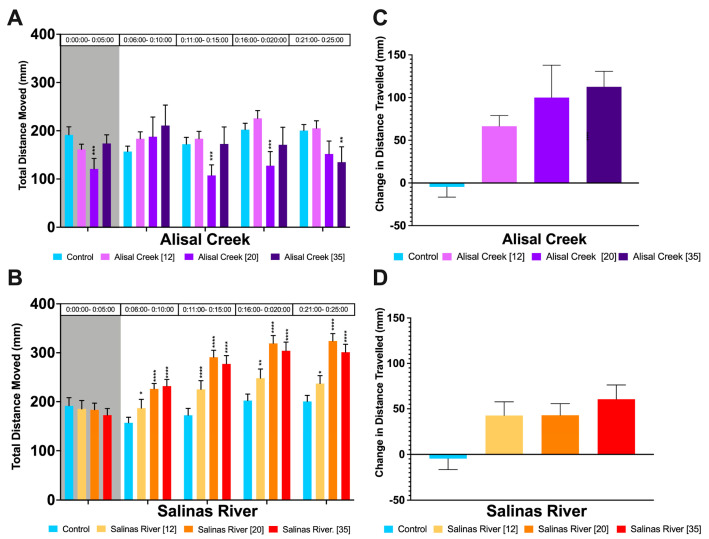
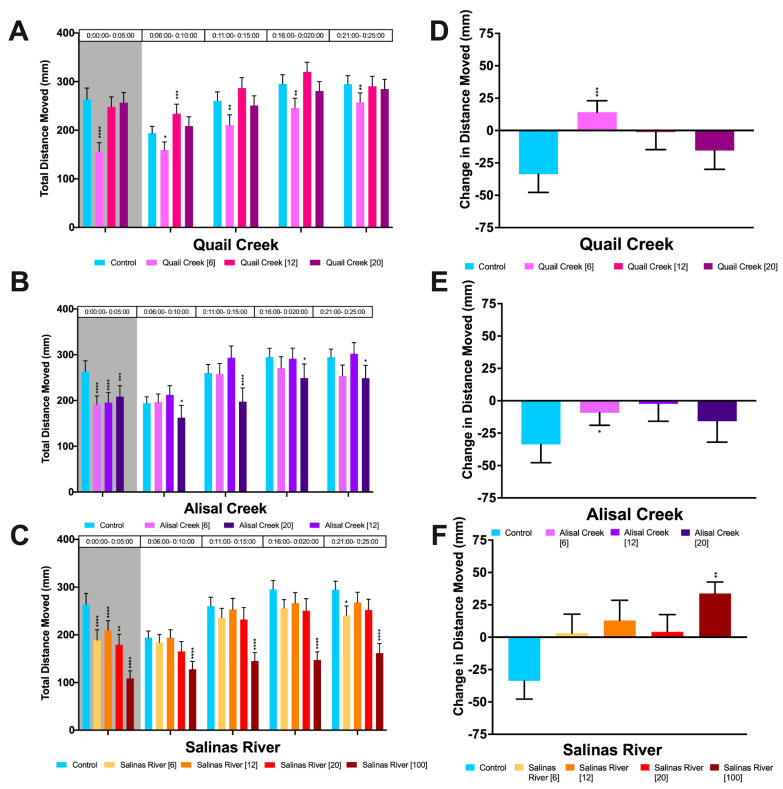
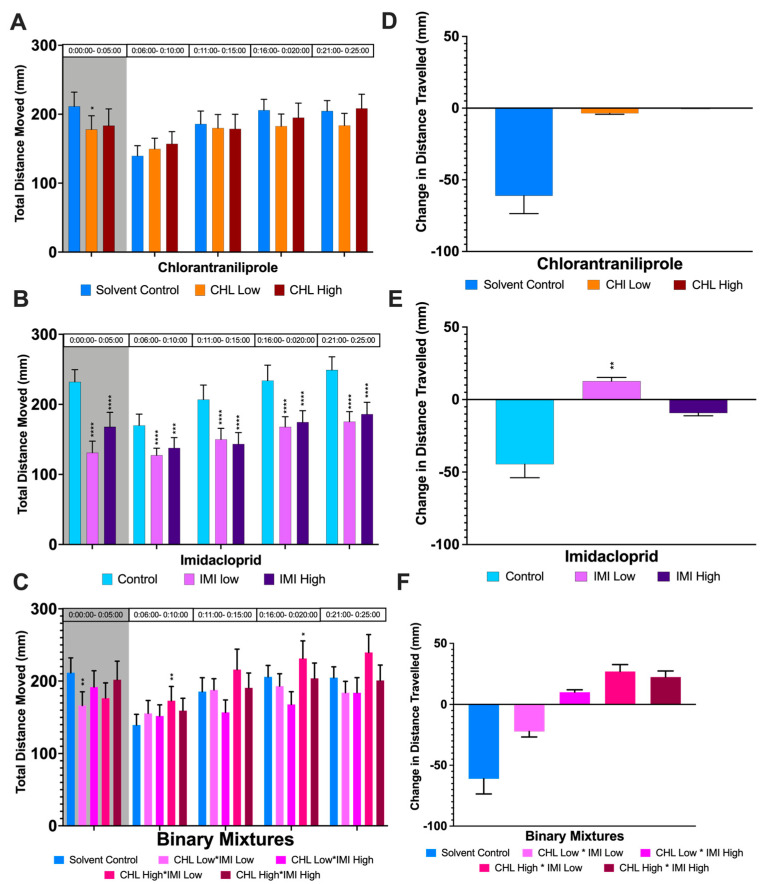
Pesticides with novel modes of action including neonicotinoids and anthranilic diamides are increasingly detected in global surface waters. Little is known about how these pesticides of concern interact in mixtures at environmentally relevant concentrations, a common exposure scenario in waterways impacted by pesticide pollution. We examined effects of chlorantraniliprole (CHL) and imidacloprid (IMI) on the sensitive invertebrate, Daphnia magna. Exposures were first performed using surface waters known to be contaminated by agricultural runoff. To evaluate the seasonal variation in chemical concentration and composition of surface waters, we tested surface water samples taken at two time points: during an extended dry period and after a first flush storm event. In surface waters, the concentrations of CHL, IMI, and other pesticides of concern increased after first flush, resulting in hypoactivity and dose-dependent photomotor responses. We then examined mortality and behavior following single and binary chemical mixtures of CHL and IMI. We detected inverse photomotor responses and some evidence of synergistic effects in binary mixture exposures. Taken together, this research demonstrates that CHL, IMI, and contaminated surface waters all cause abnormal swimming behavior in D. magna. Invertebrate swimming behavior is a sensitive endpoint for measuring the biological effects of environmental pesticides of concern.
Overview
The claims and statistics of this paper haven’t been checked yet.
Run the check — free, no account needed. It reads the open-access text and checks the sources it cites.
Integrity signals
Registry
Cites
Statistics
Figures
Verification
Claims the paper makes
The claims and statistics of this paper haven’t been checked yet.
Run the check — free, no account needed. It reads the open-access text and checks the sources it cites.
Claims other papers make about this one
Each is checked against this paper’s own text: does it say what the citing paper says it does?
In the citing paper
“From an ecological perspective, both phases may have consequences: acute hyperactivity may increase energetic expenditure and alter predator-prey interactions, whereas locomotor suppression may reduce escape efficiency, feeding performance, and population resilience [99].”
From Wildfire Ash Alters Freshwater Crustacean Behavior: Disentangling the Contributions of Suspended Macroparticles and Ash‐Induced Alkalinization (2026) · cites this paper as [99]
Self-check
Percentages, sums and reported differences re-computed from the paper’s own numbers.
The self-check needs the paper’s full text.
Citations
Cites
Systemic insecticides (neonicotinoids and fipronil): trends, uses, mode of action and metabolites
Simon‐Delso, N., Amaral-Rogers, V., Belzunces, L., Bonmatin, J. M., Chagnon, M., Downs, C. A., Furlan, L., GIBBONS, D. W., Giorio, C., Girolami, V., et al. (2014) · Environmental Science and Pollution Research · doi:10.1007/s11356-014-3470-y · Cited by 1,924
Behavioral responses to changing environments
Wong, B. B. M., & Candolin, U. (2015) · Behavioral Ecology · doi:10.1093/beheco/aru183 · Cited by 1,065
Emissions pathways, climate change, and impacts on California
Hayhoe, K., Cayan, D. R., Field, C. B., Frumhoff, P. C., Maurer, E. P., Miller, N. L., Moser, S. C., Schneider, S. H., Nicholas, K. A., Cleland, E. E., et al. (2004) · Proceedings of the National Academy of Sciences · doi:10.1073/pnas.0404500101 · Cited by 865
Loraine, G. A., & Pettigrove, M. E. (2005) · Environmental Science & Technology · doi:10.1021/es051380x · Cited by 659
Lévy, K., Woster, A. P., Goldstein, R. S., & Carlton, E. J. (2016) · Environmental Science & Technology · doi:10.1021/acs.est.5b06186 · Cited by 588
Ecological effects of pharmaceuticals in aquatic systems—impacts through behavioural alterations
Brodin, T., Piovano, S., Fick, J. B., Klaminder, J., Heynen, M., & Jonsson, M. (2014) · Philosophical Transactions of the Royal Society B Biological Sciences · doi:10.1098/rstb.2013.0580 · Cited by 528
A worldwide survey of neonicotinoids in honey
Mitchell, E. A. D., Mulhauser, B., Mulot, M., Mutabazi, A., Glauser, G., & Aebi, A. (2017) · Science · doi:10.1126/science.aan3684 · Cited by 520
Macro-Invertebrate Decline in Surface Water Polluted with Imidacloprid
Dijk, T. C. V., van Staalduinen, M. A., & van der Sluijs, J. P. (2013) · PLoS ONE · doi:10.1371/journal.pone.0062374 · Cited by 476
Pesticide effects on freshwater zooplankton: an ecological perspective
Hanazato, T. (2001) · Environmental Pollution · doi:10.1016/s0269-7491(00)00110-x · Cited by 352
Daphnia magna model in the toxicity assessment of pharmaceuticals: A review
Tkaczyk‐Wlizło, A., Bownik, A., Dudka, J., Kowal, K., & Ślaska, B. (2020) · The Science of The Total Environment · doi:10.1016/j.scitotenv.2020.143038 · Cited by 330
Research works printed but not linked: 1
- USEPA (2017). Office of Chemical Safety and Pollution Prevention Preliminary Aquatic Risk Assessment to Support the Registration Review of Imidacloprid, USEPA.
Cited by
Sorted by citations
A review of the impact of herbicides and insecticides on the microbial communities
Aravind, J., Kamaraj, M., Thayanithi, S., & Palanisamy, S. B. (2023) · Environmental Research · doi:10.1016/j.envres.2023.118020 · Cited by 68
Gu, H., Shu, Q., Dai, M., Zou, H., Wang, Y., Cheng, J., Su, Y., Li, F., & Li, B. (2023) · Pesticide Biochemistry and Physiology · doi:10.1016/j.pestbp.2023.105585 · Cited by 30
Carvalho, A. R., Morão, A. M., Gonçalves, V. M. F., Tiritan, M. E., Gorito, A. M., Pereira, M. F. R., Silva, A. M. T., Castro, B. B., Carrola, J. S., Amorim, M. M., et al. (2024) · Aquatic Toxicology · doi:10.1016/j.aquatox.2024.106906 · Cited by 11
Saalmann, V. F., Germing, K., Ringbeck, B., Kosak, L., & Eilebrecht, E. (2025) · Ecotoxicology and Environmental Safety · doi:10.1016/j.ecoenv.2025.118432 · Cited by 9
Sun, Z., Han, A., Li, J., Chen, W., Mao, J., Li, R., Shi, J., Yan, X., & Yan, C. (2026) · Pesticide Biochemistry and Physiology · doi:10.1016/j.pestbp.2026.106999 · Cited by 3
Metadata
- Authors
- Egan, N., Stinson, S. A., Deng, X., Lawler, S. P., & Connon, R. E.
- Affiliations
- University of California, Davis (US)
- California Department of Pesticide Regulation (US)
- Corresponding author
- Stinson, Sarah A.
- Venue
- Biology
- Publisher
- MDPI AG
- Published
- 2023-03-10
- Volume
- 12
- Issue
- 3
- Pages
- 425
- ISSN
- 2079-7737 (ISSN-L)
- PMC
- PMC10045752
- OpenAlex
- W4323845456
- Cited by
- 24
- References
- 59
- Citations by year
- 2026: 11 · 2025: 6 · 2024: 4 · 2023: 3
- FWCI
- 2.75
- Type
- journal article
- Language
- en
- Open access
- gold
- doi.org
- Licence
- Locations
- Biology (publishedVersion, cc-by)
- PubMed Central (publishedVersion, cc-by)
- PubMed (publishedVersion)
- eScholarship (California Digital Library) (submittedVersion, cc-by)
- DOAJ (DOAJ: Directory of Open Access Journals) (submittedVersion, cc-by-sa)
- Funders
- California Department of Pesticide Regulation (18-C0042)
- Topics
- Physical Sciences › Environmental Science › Health, Toxicology and Mutagenesis › Environmental Toxicology and Ecotoxicology
- Physical Sciences › Environmental Science › Pollution › Pesticide and Herbicide Environmental Studies
- Physical Sciences › Environmental Science › Pollution › Pharmaceutical and Antibiotic Environmental Impacts
- Keywords
- Daphnia magna, swimming behavior, chlorantraniliprole, imidacloprid, neonicotinoids, anthranilic diamides, pesticide mixtures, agricultural runoff, photomotor response, synergistic effect, invertebrate toxicity
About these checks
Registry, retraction, Cites and statistics results are computed, not judged, with one exception: a printed reference that no index lists is read once by a model before it counts as a citation error. Claims are extracted by a model and kept only when their quote appears verbatim in the text; each cited source is then checked, with a model’s help, for whether it says what the claim relies on. Those verdicts can be wrong — read the claim’s quote and the cited source before relying on one.
Statistics and arithmetic are recomputed, not judged.
Confidence bands are shown only for fields calibrated on our annotated test set. None is calibrated yet, so no band is shown.
What counts as a claim ›How we measure confidence ›How we check this ›
Are you an author, or do you see a problem with this page? Request a review
How to cite
Cite CoChat for the checks on this page, and the paper for its own findings.
- This page
- CoChat. (2026). Citation check: Swimming Behavior of Daphnia magna Is Altered by Pesticides of Concern, as Components of Agricultural Surface Water and in Acute Exposures. https://app.cochat.ai/papers/10.3390/biology12030425
- The paper
- Egan, N., Stinson, S. A., Deng, X., Lawler, S. P., & Connon, R. E. (2023). Swimming Behavior of Daphnia magna Is Altered by Pesticides of Concern, as Components of Agricultural Surface Water and in Acute Exposures. Biology. https://doi.org/10.3390/biology12030425
