

Polygenic Risk Scores in Alzheimer’s Disease: A Cross-Scale View from Genes to Brain and Behavior
Open accessThe DOI matches its Crossref record; 75 of the 75 references it cites were found in a registry or an index; none of the 152 sources its claims cite is checked for support yet.
Abstract
Alzheimer’s disease (AD) is a genetically complex disorder in which inherited susceptibility is distributed across rare high-impact variants, the apolipoprotein E (APOE) locus, and a broad polygenic background of common risk alleles. Polygenic risk scores (PRSs) provide a quantitative framework for summarizing this distributed genetic liability and have become increasingly important tools for risk stratification, cohort enrichment, and biological interpretation. In this review, we synthesize evidence on AD PRSs across multiple biological and clinical scales, moving from genes and molecular pathways to biomarkers, brain structure and function, cognition, behavior, and clinical translation. Genome-wide PRSs capture aggregate inherited risk, whereas pathway-, tissue-, cell-type-, and biomarker-specific PRSs may help clarify the biological routes through which genetic susceptibility is expressed, including amyloid and tau metabolism, lipid homeostasis, endosomal trafficking, immune regulation, glial activation, proteostasis, and mitochondrial quality control. Evidence indicates that AD PRSs are most consistently associated with amyloid-related biomarkers, while associations with tau, neurodegeneration, brain atrophy, functional connectivity, cognitive decline, and neuropsychiatric manifestations are more heterogeneous and often depend on APOE, disease stage, biomarker context, and variable computation methodologies. Although PRSs show promise for research enrichment and mechanistic stratification, their individual-level clinical utility remains limited by modest predictive performance, ancestry-related transferability, calibration challenges, and ethical considerations. Future progress will require multi-ancestry cohorts, integration of common and rare variation, multi-omic annotation, longitudinal modeling, and multimodal prediction frameworks. Ultimately, PRSs are best viewed not as stand-alone diagnostic tools, but as cross-scale instruments for linking inherited susceptibility to the heterogeneous biological and clinical manifestations of AD.
Overview
CoChat Summary
TL;DR
This narrative review synthesizes evidence on Alzheimer's disease (AD) polygenic risk scores (PRSs) across a "genes-to-brain-to-behavior" framework, arguing that PRSs are best understood as probabilistic research tools rather than stand-alone clinical predictors. It reports that PRS associations are most reproducible for amyloid-related biomarkers (especially with APOE included), while tau, neurodegeneration, imaging, cognitive, and behavioral associations are more variable and become clearer with pathway-, cell-type-, or biomarker-specific scores.
Key findings
- AD has a layered genetic architecture: heritability of late-onset AD is estimated at ~58–79%; APOE ε4 heterozygosity confers ~3-fold risk and homozygosity 8–12-fold, while ε2 reduces risk by ~40–50%; most common-variant loci have odds ratios of ~1.05–1.30, whereas rare variants (e.g., TREM2 R47H, ~3.9-fold) have larger but low-frequency effects, with ~1 in 7 late-onset AD individuals estimated to carry a rare risk variant.
- GWAS locus counts have grown with sample size — Kunkle et al. (94,437 individuals; 20 confirmed + 5 novel loci), Jansen et al. (71,880 cases/383,378 controls; 29 loci, 215 prioritized genes), Bellenguez et al. (111,326 cases/677,663 controls; 75 loci, 42 novel), and a 2026 consensus meta-analysis (128,681 cases/849,833 controls; 91 loci, 16 novel, 56 detected in clinically diagnosed AD) — leading the authors to state the number of genome-wide significant loci is best described as exceeding 90.
- As a historical benchmark, Harrison et al. reported AUCs of 0.62–0.84 for AD case–control discrimination with APOE included and 0.57–0.75 excluding APOE, though the authors stress these are descriptive ranges across heterogeneous studies, not pooled estimates.
- Cross-scale evidence: PRSs are most consistently associated with amyloid-related biomarkers; tau associations emerge with amyloid-adjusted, cell-weighted, or pathway-specific scores (e.g., in BioFINDER-1, microglial PRSs associated more with CSF pTau217 than Aβ, with the lowest mediation by Aβ positivity); imaging findings include smaller hippocampal subfield volumes in UK Biobank (17,161 participants) and pathway-specific PRS associations with white matter integrity in EPAD; behavioral evidence links AD genetic risk to mild behavioral impairment.
Methods
- Narrative review (explicitly not a systematic review or meta-analysis) of PubMed-indexed original research and reviews through 30 July 2026, using search terms for AD, dementia, PRSs, polygenic hazard scores, and related pathway, cell-type, biomarker, neuroimaging, cognition, behavior, and clinical translation terms; reference lists were also screened.
- Reports were selected for relevance to AD polygenic risk or hazard scores, methodological development, or associations with biological and clinical outcomes; relevant genetic and functional studies were included for mechanistic context, and conference abstracts were included as explicitly identified preliminary evidence.
- Findings were synthesized narratively across biological and clinical scales, organized around genetic architecture, pathways, fluid and PET biomarkers, neuroimaging, cognition/behavior, and clinical translation.
Limitations
- Stated: the review was not designed as a systematic review or meta-analysis; the authors also note that reported AUCs, hazard ratios, and ΔR2 values across studies are not directly comparable, and that discovery-target overlap and within-sample threshold selection can produce optimistic estimates.
- Stated methodological challenges for the field: limited cross-ancestry portability and population stratification; poor absolute-risk calibration (a PRS percentile is not a disease probability); heterogeneity in discovery phenotypes (clinically diagnosed vs. proxy vs. broader AD/ADRD definitions); lack of standardization across discovery GWAS, imputation panels, LD references, thresholds, APOE handling, and covariates; and that PRSs are not deterministic predictors given education, cardiovascular profile, and physical activity.
- Evident from the text: several key findings rest on single cohorts or preliminary sources — the microglia-specific PRS–plasma pTau217 result (with an estimated ~42% mediation) comes from a conference abstract whose methodological details are unavailable, and the comparative buffalo mitochondrial transcriptomics studies are offered as hypothesis-generating context rather than direct AD evidence.
Model-written summary. Check it against the paper before relying on it.
Integrity signals
Registry
Cites
Statistics
Figures
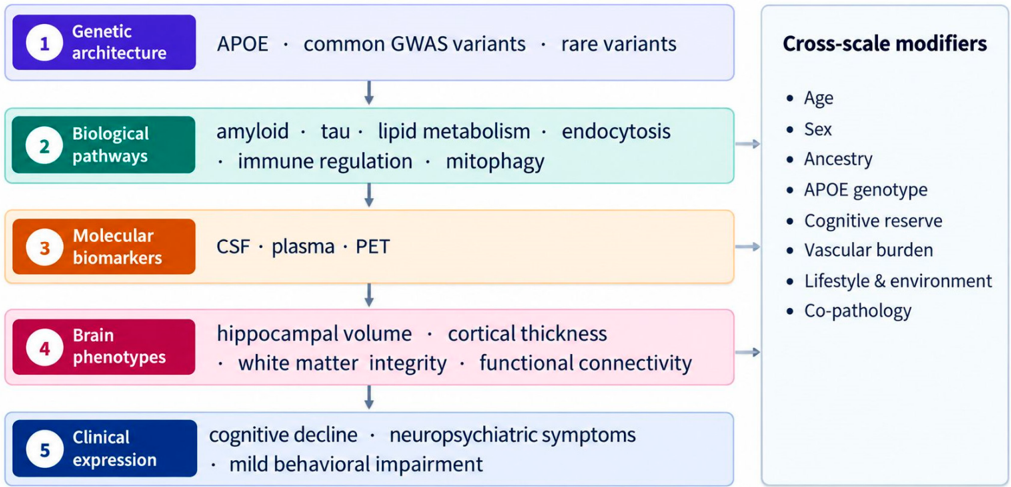
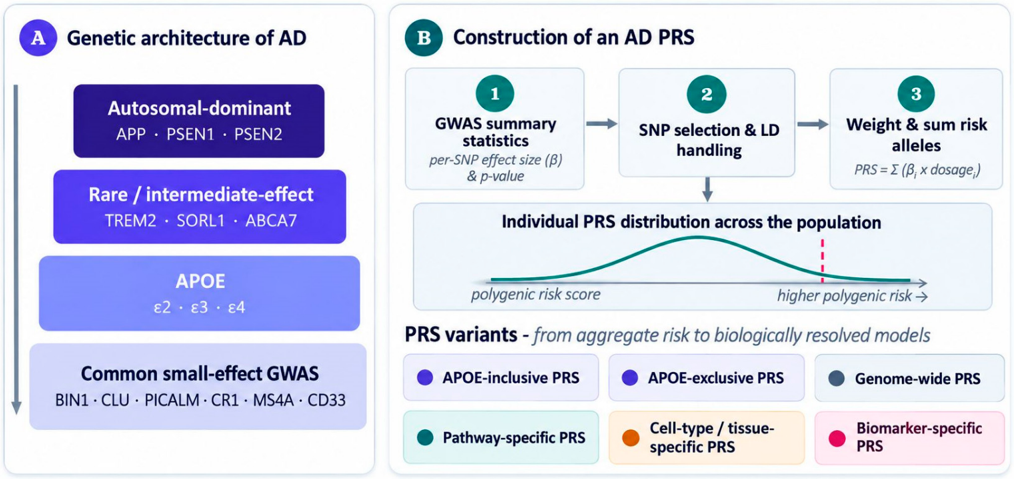
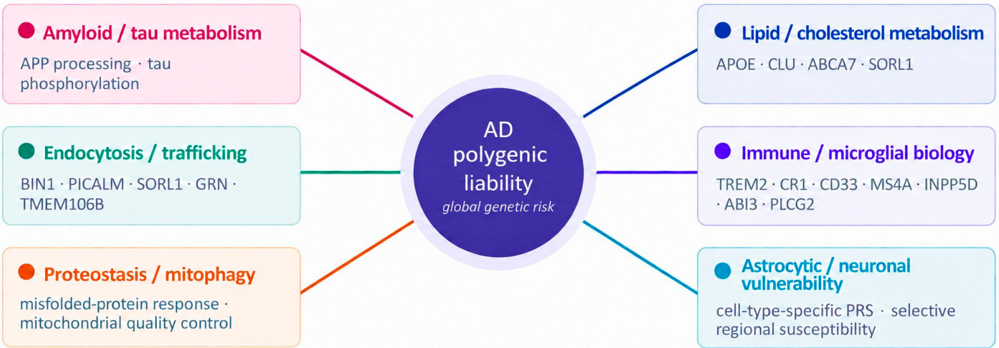
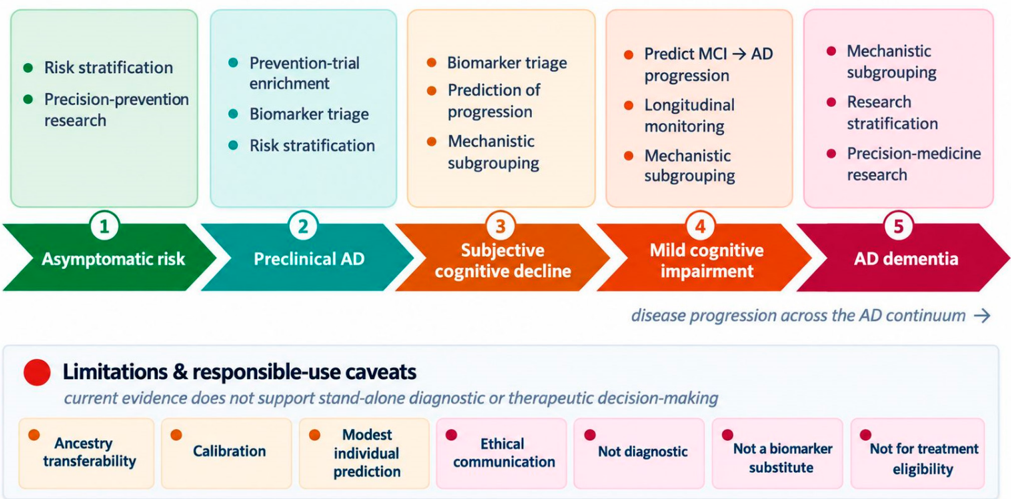
Verification
Claims the paper makes
0 Valid · 1 Not valid · 134 Not checked · 100 Own results and interpretations
A result the paper states — it cites no source for it, so there is none to check. The quote shows it is in the paper.
In the paper
“Their predictive value at the individual level remains modest, their transferability across ancestries is incomplete, and their interpretation requires careful calibration against age, APOE, biomarkers, cognition, neuroimaging, vascular risk, lifestyle, and family history.”
§ Polygenic Risk Scores in Alzheimer’s Disease: A Cross-Scale View from Genes to Brain and Behavior > 9. Conclusions
plain- Asserted: passes — The authors put it forward as true.
- Checkable: passes — It can be checked against evidence.
- Load-bearing: passes — The paper’s conclusions depend on it.
- Based: passes — The paper gives a reason why it holds.
The paper states this without a source or data behind it here, so there is nothing to check it against. The quote shows it is in the paper.
In the paper
“Current evidence suggests that conventional AD PRSs are most robustly associated with amyloid-related processes, particularly when APOE is included.”
§ Polygenic Risk Scores in Alzheimer’s Disease: A Cross-Scale View from Genes to Brain and Behavior > 9. Conclusions
hedgedstates an association- Asserted: passes — The authors put it forward as true.
- Checkable: passes — It can be checked against evidence.
- Load-bearing: passes — The paper’s conclusions depend on it.
- Based: unclear — It is unclear why the paper says it holds.
A result the paper states — it cites no source for it, so there is none to check. The quote shows it is in the paper.
In the paper
“Associations with tau, neurodegeneration, brain structure, functional networks, cognition, and behavior are more variable, but become more informative when PRSs are modeled longitudinally or refined through pathway-, cell-type-, tissue-, or biomarker-specific approaches.”
§ Polygenic Risk Scores in Alzheimer’s Disease: A Cross-Scale View from Genes to Brain and Behavior > 9. Conclusions
plainstates an association- Asserted: passes — The authors put it forward as true.
- Checkable: passes — It can be checked against evidence.
- Load-bearing: passes — The paper’s conclusions depend on it.
- Based: passes — The paper gives a reason why it holds.
A result the paper states — it cites no source for it, so there is none to check. The quote shows it is in the paper.
In the paper
“Their predictive value at the individual level remains modest, their transferability across ancestries is incomplete, and their interpretation requires careful calibration against age, APOE, biomarkers, cognition, neuroimaging, vascular risk, lifestyle, and family history.”
§ Polygenic Risk Scores in Alzheimer’s Disease: A Cross-Scale View from Genes to Brain and Behavior > 9. Conclusions
plain- Asserted: passes — The authors put it forward as true.
- Checkable: passes — It can be checked against evidence.
- Load-bearing: passes — The paper’s conclusions depend on it.
- Based: passes — The paper gives a reason why it holds.
In the paper
“Twin and family studies have estimated that the heritability of late-onset AD (LOAD) with symptom onset older than 65 years is approximately 58–79% [2]”
§ Polygenic Risk Scores in Alzheimer’s Disease: A Cross-Scale View from Genes to Brain and Behavior > 1. Introduction
What the sources say
- Not checked yetcites [2] Sims, 2020, The multiplex model of the genetics of Alzheimer’s disease, Nat. Neurosci. source
hedged- Asserted: passes — The authors put it forward as true.
- Checkable: passes — It can be checked against evidence.
- Load-bearing: unclear — It is unclear whether the paper’s conclusions depend on it.
- Based: passes — The paper gives a reason why it holds.
132 more claims
Create a free account to see all 235 claims and to verify the 152 references still open.
- Probably not a substantial claim. 20
- It may state two separate claims as one. 83
Citations
Cites
NIA‐AA Research Framework: Toward a biological definition of Alzheimer's disease
Jack, C. R., Bennett, D. A., Blennow, K., Carrillo, M. C., Dunn, B., Haeberlein, S. B., Holtzman, D. M., Jagust, W., Jessen, F., Karlawish, J., et al. (2018) · Alzheimer's & Dementia · doi:10.1016/j.jalz.2018.02.018 · Cited by 10,537
Nichols, E., Steinmetz, J. D., Vollset, S. E., Fukutaki, K., Chalek, J., Abd-Allah, F., Abdoli, A., Abualhasan, A., Abu-Gharbieh, E., Akram, T. T., et al. (2022) · The Lancet Public Health · doi:10.1016/s2468-2667(21)00249-8 · Cited by 5,575
Meta-Analysis of 74,046 Individuals Identifies 11 New Susceptibility Loci for Alzheimer’s Disease
(EADI), E. A. D. I., Lambert, J.-C., (GERAD), G. A. E. R. I. A. D., Alzheimer's Disease Genetic Consortium (ADGC), (CHARGE), C. F. H. A. A. R. I. G. E., Ibrahim-Verbaas, C. A., Harold, D., Naj, A. C., Sims, R., Bellenguez, C., et al. (2013) · Nature Genetics · doi:10.1038/ng.2802 · Cited by 4,336
Alzheimer Disease Genetics Consortium (ADGC), Kunkle, B. W., The European Alzheimer’s Disease Initiative (EADI), Cohorts for Heart and Aging Research in Genomic Epidemiology Consortium (CHARGE), Genetic and Environmental Risk in AD/Defining Genetic, P. A. E. R. F. A. D. C. (., Grenier-Boley, B., Sims, R., Bis, J. C., Damotte, V., Naj, A. C., et al. (2019) · Nature Genetics · doi:10.1038/s41588-019-0358-2 · Cited by 2,946
Clinical use of current polygenic risk scores may exacerbate health disparities
Martin, A. R., Kanai, M., Kamatani, Y., Okada, Y., Neale, B. M., & Daly, M. J. (2019) · Nature Genetics · doi:10.1038/s41588-019-0379-x · Cited by 2,821
New insights into the genetic etiology of Alzheimer’s disease and related dementias
Bellenguez, C., Küçükali, F., Jansen, I. E., Kleineidam, L., Moreno-Grau, S., Amin, N., Naj, A. C., Campos-Martin, R., Grenier-Boley, B., Andrade, V., et al. (2022) · Nature Genetics · doi:10.1038/s41588-022-01024-z · Cited by 2,498
Jansen, I. E., Savage, J. E., Watanabe, K., Bryois, J., Williams, D. M., Steinberg, S., Sealock, J., Karlsson, I. K., Hägg, S., Athanasiu, L., et al. (2019) · Nature Genetics · doi:10.1038/s41588-018-0311-9 · Cited by 2,277
Bloom (2014) · doi:10.1001/jamaneurol.2013.5847 · Cited by 2,194
Buckner, R. L., Snyder, A. Z., Shannon, B. J., LaRossa, G., Sachs, R., Fotenos, A. F., Sheline, Y. I., Klunk, W. E., Mathis, C. A., Morris, J. C., et al. (2005) · The Journal of Neuroscience · doi:10.1523/jneurosci.2177-05.2005 · Cited by 2,140
Tutorial: a guide to performing polygenic risk score analyses
Choi, S. W., Mak, T. S.-H., & O’Reilly, P. F. (2020) · Nature Protocols · doi:10.1038/s41596-020-0353-1 · Cited by 1,946
Metadata
- Authors
- Angelopoulou, E., Stamelos, I., N. Sampatakakis, S., Papageorgiou, S., Scarmeas, N., Hatzimanolis, A., Proukakis, C., & Villa, C.
- Affiliations
- National and Kapodistrian University of Athens (GR)
- 1st Department of Neurology, Aiginition Hospital, National and Kapodistrian University of Athens Medical School, 11528 Athens, Greece
- UCL Queen Square Institute of Neurology (GB)
- University of Milano-Bicocca (IT)
- Corresponding author
- Villa, Chiara
- ORCID
- Venue
- Biology
- Publisher
- MDPI AG
- Published
- 2026-10-10
- Volume
- 15
- Issue
- 20
- Pages
- 1805
- ISSN
- 2079-7737 (ISSN-L)
- PMC
- PMC13701775
- OpenAlex
- W7221322962
- Cited by
- 0
- References
- 74
- FWCI
- 0.00
- Type
- journal article
- Language
- en
- Open access
- gold
- doi.org
- Licence
- cc-by
- creativecommons.org/licenses/by/4.0/ (vor)
- creativecommons.org/licenses/by/4.0/ (tdm)
- Locations
- Biology (publishedVersion, cc-by)
- PubMed Central (publishedVersion, cc-by)
- PubMed (publishedVersion)
- BOA (University of Milano-Bicocca) (submittedVersion, cc-by)
- DOAJ (DOAJ: Directory of Open Access Journals) (submittedVersion)
- Topics
- Life Sciences › Neuroscience › Cellular and Molecular Neuroscience › Alzheimer's disease research and treatments
- Health Sciences › Medicine › Psychiatry and Mental health › Dementia and Cognitive Impairment Research
- Life Sciences › Biochemistry, Genetics and Molecular Biology › Genetics › Genetic Associations and Epidemiology
- Keywords
- polygenic risk score, Alzheimer's disease, apolipoprotein E, amyloid, tau protein, lipid homeostasis, endosomal trafficking, immune regulation, glial activation, proteostasis, mitochondrial quality control, amyloid biomarkers, brain atrophy, functional connectivity, cognitive decline, neuropsychiatric symptoms, risk stratification, rare variants, predictive performance
About these checks
Registry, retraction, Cites and statistics results are computed, not judged, with one exception: a printed reference that no index lists is read once by a model before it counts as a citation error. Claims are extracted by a model and kept only when their quote appears verbatim in the text; each cited source is then checked, with a model’s help, for whether it says what the claim relies on. Those verdicts can be wrong — read the claim’s quote and the cited source before relying on one.
A language model drew the claims from the paper on 2026-11-26, under version 3 of the claim definition (model deepseek-v4.1-flash, prompt extract-v3).
A second model labelled each claim on 2026-11-26 (model jev-1.13-20260917, definition revision gold-guideline-v0.2).
Statistics and arithmetic are recomputed, not judged.
Confidence bands are shown only for fields calibrated on our annotated test set. None is calibrated yet, so no band is shown.
What counts as a claim ›How we measure confidence ›How we check this ›
Are you an author, or do you see a problem with this page? Request a review
Data sources
Bibliographic data: Semantic Scholar, OpenAlex, Crossref.
Contains information from the Semantic Scholar Academic Graph Datasets, made available under the ODC Attribution License (ODC-BY 1.0).
Semantic Scholar’s data is described in: Kinney, R., et al. (2023). The Semantic Scholar Open Data Platform. arXiv:2301.10140.
