

Advances in Ophthalmic Optogenetics: Approaches and Applications
Open accessThe DOI matches its Crossref record; 96 of the 99 references it cites were found in a registry or an index.
Abstract
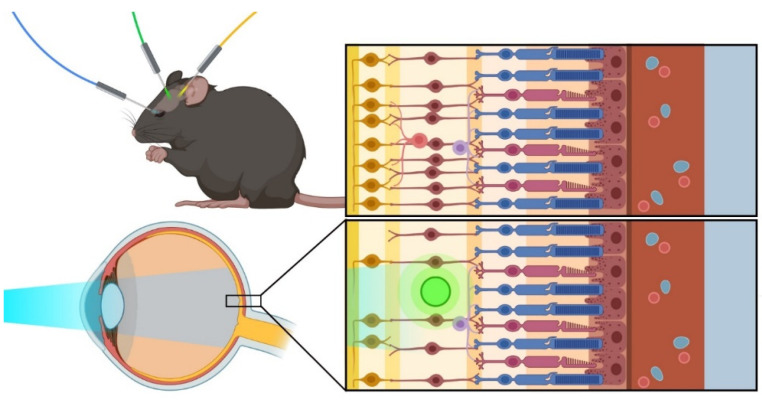
Recent advances in optogenetics hold promise for vision restoration in degenerative eye diseases. Optogenetics refers to techniques that use light to control the cellular activity of targeted cells. Although optogenetics is a relatively new technology, multiple therapeutic options are already being explored in pre-clinical and phase I/II clinical trials with the aim of developing novel, safe, and effective treatments for major blinding eye diseases, such as glaucoma and retinitis pigmentosa. Optogenetic approaches to visual restoration are primarily aimed at replacing lost or dysfunctional photoreceptors by inserting light-sensitive proteins into downstream retinal neurons that have no intrinsic light sensitivity. Such approaches are attractive because they are agnostic to the genetic causes of retinal degeneration, which raises hopes that all forms of retinal dystrophic and degenerative diseases could become treatable. Optogenetic strategies can also have a far-reaching impact on translational research by serving as important tools to study the pathogenesis of retinal degeneration and to identify clinically relevant therapeutic targets. For example, the CRY-CIBN optogenetic system has been recently applied to animal models of glaucoma, suggesting a potential role of OCRL in the regulation of intraocular pressure in trabecular meshwork. As optogenetic strategies are being intensely investigated, it appears crucial to consider the opportunities and challenges such therapies may offer. Here, we review the more recent promising optogenetic molecules, vectors, and applications of optogenetics for the treatment of retinal degeneration and glaucoma. We also summarize the preliminary results of ongoing clinical trials for visual restoration.
Overview
The claims and statistics of this paper haven’t been checked yet.
Free: it reads the open-access text and checks the first 5 claims that cite a source we can check. Create a free account to check every claim.
Integrity signals
Registry
Cites
Statistics
Figures
Verification
Claims the paper makes
The claims and statistics of this paper haven’t been checked yet.
Free: it reads the open-access text and checks the first 5 claims that cite a source we can check. Create a free account to check every claim.
Claims other papers make about this one
Each is checked against this paper’s own text: does it say what the citing paper says it does?
In the citing paper
“However, optogenetics still require optimization to allow for complex visual processing and to increase the sensitivity of the proteins that are currently used.10,15”
From Gene Therapy for Retinal Degenerative Diseases: Progress, Challenges, and Future Directions (2023) · cites this paper as [10]
Self-check
Percentages, sums and reported differences re-computed from the paper’s own numbers.
The self-check needs the paper’s full text.
Citations
Cites
Global Prevalence of Glaucoma and Projections of Glaucoma Burden through 2040
Tham, Y.-C., Li, X., Wong, T. Y., Quigley, H. A., Aung, T., & Cheng, C.-Y. (2014) · Ophthalmology · doi:10.1016/j.ophtha.2014.05.013 · Cited by 7,159
(2005) · American Journal of Ophthalmology · doi:10.1016/j.ajo.2005.03.057 · Cited by 4,396
Steinmetz, J. D., Bourne, R. R. A., Briant, P. S., Flaxman, S. R., Taylor, H. R. B., Jonas, J. B., Abdoli, A. A., Abrha, W. A., Abualhasan, A., Abu-Gharbieh, E. G., et al. (2021) · The Lancet Global Health · doi:10.1016/s2214-109x(20)30489-7 · Cited by 3,189
(2000) · American Journal of Ophthalmology · doi:10.1016/s0002-9394(00)00538-9 · Cited by 2,780
Neurodegenerative Disorders: Parkinson's Disease and Huntington's Disease
Hague, S., Klaffke, S., & Bandmann, O. (2006) · IMPERIAL COLLEGE PRESS eBooks · doi:10.1142/9781860948961_0007 · Cited by 2,767
Gordon, M. O. (2002) · Archives of Ophthalmology · doi:10.1001/archopht.120.6.714 · Cited by 2,626
Adeno-associated virus vector as a platform for gene therapy delivery
Wang, D., Tai, P. W. L., & Gao, G. (2019) · Nature Reviews Drug Discovery · doi:10.1038/s41573-019-0012-9 · Cited by 2,444
Independent optical excitation of distinct neural populations
Klapoetke, N. C., Murata, Y., Kim, S. S., Pulver, S. R., Birdsey-Benson, A., Cho, Y. K., Morimoto, T. K., Chuong, A. S., Carpenter, E. J., Tian, Z., et al. (2014) · Nature Methods · doi:10.1038/nmeth.2836 · Cited by 2,344 · cited 2×
“Natural and engineered variants of ChR, such as ChrimsonR and ChronosFP, have different kinetics and sensitivities to light and are also used in optogenetic therapies [35].”
BackgroundWeinreb, R. N., & Khaw, P. T. (2004) · The Lancet · doi:10.1016/s0140-6736(04)16257-0 · Cited by 2,222
Safety and Efficacy of Gene Transfer for Leber's Congenital Amaurosis
Maguire, A. M., Simonelli, F., Pierce, E. A., Pugh, E. N., Mingozzi, F., Bennicelli, J., Banfi, S., Marshall, K. A., Testa, F., Surace, E. M., et al. (2008) · New England Journal of Medicine · doi:10.1056/nejmoa0802315 · Cited by 2,145 · cited 1×
“Clinical trials for gene therapy to treat LCA have demonstrated the safety and efficacy of subretinal delivery of transgenes to the retina via an AAV2 vector [92,93].”
Background
Research works printed but not linked: 1
- 79. Martel, J.N.; Boulanger-Scemama, E.; Degli Esposti, S.; Galluppi, F.; Blouin, L.; Taiel, M.; Sahel, J.A. Optogenetic GS030 Therapy in Subjects with Retinitis Pigmentosa: Safety and Tolerability Up to Two Years After Treatment Administration in the Phase 1/2a PIONEER Study. Investigative Ophthalmology & Visual Science 2021 , 62 , 3236.
Cited by
Gene Therapy for Retinal Degenerative Diseases: Progress, Challenges, and Future Directions
Drag, S., Dotiwala, F., & Upadhyay, A. K. (2023) · Investigative Opthalmology & Visual Science · doi:10.1167/iovs.64.7.39 · Cited by 145
Gene Therapy for Inherited Retinal Diseases: From Laboratory Bench to Patient Bedside and Beyond
Brar, A. S., Parameswarappa, D. C., Takkar, B., Narayanan, R., Jalali, S., Mandal, S., Fujinami, K., & Padhy, S. K. (2023) · Ophthalmology and Therapy · doi:10.1007/s40123-023-00862-2 · Cited by 49
“…by an optical device worn by the patient and generate electric signals transmitted to the brain, resulting in the perception of a binary image [31, 32] In a recent trial, studying the post-approval long-term outcomes in a French population (prospective, multicenter, single-arm study) the 2-year…”
BackgroundCamouflage Nanoparticles Enable in Situ Bioluminescence-Driven Optogenetic Therapy of Retinoblastoma
Ding, J., Lu, J., Zhang, Q., Xu, Y., Song, B., Wu, Y., Shi, H., Chu, B., Wang, H., & He, Y. (2023) · ACS Nano · doi:10.1021/acsnano.3c00470 · Cited by 30
AAV genome modification for efficient AAV production
Asaad, W., Volos, P., Maksimov, D. O., Khavina, E. M., Deviatkin, A. A., Mityaeva, O. N., & Volchkov, P. (2023) · Heliyon · doi:10.1016/j.heliyon.2023.e15071 · Cited by 33
Current approaches to vision restoration using optogenetic therapy
Parnami, K., & Bhattacharyya, A. (2023) · Frontiers in Cellular Neuroscience · doi:10.3389/fncel.2023.1236826 · Cited by 29
“Until now, research has shown successful restoration of light sensitivity at the electrophysiological and behavioral level in animal models of retinitis pigmentosa (RP), a heterogeneous group of retinal disorder resulting in progressive loss of photoreceptor cells leading to impaired vision (Gilhooley et al., 2022; Pr…”
BackgroundApplications and challenges of rhodopsin-based optogenetics in biomedicine
Zhang, H., Fang, H., Liu, D., Zhang, Y., Adu‐Amankwaah, J., Yuan, J., Tan, R., & Zhu, J. (2022) · Frontiers in Neuroscience · doi:10.3389/fnins.2022.966772 · Cited by 32
Pan, C., Dong, X., Lança, C., Wang, Y., Saw, S., He, X., Hu, D., Fan, Q., Grzybowski, A. E., & Ohno‐Matsui, K. (2025) · Progress in Retinal and Eye Research · doi:10.1016/j.preteyeres.2025.101415 · Cited by 27
Retinitis Pigmentosa and Therapeutic Approaches: A Systematic Review
Confalonieri, F., Rosa, A. L., Ottonelli, G., Barone, G., Ferraro, V., Maria, A. D., Romano, M., Randazzo, A., Vallejo-García, J. L., Vinciguerra, P., et al. (2024) · Journal of Clinical Medicine · doi:10.3390/jcm13164680 · Cited by 23
Advances in AAV-mediated gene replacement therapy for pediatric monogenic neurological disorders
Zhou, L., Wang, Y., Xu, Y., Zhang, Y., & Zhu, C. (2024) · Molecular Therapy — Methods & Clinical Development · doi:10.1016/j.omtm.2024.101357 · Cited by 26
Kovacs, K. D., Ciulla, T. A., & Kiss, S. (2022) · Expert Opinion on Biological Therapy · doi:10.1080/14712598.2022.2121646 · Cited by 20
“In this strategy, bipolar or ganglion cells can be rendered sensitive to light by inducing expression of photosensitive opsin leading to an atypical photosensitization [55].”
BackgroundBecherucci, V., Bacci, G. M., Marziali, E., Sodi, A., Bambi, F., & Caputo, R. (2023) · Biomedicines · doi:10.3390/biomedicines11102656 · Cited by 20
“Furthermore, thorough investigations are needed to evaluate the therapy’s enduring effects, potential side effects, and its compatibility with individual patient profiles [135].”
BackgroundThe ABCs of Stargardt disease: the latest advances in precision medicine
Zaydon, Y. A., & Tsang, S. H. (2024) · Cell & Bioscience · doi:10.1186/s13578-024-01272-y · Cited by 20
Sharif, N. A. (2023) · Journal of Ocular Pharmacology and Therapeutics · doi:10.1089/jop.2022.0046 · Cited by 21
Cell-based Therapies for Corneal and Retinal Disorders
Ajgaonkar, B., Kumaran, A., Kumar, S., Jain, R. D., & Dandekar, P. P. (2023) · Stem Cell Reviews and Reports · doi:10.1007/s12015-023-10623-0 · Cited by 20
“These employ microbial-based opsins for treating progressive retinal degeneration (RP, glaucoma and choroideremia) [107].”
BackgroundDuncan, J. L., Bowman, A. N., Laster, A., Gelfman, C. M., Birch, D. G., Boye, S. L., Daiger, S. P., Priore, L. V. D., Zack, D. J., & Handa, J. T. (2024) · Translational Vision Science & Technology · doi:10.1167/tvst.13.12.28 · Cited by 17
Özmert, E., & Arslan, U. (2023) · Stem Cells Translational Medicine · doi:10.1093/stcltm/szad051 · Cited by 12
Allosteric inactivation of an engineered optogenetic GTPase
Jain, A., Dokholyan, N. V., & Lee, A. L. (2023) · Proceedings of the National Academy of Sciences · doi:10.1073/pnas.2219254120 · Cited by 11
Two Decades of Optogenetic Tools: A Retrospective and a Look Ahead
Duan, X., Zhu, M., & Gao, S. (2025) · Advanced Genetics · doi:10.1002/ggn2.202500021 · Cited by 12
Tran, M., Kolesnikova, M., Kim, A. H., Kowal, T. J., Ning, K., Mahajan, V. B., Tsang, S. H., & Sun, Y. (2022) · Ophthalmic Genetics · doi:10.1080/13816810.2022.2113544 · Cited by 10
Self-citationOptogenetic therapy for retinal degenerative diseases: A review
Kasem, E., Watfa, M., Afif, A., Hasan, R., Mansour, M., Almhmoud, H., & Zaino, B. (2025) · European Journal of Ophthalmology · doi:10.1177/11206721251335560 · Cited by 6
Halfmann, C., Rüland, T., Müller, F. U., Jehasse, K., & Kampa, B. M. (2023) · Frontiers in Cellular Neuroscience · doi:10.3389/fncel.2023.1258773 · Cited by 6
“…were used in animal models of retinitis pigmentosa to elicit activity in retinal and downstream circuits to restore vision or delay retinal degeneration (Aghaizu et al., 2017; Dias et al., 2018; Ayton et al., 2020; Farnum and Pelled, 2020; Kleinlogel et al., 2020; Prosseda et al., 2022).”
Xie, Y., Zhou, Y., Guo, J., Zhang, Z., Zhu, Y., Goldys, E. M., Deng, W., & Chen, W. (2025) · Materials Today · doi:10.1016/j.mattod.2025.06.034 · Cited by 5
Information Transmission through Biotic–Abiotic Interfaces to Restore or Enhance Human Function
Kelly, A. R., & Glover, D. J. (2024) · ACS Applied Bio Materials · doi:10.1021/acsabm.4c00435 · Cited by 5
Tackling visual impairment: emerging avenues in ophthalmology
Lin, F., Su, Y., Zhao, C., Akter, F., Yao, S., Huang, S., Shao, X., & Yao, Y. (2025) · Frontiers in Medicine · doi:10.3389/fmed.2025.1567159 · Cited by 10
“Additionally, it is being evaluated for dry AMD, with a Phase II study currently ongoing (182).”
Gene and cell-based therapies for retinal and optic nerve disease
Esposito, E. P., Han, I. C., & Johnson, T. V. (2024) · Handbook of clinical neurology · doi:10.1016/b978-0-323-90120-8.00016-2 · Cited by 5
Regulatory aspects of optogenetic research and therapy for retinitis pigmentosa under EU law
Freise, J. (2025) · Frontiers in Medical Technology · doi:10.3389/fmedt.2025.1548927 · Cited by 4
Optogenetics: A Novel Therapeutic Avenue for Age-Related Macular Degeneration
Grenga, P., Ciancimino, C., Meduri, A., & Fragiotta, S. (2025) · Biomolecules · doi:10.3390/biom15091286 · Cited by 3
“Over the last years, a growing body of research has supported that optogenetics could be a vision-restoring strategy in patients with retinal disease and well-preserved BCs and RGCs [20,33–36].”
Optogenetics Neuromodulation of the Nose
Xiang, F., Zhang, S., Tang, M., Li, P., Zhang, H., Xiong, J., Zhang, Q., & Li, X. (2024) · Behavioural Neurology · doi:10.1155/2024/2627406 · Cited by 3
“Currently, four companies have progressed optogenetic retinal gene therapies into clinical trials [82].”
Functional In Vitro Assessment of rAAV-Delivered Retinol Dehydrogenase 12 (RDH12) Activity
Pavlova, P., Averina, M., Gurtsieva, D., Galieva, A., Ivanov, R. A., Karabelsky, A. V., & Minskaia, E. (2026) · International Journal of Molecular Sciences · doi:10.3390/ijms27031366 · Cited by 2
“…approaches based on the introduction of photosensitive channel proteins (opsins) into functional, initially non-photosensitive retinal cells [12], the use of RNA interference to correct defective splicing [13], genomic editing using the CRISPR/Cas system and base and prime editing…”
Galdikaitė, E., Krušnauskas, R., Henderson, E., & Bujakowska, K. M. (2026) · Molecular Aspects of Medicine · doi:10.1016/j.mam.2026.101462 · Cited by 2
Idzhilova, O. S., Колотова, Д. Е., Smirnova, G. R., Abonakour, A., Dolgikh, D. A., Petrovskaya, L. E., Kirpichnikov, M. P., Оstrovsky, М. А., & Malyshev, A. Y. (2023) · Doklady Biological Sciences · doi:10.1134/s0012496623700369 · Cited by 1
“However, prosthetics of the degenerative retina with these proteins has restored the vision function in rodents [3–5] and, partly, patients [6, 7].”
BackgroundIdzhilova, O. S., Колотова, Д. Е., Smirnova, G. R., Abonakour, A., Dolgikh, D. A., Petrovskaya, L. E., Kirpichnikov, A. O. T. R. M. P., Ostrovsky, A. O. T. R. M. A., & Malyshev, A. Y. (2023) · Доклады Российской академии наук Науки о жизни · doi:10.31857/s268673892360005x · Cited by 1
Optogenetics as a Novel Therapeutic Approach for Ocular Disease
Vingolo, E. M., Mascolo, S., Calabro, M., Miccichè, F., & Barresi, M. (2025) · Journal of Clinical & Translational Ophthalmology · doi:10.3390/jcto3040021 · Cited by 1
“Patients with advanced optic nerve damage have demonstrated partial recovery of light perception following opto-genetic treatment [36], marking a significant milestone in the field of vision restoration.”
Regulation of insulin expression and release in gene and cell therapy of insulin-deficient diabetes
Xie, L., Lu, W., Yu, J., Zhang, Y., Gao, H., Xie, C., Tian, Y., Liu, M., & Wang, G. (2025) · European Journal of Endocrinology · doi:10.1093/ejendo/lvaf231 · Cited by 1
Evaluation of Lipid Nanoparticles as Vehicles for Optogenetic Delivery in Primary Cortical Neurons
Celdrán, J. D., Humphreys, L., Verdú, M. J., González, D., Soto‐Sánchez, C., Martínez, G., Enríquez, L., Maldonado, I., Gallego, I., Mashal, M., et al. (2025) · Pharmaceutics · doi:10.3390/pharmaceutics18010004
“Even though optogenetics is a relatively recent technology, several groups have currently registered early phase clinical trials in patients affected by retinitis pigmentosa (RP), in which they have expressed different optogenetic genes with different characteristics [13–15].”
Goyal, S., & Vanita, V. (2026) · Elsevier eBooks · doi:10.1016/b978-0-443-43986-5.00042-4
Shen, P.-X., Wang, P., & Wang, H. (2026) · Cellular and Molecular Neurobiology · doi:10.1007/s10571-026-01740-8 · Cited by 1
“In human-related studies, most advances are occurring in immune-privileged areas such as the eye and brain (Lindner et al. 2022; Prosseda et al. 2022).”
Gene therapy development for retinal diseases
Reichel, F. F., Bellingrath, J.-S., Király, P., & FISCHER, M. D. (2026) · Handbook of clinical neurology · doi:10.1016/b978-0-443-22212-2.00016-1
Shu, X., Zhang, J., & Qin, Z. (2026) · Frontiers in Cellular Neuroscience · doi:10.3389/fncel.2026.1857896
“It is reported that optogenetic application for vision recovery has led to at least four ongoing clinical trials (De Silva and Moore, 2022; Prosseda et al., 2022).”
InfluentialD’Ardenne, K. (2026) · The Conversation · doi:10.64628/aak.nr5xfqpqv
Metadata
- Authors
- Prosseda, P. P., Tran, M., Kowal, T., Wang, B., & Sun, Y.
- Affiliations
- Stanford Medicine (US)
- University of Nevada, Reno (US)
- Corresponding author
- Sun, Yang
- Venue
- Biomolecules
- Publisher
- MDPI AG
- Published
- 2022-02-08
- Volume
- 12
- Issue
- 2
- Pages
- 269
- ISSN
- 2218-273X (ISSN-L)
- PMC
- PMC8961521
- OpenAlex
- W4211263455
- Cited by
- 41
- References
- 99
- Citations by year
- 2026: 8 · 2025: 10 · 2024: 7 · 2023: 12 · 2022: 4
- FWCI
- 1.18
- Type
- journal article
- Language
- en
- Open access
- gold
- doi.org
- Licence
- Locations
- Biomolecules (publishedVersion, cc-by)
- PubMed Central (publishedVersion, cc-by)
- PubMed (publishedVersion)
- DOAJ (DOAJ: Directory of Open Access Journals) (submittedVersion, cc-by-sa)
- Funders
- National Institutes of Health (NIH) / National Eye Institute (NEI) (K08-EY022058; R01-EY025295; F32-EY032775-01; T32-EY027816)
- U.S. Department of Veterans Affairs (CX001298)
- Topics
- Life Sciences › Neuroscience › Cellular and Molecular Neuroscience › Photoreceptor and optogenetics research
- Health Sciences › Medicine › Ophthalmology › Retinal Development and Disorders
- Health Sciences › Medicine › Ophthalmology › Glaucoma and retinal disorders
- Keywords
- optogenetics, vision restoration, retinal degeneration, glaucoma, retinitis pigmentosa, photoreceptor replacement, light-sensitive proteins, OCRL, intraocular pressure, trabecular meshwork, retinal dystrophy, gene therapy vectors, clinical trials
- MeSH terms
- Animals, Retina, Retinal Degeneration, Retinitis Pigmentosa, Vision, Ocular, Optogenetics
About these checks
Registry, retraction, Cites and statistics results are computed, not judged, with one exception: a printed reference that no index lists is read once by a model before it counts as a citation error. Claims are extracted by a model and kept only when their quote appears verbatim in the text; each cited source is then checked, with a model’s help, for whether it says what the claim relies on. Those verdicts can be wrong — read the claim’s quote and the cited source before relying on one.
Statistics and arithmetic are recomputed, not judged.
Confidence bands are shown only for fields calibrated on our annotated test set. None is calibrated yet, so no band is shown.
What counts as a claim ›How we measure confidence ›How we check this ›
Are you an author, or do you see a problem with this page? Request a review
Data sources
Bibliographic data: Semantic Scholar, OpenAlex, Crossref.
Contains information from the Semantic Scholar Academic Graph Datasets, made available under the ODC Attribution License (ODC-BY 1.0).
Semantic Scholar’s data is described in: Kinney, R., et al. (2023). The Semantic Scholar Open Data Platform. arXiv:2301.10140.
