

The Pathomechanism and Current Treatments for Chronic Interstitial Cystitis and Bladder Pain Syndrome
Open accessThe DOI matches its Crossref record; 100 of the 100 references it cites were found in a registry or an index; 2 of the 73 sources its claims cite were checked for support.
Abstract
Interstitial cystitis/bladder pain syndrome (IC/BPS) is a chronic and debilitating condition characterized by symptoms such as bladder pain, frequent urination, and nocturia. Pain is typically perceived in the lower abdomen, pelvic floor, or urethra, causing significant discomfort and impacting quality of life. Due to the similarity of its symptoms with those of overactive bladder and acute bacterial cystitis, patients often face misdiagnosis and delayed appropriate treatment. Hunner’s (HIC) and non-Hunner’s IC (NHIC), each with distinct clinical presentations, urothelial dysfunction, chronic inflammation, and central sensitization and thus multimodal symptomatic treatment approaches, may be the most common pathogeneses of IC/BPS. Treatment of IC/BPS should involve identifying the different clinical phenotypes and underlying pathophysiology causing clinical symptoms and developing strategies tailored to the patient’s needs. This review discusses the roles of urine biomarkers, bladder inflammation, and glycosaminoglycans in the pathogenesis of IC/BPS. Various bladder treatment modalities are explored, including glycosaminoglycan replenishment, botulinum toxin A injection, platelet-rich plasma injection, low-energy shock waves, immunosuppression, and low-dose oral prednisolone. Pelvic floor muscle physiotherapy and bladder therapy combined with psychiatric consultation can help alleviate psychological stress and enhance the quality of life of patients with IC/BPS. Elucidating the pathological mechanisms and exploring diverse treatment options would help advance the care of individuals suffering from this challenging bladder condition.
Overview
CoChat Summary
TL;DR
IC/BPS is a chronic bladder pain syndrome with distinct Hunner (HIC) and non-Hunner (NHIC) phenotypes, each involving urothelial dysfunction, chronic inflammation, autoimmunity, viral infection, central sensitization, and pelvic/psychological factors. This narrative review synthesizes pathophysiologic mechanisms and proposes personalized multimodal therapy, including GAG replenishment, botulinum toxin A, platelet-rich plasma, low-energy shock waves, immunosuppression, and psychiatric/pelvic floor care.
Key findings
- HIC and NHIC are distinct disorders: HIC features Hunner lesions, severe bladder pain, contracted bladder, dense inflammation, and lymphoid follicle aggregation in 40% of cases; NHIC features glomerulation after hydrodistension and more associated functional somatic syndromes. EBV was detected in 87.5% of HIC bladder tissues versus 17.4% of NHIC patients with high-grade glomerulation, with latent and lytic infection suggesting persistent/reactivated EBV.
- Intravesical BoNT-A in a randomized placebo-controlled trial reduced pain at week 8 (−2.6 ± 2.8 vs. −0.9 ± 2.2, p = 0.021) and achieved success rates of 63% vs. 15% (p = 0.028); repeated injections were better than a single injection. PRP success improved from 45% after the first injection to 70% at the primary endpoint and remained 67.5% at 3 months after the fourth injection. LESW improved VAS ≥3 in 57.1% vs. 19.0% (LESWs vs. placebo; p = 0.011).
- Other reported responses: antihistamines, 63% (38/60); intravesical tacrolimus, 56% (13/24); low-dose prednisolone in HIC, 64.5% at 12 months with mean maintenance dose 3.0 mg. Cyclosporine showed greater reduction in urinary frequency and higher subjective response than pentosan polysulfate; certolizumab pegol improved bladder pain and frequency but was not superior to placebo until 18 weeks; adalimumab was not superior to placebo.
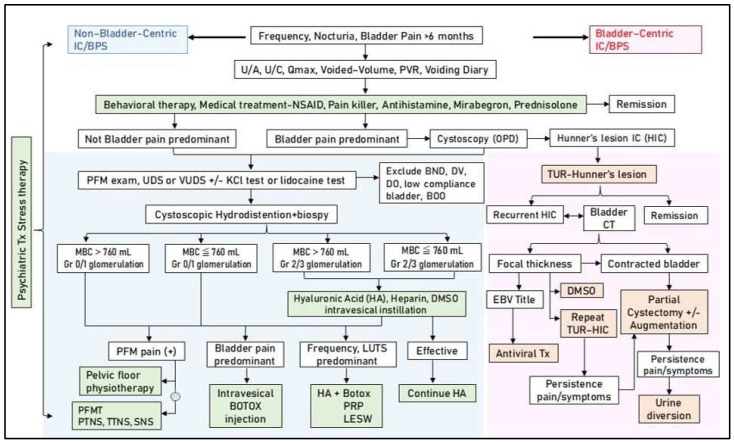
- The proposed multimodal algorithm is phenotype-driven: fulguration and antivirals for HIC; for NHIC, hydrodistension with BoNT-A every 6 months or suprapubic LESW plus GAG for significant pain/high-grade glomerulation; monthly PRP for four months plus GAG for frequency-predominant symptoms; pelvic floor physiotherapy and psychiatric consultation for pelvic pain and anxiety/depression.
Methods
- Narrative review; literature searched in PubMed, MEDLINE, and ScienceDirect from 1982 to April 2024 using keywords “interstitial cystitis” or “bladder pain syndrome” or “painful bladder syndrome” and “pathophysiology” or “bladder therapy,” limited to English-language full-text articles.
- Reviewed basic and clinical research on clinical characteristics, cystoscopic features, urine biomarkers, bladder inflammation, urothelial dysfunction, and novel bladder treatments; findings were synthesized narratively into a proposed multimodal treatment strategy. No systematic review, meta-analysis, or formal quality appraisal is described.
Limitations
- Stated in the paper: data from large randomized controlled studies are limited for GAG replenishment; clinical trials for BoNT-A, PRP, and LESW are few; a randomized comparative trial is lacking; there has been no comparison of safety and efficacy between novel and conventional treatments; and treatment duration and biomarkers for determining antiviral treatment duration have not been established.
- Evident from the text: this is a narrative review with a non-systematic search and no formal risk-of-bias assessment; many cited studies are small cohorts, single-center, or preliminary, and IC/BPS phenotypes are heterogeneous, limiting direct comparisons and generalizability.
Model-written summary. Check it against the paper before relying on it.
Integrity signals
Registry
Cites
Statistics
Figures
Verification
Claims the paper makes
2 Valid · 1 Not valid · 60 Not checked · 10 Own results and interpretations
The cited sources support only part of this claim — read each source’s verdict below.
In the paper
“If acute inflammation is not resolved, chronic inflammatory cells may infiltrate into the suburothelium and the detrusor muscle, resulting in pan-cystitis and chronic scar formation [8].”
§ The Pathomechanism and Current Treatments for Chronic Interstitial Cystitis and Bladder Pain Syndrome > 2. The Pathophysiology of NHIC
What the sources say
- Partly supportedcites [8] Akiyama Y. Luo Y. Hanno P.M. Maeda D. Homma Y. Interstitial cystitis/bladder pain syndrome: The evolving landscape, animal models and future perspectives Int. J. Urol. 2020 27 491 503 10.1111/iju.14229 32246572 PMC7768977 sourceExperimental — accuracy not yet measured
The 'Categorization of IC/BPS' section of Akiyama et al. (2020) does support part of the attribution: IC/BPS with Hunner lesions 'manifests epithelial denudation and chronic inflammatory changes, such as lymphoplasmacytic and MC infiltration, stromal fibrosis, and edema,' and 'these histological changes are not confined to Hunner lesions, but can be observed in the entire bladder (i.e. pancystitis)' (citing Maeda et al. 2015, ref 19). However, our copy nowhere frames this as the sequelae of unresolved acute inflammation, does not describe inflammatory cells infiltrating the detrusor muscle, and does not state chronic scar formation as an outcome — the closest detrusor-related content is a reference-listed study (Richter et al. 2010, ref 81) on detrusor fibrosis, not a claim made here. The temporal/causal chain and the detrusor-muscle and scar-formation elements of the citing sentence are therefore unsupported by this source. (LLM, conf=0.70)
hedgedstates a possible cause- Asserted: passes — The authors put it forward as true.
- Checkable: passes — It can be checked against evidence.
- Load-bearing: unclear — It is unclear whether the paper’s conclusions depend on it.
- Based: passes — The paper gives a reason why it holds.
- Partly supported
The cited sources support only part of this claim — read each source’s verdict below.
In the paper
“Although BoNT-A, PRP, and LESWs have been shown to effectively reduce inflammation, improve urothelial regeneration, and improve IC symptoms in IC/BPS bladders, the relevant clinical trials are few.”
§ The Pathomechanism and Current Treatments for Chronic Interstitial Cystitis and Bladder Pain Syndrome > 8. Multimodal Active Therapy Based on the Pathophysiology of IC/BPS
What the sources say
- Partly supportedcites [98] Lin C.C. Huang Y.C. Lee W.C. Chuang Y.C. New Frontiers or the Treatment of Interstitial Cystitis/Bladder Pain Syndrome—Focused on Stem Cells, Platelet-Rich Plasma, and Low-Energy Shock Wave Int. Neurourol. J. 2020 24 211 221 10.5213/inj.2040104.052 33017892 PMC7538293 sourceExperimental — accuracy not yet measured
For PRP and LESW the source clearly supports scarcity of clinical trials: the FUTURE DIRECTIONS section reports that a clinicaltrials.gov search on 'PRP', 'shock wave', 'interstitial cystitis' etc. found 'no major clinical trials are recruiting or underway', calling for multicenter randomized trials, and the Abstract states that despite preclinical proof of bladder regeneration, pain relief and anti-inflammation, 'clinical studies are still in their infancy' / 'solid evidence from clinical studies remains to be obtained'. BoNT-A, however, is outside this review's scope (stem cells, PRP, LESW): our copy mentions botulinum toxin only once, in CURRENT TREATMENT OF IC/BPS, as one item in the principles of pharmacotherapy ('intravesical botulinum toxin injection and dimethyl sulfoxide instillation'), with no statement about the number or paucity of BoNT-A clinical trials in IC/BPS. The BoNT-A component of the attributed claim is therefore not supported by this source. (LLM, conf=0.78)
plain- Asserted: passes — The authors put it forward as true.
- Checkable: passes — It can be checked against evidence.
- Load-bearing: passes — The paper’s conclusions depend on it.
- Based: passes — The paper gives a reason why it holds.
- Partly supported
None of the sources cited for this claim have been checked yet.
In the paper
“A comprehensive search of the literature for randomized control trials of different intravesical therapies for IC/BPS showed statistically significant improvements in IC symptoms compared to the controls or placebos [99].”
§ The Pathomechanism and Current Treatments for Chronic Interstitial Cystitis and Bladder Pain Syndrome > 8. Multimodal Active Therapy Based on the Pathophysiology of IC/BPS
What the sources say
- Not checked yetcites [99] Park J.J. Kim K.T. Lee E.J. Chun J. Lee S. Shim S.R. Kim J.H. Current updates relating totreatment for interstitial cystitis/bladder pain syndrome: Systematic review and network meta-analysis BMC Urol. 2024 24 95 10.1186/s12894-024-01485-w 38658949 PMC11040764 source
Checked before — its earlier verdict is held back until a new check runs.
plainstates a cause- Asserted: passes — The authors put it forward as true.
- Checkable: passes — It can be checked against evidence.
- Load-bearing: passes — The paper’s conclusions depend on it.
- Based: passes — The paper gives a reason why it holds.
- Not checked yet
None of the sources cited for this claim have been checked yet.
In the paper
“A randomized comparative trial is still lacking [98].”
§ The Pathomechanism and Current Treatments for Chronic Interstitial Cystitis and Bladder Pain Syndrome > 8. Multimodal Active Therapy Based on the Pathophysiology of IC/BPS
What the sources say
- Not checked yetcites [98] Lin C.C. Huang Y.C. Lee W.C. Chuang Y.C. New Frontiers or the Treatment of Interstitial Cystitis/Bladder Pain Syndrome—Focused on Stem Cells, Platelet-Rich Plasma, and Low-Energy Shock Wave Int. Neurourol. J. 2020 24 211 221 10.5213/inj.2040104.052 33017892 PMC7538293 source
Checked before — its earlier verdict is held back until a new check runs.
plain- Asserted: passes — The authors put it forward as true.
- Checkable: passes — It can be checked against evidence.
- Load-bearing: passes — The paper’s conclusions depend on it.
- Based: passes — The paper gives a reason why it holds.
- Not checked yet
A result the paper states — it cites no source for it, so there is none to check. The quote shows it is in the paper.
In the paper
“Since the pathophysiology of IC/BPS is multifactorial, an algorithm for treatment should be established in individual patients with IC/BPS.”
§ The Pathomechanism and Current Treatments for Chronic Interstitial Cystitis and Bladder Pain Syndrome > 8. Multimodal Active Therapy Based on the Pathophysiology of IC/BPS
plain- Asserted: passes — The authors put it forward as true.
- Checkable: passes — It can be checked against evidence.
- Load-bearing: passes — The paper’s conclusions depend on it.
- Based: passes — The paper gives a reason why it holds.
42 more claims
Create a free account to see all 73 claims and to verify the 71 references still open.
- Probably not a substantial claim. 7
- It may state two separate claims as one. 22
Self-check
Percentages, sums and reported differences re-computed from the paper’s own numbers.
Rated minor: it would not touch a result — a value no result rests on, a p-value that stays on the same side of the significance level, or a conflict that is clerical, resolved elsewhere in the paper, or outside its own findings.
In the paper
“56% (13/24) of the patients responded to tacrolimus installation”
§ The Pathomechanism and Current Treatments for Chronic Interstitial Cystitis and Bladder Pain Syndrome > 5. Autoimmune Reactions and Treatment for NHIC
Reported 56 · recomputed 54.166667
Citations
Cites
Jang, D.-I., Lee, A.-H., Shin, H.-Y., Song, H.-R., Park, J.-H., Kang, T.-B., Lee, S.-R., & Yang, S.-H. (2021) · International Journal of Molecular Sciences · doi:10.3390/ijms22052719 · Cited by 1,694
van de Merwe, J. P., Nordling, J., Bouchelouche, P., Bouchelouche, K., Cervigni, M., Daha, L. K., Elneil, S., Fall, M., Hohlbrugger, G., Irwin, P., et al. (2008) · European Urology · doi:10.1016/j.eururo.2007.09.019 · Cited by 952
Fibromyalgia and overlapping disorders: The unifying concept of central sensitivity syndromes
Yunus, M. B. (2007) · Seminars in Arthritis and Rheumatism · doi:10.1016/j.semarthrit.2006.12.009 · Cited by 780 · cited 1×
“Patients may also have anxiety and depression [83].”
BackgroundAUA Guideline for the Diagnosis and Treatment of Interstitial Cystitis/Bladder Pain Syndrome
Hanno, P. M., Burks, D. A., Clemens, J. Q., Dmochowski, R. R., Erickson, D., FitzGerald, M. P., Forrest, J. B., Gordon, B., Gray, M., Mayer, R. D., et al. (2011) · Journal of Urology · doi:10.1016/j.juro.2011.03.064 · Cited by 687
Thangam, E. B., Jemima, E. A., Singh, H., Baig, M. S., Khan, M., Mathias, C. B., Church, M. K., & Saluja, R. (2018) · Frontiers in Immunology · doi:10.3389/fimmu.2018.01873 · Cited by 534
Interstitial cystitis early diagnosis, pathology, and treatment
Messing, E. M., & Stamey, T. A. (1978) · Urology · doi:10.1016/0090-4295(78)90286-8 · Cited by 404
Diagnosis and Treatment of Interstitial Cystitis/Bladder Pain Syndrome
Clemens, J. Q., Erickson, D. R., Varela, N. P., & Lai, H. H. (2022) · Journal of Urology · doi:10.1097/ju.0000000000002756 · Cited by 362
The Mast Cell in Interstitial Cystitis: Role in Pathophysiology and Pathogenesis
Sant, G. R., Kempuraj, D., Marchand, J. E., & Theoharides, T. C. (2007) · Urology · doi:10.1016/j.urology.2006.08.1109 · Cited by 337
Parsons, C. L. (2007) · Urology · doi:10.1016/j.urology.2006.03.084 · Cited by 288
SANT, G. R., PROPERT, K. J., HANNO, P. M., BURKS, D., CULKIN, D., DIOKNO, A. C., HARDY, C., LANDIS, J. R., MAYER, R., MADIGAN, R., et al. (2003) · Journal of Urology · doi:10.1097/01.ju.0000083020.06212.3d · Cited by 281
Cited by
Global Consensus on Interstitial Cystitis/Bladder Pain Syndrome: An Update on Therapeutic Treatments
Buford, K., Peters, K. M., RIEDL, C. R., Mishra, N. N., Wyndaele, J., Lovász, S., Pinto, R. A., & Birder, L. A. (2025) · Neurourology and Urodynamics · doi:10.1002/nau.70106 · Cited by 19
Decoding Chronicity: Oxidative Stress and Inflammation as Systems Hubs
Formanowicz, D. (2025) · Biomedicines · doi:10.3390/biomedicines13122976 · Cited by 17
“Complementary reviews advocate for multimodal care, as seen in [11], which discusses approaches for IC/BPS management, including glycosaminoglycan replenishment, botulinum toxin type A (BTX-A), and pelvic floor therapy, highlighting phenotype-oriented algorithms.”
Anjum, İ., Nasir, A., Naseer, F., Ibrahim, A., Rehman, B., Bashir, F., & Ain, Q. T. (2025) · Frontiers in Pharmacology · doi:10.3389/fphar.2025.1483548 · Cited by 7
Yu, W., Jhang, J., Jiang, Y., & Kuo, H. (2026) · Tzu Chi Medical Journal · doi:10.4103/tcmj.tcmj-d-25-00028 · Cited by 4
“The causes for the unsatisfactory success rate are the heterogeneity of the disease, which might exhibit different pathophysiology and underlying etiology [2,9].”
Self-citationLong, X., Yu, B., Chen, M., Zhang, Q., Wang, Y., Huang, Y., Wu, J., Cen, P., Lan, H., Long, J., et al. (2025) · European Journal of Pharmacology · doi:10.1016/j.ejphar.2025.178184 · Cited by 3
Yang, D., He, Y., Alimu, P., Cao, D., & Liu, J. (2025) · Naunyn-Schmiedeberg s Archives of Pharmacology · doi:10.1007/s00210-025-04824-2 · Cited by 3
Zheng, Q., Zhang, P., Guo, W., Zhang, J., Zhang, F., Ma, C., Yang, Y., Cui, L., Yu-ling, W., & Zhang, L. (2025) · Bladder · doi:10.14440/bladder.2024.0052 · Cited by 2
“In contrast, inflammation in Hunner’s IC/BPS, which involves Epstein–Barr virus 14 infection in ulcerative lesions, is currently treated mainly with bladder mucosal cauterization.”
Tian, J.-H., Yu, W., Jhang, J., Jiang, Y., & Kuo, H. (2026) · International Urology and Nephrology · doi:10.1007/s11255-026-05065-9 · Cited by 3
Self-citationYu, W., Jhang, J., Jiang, Y., & Kuo, H. (2026) · Biomedicines · doi:10.3390/biomedicines14040834 · Cited by 2
“Based on the pathophysiology and clinical characteristics of the bladder disease, it is reasonable to implement a multimodal therapy for patients with IC/BPS and those who present with bladder and extra-bladder pathophysiology [9].”
InfluentialSelf-citationLi, X. G., Ma, Y., He, D., Huang, Y., Jiang, Y., Zhao, H., Ge, S., Zhao, R., Yuan, H., Jiang, W., et al. (2026) · Advanced Science · doi:10.1002/advs.76390 · Cited by 2
“HA and HA/CS are glycosaminoglycan (GAG)-replacement formulations that primarily function by protecting and restoring the bladder mucosal barrier [ 35, 36 ].”
Self-citationYang, C.-C., Jiang, Y.-H., & Kuo, H. (2025) · Urological Science · doi:10.1097/us9.0000000000000077 · Cited by 2
Self-citationHung, M., Yang, E., Ying, T.-H., Chien, P., Huang, Y.-T., & Chang, W.-W. (2025) · International Journal of Molecular Sciences · doi:10.3390/ijms27010130 · Cited by 1
“Urothelial dysfunction, often due to repeated bladder insults, is believed to permit urinary toxins, pathogens, and cationic substances to penetrate the suburothelial layer, resulting in chronic inflammation and neural sensitization [3,4].”
Zhao, J., Ju, C., Shao, C., Sun, Y., Yang, T., Liu, J., Wu, D., Li, H., Jia, R., Zhou, L., et al. (2026) · International Immunopharmacology · doi:10.1016/j.intimp.2026.116485 · Cited by 1
Wenjie, Y., Xin, J., Yang, L., Chenxi, L., & Gao, X. (2026) · Journal of Ethnopharmacology · doi:10.1016/j.jep.2026.121566 · Cited by 1
Yu, W., Jiang, Y., Jhang, J., & Kuo, H. (2026) · International Journal of Urology · doi:10.1111/iju.70416 · Cited by 1
Self-citationWang, W., Ma, J., Hou, C., Chen, J., & Ni, K. (2026) · Materials Today Bio · doi:10.1016/j.mtbio.2026.103673 · Cited by 1
“Available evidence indicates that disease development is associated with urothelial barrier dysfunction [62], aberrant mast-cell activation [63,64], neurogenic inflammation and central sensitization [65], autoimmunity [66,67], and genetic susceptibility [68].”
Increased prevalence of type 2 diabetes mellitus in urologic chronic pelvic pain syndrome
Rubin, B. E., Bleau, J. I., Plante, C. A., & Comiter, C. V. (2025) · Continence · doi:10.1016/j.cont.2025.102281 · Cited by 1
Huang, J., Zhao, L., Zhang, H., Wu, H., & Wang, L. (2025) · International Journal of Gynecology & Obstetrics · doi:10.1002/ijgo.70686
“8,9 The systemic inflammation response index (SIRI) is a composite inflammation index based on peripheral blood neutrophil, monocyte, and lymphocyte counts, calculated as SIRI = (neutrophil count × monocyte count) / lymphocyte count.”
Urogenital Findings in Ehlers-Danlos Syndrome Correlate with Underlying Tissue Laxity Mechanisms
Tonk, S. S., & Wilson, G. N. (2025) · Journal of Biosciences and Medicines · doi:10.4236/jbm.2025.1312013
qizi, M. S. V., & Rafaelovna, S. R. (2025) · Современная наука и исследования · doi:10.5281/zenodo.17745853
Yu, W., & Kuo, H. (2025) · Current Bladder Dysfunction Reports · doi:10.1007/s11884-025-00802-9
“Despite the availability of oral medications, intravesical instillations, and behavioral therapies, a substantial proportion of patients remain refractory to conventional treatments due to the unclear etiology and pathophysiology, which continue to pose a major challenge [15].”
Self-citationShi, M., Xue, W., Wen, X., & Pang, L. (2026) · BMC Urology · doi:10.1186/s12894-026-02061-0
“Interstitial cystitis (IC) is a complex chronic inflammatory disorder, and its pathogenesis is characterized by the dysregulation of multiple immune cells and molecular pathways [12, 13].”
Interstitial cystitis: a phenotype and rare variant exome sequencing study
Motelow, J. E., Malakar, A., Murthy, S. B. K., Verbitsky, M., Kahn, A., Estrella, E. A., Shao, W., Kunkel, L. M., Wiesenhahn, M., Beckett, J., et al. (2026) · EBioMedicine · doi:10.1016/j.ebiom.2026.106150
Dong, X., Guo, Z., Chen, X., Liu, S., He, C., Chen, C., & Zhao, J. (2026) · Urologia Journal · doi:10.1177/03915603261440236
“33 This study systematically analyzed the immune microenvironmental characteristics of IC/BPS by integrating singlecell RNA sequencing (scRNAseq), bulk RNAseq, and multiomics approaches.”
Yu, W., Jhang, J., Jiang, Y., & Kuo, H. (2026) · International Urogynecology Journal · doi:10.1007/s00192-026-06651-2
“The main reason is that the pathophysiology of IC/BPS, including chronic inflammation, increased urothelial cell apoptosis, reduced apical cell proliferation, and improved urothelial barrier dysfunction [8].”
Self-citationLived experiences of women with interstitial cystitis
Lu, Y.-Y., Lin, S.-H., & Wu, S.-F. (2026) · European Journal of Obstetrics & Gynecology and Reproductive Biology · doi:10.1016/j.ejogrb.2026.115166
Zhan, P., Chen, J., Zhao, J., Tang, M., Gao, T., Fu, S., Li, H., & Wang, J. (2026) · Medicine · doi:10.1097/md.0000000000049051
“[6,7] This study aims to address the following questions: Which specific immune cell types causally influence the risk of cystitis?”
Interstitial Cystitis and Dietary Interventions: A Systematic Review
Alahmed, F. B., Hall, A., Rhodes, S., Jarvis, M., & Sheyn, D. (2026) · International Urogynecology Journal · doi:10.1007/s00192-026-06572-0
“In clinical practice, medications such as pentosan polysulfate sodium, nonsteroidal anti-inflammatory drugs (NSAIDs), and anti-depressants have been used to reduce interstitial cystitis/ bladder pain syndrome (IC/BPS) flares [3, 4].”
Favero, G., Zeppernick, F. A., Zeppernick, M. M., Pfiffer, T., Schwandner, T., & Meinhold-Heerlein, I. M. (2026) · Archives of Gynecology and Obstetrics · doi:10.1007/s00404-026-08507-y
Are We Missing the Bladder? Reflections on Endometriosis and IC/BPS
Favero, G. D., Zeppernick, F. A., Zeppernick, M. M., Pfiffer, T., Schwandner, T., & Meinhold-Heerlein, I. M. (2026) · International Urogynecology Journal · doi:10.1007/s00192-026-06804-3
Microglial TLR4 Mediates Post-UTI Chronic Pelvic PainPreprint
Jmii, H., Ghura, S., Schaeffer, A. J., & Klumpp, D. (2026) · bioRxiv (Cold Spring Harbor Laboratory) · doi:10.64898/2026.08.04.742321
“Acute UTI disrupts urothelial integrity and causes bladder inflammation and sensory nerve responses [9 – 11] .”
Chaparala, V., Kallurkar, A. R., Jones, C., Reddy, A., Shekoohi, S., & Kaye, A. D. (2026) · Springer eBooks · doi:10.1007/978-3-032-25214-2_26
Challenges in modeling interstitial cystitis: implications for drug discovery efforts
Arnott, J. A., & Planey, S. L. (2026) · Expert Opinion on Drug Discovery · doi:10.1080/17460441.2026.2726301
“Despite decades of research, no curative or consistently effective disease-modifying therapy has been developed for IC/BPS. Current care remains largely symptom based, reflecting the limited success of existing interventions across a biologically heterogeneous patient population [2,6,17].”
Kuo, C.-Y., Yu, W., Jiang, Y., Jhang, J., & Kuo, H. (2026) · Tzu Chi Medical Journal · doi:10.4103/tcmj.tcmj-d-26-00232
Self-citationFavero, G. D., Pfiffer, T., Perales, I., & Meinhold-Heerlein, I. M. (2026) · Deutsches Ärzteblatt · doi:10.3238/persgyn.2026.10.16.03
王建国, Zhang, N., Yang, S., & Chen, W. (2026) · Biomedicines · doi:10.3390/biomedicines14102266
“Through released mediators, they communicate with immune cells, afferent nerves, stromal cells, and detrusor muscle [7,8,10].”
InfluentialIngawale, S., Khan, H. B., & Nadeem, M. (2026) · Expert Review of Clinical Pharmacology · doi:10.1080/17512433.2026.2747637
“The therapeutic pathway is multimodal, and treatment response varies substantially between phenotypes [1–3].”
Qiao, P., Tian, Z., & He, Z. (2026) · LUTS Lower Urinary Tract Symptoms · doi:10.1111/luts.70101
Sheikhi, Z., Soleimani, B., Aslzare, M., Aghasizadeh, M., & Qayenipour, P. (2026) · Trends in Urology & Men s Health · doi:10.1002/tre.70054
Metadata
- Authors
- Yu, W.-R., Jhang, J.-F., Jiang, Y.-H., & Kuo, H.-C.
- Affiliations
- Tzu Chi University (TW)
- Corresponding author
- Kuo, Hann-Chorng
- Venue
- Biomedicines
- Publisher
- MDPI AG
- Published
- 2024-09-10
- Volume
- 12
- Issue
- 9
- Pages
- 2051
- ISSN
- 2227-9059 (ISSN-L)
- PMC
- PMC11428245
- OpenAlex
- W4402430374
- Semantic Scholar
- dfa8ed44d0ec591b2333dd50a0483b7926a91863
- Cited by
- 39
- References
- 99
- Citations by year
- 2026: 26 · 2025: 13
- FWCI
- 3.13
- Type
- journal article
- Language
- en
- Open access
- gold
- doi.org
- Licence
- Locations
- Biomedicines (publishedVersion, cc-by)
- PubMed Central (publishedVersion, cc-by)
- PubMed (publishedVersion)
- DOAJ (DOAJ: Directory of Open Access Journals) (submittedVersion, cc-by-sa)
- Funders
- Buddhist Tzu Chi Medical Foundation (TCMF-MP-110-03-01, TCMF-SP-112-01)
- Topics
- Health Sciences › Medicine › Urology › Urinary Bladder and Prostate Research
- Health Sciences › Medicine › Surgery › Urinary and Genital Oncology Studies
- Health Sciences › Medicine › Urology › Urinary Tract Infections Management
- Keywords
- interstitial cystitis, urothelial dysfunction, chronic inflammation, central sensitization, urinary biomarkers, cystitis, glycosaminoglycans, botulinum toxin type A, platelet-rich plasma, low-energy shock wave therapy, immunosuppression, low-dose prednisolone, psychological stress, quality of life
About these checks
Registry, retraction, Cites and statistics results are computed, not judged, with one exception: a printed reference that no index lists is read once by a model before it counts as a citation error. Claims are extracted by a model and kept only when their quote appears verbatim in the text; each cited source is then checked, with a model’s help, for whether it says what the claim relies on. Those verdicts can be wrong — read the claim’s quote and the cited source before relying on one.
The claim verdicts this report counts are experimental: their accuracy is not yet measured.
A language model drew the claims from the paper on 2026-11-18, under version 3 of the claim definition (model deepseek-v4.1-flash, prompt extract-v3).
A second model labelled each claim on 2026-11-18 (model jev-1.13-20260917, definition revision gold-guideline-v0.2).
Cited sources are checked with a language model’s help (qwen3.8-omni-flash).
Statistics and arithmetic are recomputed, not judged.
Confidence bands are shown only for fields calibrated on our annotated test set. None is calibrated yet, so no band is shown.
What counts as a claim ›How we measure confidence ›How we check this ›
Are you an author, or do you see a problem with this page? Request a review
Data sources
Bibliographic data: Semantic Scholar, OpenAlex, Crossref.
Contains information from the Semantic Scholar Academic Graph Datasets, made available under the ODC Attribution License (ODC-BY 1.0).
Semantic Scholar’s data is described in: Kinney, R., et al. (2023). The Semantic Scholar Open Data Platform. arXiv:2301.10140.
