

The DOI matches its Crossref record; 241 of the 242 references it cites were found in a registry or an index.
Can Metformin Exert as an Active Drug on Endothelial Dysfunction in Diabetic Subjects
Open accessAbstract
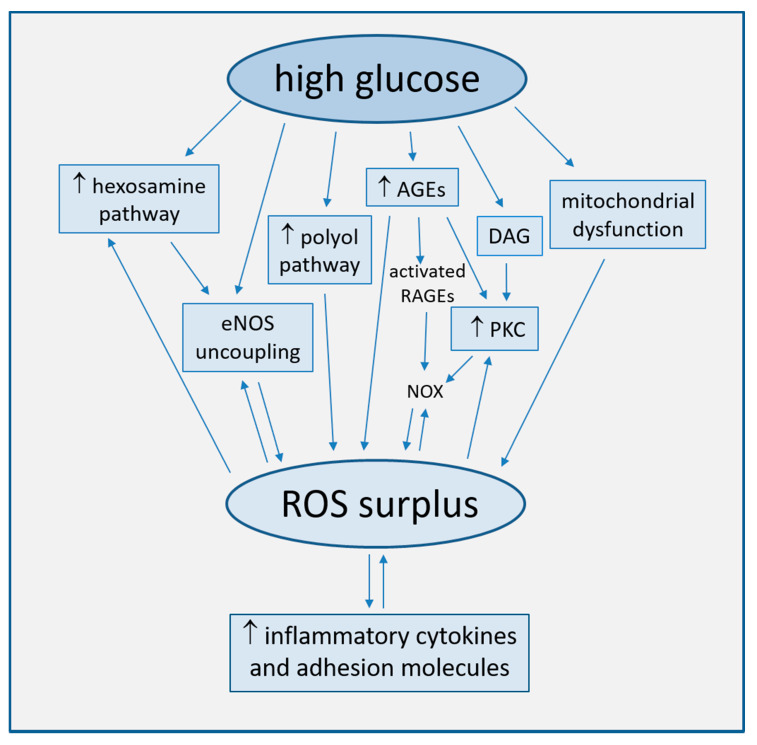
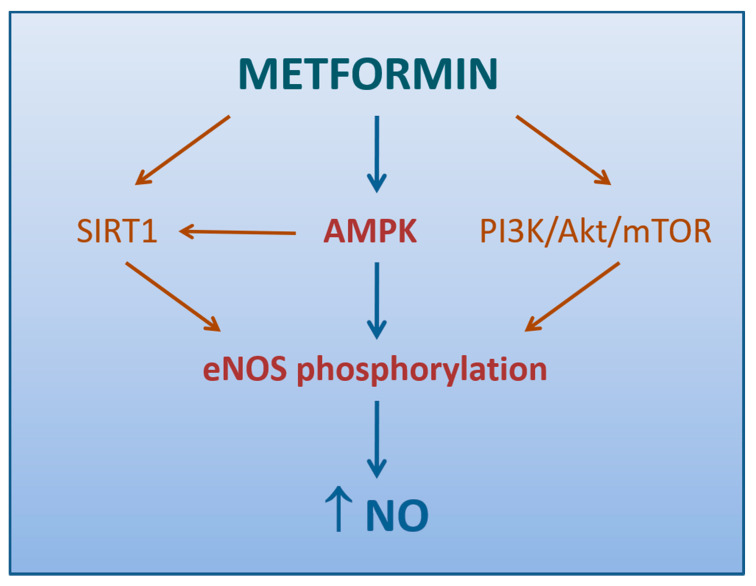
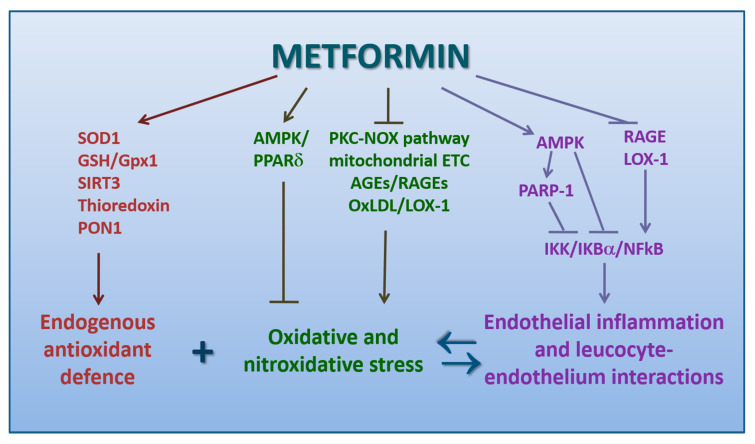
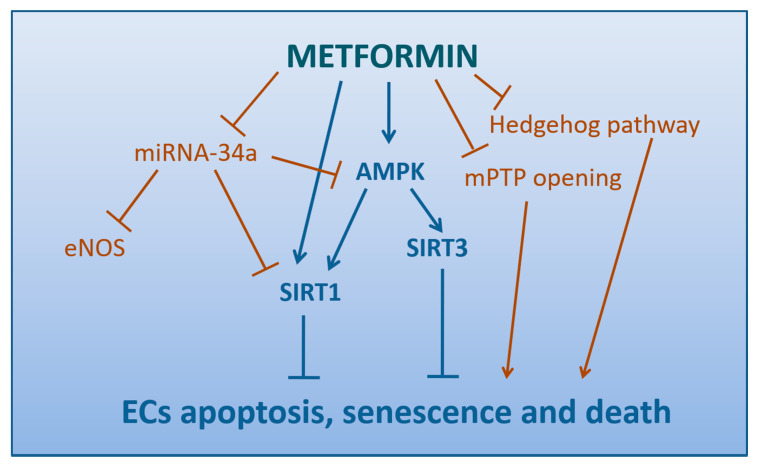
Cardiovascular mortality is a major cause of death among in type 2 diabetes (T2DM). Endothelial dysfunction (ED) is a well-known important risk factor for the development of diabetes cardiovascular complications. Therefore, the prevention of diabetic macroangiopathies by preserving endothelial function represents a major therapeutic concern for all National Health Systems. Several complex mechanisms support ED in diabetic patients, frequently cross-talking each other: uncoupling of eNOS with impaired endothelium-dependent vascular response, increased ROS production, mitochondrial dysfunction, activation of polyol pathway, generation of advanced glycation end-products (AGEs), activation of protein kinase C (PKC), endothelial inflammation, endothelial apoptosis and senescence, and dysregulation of microRNAs (miRNAs). Metformin is a milestone in T2DM treatment. To date, according to most recent EASD/ADA guidelines, it still represents the first-choice drug in these patients. Intriguingly, several extraglycemic effects of metformin have been recently observed, among which large preclinical and clinical evidence support metformin's efficacy against ED in T2DM. Metformin seems effective thanks to its favorable action on all the aforementioned pathophysiological ED mechanisms. AMPK pharmacological activation plays a key role, with metformin inhibiting inflammation and improving ED. Therefore, aim of this review is to assess metformin's beneficial effects on endothelial dysfunction in T2DM, which could preempt development of atherosclerosis.
Overview
The claims and statistics of this paper haven’t been checked yet.
Run the check — free, no account needed. It reads the open-access text and checks the sources it cites.
Integrity signals
Registry
Cites
Statistics
Figures
Verification
Claims the paper makes
The claims and statistics of this paper haven’t been checked yet.
Run the check — free, no account needed. It reads the open-access text and checks the sources it cites.
Claims other papers make about this one
Each is checked against this paper’s own text: does it say what the citing paper says it does?
In the citing paper
“Based on critical reviews of the literature, the answer appears to be “yes”, although the clinical data could be interpreted as secondary to metformin’s actions to enhance insulin sensitivity and lower blood glucose levels (34, 106, 173).”
From A Critical Review of the Evidence That Metformin Is a Putative Anti-Aging Drug That Enhances Healthspan and Extends Lifespan (2021) · cites this paper as [173]
Self-check
Percentages, sums and reported differences re-computed from the paper’s own numbers.
The self-check needs the paper’s full text.
Citations
Cites
10 retracted
Activation of the AMP-activated Protein Kinase by the Anti-diabetic Drug Metformin in Vivo
Zou, M., Kirkpatrick, S. S., Davis, B. J., Nelson, J. S., Wiles, W. G., Schlattner, U., Neumann, D., Brownlee, M., Freeman, M. B., & Goldman, M. H. (2004) · Journal of Biological Chemistry · doi:10.1074/jbc.m404421200 · Cited by 480
RetractedMetformin monotherapy for type 2 diabetes mellitus
Sáenz, A., Fernandez-Esteban, I., Mataix, A. L., Segura, M. A., Figuls, M. R. I., & Moher, D. (2005) · Cochrane Database of Systematic Reviews · doi:10.1002/14651858.cd002966.pub3 · Cited by 310
RetractedXu, J., Wu, Y., Song, P., Zhang, M., Wang, S., & Zou, M. (2007) · Circulation · doi:10.1161/circulationaha.106.684795 · Cited by 193
RetractedDong, Y., Zhang, M., Wang, S., Liang, B., Zhao, Z., Liu, C., Wu, M., Choi, H. C., Lyons, T. J., & Zou, M. (2010) · Diabetes · doi:10.2337/db09-1637 · Cited by 187
RetractedWang, S., Xu, J. C., Song, P., Viollet, B., & Zou, M. (2009) · Diabetes · doi:10.2337/db09-0267 · Cited by 137
RetractedHao, B., Xiao, Y., Song, F., Long, X., Huang, J., Tian, M., Deng, S., & Wu, Q. (2017) · International Journal of Molecular Medicine · doi:10.3892/ijmm.2017.3346 · Cited by 42
RetractedBułdak, Ł., Łabuzek, K., Bułdak, R. J., Machnik, G., Bołdys, A., Basiak, M., & Okopień, B. (2016) · Experimental and Therapeutic Medicine · doi:10.3892/etm.2016.2977 · Cited by 19
RetractedYu, B., Wu, Y., & Zhao, L. (2019) · Biochemical and Biophysical Research Communications · doi:10.1016/j.bbrc.2019.11.181 · Cited by 6
RetractedBułdak, Ł., Łabuzek, K., Bułdak, R. J., Machnik, G., Bołdys, A., Basiak, M., & Okopień, B. (2016) · Experimental and Therapeutic Medicine · doi:10.3892/etm.2016.3973 · Cited by 5
RetractedZou, M., Kirkpatrick, S. S., Davis, B. J., Nelson, J. S., Wiles, W. G., Schlattner, U., Neumann, D., Brownlee, M., Freeman, M. B., & Goldman, M. H. (2019) · Journal of Biological Chemistry · doi:10.1074/jbc.w119.010595 · Cited by 1
Retracted
Cited by
Sorted by citations
Mohammed, I., Hollenberg, M. D., Ding, H., & Triggle, C. R. (2021) · Frontiers in Endocrinology · doi:10.3389/fendo.2021.718942 · Cited by 278
Metformin: Is it a drug for all reasons and diseases?
Triggle, C. R., Mohammed, I., Bshesh, K., Marei, I., Ye, K., Ding, H., MacDonald, R. S., Hollenberg, M. D., & Hill, M. A. (2022) · Metabolism · doi:10.1016/j.metabol.2022.155223 · Cited by 300
Metformin: A Review of Potential Mechanism and Therapeutic Utility Beyond Diabetes
Dutta, S., Shah, R., Singhal, S., Dutta, S. B., Bansal, S., Sinha, S., & Haque, M. (2023) · Drug Design Development and Therapy · doi:10.2147/dddt.s409373 · Cited by 296
The Effects of Curcumin on Diabetes Mellitus: A Systematic Review
Marton, L. T., Pescinini-e-Salzedas, L. M., Camargo, M. E. C., Barbalho, S. M., Haber, J. F. D. S., Sinatora, R. V., Detregiachi, C. R. P., Gírio, R. J. S., Buchaim, D. V., & Bueno, P. C. D. S. (2021) · Frontiers in Endocrinology · doi:10.3389/fendo.2021.669448 · Cited by 220
Pathophysiological Association between Diabetes Mellitus and Endothelial Dysfunction
Maruhashi, T., & Higashi, Y. (2021) · Antioxidants · doi:10.3390/antiox10081306 · Cited by 203
Metadata
- Authors
- Salvatore, T., Pafundi, P. C., Galiero, R., Rinaldi, L., Caturano, A., Vetrano, E., Aprea, C., Albanese, G., Di Martino, A., Ricozzi, C., Imbriani, S., & Sasso, F. C.
- Affiliations
- University of Campania "Luigi Vanvitelli" (IT)
- Department of Advanced Medical and Surgical Sciences, University of Campania Luigi Vanvitelli, Piazza Luigi Miraglia 2, I-80138 Naples, Italy
- Corresponding author
- Sasso, Ferdinando Carlo
- ORCID
- Venue
- Biomedicines
- Publisher
- MDPI AG
- Published
- 2020-12-22
- Volume
- 9
- Issue
- 1
- Pages
- 3
- ISSN
- 2227-9059 (ISSN-L)
- PMC
- PMC7822116
- OpenAlex
- W3113948922
- Cited by
- 97
- References
- 242
- Citations by year
- 2026: 5 · 2025: 8 · 2024: 22 · 2023: 13 · 2022: 32 · 2021: 17
- FWCI
- 1.98
- Type
- journal article
- Language
- en
- Open access
- gold
- doi.org
- Licence
- Locations
- Biomedicines (publishedVersion, cc-by)
- Europe PMC (PubMed Central) (publishedVersion, other-oa)
- PubMed Central (publishedVersion, cc-by)
- PubMed (publishedVersion)
- DOAJ (DOAJ: Directory of Open Access Journals) (submittedVersion, cc-by-sa)
- Archivio Istituzionale della Ricerca - Università degli Studi della Campania "Luigi Vanvitelli" (submittedVersion)
- Archivio Istituzionale della Ricerca - Università degli Studi del Molise (submittedVersion)
- Topics
- Health Sciences › Medicine › Physiology (medical) › Nitric Oxide and Endothelin Effects
- Health Sciences › Medicine › Endocrinology, Diabetes and Metabolism › Diabetes Treatment and Management
- Life Sciences › Biochemistry, Genetics and Molecular Biology › Molecular Biology › Metabolism, Diabetes, and Cancer
- Keywords
- metformin, endothelial dysfunction, type 2 diabetes, AMPK activation, diabetic macroangiopathy, cardiovascular complications, endothelial inflammation, oxidative stress, advanced glycation end products, polyol pathway, protein kinase C, endothelial cell apoptosis, microRNA, atherosclerosis prevention
About these checks
Registry, retraction, Cites and statistics results are computed, not judged, with one exception: a printed reference that no index lists is read once by a model before it counts as a citation error. Claims are extracted by a model and kept only when their quote appears verbatim in the text; each cited source is then checked, with a model’s help, for whether it says what the claim relies on. Those verdicts can be wrong — read the claim’s quote and the cited source before relying on one.
Statistics and arithmetic are recomputed, not judged.
Confidence bands are shown only for fields calibrated on our annotated test set. None is calibrated yet, so no band is shown.
What counts as a claim ›How we measure confidence ›How we check this ›
Are you an author, or do you see a problem with this page? Request a review
