

Chronic Ethanol Exposure during Adolescence Increases Voluntary Ethanol Consumption in Adulthood in Female Sprague Dawley Rats
Open accessThe DOI matches its Crossref record; 33 of the 33 references it cites were found in a registry or an index.
Abstract
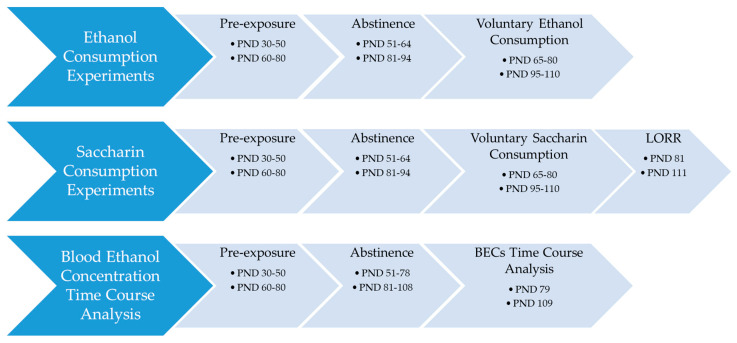
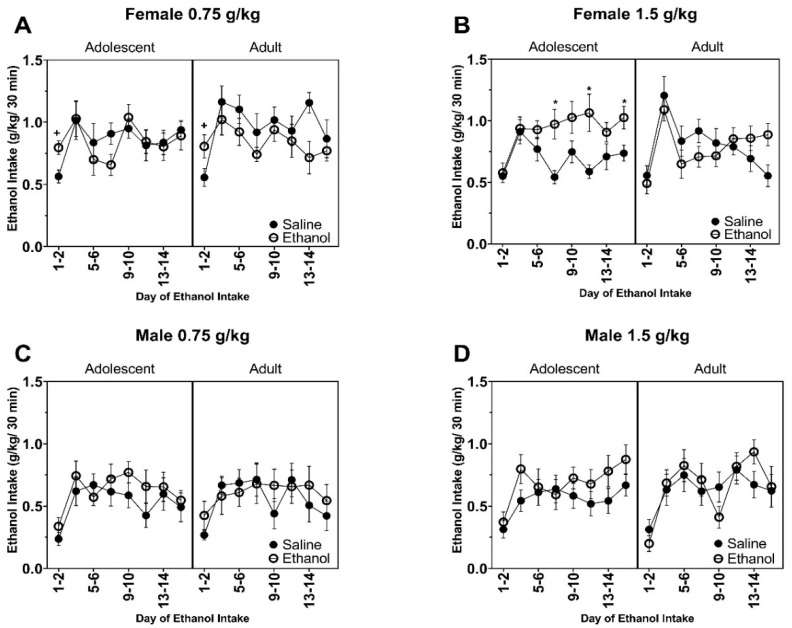
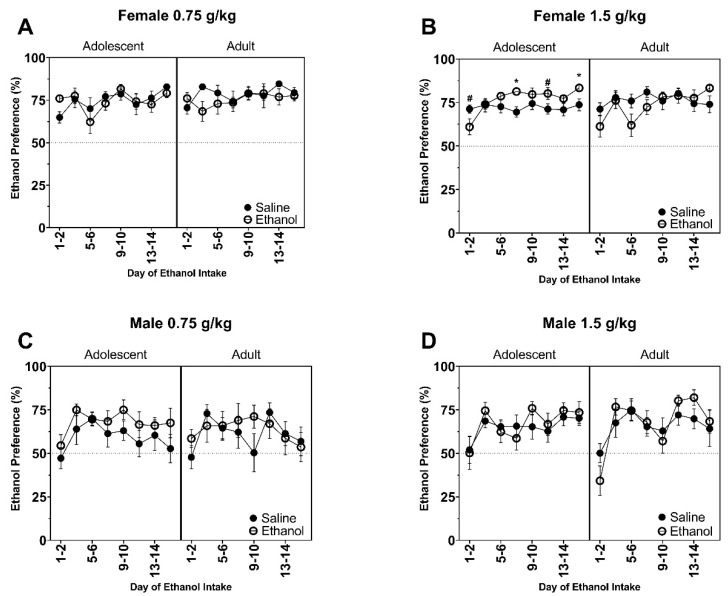
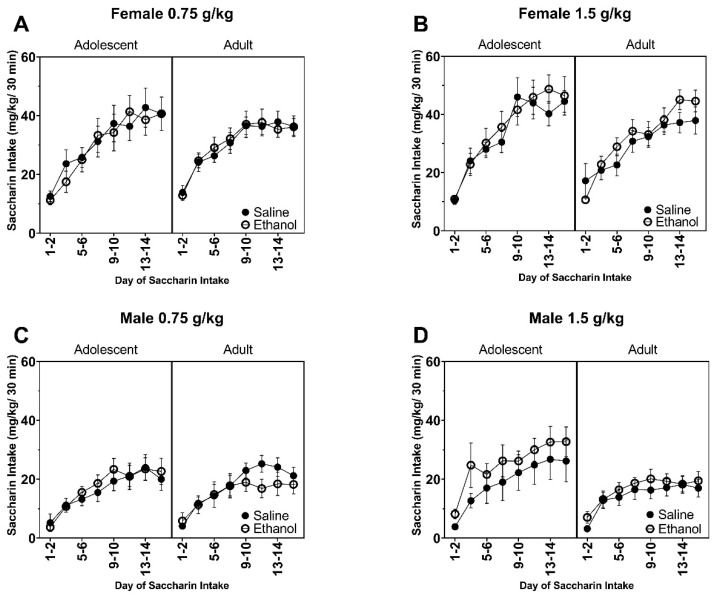
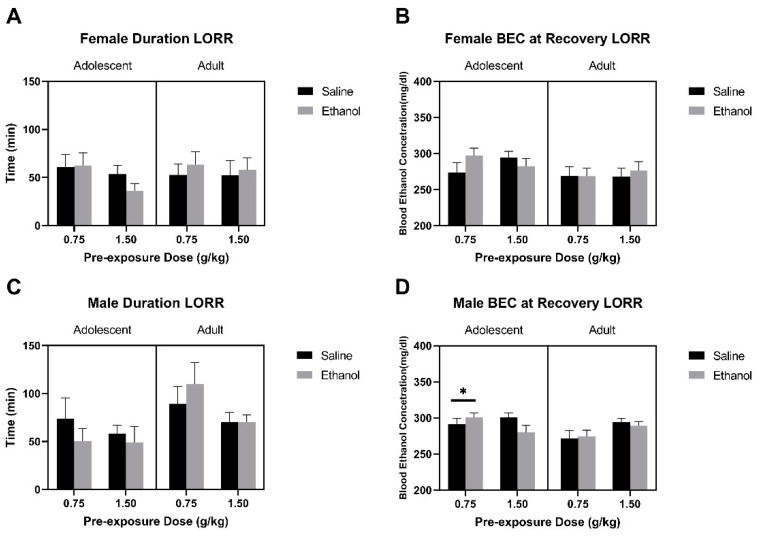
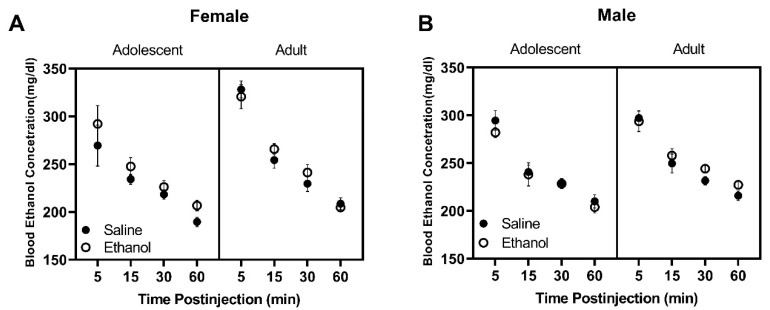
Early alcohol use is a major concern due to the dramatic rise in alcohol use during adolescence. In humans, adolescent males and females consume alcohol at equivalent rates; however, in adulthood males are more likely to consume harmful levels of alcohol. In animal models, the long-term dose-dependent and sex-dependent effects of alcohol exposure during adolescence have not been readily assessed relative to exposure that is initiated in adulthood. The purpose of the present set of experiments was to determine if adolescent exposure to chronic ethanol would predispose male and female rats to greater ethanol intake in adulthood when compared to animals that were not exposed to chronic ethanol exposure until early adulthood. Male and female rats were chronically administered 0.75 g/kg or 1.5 g/kg ethanol or saline for 21 days during adolescence (postnatal day (PND) 30–50) or adulthood (PND 60–80). All rats subsequently underwent 14-days of abstinence (PND 51–64 or PND 81–94, respectively). Finally, all rats were given 30-min daily access to saccharin-sweetened ethanol or saccharin alone from PND 65–80 for adolescent-exposed rats and PND 95–110 for adult-exposed rats. Exposure to 0.75 g/kg ethanol did not alter ethanol or saccharin intake in adolescent-exposed or adult-exposed rats, regardless of sex. In contrast, chronic exposure to the higher 1.5 g/kg dose during adolescence increased ethanol intake in adulthood in female rats. However, there was no change in saccharin intake in animals exposed to 1.5 g/kg ethanol during adolescence or adulthood, regardless of sex. Additionally, there were no clear age- and ethanol-dependent changes in duration of loss of righting reflex and blood ethanol concentrations to a challenge administration of a higher dose of ethanol. The results of the present set of experiments indicate chronic exposure to a high dose of ethanol during adolescence in female rats did indeed predispose rats to consume more ethanol in adulthood. Given that these effects were only observed in adolescent-exposed female rats, these results support a unique vulnerability to the long-term consequences of adolescent ethanol exposure in female rats, an effect that is not merely mediated by the sweetener used in the ethanol solution.
Overview
The claims and statistics of this paper haven’t been checked yet.
Free: it reads the open-access text and checks the first 5 claims that cite a source we can check. Create a free account to check every claim.
Integrity signals
Registry
Cites
Statistics
Figures
Verification
Claims the paper makes
The claims and statistics of this paper haven’t been checked yet.
Free: it reads the open-access text and checks the first 5 claims that cite a source we can check. Create a free account to check every claim.
Claims other papers make about this one
Each is checked against this paper’s own text: does it say what the citing paper says it does?
The cited source says what the claim attributes to it.
In the citing paper
“AAE also increases future alcohol consumption in rodents [32, 33], as well as humans [34].”
From Consequences of adolescent drug use (2023) · cites this paper as [32]
Self-check
Percentages, sums and reported differences re-computed from the paper’s own numbers.
The self-check needs the paper’s full text.
Citations
Cites
The adolescent brain and age-related behavioral manifestations
Spear, L. P. (2000) · Neuroscience & Biobehavioral Reviews · doi:10.1016/s0149-7634(00)00014-2 · Cited by 5,433 · cited 1×
“Adolescence is the time period in which most alcohol experimentation and the development of addiction begins [1].”
BackgroundJohnston, L., Miech, R., & O'Malley, P. (2020) · doi:10.3998/2027.42/162579 · Cited by 1,611 · cited 2×
“Consequently, the impact of adolescent episodic heavy or binge drinking is important to understand its effects on prolonged alcohol drinking behaviors [2].”
BackgroundAge at first drink and the first incidence of adult-onset DSM-IV alcohol use disorders
Dawson, D. A., Goldstein, R. B., Patricia Chou, S., June Ruan, W., & Grant, B. F. (2008) · Alcoholism: Clinical and Experimental Research · doi:10.1111/j.1530-0277.2008.00806.x · Cited by 548 · cited 1×
“Drinking before age 15 in humans is associated with a several-fold higher drinking likelihood in adulthood compared to those that waited longer to begin drinking alcohol [6].”
BackgroundPascual, M., Boix, J., Felipo, V., & Guerri, C. (2009) · Journal of Neurochemistry · doi:10.1111/j.1471-4159.2008.05835.x · Cited by 317
Decreased Sensitivity to the Hypnotic Effects of Ethanol Early in Ontogeny
Silveri, M. M., & Spear, L. P. (1998) · Alcoholism: Clinical and Experimental Research · doi:10.1111/j.1530-0277.1998.tb04310.x · Cited by 260 · cited 1×
“Adolescent rats are less sensitive to the sedative effects of ethanol compared to adult rats [13] and show tolerance to the hypnotic effects of ethanol [12,24].”
BackgroundDifferential Effects of Ethanol in Adolescent and Adult Rats
Little, P. J., Kuhn, C. M., Wilson, W. A., & Swartzwelder, H. S. (1996) · Alcoholism: Clinical and Experimental Research · doi:10.1111/j.1530-0277.1996.tb01133.x · Cited by 240 · cited 1×
“Adolescent rats are less sensitive to the sedative effects of ethanol compared to adult rats [13] and show tolerance to the hypnotic effects of ethanol [12,24].”
BackgroundVetter, C. S., Doremus‐Fitzwater, T. L., & Spear, L. P. (2007) · Alcoholism: Clinical and Experimental Research · doi:10.1111/j.1530-0277.2007.00417.x · Cited by 202 · cited 1×
“In contrast, other work has shown that rats given voluntary access to unsweetened ethanol beginning in adolescence and extending into adulthood (PND 28–90) showed no differences from rats that began voluntarily consuming ethanol beginning in adulthood (PND 71–90; [21]).”
ResultPatrick, M. E., Schulenberg, J. E., O'malley, P. M., Johnston, L. D., & Bachman, J. G. (2011) · Journal of Studies on Alcohol and Drugs · doi:10.15288/jsad.2011.72.106 · Cited by 183 · cited 1×
“Escalated rates of alcohol drinking during adolescence can be attributed to increases in risk-taking, novelty-seeking, and social behavioral motivations [3,4].”
BackgroundDifferential effects of ethanol on motor coordination in adolescent and adult rats
White, A. (2002) · Pharmacology Biochemistry and Behavior · doi:10.1016/s0091-3057(02)00860-2 · Cited by 176 · cited 1×
“Previous research suggests that higher ethanol doses have a greater impact compared to lower doses in both age groups [14].”
BackgroundCrews, F. T., Robinson, D. L., Chandler, L. J., Ehlers, C. L., Mulholland, P. J., Pandey, S. C., Rodd, Z. A., Spear, L. P., Swartzwelder, H. S., & Vetreno, R. P. (2019) · Alcoholism: Clinical and Experimental Research · doi:10.1111/acer.14154 · Cited by 165
Lancaster, F. E., Brown, T. D., Coker, K. L., Elliott, J. A., & Wren, S. B. (1996) · Alcoholism: Clinical and Experimental Research · doi:10.1111/j.1530-0277.1996.tb01945.x · Cited by 164 · cited 1×
“In rodent work, sex differences in voluntary alcohol drinking have been observed, beginning in adolescence [9].”
BackgroundGilpin, N. W., Karanikas, C. A., & Richardson, H. N. (2012) · PLoS ONE · doi:10.1371/journal.pone.0031466 · Cited by 146 · cited 1×
“0 g/kg via intraperitoneal injections decreased ethanol consumption in adulthood in male Wistar rats [32].”
MethodMotivational properties of ethanol in naive rats as studied by place conditioning
van der Kooy, D., O'Shaughnessy, M., Mucha, R. F., & Kalant, H. (1983) · Pharmacology Biochemistry and Behavior · doi:10.1016/0091-3057(83)90117-x · Cited by 137
Place Conditioning: Age-Related Changes in the Rewarding and Aversive Effects of Alcohol
Philpot, R. M., Badanich, K. A., & Kirstein, C. L. (2003) · Alcoholism: Clinical & Experimental Research · doi:10.1097/01.alc.0000060530.71596.d1 · Cited by 127
Self-citationSex differences in the behavioral sequelae of chronic ethanol exposure
Jury, N. J., DiBerto, J. F., Kash, T. L., & Holmes, A. (2017) · Alcohol · doi:10.1016/j.alcohol.2016.07.007 · Cited by 115 · cited 3×
“In studies conducted in mice, no sex differences in duration of LORR were observed [26,27].”
BackgroundCorrea, M., Arizzi, M. N., Betz, A. J., Mingote, S., & Salamone, J. D. (2003) · Brain Research Bulletin · doi:10.1016/j.brainresbull.2003.09.013 · Cited by 114 · cited 1×
“In contrast, low ethanol doses produce stimulatory effects of locomotor activity [16] in adult rats.”
BackgroundDevelopmental Differences in the Acquisition of Tolerance to Ethanol
Swartzwelder, H. S., Richardson, R., Markwiese, B. J., Wilson, W. A., & Little, P. (1998) · Alcohol · doi:10.1016/s0741-8329(97)00135-3 · Cited by 108 · cited 1×
“Adolescent rats are less sensitive to the sedative effects of ethanol compared to adult rats [13] and show tolerance to the hypnotic effects of ethanol [12,24].”
BackgroundBarry, A. E., King, J. L., Sears, C. L., Harville, C., Bondoc, I., & Joseph, K. (2015) · Journal of School Health · doi:10.1111/josh.12351 · Cited by 99
Trajectories of Adolescent Alcohol Use by Gender and Early Initiation Status
Bolland, K. A., Bolland, J. M., Tomek, S., Devereaux, R. S., Mrug, S., & Wimberly, J. C. (2016) · Youth & Society · doi:10.1177/0044118x13475639 · Cited by 88 · cited 2×
“These data indicate the age of initiation of alcohol use can be a significant predictor of higher alcohol and other substance abuse later in life [7,10,11] and highlight important sex differences based on adolescent alcohol use that may influence alcohol use disorders later in life.”
BackgroundAlcohol during adolescence selectively alters immediate and long-term behavior and neurochemistry
Maldonado-Devincci, A. M., Badanich, K. A., & Kirstein, C. L. (2010) · Alcohol · doi:10.1016/j.alcohol.2009.09.035 · Cited by 88
Self-citationSilvers, J. M., Tokunaga, S., Mittleman, G., & Matthews, D. B. (2003) · Alcoholism: Clinical and Experimental Research · doi:10.1097/01.alc.0000090141.66526.22 · Cited by 85 · cited 1×
“0 g/kg ethanol and assessed for LORR according to previously published methods [28].”
MethodLinsenbardt, D. N., Moore, E. M., Gross, C. D., Goldfarb, K. J., Melón, L. C., & Boehm, S. L. (2009) · Alcoholism Clinical and Experimental Research · doi:10.1111/j.1530-0277.2008.00857.x · Cited by 83 · cited 4×
“In studies conducted in mice, no sex differences in duration of LORR were observed [26,27].”
BackgroundResultInfluentialEffects of adolescent ethanol exposure on ethanol consumption in adult rats
Slawecki, C. J., & Betancourt, M. (2002) · Alcohol · doi:10.1016/s0741-8329(01)00192-6 · Cited by 81 · cited 1×
“Forced periadolescent (PND 30–40) exposure to ethanol vapor for 12 h a day also did not enhance sucrose sweetened ethanol drinking in adulthood (>PND 92; [22]).”
BackgroundAge-related differences in the blood alcohol levels of Wistar rats
Walker, B. M., & Ehlers, C. L. (2009) · Pharmacology Biochemistry and Behavior · doi:10.1016/j.pbb.2008.09.017 · Cited by 80
Maldonado-Devincci, A. M., Alipour, K. K., Michael, L. A., & Kirstein, C. L. (2010) · Pharmacology Biochemistry and Behavior · doi:10.1016/j.pbb.2010.07.008 · Cited by 70 · cited 1×
“We previously published work showing that chronic intermittent ethanol exposure via gavage increased sweetened ethanol intake in adulthood [20].”
BackgroundSelf-citationBadanich, K. A., Maldonado, A. M., & Kirstein, C. L. (2007) · Alcoholism: Clinical and Experimental Research · doi:10.1111/j.1530-0277.2007.00370.x · Cited by 66 · cited 1×
“However, we previously showed that chronic exposure to the low dose of ethanol during adolescence altered basal dopamine levels in adulthood in male rats [29].”
BackgroundSelf-citationIntermittent access to beer promotes binge-like drinking in adolescent but not adult Wistar rats
Hargreaves, G. A., Monds, L. A., Gunasekaran, N., Dawson, B., & McGregor, I. S. (2009) · Alcohol · doi:10.1016/j.alcohol.2009.02.005 · Cited by 56
Tests of the effects of adolescent early alcohol exposures on adult outcomes
Irons, D. E., Iacono, W. G., & McGue, M. (2015) · Addiction · doi:10.1111/add.12747 · Cited by 54 · cited 1×
“These data indicate the age of initiation of alcohol use can be a significant predictor of higher alcohol and other substance abuse later in life [7,10,11] and highlight important sex differences based on adolescent alcohol use that may influence alcohol use disorders later in life.”
BackgroundLand, C., & Spear, N. E. (2003) · Neurobiology of Learning and Memory · doi:10.1016/j.nlm.2003.08.005 · Cited by 53 · cited 1×
“Low doses of ethanol impaired the memory of an appetitively-motivated odor discrimination in adolescents [23].”
BackgroundAlcohol Consumption in Adolescence: a Translational Perspective
SPEAR, L. P. (2016) · Current Addiction Reports · doi:10.1007/s40429-016-0088-9 · Cited by 50 · cited 2×
“Escalated rates of alcohol drinking during adolescence can be attributed to increases in risk-taking, novelty-seeking, and social behavioral motivations [3,4].”
BackgroundInfluentialMaldonado, A. M., Finkbeiner, L. M., Alipour, K. K., & Kirstein, C. L. (2008) · Alcoholism: Clinical and Experimental Research · doi:10.1111/j.1530-0277.2008.00733.x · Cited by 36
Self-citationAdolescent and adult heart rate responses to self-administered ethanol
Ristuccia, R. C., & Spear, L. P. (2008) · Alcoholism Clinical and Experimental Research · doi:10.1111/j.1530-0277.2008.00752.x · Cited by 35 · cited 2×
“However, the adolescent rats consumed the majority of ethanol during the first 30 min, whereas the adult rats show a more evenly spread pattern of ethanol consumption over the 2 h duration [30].”
BackgroundReversal learning and experimenter-administered chronic intermittent ethanol exposure in male rats
Badanich, K. A., Fakih, M. E., Gurina, T. S., Roy, E. K., Hoffman, J. L., Uruena-Agnes, A. R., & Kirstein, C. L. (2016) · Psychopharmacology · doi:10.1007/s00213-016-4395-6 · Cited by 33
Self-citation
Cited by
Consequences of adolescent drug use
Steinfeld, M. R., & Torregrossa, M. M. (2023) · Translational Psychiatry · doi:10.1038/s41398-023-02590-4 · Cited by 237
“AAE also increases future alcohol consumption in rodents [32, 33], as well as humans [34].”
BackgroundTowner, T. T., Papastrat, K. M., SPEAR, L. P., Varlinskaya, E. I., & Werner, D. F. (2022) · Alcoholism Clinical and Experimental Research · doi:10.1111/acer.14847 · Cited by 15
Adolescent alcohol and nicotine exposure alters the adult response to alcohol use
Hauser, S. R., Waeiss, R. A., Deehan, G. A., Engleman, E. A., Bell, R. L., & Rodd, Z. A. (2023) · Advances in Drug and Alcohol Research · doi:10.3389/adar.2023.11880 · Cited by 12
“In contrast, administration of a lower dose of ethanol (1.5 g/kg/ IP; PND 30 – 50) enhanced consumption of a sweetened ethanol solution during limited access testing in female adult rats (PND 65 – 80), whereas reducing the dose by half (0.75 g/kg/IP) did not [64].”
BackgroundInfluentialXu, Y., Sexton, H. G., Henderson, A. N., Harris, C. M., Huber, J. D., & Risher, M. (2025) · Alcoholism Clinical and Experimental Research · doi:10.1111/acer.70027 · Cited by 2
Shobande, M., Kumari, A., Pearson, M., Baker, J. A., Hall, N. I., Waters, R. C., Emehel, C. E., Hill, D., Fowlkes, M. E., Dean, T. L., et al. (2026) · Frontiers in Behavioral Neuroscience · doi:10.3389/fnbeh.2025.1614537 · Cited by 1
Self-citation
Metadata
- Authors
- Maldonado-Devincci, A. M., & Kirstein, C. L.
- Affiliations
- Department of Psychology, College of Health and Human Sciences, North Carolina Agricultural and Technical State University, Greensboro, NC 27411, USA
- University of South Florida (US)
- Venue
- Brain Sciences
- Publisher
- MDPI AG
- Published
- 2020-11-24
- Volume
- 10
- Issue
- 12
- Pages
- 900
- ISSN
- 2076-3425 (ISSN-L)
- PMC
- PMC7761054
- OpenAlex
- W3109715591
- Cited by
- 7
- References
- 33
- Citations by year
- 2026: 2 · 2025: 1 · 2024: 1 · 2023: 2 · 2022: 1
- FWCI
- 0.54
- Type
- journal article
- Language
- en
- Open access
- gold
- doi.org
- Licence
- Locations
- Brain Sciences (publishedVersion, cc-by)
- PubMed Central (publishedVersion, cc-by)
- PubMed (publishedVersion)
- DOAJ (DOAJ: Directory of Open Access Journals) (submittedVersion)
- Funders
- National Institute on Alcohol Abuse and Alcoholism (AA017667)
- Topics
- Health Sciences › Medicine › Epidemiology › Substance Abuse Treatment and Outcomes
- Health Sciences › Medicine › Pathology and Forensic Medicine › Alcohol Consumption and Health Effects
- Health Sciences › Medicine › Pediatrics, Perinatology and Child Health › Prenatal Substance Exposure Effects
- Keywords
- adolescent ethanol exposure, voluntary ethanol consumption, sex differences, female rats, chronic ethanol exposure, ethanol challenge, blood alcohol concentration, righting reflex, early alcohol use
About these checks
Registry, retraction, Cites and statistics results are computed, not judged, with one exception: a printed reference that no index lists is read once by a model before it counts as a citation error. Claims are extracted by a model and kept only when their quote appears verbatim in the text; each cited source is then checked, with a model’s help, for whether it says what the claim relies on. Those verdicts can be wrong — read the claim’s quote and the cited source before relying on one.
Statistics and arithmetic are recomputed, not judged.
Confidence bands are shown only for fields calibrated on our annotated test set. None is calibrated yet, so no band is shown.
What counts as a claim ›How we measure confidence ›How we check this ›
Are you an author, or do you see a problem with this page? Request a review
Data sources
Bibliographic data: Semantic Scholar, OpenAlex, Crossref.
Contains information from the Semantic Scholar Academic Graph Datasets, made available under the ODC Attribution License (ODC-BY 1.0).
Semantic Scholar’s data is described in: Kinney, R., et al. (2023). The Semantic Scholar Open Data Platform. arXiv:2301.10140.
