

Protein Misfolding and Aggregation as a Therapeutic Target for Polyglutamine Diseases
Open accessThe DOI matches its Crossref record; 147 of the 149 references it cites were found in a registry or an index.
Abstract
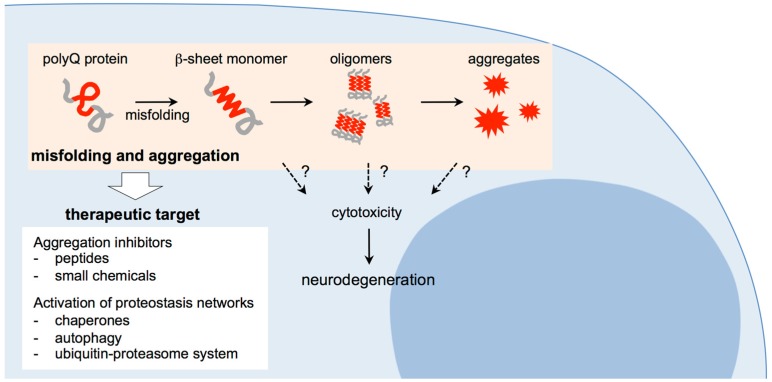
The polyglutamine (polyQ) diseases, such as Huntington’s disease and several types of spinocerebellar ataxias, are a group of inherited neurodegenerative diseases that are caused by an abnormal expansion of the polyQ tract in disease-causative proteins. Proteins with an abnormally expanded polyQ stretch undergo a conformational transition to β-sheet rich structure, which assemble into insoluble aggregates with β-sheet rich amyloid fibrillar structures and accumulate as inclusion bodies in neurons, eventually leading to neurodegeneration. Since misfolding and aggregation of the expanded polyQ proteins are the most upstream event in the most common pathogenic cascade of the polyQ diseases, they are proposed to be one of the most ideal targets for development of disease-modifying therapies for polyQ diseases. In this review, we summarize the current understanding of the molecular pathogenic mechanisms of the polyQ diseases, and introduce therapeutic approaches targeting misfolding and aggregation of the expanded polyQ proteins, which are not only effective on a wide spectrum of polyQ diseases, but also broadly correct the functional abnormalities of multiple downstream cellular processes affected in the aggregation process of polyQ proteins. We hope that in the near future, effective therapies are developed, to bring hope to many patients suffering from currently intractable polyQ diseases.
Overview
The claims and statistics of this paper haven’t been checked yet.
Free: it reads the open-access text and checks the first 5 claims that cite a source we can check. Create a free account to check every claim.
Integrity signals
Registry
Cites
Statistics
Figures
Verification
Claims the paper makes
The claims and statistics of this paper haven’t been checked yet.
Free: it reads the open-access text and checks the first 5 claims that cite a source we can check. Create a free account to check every claim.
Claims other papers make about this one
Each is checked against this paper’s own text: does it say what the citing paper says it does?
The source backs part of the claim, not all of it — or backs it for a different population, condition or comparison.
In the citing paper
“Similar to α-syn in PD and Tau in AD, polyQ-HTT aggregates exert toxic gain-of-function effects, forming β-sheet-rich structures that disrupt essential cellular pathways and cause neurotoxicity [169,170].”
From The Impact of Neurotoxin Proteins Trafficked by Primary Cilia and Extracellular Vesicles in Neurodegenerative Diseases (2025) · cites this paper as [170]
Experimental — accuracy not yet measuredThe cited source says what the claim attributes to it.
In the citing paper
“Similar to α-syn in PD and Tau in AD, polyQ-HTT aggregates exert toxic gain-of-function effects, forming β-sheet-rich structures that disrupt essential cellular pathways and cause neurotoxicity [169,170].”
From The Impact of Neurotoxin Proteins Trafficked by Primary Cilia and Extracellular Vesicles in Neurodegenerative Diseases (2025) · cites this paper as [170]
Self-check
Percentages, sums and reported differences re-computed from the paper’s own numbers.
The self-check needs the paper’s full text.
Citations
Cites
MACDONALD, M. (1993) · Cell · doi:10.1016/0092-8674(93)90585-e · Cited by 8,366
Common structure of soluble amyloid oligomers implies common mechanism of pathogenesis
Kayed, R., Head, E., Thompson, J. L., McIntire, T. M., Milton, S. C., Cotman, C. W., & Glabe, C. G. (2003) · Science · doi:10.1126/science.1079469 · Cited by 4,064 · cited 1×
“reported that treatment of cells with soluble oligomers of the polyQ protein results in significant cell death, which is inhibited by oligomer-specific antibodies, suggesting the potential cytotoxicity of the soluble intermediate species formed during the aggregation process [63].”
BackgroundMolecular chaperones in protein folding and proteostasis
Hartl, F. U., Bracher, A., & Hayer-Hartl, M. (2011) · Nature · doi:10.1038/nature10317 · Cited by 3,381 · cited 1×
“Among them, molecular chaperones have central roles in maintaining cellular proteostasis that assist refolding of misfolded proteins, and mediate degradation through autophagy and proteasome machinery [82].”
BackgroundAndrogen receptor gene mutations in X-linked spinal and bulbar muscular atrophy
Spada, A. R. L., Wilson, E. M., Lubahn, D. B., Harding, A. E., & Fischbeck, K. H. (1991) · Nature · doi:10.1038/352077a0 · Cited by 2,784 · cited 13×
“So far, antisense oligonucleotides (ASO), short interfering RNAs (siRNA), and short hairpin RNAs (shRNA) have been employed to decrease the level of the disease-associated proteins of the polyQ diseases, including HD, SBMA, and several types of SCAs, and thus, to improve phenotypes of animal models for such diseases […”
BackgroundInfluentialAggregation of Huntingtin in Neuronal Intranuclear Inclusions and Dystrophic Neurites in Brain
DiFiglia, M., Sapp, E., Chase, K. O., Davies, S. W., Bates, G. P., Vonsattel, J. P., & Aronin, N. (1997) · Science · doi:10.1126/science.277.5334.1990 · Cited by 2,439
Ravikumar, B., Vacher, C., Berger, Z., Davies, J. E., Luo, S., Oroz, L. G., Scaravilli, F., Easton, D. F., Duden, R., O'Kane, C. J., et al. (2004) · Nature Genetics · doi:10.1038/ng1362 · Cited by 2,347 · cited 7×
“The polyQ-dependent pathogenesis has also recently been confirmed in a common marmoset transgenic model of SCA3, which was generated as the first primate model of the polyQ diseases [28].”
BackgroundInfluentialImpairment of the Ubiquitin-Proteasome System by Protein Aggregation
Bence, N. F., Sampat, R. M., & Kopito, R. R. (2001) · Science · doi:10.1126/science.292.5521.1552 · Cited by 2,187
Davies, S. W., Turmaine, M., Cozens, B. A., DiFiglia, M., Sharp, A. H., Ross, C. A., Scherzinger, E., Wanker, E. E., Mangiarini, L., & Bates, G. P. (1997) · Cell · doi:10.1016/s0092-8674(00)80513-9 · Cited by 2,181 · cited 1×
“Since formation of intranuclear inclusions in a transgenic mouse model of HD is followed by the onset of disease phenotypes [38], and the level of inclusion bodies formed in brains apparently correlates with the severity of polyQ disease phenotypes, they were considered to be responsible for neurodegeneration in the p…”
BackgroundInclusion body formation reduces levels of mutant huntingtin and the risk of neuronal death
Arrasate, M., Mitra, S., Schweitzer, E. S., Segal, M. R., & Finkbeiner, S. (2004) · Nature · doi:10.1038/nature02998 · Cited by 1,979 · cited 1×
“demonstrated that the levels of diffused polyQ proteins, rather than those of inclusions, accurately predict an increased risk of death [50].”
BackgroundAggresomes, inclusion bodies and protein aggregation
Kopito, R. R. (2000) · Trends in Cell Biology · doi:10.1016/s0962-8924(00)01852-3 · Cited by 1,921
Cited by
On the wrong DNA track: Molecular mechanisms of repeat-mediated genome instability
Khristich, A. N., & Mirkin, S. M. (2020) · Journal of Biological Chemistry · doi:10.1074/jbc.rev119.007678 · Cited by 289
Autophagy in Neurodegenerative Diseases: A Hunter for Aggregates
Park, H., Kang, J.-H., & Lee, S. (2020) · International Journal of Molecular Sciences · doi:10.3390/ijms21093369 · Cited by 207
Fluorescent Diagnostic Probes in Neurodegenerative Diseases
Zhou, J., Jangili, P., Son, S., Ji, M. S., Won, M., & Kim, J. S. (2020) · Advanced Materials · doi:10.1002/adma.202001945 · Cited by 204
Targeting Intrinsically Disordered Transcription Factors: Changing the Paradigm
Tsafou, K., Tiwari, P. B., Forman-Kay, J. D., Metallo, S. J., & Toretsky, J. A. (2018) · Journal of Molecular Biology · doi:10.1016/j.jmb.2018.04.008 · Cited by 112
The Multiple Roles of Autophagy in Neural Function and Diseases
Li, Y., Qin, Z., & Sheng, R. (2023) · Neuroscience Bulletin · doi:10.1007/s12264-023-01120-y · Cited by 118
“Cortical pyramidal neurons and striatal projection neurons specifically degenerate in HD brains due to the aggregation of the N-terminal mutant HTT and the development of intranuclear inclusion [91, 92].”
BackgroundCHIP as a therapeutic target for neurological diseases
Zhang, S., Hu, Z., Mao, C., Shi, C., & Xu, Y. (2020) · Cell Death and Disease · doi:10.1038/s41419-020-02953-5 · Cited by 79
Protein aggregation and therapeutic strategies in SOD1- and TDP-43- linked ALS
Tsekrekou, M., Giannakou, M., Papanikolopoulou, K., & Σκρέτας, Γ. (2024) · Frontiers in Molecular Biosciences · doi:10.3389/fmolb.2024.1383453 · Cited by 81
“Polyglutamine binding peptide 1 (QBP1) is an octapeptide, designed to prevent polyglutamine amyloid formation (Nagai et al., 2000; Nagai et al., 2003; Takeuchi and Nagai, 2017).”
BackgroundMolecular Mechanisms and Therapeutics for Spinocerebellar Ataxia Type 2
Egorova, P. A., & Борисович, Б. И. (2019) · Neurotherapeutics · doi:10.1007/s13311-019-00777-6 · Cited by 62
“structures and accumulates as inclusion bodies in neurons [9].”
BackgroundPolyglutamine (PolyQ) Diseases: Navigating the Landscape of Neurodegeneration
Tenchov, R., Sasso, J. M., & Zhou, Q. A. (2024) · ACS Chemical Neuroscience · doi:10.1021/acschemneuro.4c00184 · Cited by 59
Protein Aggregation Inhibitors as Disease-Modifying Therapies for Polyglutamine Diseases
Minakawa, E. N., & Nagai, Y. (2021) · Frontiers in Neuroscience · doi:10.3389/fnins.2021.621996 · Cited by 49
Self-citationHuntington’s disease: nearly four decades of human molecular genetics
Gusella, J. F., Lee, J., & MacDonald, M. E. (2021) · Human Molecular Genetics · doi:10.1093/hmg/ddab170 · Cited by 53
“candidates (36,37), though many of these turned out to be assay-format specific.”
BackgroundThe polyglutamine protein ATXN2: from its molecular functions to its involvement in disease
da Costa, R. G., Conceição, A., Matos, C. A., & Nóbrega, C. (2024) · Cell Death and Disease · doi:10.1038/s41419-024-06812-5 · Cited by 53
“ATXN2 is widely distributed in the cytoplasm, but its expanded form tends to aggregate and shift its subcellular localization into neuronal inclusions, which is a central feature of SCA2 [22].”
BackgroundAutophagy in Spinocerebellar ataxia type 2, a dysregulated pathway, and a target for therapy
Marcelo, A., Afonso, I. T., Afonso‐Reis, R., Brito, D. V. C., da Costa, R. G., Rosa, A., Alves-Cruzeiro, J., Ferreira, B., Henriques, C., Nobre, R. J., et al. (2021) · Cell Death and Disease · doi:10.1038/s41419-021-04404-1 · Cited by 44
“or transcription factors [9, 59], a process that is exacerbated by the failure in protein degradation systems, such as autophagy [60].”
BackgroundDrugging DNA Damage Repair Pathways for Trinucleotide Repeat Expansion Diseases
Benn, C., Gibson, K. R., & Reynolds, D. S. (2021) · Journal of Huntington s Disease · doi:10.3233/jhd-200421 · Cited by 39
“Examples relevant to HD include modulation of aggregation or repurposing of existing PDE10A inhibitors, which have not been successful to date [2, 26, 27].”
BackgroundArginine is a disease modifier for polyQ disease models that stabilizes polyQ protein conformation
Minakawa, E. N., Popiel, H. A., Tada, M., Takahashi, T., Yamane, H., Saitoh, Y., Takahashi, Y., Ozawa, D., Takeda, A., Takeuchi, T., et al. (2020) · Brain · doi:10.1093/brain/awaa115 · Cited by 36
Self-citationHickman, R. A., Faust, P. L., Marder, K. S., Yamamoto, A., & Vonsattel, J. (2022) · Acta Neuropathologica Communications · doi:10.1186/s40478-022-01364-1 · Cited by 34
“If aggregated HTT and its oligomers are toxic, then the distribution of these inclusions may be clinically significant and their removal would be therapeutically relevant [2, 3, 13, 16, 18, 41, 59, 66].”
BackgroundCordeiro, L. M., Soares, M. V., da Silva, A. F., Machado, M. L., Baptista, F. B. O., da Silveira, T. L., Arantes, L. P., & Soares, F. A. A. (2021) · Nutritional Neuroscience · doi:10.1080/1028415x.2021.1956254 · Cited by 36
“2 in particular plays a protective role against polyQ [46], and in the present study rutin treatment was able to increase the expression of this chaperone Figure 4.”
BackgroundJoshi, B. S., Youssef, S. A., Bron, R., de Bruin, A., Kampinga, H. H., & Zuhorn, I. S. (2021) · iScience · doi:10.1016/j.isci.2021.103282 · Cited by 31
“The expanded polyQ-containing Htt protein has an increased aggregation propensity, which is proportional to the length of the repeat and inversely correlated to the age of onset of the progressive degeneration of neurons in specific brain areas (Takeuchi and Nagai, 2017).”
BackgroundDynamic nanoassemblies for imaging and therapy of neurological disorders
Zhang, L., Sun, H., Zhao, J., Lee, J., Low, L. E., Gong, L., Chen, Y., Wang, N., Zhu, C., Lin, P., et al. (2021) · Advanced Drug Delivery Reviews · doi:10.1016/j.addr.2021.113832 · Cited by 28
Picó, S., Parras, A., Santos‐Galindo, M., Pose‐Utrilla, J., Castro, M., Fraga, E., Hernández, I. H., Elorza, A., Anta, H., Wang, N., et al. (2021) · Science Translational Medicine · doi:10.1126/scitranslmed.abe7104 · Cited by 29
“Similar polyQ-encoding CAG mutations in different genes cause spinal-bulbar muscular atrophy, dentatorubral-pallidoluysian atrophy, and multiple dominant spinocerebellar ataxias (SCAs) (7), and there is evidence of toxicity being mediated by both the expanded CAGcontaining mRNAs and the polyQ-containing proteins (8, 9…”
BackgroundMolecular mechanism of the inhibition of TDP-43 amyloidogenesis by QBP1
Mompeán, M., de Mingo, D. R., Hervás, R., Fernández‐Ramírez, M. D. C., Carrión‐Vázquez, M., & Laurents, D. V. (2019) · Archives of Biochemistry and Biophysics · doi:10.1016/j.abb.2019.108113 · Cited by 27
RNA-Mediated Disease Mechanisms in Neurodegenerative Disorders
Neueder, A. (2018) · Journal of Molecular Biology · doi:10.1016/j.jmb.2018.12.012 · Cited by 26
McIntosh, C. S., Li, D., Wilton, S. D., & Aung-Htut, M. T. (2021) · Biomedicines · doi:10.3390/biomedicines9111499 · Cited by 26
Understanding the importance of autophagy in human diseases using Drosophila
Bhattacharjee, A., Szabó, Á., Csizmadia, T., Laczkó‐Dobos, H., & Juhász, G. (2019) · Journal of genetics and genomics/Journal of Genetics and Genomics · doi:10.1016/j.jgg.2019.03.007 · Cited by 24
The molecular pathogenesis of repeat expansion diseases
Fujino, Y., & Nagai, Y. (2021) · Biochemical Society Transactions · doi:10.1042/bst20200143 · Cited by 21
Self-citationGlutamine Codon Usage and polyQ Evolution in Primates Depend on the Q Stretch Length
Mier, P., & Andrade-Navarro, M. A. (2018) · Genome Biology and Evolution · doi:10.1093/gbe/evy046 · Cited by 25
“…despite the many attempts to fathom the role of the extended polyQ in the progression of the disorder and the development of potential therapeutic approaches (Hughes and Olson 2001; Robertson and Bottomley 2010; Margulis et al. 2013; Fan et al. 2014; Takeuchi et al. 2014; Takeuchi and Nagai 2017).”
BackgroundPriya, S. B., & Gromiha, M. M. (2019) · Journal of Cellular Biochemistry · doi:10.1002/jcb.28338 · Cited by 18
He, R., Lai, X., Sun, C., Kung, T., Hong, J., Jheng, Y., Liao, W., Chen, J., Liao, Y., Tu, P., et al. (2019) · Advanced Science · doi:10.1002/advs.201901165 · Cited by 19
Wardman, J. H., Henriksen, E. E., Marthaler, A. G., Nielsen, J. E., & Nielsen, T. T. (2020) · The Cerebellum · doi:10.1007/s12311-019-01092-8 · Cited by 17
“polyglutamine sequences can cause aggregation of affected proteins in neurodegenerative disease [1].”
Targeting Inflammation, PHA-767491 Shows a Broad Spectrum in Protein Aggregation Diseases
Chung, Y.-H., Lin, C.-W., Huang, H., Chen, S.-L., Huang, H.-J., Sun, Y., Lee, G.-C., Lee‐Chen, G., Chang, Y.-C., & Hsieh‐Li, H. M. (2020) · Journal of Molecular Neuroscience · doi:10.1007/s12031-020-01521-y · Cited by 18
Assessing the cognitive status of Drosophila by the value-based feeding decision
Yu, C.-C., Chang, F.-C., Hong, Y.-H., Li, J., Chen, P., Chen, C., Chiu, T.-W., Lu, T., Wang, Y., & Kao, C.-F. (2021) · npj Aging and Mechanisms of Disease · doi:10.1038/s41514-021-00075-6 · Cited by 15
Borbolla‐Jiménez, F. V., Prado-Audelo, M. L. D., Cisneros, B., Caballero-Florán, I. H., Leyva‐Gómez, G., & Magaña, J. J. (2021) · Pharmaceutics · doi:10.3390/pharmaceutics13071018 · Cited by 13
Khaled, M., Strodel, B., & Sayyed–Ahmad, A. (2023) · Frontiers in Molecular Biosciences · doi:10.3389/fmolb.2023.1143353 · Cited by 12
“This makes it difficult to resolve the structure of regions surrounding the polyQ tracts (Takeuchi and Nagai, 2017).”
BackgroundMicroRNAs regulating autophagy: opportunities in treating neurodegenerative diseases
Mohseni, M., Behzad, G., Farhadi, A., Behroozi, J., Mohseni, H., & Valipour, B. (2024) · Frontiers in Neuroscience · doi:10.3389/fnins.2024.1397106 · Cited by 14
“…striatum and cortex are affected by cytotoxicity caused by an abnormal expansion of a polyQ repeat in exon 1, resulting in the formation of mutant huntingtin (mHtt) proteins that form β -sheet-rich structures and ubiquitin-positive aggregates (Takeuchi and Nagai, 2017; Maat-Schieman et al., 1999).”
Polyglutamine disorders: Pathogenesis and potential drug interventions
Tandon, S., Aggarwal, P., & Sarkar, S. (2024) · Life Sciences · doi:10.1016/j.lfs.2024.122562 · Cited by 15
Repeat Expansion Disease Models
Ueyama, M., & Nagai, Y. (2018) · Advances in experimental medicine and biology · doi:10.1007/978-981-13-0529-0_5 · Cited by 13
Self-citationPolyglutamine spinocerebellar ataxias: emerging therapeutic targets
Neves‐Carvalho, A., Duarte‐Silva, S., Teixeira‐Castro, A., & Maciel, P. (2020) · Expert Opinion on Therapeutic Targets · doi:10.1080/14728222.2020.1827394 · Cited by 11
Takeuchi, T., & Nagai, Y. (2022) · Neurochemistry International · doi:10.1016/j.neuint.2022.105357 · Cited by 10
Self-citationIshihara, T., Tada, M., Kanemitsu, Y., Takahashi, Y., Ishikawa, K., Ikenaka, K., Hirano, M., Yokota, T., Minakawa, E. N., Saito, K., et al. (2024) · EClinicalMedicine · doi:10.1016/j.eclinm.2024.102952 · Cited by 8
Self-citationChaperone therapy for lysosomal and non-lysosomal protein misfolding diseases
Suzuki, Y. (2023) · Brain and Development · doi:10.1016/j.braindev.2023.02.004 · Cited by 10
Restoration from polyglutamine toxicity after free electron laser irradiation of neuron-like cells
茂原, 美., Kawasaki, T., Owada, R., Imai, T., Kanetaka, H., Izumi, S., Tsukiyama∥, K., & Nakamura, K. (2018) · Neuroscience Letters · doi:10.1016/j.neulet.2018.07.031 · Cited by 9
Kolkwitz, P. E., Mohrlüder, J., & Willbold, D. (2022) · Biomolecules · doi:10.3390/biom12020157 · Cited by 8
Non-cell Autonomous Maintenance of Proteostasis by Molecular Chaperones and Its Molecular Mechanism
Takeuchi, T. (2018) · Biological and Pharmaceutical Bulletin · doi:10.1248/bpb.b18-00141 · Cited by 7
Self-citationSilva, R. S. E., Sousa, A. D., Vieira, J., & Vieira, C. P. (2023) · Frontiers in Molecular Neuroscience · doi:10.3389/fnmol.2023.1140719 · Cited by 9
“These structural changes of the protein (Takeuchi and Nagai, 2017) lead to different accessibility at specific interacting residues that are needed for the normal protein activity (Lim et al.”
BackgroundMoldovean‐Cioroianu, N. S. (2024) · International Journal of Molecular Sciences · doi:10.3390/ijms25126789 · Cited by 8
“[85], 2020 [115], 2021 [117] and 2022 [125] in the context of polyQ-related disorders.”
BackgroundInfluentialBiocompatible Inhibitor Based on Chitosan and Amphiphilic Peptide against Mutant Huntingtin Toxicity
Wahyuningtyas, D., Chen, W., Huang, C.-H., He, Y., & Huang, J. J. (2019) · ChemBioChem · doi:10.1002/cbic.201900242 · Cited by 7
Chen, Z. S., Yan, M., Pei, W., Yan, B., Huang, C., & Chan, H. Y. E. (2022) · International Journal of Biological Macromolecules · doi:10.1016/j.ijbiomac.2022.07.133 · Cited by 7
Venkateswaran, S., Michaud, J., Itō, Y., Geraghty, M. T., Lewis, E. C., Ellezam, B., Boycott, K. M., Dyment, D. A., & Kernohan, K. D. (2024) · Movement Disorders · doi:10.1002/mds.29938 · Cited by 6
Oral administration of arginine suppresses Aβ pathology in animal models of Alzheimer's disease
Fujii, K., Takeuchi, T., Fujino, Y., Tanaka, N., Fujino, N., Takeda, A., Minakawa, E. N., & Nagai, Y. (2025) · Neurochemistry International · doi:10.1016/j.neuint.2025.106082 · Cited by 6
Self-citationCopper Homeostasis and Cuproptosis in Neurological Disorders
Liu, W., Xue, Y., Cao, C., Yang, L., & Zhang, L. (2026) · Drug Design Development and Therapy · doi:10.2147/dddt.s580005 · Cited by 12
“172 These abnormal aggregates disrupt cellular protein homeostasis, axonal transport, transcription, translation, mitochondrial, and synaptic functions.”
Chaperones as Potential Pharmacological Targets for Treating Protein Aggregation Illness
Rani, S., & Tuteja, M. (2025) · Current Protein and Peptide Science · doi:10.2174/0113892037338028241230092414 · Cited by 6
“Trim”ming PolyQ proteins with engineered PML
Dhar, N., Arsiwala, A., Murali, S., & Kane, R. S. (2019) · Biotechnology and Bioengineering · doi:10.1002/bit.27220 · Cited by 4
Sharbafshaaer, M., Pepe, R., Notariale, R., Canale, F., Tessitore, A., Tedeschi, G., & Trojsi, F. (2025) · International Journal of Molecular Sciences · doi:10.3390/ijms26157644 · Cited by 6
“Co-regulators, transcription factors, and RBPs such as TDP-43 and hnRNPA1 are sequestered by these aggregates, upsetting transcriptional homeostasis, resulting in a self-replicating aggregation cascade [76].”
Peng, S. I., Leong, L. I., Sun, J. K., Chen, Z. S., Chow, H., & Chan, H. Y. E. (2022) · Molecular Therapy — Nucleic Acids · doi:10.1016/j.omtn.2022.06.004 · Cited by 3
“Both CAG RNA foci and polyQ protein aggregates are signature pathogenic hallmarks of polyQ diseases.(19,20) Expanded CAG RNA foci are involved in some gainof-function and cellular protein sequestration pathological mechanisms that confer neuronal RNA toxicity.”
BackgroundTanimoto, S., & Okumura, H. (2024) · ACS Chemical Neuroscience · doi:10.1021/acschemneuro.4c00276 · Cited by 4
Cristofani, R., Tedesco, B., Ferrari, V., Chierichetti, M., Cozzi, M., Pramaggiore, P., Cornaggia, L., Mohamed, A. A., Casarotto, E., Brodňanová, M., et al. (2025) · Cell Communication and Signaling · doi:10.1186/s12964-025-02351-4 · Cited by 4
“Moreover, although many polyQ-containing proteins are ubiquitously expressed, each polyQ-expanded related ND is characterised by the degeneration of specific neuronal populations, causing subsequent neurological symptoms [21, 35, 36].”
Danna, R., Kondle, S., Amar, O., Mabourakh, M., Chen, G., Fadol, W. B., & Mohieldin, A. M. (2025) · Biology · doi:10.3390/biology14121787 · Cited by 2
“Similar to α -syn in PD and Tau in AD, polyQ-HTT aggregates exert toxic gain-of-function effects, forming β -sheet-rich structures that disrupt essential cellular pathways and cause neurotoxicity [169,170].”
Schweitzer‐Stenner, R. (2026) · Quarterly Reviews of Biophysics · doi:10.1017/s0033583526100080 · Cited by 2
López-García, P., McGreevy, K. R., Vaquero, M. E., Suarez‐Rivero, J. M., Moreno-Rodríguez, A., Pérez‐Pulido, A. J., de Mingo, D. R., Pallé, A., Popiel, H. A., Santi, A., et al. (2026) · Advanced Science · doi:10.1101/2025.01.27.635080 · Cited by 3
Self-citationREV1 inhibition enhances trinucleotide repeat mutagenesis
Siegel, A., Almstead, D., Kothandaraman, N., Reich, J., Lamkin, E. N., Victor, J., Grover, A., Ikeh, K., Koval, H., Crompton, A., et al. (2025) · Open Biology · doi:10.1098/rsob.250234 · Cited by 2
Palacios, V. R.-E., Borbolla‐Jiménez, F. V., Meza‐Dorantes, A., Villarreal-Ramírez, R., Cisneros, B., & Magaña, J. J. (2026) · The Cerebellum · doi:10.1007/s12311-026-01981-9 · Cited by 1
Das, J. K., & Maheshwari, A. (2026) · Newborn · doi:10.5005/jp-journals-11002-0171 · Cited by 1
New Approaches in Studies of the Molecular Pathogenesis of Type 2 Spinocerebellar Ataxia
Egorova, P. A., & Борисович, Б. И. (2020) · Neuroscience and Behavioral Physiology · doi:10.1007/s11055-020-00988-x · Cited by 1
“Prevention of aggregate formation and accumulation of incorrectly folded proteins with expanded polyglutamine tracts can be regarded as a promising therapeutic approach for developing disease-modifying therapy for polyglutamine tract diseases [9].”
BackgroundTanimoto, S., & Okumura, H. (2023) · Journal of Computer Chemistry Japan · doi:10.2477/jccj.2023-0020 · Cited by 1
Nagai, Y. (2021) · Contemporary clinical neuroscience · doi:10.1007/978-3-030-75817-2_28
Self-citationThe genetic basis of neurodegenerative disorders: Implications in Alzheimer's disease
Jilani, M. G., Hoque, M., Tabrez, S. S. M., & Ali, S. (2024) · Elsevier eBooks · doi:10.1016/b978-0-443-15540-6.00002-1 · Cited by 1
A potential anti-amyloidogenic therapy for type 2 diabetes based on the QBP1 peptidePreprint
Tejero-Ojeda, M. M., Vives, A. B., Wojciechowski, M., Pham, D. Q. H., Chwastyk, M., Vallejo, M., Novials, A., & Carrión‐Vázquez, M. (2025) · bioRxiv (Cold Spring Harbor Laboratory) · doi:10.1101/2025.05.06.652241
“…in a polyQ mouse model was previously hindered by proteolytic degradation and poor blood-brain barrier (BBB) penetration (Popiel et al., 2013, 2009; Takeuchi and Nagai, 2017), recent findings indicate that intranasal delivery significantly enhances its brain uptake and therapeutic efficacy…”
Abjean, L. (2019) · theses.fr (ABES) · doi:10.70675/f664e003zf93fz467eza6a3z3d953eaffe4e
“Enfin, des stratégies de réduction de l’agrégation par des inhibiteurs peptidiques ou chimiques ont montré une amélioration des troubles moteurs, de l’atrophie ou de la dégénérescence neuronale dans des modèles animaux de la MH (Nagai et al., 2003; Zhang et al., 2005; Takeuchi and Nagai, 2017).”
BackgroundLotz, C. (2019) · theses.fr (ABES) · doi:10.70675/35213e27zda27z484az886azd1ed4013e75a · Cited by 1
Experimental Therapeutic Approaches: Molecular, Genetic, and Behavioral
Selimovic, A., Soles, A., & Cvetanović, M. (2026) · Contemporary clinical neuroscience · doi:10.1007/978-3-032-18296-8_26
Protein aggregation in amyotrophic lateral sclerosis
Saini, P., Prakash, A., & Khan, M. A. I. (2026) · Elsevier eBooks · doi:10.1016/b978-0-443-36636-9.00003-4
Metadata
- Authors
- Takeuchi, T., & Nagai, Y.
- Affiliations
- The University of Osaka (JP)
- Corresponding author
- Takeuchi, Toshihide
- Nagai, Yoshitaka
- Venue
- Brain Sciences
- Publisher
- MDPI AG
- Published
- 2017-10-11
- Volume
- 7
- Issue
- 10
- Pages
- 128
- ISSN
- 2076-3425 (ISSN-L)
- PMC
- PMC5664055
- OpenAlex
- W2762018403
- Cited by
- 71
- References
- 149
- Citations by year
- 2026: 7 · 2025: 7 · 2024: 10 · 2023: 5 · 2022: 5 · 2021: 12 · 2020: 10 · 2019: 9 · 2018: 6
- FWCI
- 0.84
- Type
- journal article
- Language
- en
- Open access
- gold
- doi.org
- Licence
- Locations
- Brain Sciences (publishedVersion, cc-by)
- PubMed Central (publishedVersion, cc-by)
- PubMed (publishedVersion)
- DOAJ (DOAJ: Directory of Open Access Journals) (submittedVersion, cc-by-sa)
- Funders
- Ministry of Education, Culture, Sports, Science and Technology
- Japan Society for the Promotion of Science
- Ministry of Health, Labour and Welfare
- Japan Agency for Medical Research and Development
- Japan Science and Technology Agency
- National Center of Neurology and Psychiatry
- Topics
- Life Sciences › Neuroscience › Cellular and Molecular Neuroscience › Genetic Neurodegenerative Diseases
- Life Sciences › Biochemistry, Genetics and Molecular Biology › Molecular Biology › Prion Diseases and Protein Misfolding
- Health Sciences › Medicine › Clinical Neurology › Amyotrophic Lateral Sclerosis Research
- Keywords
- polyglutamine diseases, protein misfolding, protein aggregation, Huntington's disease, spinocerebellar ataxia, neurodegeneration, disease-modifying therapy, molecular pathogenesis, therapeutic target
About these checks
Registry, retraction, Cites and statistics results are computed, not judged, with one exception: a printed reference that no index lists is read once by a model before it counts as a citation error. Claims are extracted by a model and kept only when their quote appears verbatim in the text; each cited source is then checked, with a model’s help, for whether it says what the claim relies on. Those verdicts can be wrong — read the claim’s quote and the cited source before relying on one.
Statistics and arithmetic are recomputed, not judged.
Confidence bands are shown only for fields calibrated on our annotated test set. None is calibrated yet, so no band is shown.
What counts as a claim ›How we measure confidence ›How we check this ›
Are you an author, or do you see a problem with this page? Request a review
Data sources
Bibliographic data: Semantic Scholar, OpenAlex, Crossref.
Contains information from the Semantic Scholar Academic Graph Datasets, made available under the ODC Attribution License (ODC-BY 1.0).
Semantic Scholar’s data is described in: Kinney, R., et al. (2023). The Semantic Scholar Open Data Platform. arXiv:2301.10140.
