

The DOI matches its Crossref record; 6 of the 6 references it cites were found in a registry or an index.
Who Will Save the Savior? The Relationship between Therapists’ Secondary Traumatic Stress, Secondary Stress Self-Efficacy, and Attitudes toward Trauma-Informed Care
Abstract
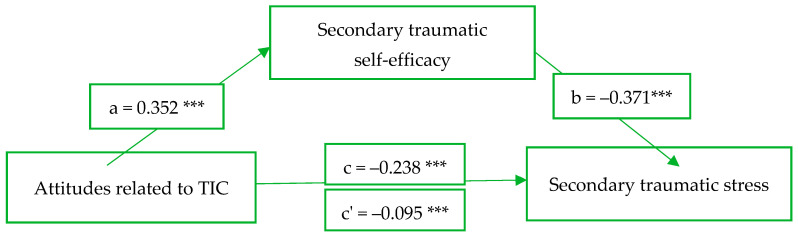
Therapists who treat traumatized preschool children are vulnerable to secondary traumatic stress. This study investigates the relationship between therapists’ attitudes toward trauma-informed care (TIC) and risk of secondary traumatic stress, with secondary traumatic self-efficacy as a mediating variable. Participants included Israeli social workers (N = 101) in preschool trauma frameworks, with 97.2% following trauma-informed care principles. The questionnaire combined three instruments: attitudes related to TIC (ARTIC), secondary traumatic stress (STS), and secondary traumatic stress efficacy (STSE). Therapists with less positive attitudes toward trauma-informed care showed higher levels of secondary traumatic stress (r[99] = −0.23, p = 0.019), while more positive attitudes predicted higher levels of secondary traumatic stress efficacy (r[99] = 40, p < 0.001). Secondary traumatic self-efficacy mediated the relationship between attitudes toward trauma-informed care and secondary traumatic stress (z = 2.72, p = 0.006). Therapists’ secondary traumatic stress may be reduced by improving positive attitudes toward trauma-informed care and enhancing their secondary traumatic self-efficacy.
Overview
The claims and statistics of this paper haven’t been checked yet.
Run the check — free, no account needed. It reads the open-access text and checks the sources it cites.
Integrity signals
Registry
Cites
Statistics
Figures
Verification
Claims the paper makes
The claims and statistics of this paper haven’t been checked yet.
Run the check — free, no account needed. It reads the open-access text and checks the sources it cites.
Claims other papers make about this one
Each is checked against this paper’s own text: does it say what the citing paper says it does?
In the citing paper
“On the other hand, exposure to secondary trauma is linked to lower professional confidence (Syed Ali et al., 2023), and secondary traumatic self-efficacy predicts attitudes toward trauma-informed practice (Miller Itay & Turliuc, 2023).”
From Effectiveness Of Narrative Therapy In Addressing Psychological Challenges: A Systematic Review Of Randomised Controlled Trials (2026) · cites this paper as Miller Itay & Turliuc, 2023
Self-check
Percentages, sums and reported differences re-computed from the paper’s own numbers.
The self-check needs the paper’s full text.
Citations
Cites
Felitti, V. J., Anda, R. F., Nordenberg, D., Williamson, D. F., Spitz, A. M., Edwards, V., Koss, M. P., & Marks, J. S. (1998) · American Journal of Preventive Medicine · doi:10.1016/s0749-3797(98)00017-8 · Cited by 18,943 · cited 1×
“…traumatic events, including physical, sexual, and emotional abuse, experience of household dysfunction (e.g., divorce/separation, domestic violence), and living with an adult experiencing poor mental health (psychopathology, substance use/misuse, or incarceration), as Felitti et al. indicated [22].”
BackgroundCore Implementation Components
Fixsen, D. L., Blase, K. A., Naoom, S. F., & Wallace, F. (2009) · Research on Social Work Practice · doi:10.1177/1049731509335549 · Cited by 1,103
Development and Validation of the Secondary Traumatic Stress Scale
Bride, B. E., Robinson, M. M., Yegidis, B., & Figley, C. R. (2004) · Research on Social Work Practice · doi:10.1177/1049731503254106 · Cited by 874 · cited 5×
“Therapists suffering from STS are also likely to be absent from work more often [30,36,37].”
BackgroundMethodInfluentialAarons, G. A. (2005) · Child and Adolescent Psychiatric Clinics of North America · doi:10.1016/j.chc.2004.04.008 · Cited by 296
Meadors, P., & Lamson, A. (2008) · Journal of Pediatric Health Care · doi:10.1016/j.pedhc.2007.01.006 · Cited by 243 · cited 2×
“This is expected to decrease the harm to the well-being of therapists, allow them to provide higher-quality service to clients, and create a more positive work environment for their colleagues and organization [30,35–37].”
BackgroundMelinte, B. M., Turliuc, M. N., & Măirean, C. (2023) · Clinical Psychology: Science and Practice · doi:10.1037/cps0000159 · Cited by 13
Self-citation
Research works printed but not linked: 47
- Bartlett, 2021, Trauma-informed practices in early childhood education, ZERO TO THREE J., 41, 24
- Kenardy, 2011, Trauma in early childhood: A neglected population, Clin. Child Fam. Psychol. Rev., 14, 231, 10.1007/s10567-011-0094-3 · DOI
- Lieberman, 2004, Traumatic stress and quality of attachment: Reality and internalization in disorders of infant mental health, Infant Ment. Health J., 25, 336, 10.1002/imhj.20009 · DOI
- Bartlett, 2018, The impact of a statewide trauma-informed care initiative in child welfare on the well-being of children and youth with complex trauma, Child. Youth Serv. Rev., 84, 110, 10.1016/j.childyouth.2017.11.015 · DOI
- Zeanah, 2018, Child abuse and neglect, J. Am. Acad. Child Adolesc. Psychiatry, 57, 637, 10.1016/j.jaac.2018.06.007 · DOI
- ZERO TO THREE (2016). DC:0–5™: Diagnostic Classification of Mental Health and Developmental Disorders of Infancy and Early Childhood, ZERO TO THREE. · DOI
- Fredrickson, 2019, Trauma-informed care for infant and early childhood abuse, J. Aggress. Maltreatment Trauma, 28, 389, 10.1080/10926771.2019.1601143 · DOI
- Lieberman, A.F., and Van Horn, P. (2011). Psychotherapy with Infants and Young Children: Repairing the Effects of Stress and Trauma on Early Attachment, Guilford Press.
- Brom, D., Pat-Horenczyk, R., and Ford, J.D. (2008). Treating Traumatized Children: Risk, Resilience and Recovery, Routledge. · DOI
- Garwood, 2020, Trauma-informed care intervention for culture and climate change within a child welfare agency, Child Welf., 98, 1
- Barton, S., Gonzalez, R., and Tomlinson, P. (2011). Therapeutic Residential Care for Children and Young People: An Attachment and Trauma-Informed Model for Practice [Kindle Edition], Jessica Kingsley Publishers.
- Sprang, 2011, Secondary traumatic stress and burnout in child welfare staff: A comparative analysis of occupational distress across professional groups, Child Welf., 90, 149
- Bartlett, 2016, Trauma-informed care in the Massachusetts Child Trauma Project, Child Maltreatment, 21, 101, 10.1177/1077559515615700 · DOI
- Hanson, 2016, A critical look at trauma-informed care among agencies and systems serving maltreated youth and their families, Child Maltreatment, 21, 95, 10.1177/1077559516635274 · DOI · Paper page
- Santacrose, 2020, In the trauma-informed care trenches: Teacher compassion satisfaction, secondary traumatic stress, burnout, and intent to leave education within underserved elementary schools, Child Abus. Negl., 110, 104437, 10.1016/j.chiabu.2020.104437 · DOI
- Sprang, 2022, An Investigation of Secondary Traumatic Stress and Trauma-informed Care Utilization in School Personnel, J. Child Adolesc. Trauma, 15, 1095, 10.1007/s40653-022-00465-2 · DOI
- Baker, 2016, Development and psychometric evaluation of the Attitudes Related to Trauma-Informed Care (ARTIC) Scale, Sch. Ment. Health, 8, 61, 10.1007/s12310-015-9161-0 · DOI
- Bargeman, 2021, Trauma-informed care as a rights-based “standard of care”: A critical review, Child Abus. Negl., 119, 104762, 10.1016/j.chiabu.2020.104762 · DOI
- Crouch, 2019, Prevalence of adverse childhood experiences (ACEs) among US children, Child Abus. Negl., 92, 209, 10.1016/j.chiabu.2019.04.010 · DOI
- Brown, 2012, Risking connection trauma training: A pathway toward trauma-informed care in child congregate care settings, Psychol. Trauma Theory Res. Pract. Policy, 4, 507, 10.1037/a0025269 · DOI
- Lotzin, 2018, “Learning how to ask”: Effectiveness of a training for trauma inquiry and response in substance use disorder healthcare professionals, Psychol. Trauma Theory Res. Pract. Policy, 10, 229, 10.1037/tra0000269 · DOI
- Niimura, 2019, Effectiveness of 1-day trauma-informed care training programme on attitudes in psychiatric hospitals: A pre–post study, Int. J. Ment. Health Nurs., 28, 980, 10.1111/inm.12603 · DOI
- Rossen, E., and Hull, R.V. (2013). Supporting and Educating Traumatized Students: A Guide for School-Based Professionals, Oxford University Press. · DOI
- Itzhaky, 2022, Secondary traumatic stress and vicarious post-traumatic growth among social workers who have worked with abused children, J. Soc. Work, 22, 170, 10.1177/1468017320981363 · DOI
- Figley, C.R. (1995). Compassion Fatigue: Coping with Secondary Traumatic Stress Disorder in Those Who Treat the Traumatized, Routledge. Available online: https://www.emdr.org.il/wp-ntent/uploads/2021/08/Figley1995CompassionFatiguebook.pdfco.
- Bride, 2007, Correlates of secondary traumatic stress in child protective services workers, J. Evid. Based Soc. Work, 4, 69, 10.1300/J394v04n03_05 · DOI
- Harris, 2003, Childhood abuse history, secondary traumatic stress, and child welfare workers, Child Welf., 82, 5
- Thomas, 2010, Intrapsychic correlates of professional quality of life: Mindfulness, empathy, and emotional separation, J. Soc. Soc. Work Res., 1, 83, 10.5243/jsswr.2010.7 · DOI
- Dombo, 2016, Vicarious trauma in child welfare workers: A study of organizational responses, J. Public Child Welf., 10, 505, 10.1080/15548732.2016.1206506 · DOI
- Craig, 2010, Compassion satisfaction, compassion fatigue, and burnout in a national sample of trauma treatment therapists, Anxiety Stress Coping, 23, 319, 10.1080/10615800903085818 · DOI · Paper page
- Holttum, 2013, Compassion satisfaction, burnout, and secondary traumatic stress in UK therapists who work with adult trauma clients, Eur. J. Psychotraumatology, 4, 21869, 10.3402/ejpt.v4i0.21869 · DOI
- David, 2022, Teaching professionals about trauma-informed practice for children and their families: A toolkit for practitioners, Int. J. Child Maltreatment Res. Policy Pract., 5, 311, 10.1007/s42448-022-00114-z · DOI
- DeCandia, 2015, Trauma-informed care: An ecological response, J. Child Youth Care Work, 25, 7, 10.5195/jcycw.2015.69 · DOI
- Lietz, 2019, Building learning cultures in the child welfare workforce, Child. Youth Serv. Rev., 99, 360, 10.1016/j.childyouth.2019.01.023 · DOI
- Fansher, 2020, Burnout among forensic interviewers, how they cope, and what agencies can do to help, Child Maltreatment, 25, 117, 10.1177/1077559519843596 · DOI
- Hazen, 2020, Evaluating the facilitating attuned interactions (FAN) approach: Vicarious trauma, professional burnout, and reflective practice, Child. Youth Serv. Rev., 112, 104925, 10.1016/j.childyouth.2020.104925 · DOI
- Benight, 2004, Social cognitive theory of posttraumatic recovery: The role of perceived self-efficacy, Behav. Res. Ther., 42, 1129, 10.1016/j.brat.2003.08.008 · DOI · Paper page
- Jamshi, 2021, Burnout and depressive symptoms among social workers: The contribution of conflict management and social support resources, Soc. Welf., 43, 419
- Bonach, 2012, Predictors of secondary traumatic stress among children’s advocacy center forensic interviewers, J. Child Sex. Abus., 21, 295, 10.1080/10538712.2012.647263 · DOI
- Cieslak, 2014, A meta-analysis of the relationship between job burnout and secondary traumatic stress among workers with indirect exposure to trauma, Psychol. Serv., 11, 75, 10.1037/a0033798 · DOI
- Stephens, 2016, Secondary traumatic stress, vicarious posttraumatic growth, and coping among health professionals; A comparison study, N. Z. J. Psychol. (Online), 45, 20
- Hayes, A.F. (2018). Introduction to Mediation, Moderation, and Conditional Process Analysis: A Regression-Based Approach (Methodology in the Social Sciences), The Guilford Press. [2nd ed.].
- Hayes, F. (2017). Partial, conditional, and moderated mediation: Quantification, inference, and interpretation. Commun. Monogr. · DOI · Paper page
- Stamm, B.H. (1999). Secondary Traumatic Stress: Self-Care Issues for Clinicians, Researchers Educators, Sidran Press. [2nd ed.].
- David, 2017, Self-efficacy as a mediator in bottom-up dissemination of a research-supported intervention for young, traumatized children and their families, J. Evid. Inf. Soc. Work, 14, 53, 10.1080/23761407.2017.1298072 · DOI
- Holohan, 2011, Treating traumatized OEF/OIF veterans: How does trauma treatment affect the clinician?, Prof. Psychol. Res. Pract., 42, 79, 10.1037/a0022297 · DOI
- Kalaitzaki, 2022, From secondary traumatic stress to vicarious posttraumatic growth amid COVID-19 lockdown in Greece: The role of health care workers’ coping strategies, Psychol. Trauma Theory Res. Pract. Policy, 14, 273, 10.1037/tra0001078 · DOI
Cited by
Sorted by citations
Permatasari, D. P., Windarwati, H. D., & Lestari, R. (2026) · Indigenous: Jurnal Ilmiah Psikologi · doi:10.23917/indigenous.v11i1.13778
Metadata
- Authors
- Miller Itay, M. R., & Turliuc, M. N.
- Affiliations
- Faculty of Psychology and Educational Sciences, Alexandru Ioan Cuza University of Iași, 700506 Iaşi, Romania
- Venue
- Behavioral Sciences
- Publisher
- MDPI AG
- Published
- 2023-12-13
- Volume
- 13
- Issue
- 12
- Pages
- 1012
- ISSN
- 2076-328X
- PMC
- PMC10740790
- Cited by
- 7
- References
- 6
- Language
- en
About these checks
Registry, retraction, Cites and statistics results are computed, not judged, with one exception: a printed reference that no index lists is read once by a model before it counts as a citation error. Claims are extracted by a model and kept only when their quote appears verbatim in the text; each cited source is then checked, with a model’s help, for whether it says what the claim relies on. Those verdicts can be wrong — read the claim’s quote and the cited source before relying on one.
Statistics and arithmetic are recomputed, not judged.
Confidence bands are shown only for fields calibrated on our annotated test set. None is calibrated yet, so no band is shown.
What counts as a claim ›How we measure confidence ›How we check this ›
Are you an author, or do you see a problem with this page? Request a review
How to cite
Cite CoChat for the checks on this page, and the paper for its own findings.
- This page
- CoChat. (2026). Citation check: Who Will Save the Savior? The Relationship between Therapists’ Secondary Traumatic Stress, Secondary Stress Self-Efficacy, and Attitudes toward Trauma-Informed Care. https://app.cochat.ai/papers/10.3390/bs13121012
- The paper
- Miller Itay, M. R., & Turliuc, M. N. (2023). Who Will Save the Savior? The Relationship between Therapists’ Secondary Traumatic Stress, Secondary Stress Self-Efficacy, and Attitudes toward Trauma-Informed Care. Behavioral Sciences. https://doi.org/10.3390/bs13121012
