

Performance of Cast-in-Place Repair Concrete Incorporating Recycled Coarse Aggregate Under Partially Exposed Sulfate Corrosion Environments
Open accessThe DOI matches its Crossref record; 47 of the 47 references it cites were found in a registry or an index; none of the 34 sources its claims cite is checked for support yet.
Abstract
To investigate the sulfate corrosion resistance of cast-in-place repair concrete incorporating recycled coarse aggregate (RCA) under partially exposed conditions, cast-in-place repair concrete specimens with different RCA contents (0%, 30%, and 50%) were immersed in Na2SO4 solution. The study systematically investigated the changes in apparent morphology, dimensions, mass, and mechanical properties of the specimens under sulfate corrosion. SEM, XRD, TG/DTG, and MIP were used to characterize the microstructure and mineral composition of the specimens at different corrosion ages. Results indicate that RCA cast-in-place repair concrete partially exposed to a sulfate corrosion environment undergoes coupled physical and chemical corrosion, and the interfacial zone between the recycled aggregate concrete to the base concrete represents the most vulnerable region in the composite system. Incorporating 30% RCA can effectively reduce the degradation rate of specimens under sulfate corrosion, enhance the compactness of the bonding interface, and optimize the interfacial bond strength, compressive strength, and pore structure of the specimens. Excessive RCA content disrupts the internal pore structure, accelerates sulfate ion ingress, and weakens the interfacial bond strength. The presence of RCA significantly reduces the interfacial shear strength of the specimens. After 360 days of sulfate corrosion, specimens featuring 30% and 50% RCA contents exhibit a reduction in shear strength of 15.91% and 40.0%, respectively, compared with the 0% RCA content specimen. Research findings provide a theoretical basis for the application of RCA in concrete repair engineering.
Overview
CoChat Summary
TL;DR
This study examines how recycled coarse aggregate (RCA) content (0%, 30%, 50%) affects the sulfate corrosion resistance of cast-in-place repair concrete — recycled aggregate concrete cast onto cured base concrete — under partially exposed (half-immersed) conditions in 10 wt% Na₂SO₄. It finds that 30% RCA optimizes interfacial bond, compressive strength, and pore structure, while 50% RCA accelerates deterioration, with the recycled-aggregate-to-base-concrete interface being the weakest region.
Key findings
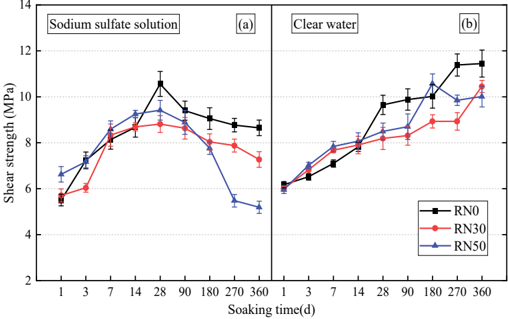
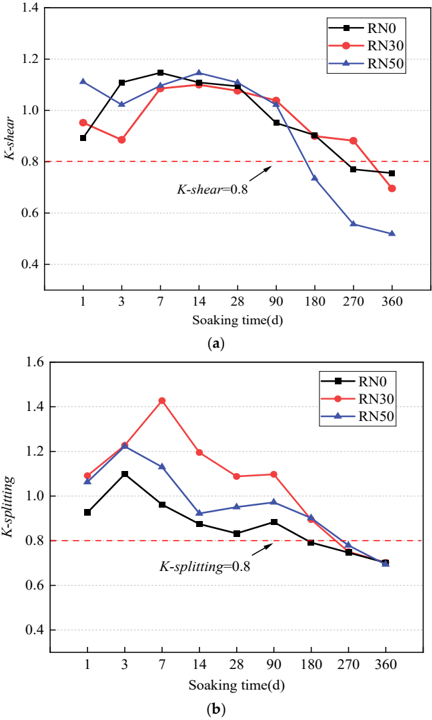
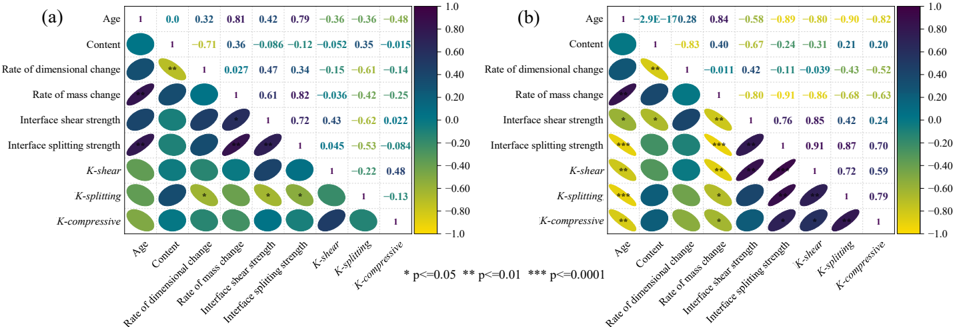
- After 360 days of sulfate corrosion, interfacial shear strength of RN30 and RN50 specimens was reduced by 15.91% and 40.0%, respectively, relative to RN0; shear strength decreased with increasing RCA content.
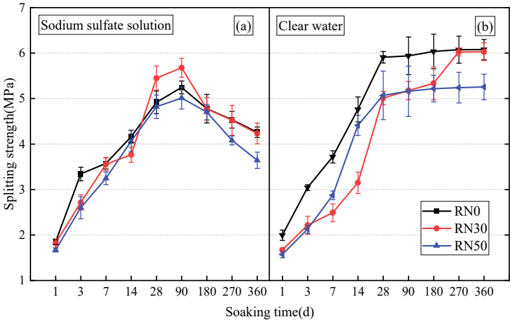
- Interfacial splitting strengths after 360 days were 4.26 MPa (RN0), 4.24 MPa (RN30), and 3.64 MPa (RN50) — RN30 comparable to RN0 and 16.48% higher than RN50.
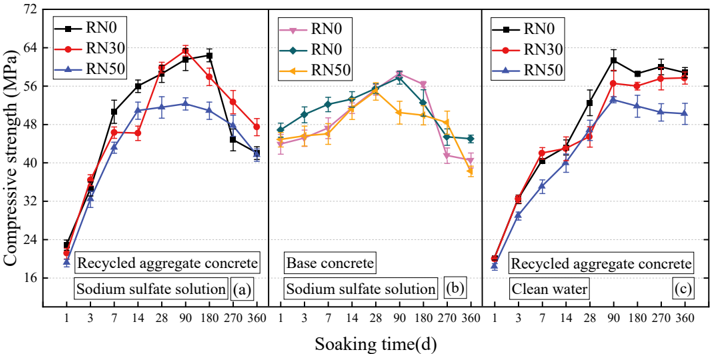
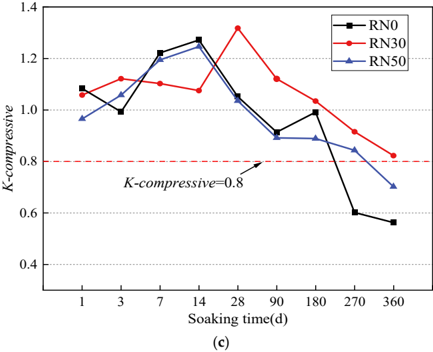
- Compressive strength of cast-in-place recycled aggregate concrete after 360 days reached 42.03, 47.45, and 41.62 MPa for 0%, 30%, and 50% RCA, versus 40.51, 44.98, and 38.22 MPa for the corresponding base concrete; RN30's cast concrete was 12.89% and 14.00% higher than RN0's and RN50's, and its base concrete 11.02% and 17.66% higher.
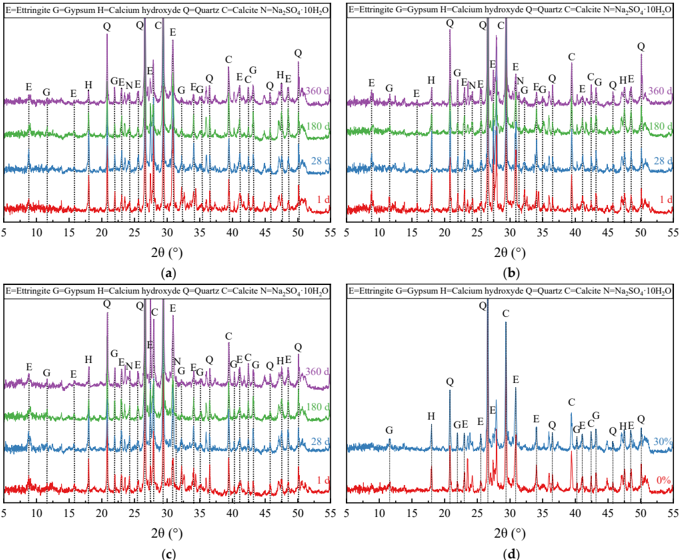
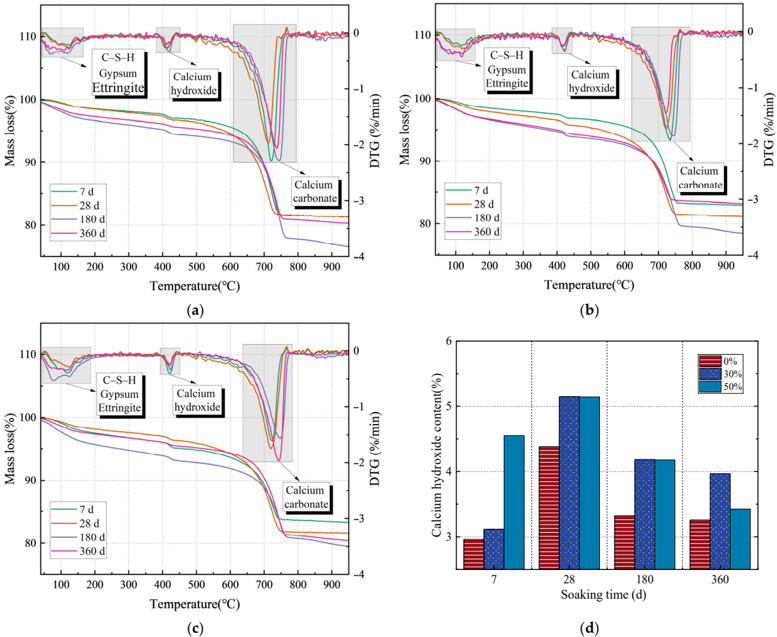
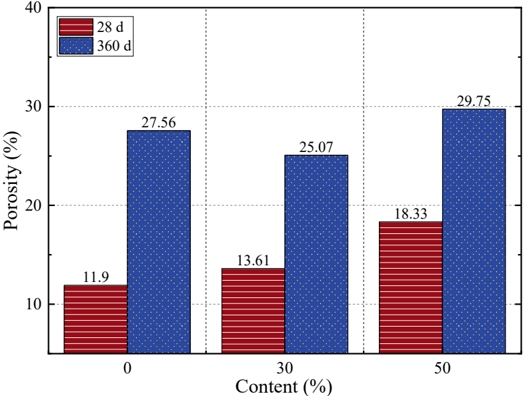
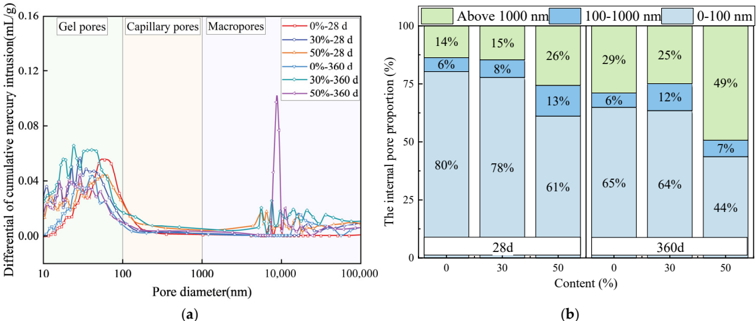
- After 360 days, RN30 porosity was 9.93% and 18.67% lower than RN0 and RN50, and its macropore content 13.79% and 48.98% lower; RN50's main pore-size peak shifted to the macropore range (~8000–10,000 nm). Ca(OH)₂ content at 360 days fell by 1.13%, 1.18%, and 1.72% for RN0, RN30, and RN50 relative to 28 days.
Methods
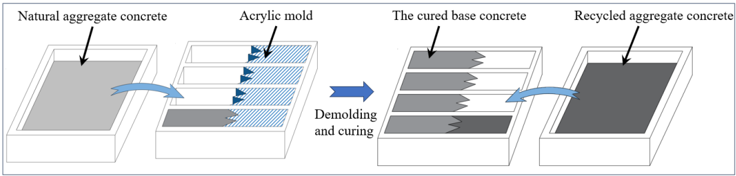
- Specimens were fabricated in two stages: base concrete cast, cured 28 days in water, then recycled aggregate concrete cast on top with a "W-shaped" bonding interface; RCA contents were 0%, 30%, and 50% (RN0, RN30, RN50), constant water-to-cement ratio 0.45, RCA pre-wetted to saturated surface-dry.
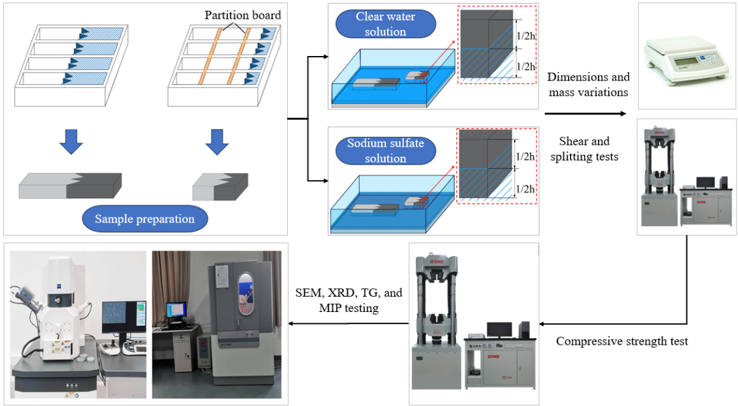
- Long-term immersion test: specimens half-immersed (liquid depth at half specimen height) in 10 wt% Na₂SO₄ solution, with clean-water controls; solution replaced monthly; tested at 1, 3, 7, 14, 28, 90, 180, 270, and 360 days.
- Macroscopic tests (appearance, dimension, mass, shear, splitting, and compressive strength; sulfate resistance coefficient K with failure threshold 0.8) averaged over three replicates; microscopic characterization by SEM-EDS, XRD, TG/DTG, and MIP.
Limitations
- The paper states no explicit limitations section; the following are evident from the text.
- Testing used a single sulfate exposure (10 wt% Na₂SO₄, partial immersion) and a single water-to-cement ratio (0.45), so results may not transfer to other concentrations, exposure modes (e.g., wet–dry cycles, full immersion), or mix designs.
- Only three RCA contents (0%, 30%, 50%) were tested, and the work is laboratory-scale with no field validation; the authors note that specimens were immersed in the same tank and randomly placed, and that the shear strength results depend on the inherent strength of RCA.
Model-written summary. Check it against the paper before relying on it.
Integrity signals
Registry
Cites
Statistics
Figures
Verification
Claims the paper makes
0 Valid · 0 Not valid · 27 Not checked · 151 Own results and interpretations
A result the paper states — it cites no source for it, so there is none to check. The quote shows it is in the paper.
In the paper
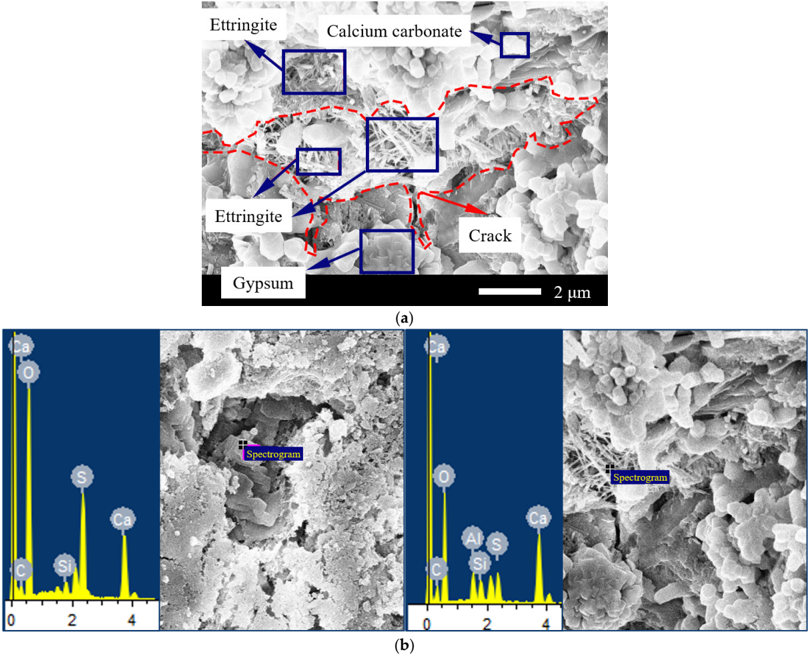
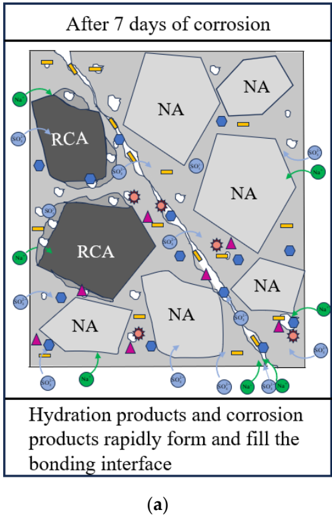
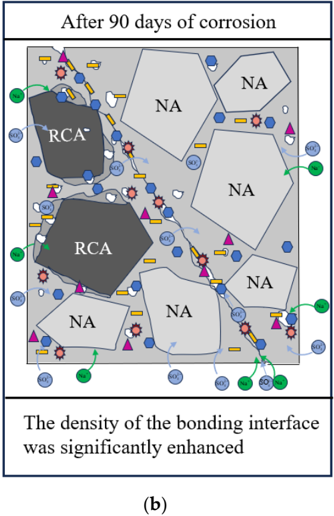
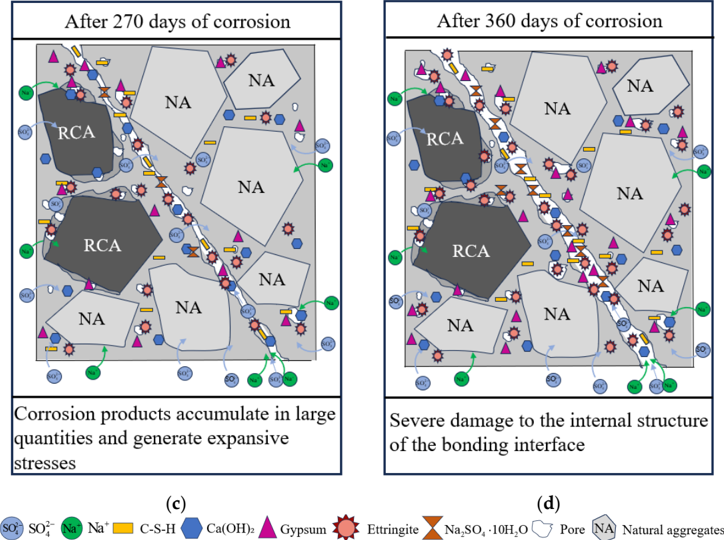
“In addition, the reaction process consumed calcium hydroxide (Ca(OH) 2 ).”
§ Performance of Cast-in-Place Repair Concrete Incorporating Recycled Coarse Aggregate Under Partially Exposed Sulfate Corrosion Environments > 3.7. Microstructure and Mineral Composition Analysis
plainstates a cause- Asserted: passes — The authors put it forward as true.
- Checkable: passes — It can be checked against evidence.
- Load-bearing: unclear — It is unclear whether the paper’s conclusions depend on it.
- Based: passes — The paper gives a reason why it holds.
A result the paper reports from its own data — it cites no other source for it, so there is none to check. The quote shows it is in the paper.
In the paper
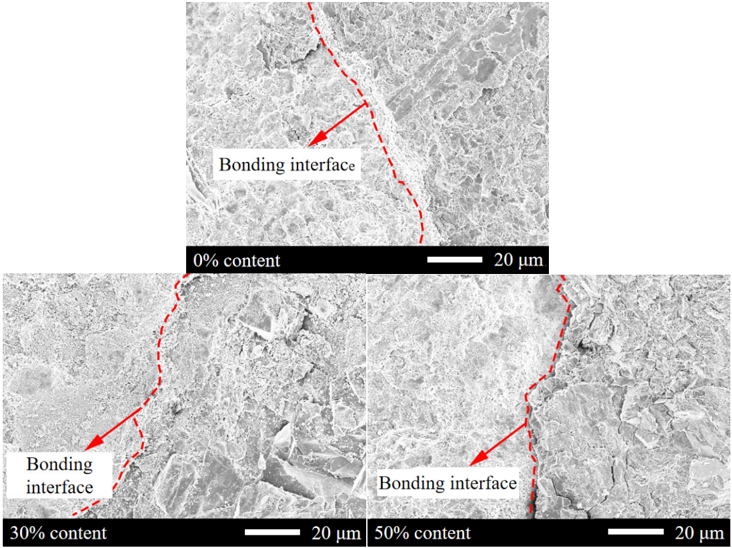
“the bonding interface of RN30 is denser than that of RN0 and RN50 after 270 days of sulfate corrosion”
§ Performance of Cast-in-Place Repair Concrete Incorporating Recycled Coarse Aggregate Under Partially Exposed Sulfate Corrosion Environments > 3.7. Microstructure and Mineral Composition Analysis
plain- Asserted: passes — The authors put it forward as true.
- Checkable: passes — It can be checked against evidence.
- Load-bearing: passes — The paper’s conclusions depend on it.
- Based: passes — The paper gives a reason why it holds.
A result the paper reports from its own data — it cites no other source for it, so there is none to check. The quote shows it is in the paper.
In the paper
“After 360 days of sulfate corrosion, specimens featuring 30% and 50% RCA contents exhibit a reduction in shear strength of 15.91% and 40.0%, respectively, compared with the 0% RCA content specimen.”
§ Performance of Cast-in-Place Repair Concrete Incorporating Recycled Coarse Aggregate Under Partially Exposed Sulfate Corrosion Environments > Abstract
plainstates a cause- Asserted: passes — The authors put it forward as true.
- Checkable: passes — It can be checked against evidence.
- Load-bearing: passes — The paper’s conclusions depend on it.
- Based: passes — The paper gives a reason why it holds.
A result the paper reports from its own data — it cites no other source for it, so there is none to check. The quote shows it is in the paper.
In the paper
“the peak intensity of corrosion products in RN50 was significantly higher than that in RN0 and RN30.”
§ Performance of Cast-in-Place Repair Concrete Incorporating Recycled Coarse Aggregate Under Partially Exposed Sulfate Corrosion Environments > 3.7. Microstructure and Mineral Composition Analysis
plain- Asserted: passes — The authors put it forward as true.
- Checkable: passes — It can be checked against evidence.
- Load-bearing: unclear — It is unclear whether the paper’s conclusions depend on it.
- Based: passes — The paper gives a reason why it holds.
A result the paper states — it cites no source for it, so there is none to check. The quote shows it is in the paper.
In the paper
“after 360 days of corrosion, the compressive strength of cast-in-place recycled aggregate concrete with all three RCA contents is higher than that of the corresponding base concrete.”
§ Performance of Cast-in-Place Repair Concrete Incorporating Recycled Coarse Aggregate Under Partially Exposed Sulfate Corrosion Environments > 3.5. Compressive Strength
plainstates an association- Asserted: passes — The authors put it forward as true.
- Checkable: passes — It can be checked against evidence.
- Load-bearing: passes — The paper’s conclusions depend on it.
- Based: passes — The paper gives a reason why it holds.
110 more claims
Create a free account to see all 178 claims and to verify the 34 references still open.
- It may state two separate claims as one. 53
- The quote only partly states this claim. 1
- Probably not a substantial claim. 12
Self-check
Percentages, sums and reported differences re-computed from the paper’s own numbers.
Each contradiction between two passages listed here was confirmed by an independent check.
Rated minor: it would not touch a result — a value no result rests on, a p-value that stays on the same side of the significance level, or a conflict that is clerical, resolved elsewhere in the paper, or outside its own findings.
In the paper
§ Performance of Cast-in-Place Repair Concrete Incorporating Recycled Coarse Aggregate Under Partially Exposed Sulfate Corrosion Environments > 2.3.1. Appearance, Dimensional, and Mass Measurements
“where ∆L denotes the percentage mass variation in the specimen relative to the previous corrosion age;”
§ Performance of Cast-in-Place Repair Concrete Incorporating Recycled Coarse Aggregate Under Partially Exposed Sulfate Corrosion Environments > 2.3.1. Appearance, Dimensional, and Mass Measurements
“where ∆L denotes the relative dimensional variation in the specimen between two consecutive corrosion ages (%);”
Citations
Cites
Etxeberria, M., Vázquez, E., Marí, A., & Barra, M. (2007) · Cement and Concrete Research · doi:10.1016/j.cemconres.2007.02.002 · Cited by 1,774
Morandeau, A., Thiéry, M., & Dangla, P. (2014) · Cement and Concrete Research · doi:10.1016/j.cemconres.2013.11.015 · Cited by 1,114
Microstructural analysis of recycled aggregate concrete produced from two-stage mixing approach
Tam, V. W. Y., Gao, X. F., & Tam, C. M. (2005) · Cement and Concrete Research · doi:10.1016/j.cemconres.2004.10.025 · Cited by 997
Duan, Z. H., & Poon, C. S. (2014) · Materials & Design · doi:10.1016/j.matdes.2014.01.044 · Cited by 588
Characterizing the generation and flows of construction and demolition waste in China
Zheng, L., Wu, H., Zhang, H., Duan, H., Wang, J., Jiang, W., Dong, B., Liu, G., Zuo, J., & Song, Q. (2017) · Construction and Building Materials · doi:10.1016/j.conbuildmat.2017.01.055 · Cited by 535
Does gypsum formation during sulfate attack on concrete lead to expansion?
Tian, B., & Cohen, M. D. (2000) · Cement and Concrete Research · doi:10.1016/s0008-8846(99)00211-2 · Cited by 453
Mechanism of sulfate attack: A fresh look
Santhanam, M., Cohen, M. D., & Olek, J. (2002) · Cement and Concrete Research · doi:10.1016/s0008-8846(02)00724-x · Cited by 453
Kim, J. (2022) · Construction and Building Materials · doi:10.1016/j.conbuildmat.2022.127071 · Cited by 367
Influence of mixed recycled aggregate on the physical – mechanical properties of recycled concrete
Medina, C., Zhu, W., Howind, T., Sánchez de Rojas, M. I., & Frías, M. (2014) · Journal of Cleaner Production · doi:10.1016/j.jclepro.2014.01.002 · Cited by 352
Yildirim, S. T., Meyer, C., & Herfellner, S. (2015) · Construction and Building Materials · doi:10.1016/j.conbuildmat.2015.05.045 · Cited by 242
Metadata
- Authors
- Li, Z., Chen, Z., Zhao, G., Chen, L., Yue, L., Gu, G., Zhu, J., Ding, S., & Nie, Z.
- Affiliations
- Chang'an University (CN)
- Corresponding author
- Chen, Zhilong
- ORCID
- Venue
- Buildings
- Publisher
- MDPI AG
- Published
- 2026-03-20
- Volume
- 16
- Issue
- 6
- Pages
- 1239
- ISSN
- 2075-5309 (ISSN-L)
- OpenAlex
- W7139955827
- Cited by
- 0
- References
- 47
- FWCI
- 0.00
- Type
- journal article
- Language
- en
- Open access
- gold
- doi.org
- Licence
- Locations
- Buildings (publishedVersion, cc-by)
- DOAJ (DOAJ: Directory of Open Access Journals) (submittedVersion)
- Funders
- National Natural Science Foundations of China (52378322)
- National Postdoctoral Program for Innovative Talents (BX20200287)
- Key Research and Development Program of Shaanxi Province (2025CY-YBXM-156, 2024SF-YBXM-642)
- Fundamental Research Funds for the Central Universities CHD (300102213205)
- Topics
- Physical Sciences › Engineering › Building and Construction › Recycled Aggregate Concrete Performance
- Physical Sciences › Engineering › Civil and Structural Engineering › Concrete Corrosion and Durability
- Physical Sciences › Engineering › Building and Construction › Structural Behavior of Reinforced Concrete
- Keywords
- recycled coarse aggregate, sulfate corrosion, interfacial strength, interfacial region, compressive strength, pore structure, sodium sulfate solution, concrete repair
About these checks
Registry, retraction, Cites and statistics results are computed, not judged, with one exception: a printed reference that no index lists is read once by a model before it counts as a citation error. Claims are extracted by a model and kept only when their quote appears verbatim in the text; each cited source is then checked, with a model’s help, for whether it says what the claim relies on. Those verdicts can be wrong — read the claim’s quote and the cited source before relying on one.
A language model drew the claims from the paper on 2026-11-27, under version 3 of the claim definition (model deepseek-v4.1-flash, prompt extract-v3).
A second model labelled each claim on 2026-11-27 (model jev-1.13-20260917, definition revision gold-guideline-v0.2).
Statistics and arithmetic are recomputed, not judged.
Confidence bands are shown only for fields calibrated on our annotated test set. None is calibrated yet, so no band is shown.
What counts as a claim ›How we measure confidence ›How we check this ›
Are you an author, or do you see a problem with this page? Request a review
How to cite
Cite CoChat for the checks on this page, and the paper for its own findings.
- This page
- CoChat. (2026). Citation check: Performance of Cast-in-Place Repair Concrete Incorporating Recycled Coarse Aggregate Under Partially Exposed Sulfate Corrosion Environments. https://app.cochat.ai/papers/10.3390/buildings16061239
- The paper
- Li, Z., Chen, Z., Zhao, G., Chen, L., Yue, L., Gu, G., Zhu, J., Ding, S., & Nie, Z. (2026). Performance of Cast-in-Place Repair Concrete Incorporating Recycled Coarse Aggregate Under Partially Exposed Sulfate Corrosion Environments. Buildings. https://doi.org/10.3390/buildings16061239
Data sources
Bibliographic data: Semantic Scholar, OpenAlex, Crossref.
Contains information from the Semantic Scholar Academic Graph Datasets, made available under the ODC Attribution License (ODC-BY 1.0).
Semantic Scholar’s data is described in: Kinney, R., et al. (2023). The Semantic Scholar Open Data Platform. arXiv:2301.10140.
